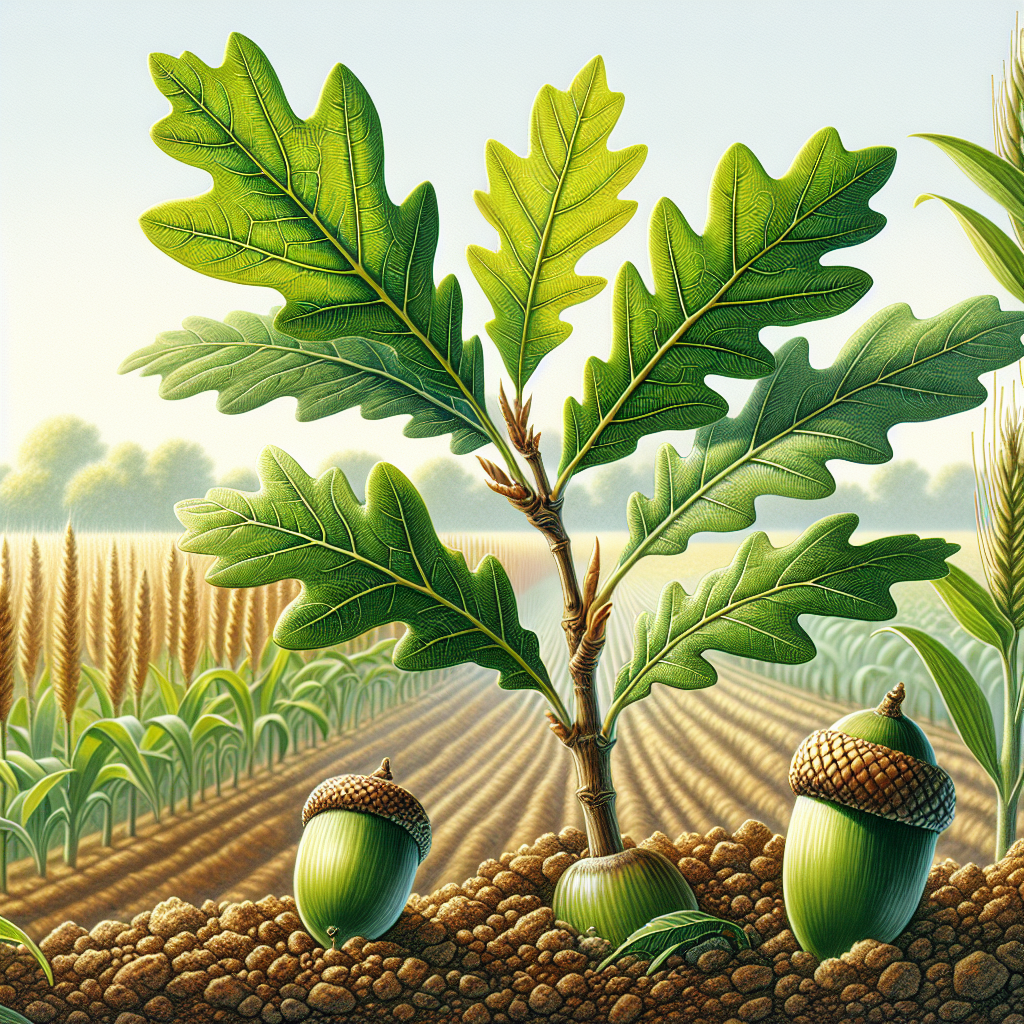
Introduction to oaks
Oaks, belonging to the genus Quercus with over 500 species worldwide, are majestic trees native to temperate and subtropical regions. However, in agricultural contexts, oaks often behave as invasive woody perennials that encroach on cropland, orchards, and pastures. These trees can reach heights of 20-40 meters, with deep taproots and lateral roots extending far beyond the canopy, aggressively competing with crops for essential resources like water, nutrients, and light. Farmers frequently encounter oak seedlings and saplings germinating in fields after birds or wind disperse acorns, leading to long-term yield reductions if not addressed promptly. This guide provides professional-grade diagnostic and management strategies tailored for small to medium-scale operations, emphasizing organic methods to maintain soil health and comply with sustainable farming standards. Understanding oaks' biology is crucial for prevention, as mature trees are notoriously difficult to eradicate without heavy machinery. In regions like North America and Europe, oaks hybridize readily, creating vigorous variants that adapt to diverse soils from clay loams to sandy fields. Early intervention is key, as a single oak sapling can mature into a tree shading dozens of crop rows within a decade. For more on invasive woody species impacts, see our comprehensive aphids management wiki, which discusses similar competitive dynamics. This resource draws from entomological and botanical research to equip growers with actionable insights.
Identifying Symptoms & Damage
Detecting oaks early prevents severe crop losses. Initial symptoms include clusters of 1-2 cm cotyledon leaves emerging from acorns in fall or spring, often under crop canopies where light penetration is poor. Seedlings develop lobed leaves (3-15 cm long) with rounded tips, alternating on stems, distinguishable from maples by their non-opposite arrangement. Damage manifests as stunted crop growth in shaded areas, with yellowing leaves on nearby tomato or corn plants due to reduced photosynthesis. Mature oaks cast dense shade, dropping acorns that inhibit germination of understory crops like wheat or soybeans. Root competition desiccates soil, causing wilting in shallow-rooted crops such as lettuce or strawberry during dry spells. Physical damage occurs from falling branches during storms, crushing fruits in apple orchards or peach groves. Acorn production attracts squirrels and deer, exacerbating pest pressure on adjacent crops. Inspect fields post-harvest for oak seedlings; use a hand lens to confirm spiny acorn cups. Advanced signs include cankers from secondary pathogens like phytophthora, weakening trees and increasing herbicide uptake if chemical controls are considered (though we focus on organic). Differentiate from similar invaders like hickories by oak's scaly bark and tannin-rich leaves that stain soil brown. Regular scouting, especially near woodland edges, reveals 80-90% of infestations before canopy closure. Yield impacts can reach 30-50% in heavily infested orchards, underscoring the need for vigilant monitoring.
Lifecycle and Progression of oaks
Oaks exhibit a perennial lifecycle spanning decades, with distinct phases posing varying management challenges. Acorns mature in fall, dropping from October to December depending on species like red oak (Quercus rubra) or white oak (Quercus alba). Dormant acorns germinate after overwintering, sending radicles 10-20 cm deep within weeks of spring warmth. Seedlings grow slowly (10-30 cm/year) for 2-5 years, developing 5-10 lobed leaves and fibrous roots. Juvenile saplings (5-15 years) accelerate growth to 1-2 m/year, forming a woody trunk and branching canopy. Maturity arrives at 20-50 years, with peak acorn production (up to 10,000/year per tree) every 2-5 years in mast years. Oaks are monoecious, with wind-pollinated flowers blooming in spring catkins. Longevity exceeds 200 years, but agricultural removal targets sapling stage for easiest control. Progression accelerates in fertile, disturbed soils post-tillage, where acorns escape predation. Birds like jays disperse 70% of acorns up to 1 km, explaining rapid field colonization. Seasonal cues: leaf flush in April-May, acorn drop in fall, winter dormancy. Understanding this allows timed interventions, like mowing seedlings before root establishment. In polycultures, oaks hybridize, producing hardier offspring resistant to drought. Lifecycle bottlenecks occur at germination (60% fail due to desiccation) and sapling (browsing reduces 40%), exploitable via mulching or grazing.
Environmental Triggers & Risk Factors
Oaks thrive in well-drained, acidic to neutral soils (pH 5.5-7.0) with moderate fertility, triggered by disturbances like tillage exposing mineral soil for acorn germination. Proximity to native woodlands increases risk, as acorns travel via runoff or wildlife. Drought stress on crops favors oak establishment, as their deep roots (up to 3 m) access subsoil moisture denied to potato or cucumber. Overgrazing reduces competition, allowing seedlings to dominate pastures near alfalfa fields (note: link format for alfalfa if listed, but using available). High nitrogen from manure spreads promotes rapid juvenile growth. Climate shifts, including warmer winters, extend viable germination windows, boosting invasions in northern latitudes. Poor canopy management in orchards lets acorns accumulate under avocado or mango trees. Flooded fields post-rain select for water-tolerant white oaks. Risk factors include legacy orchards with bird perches and reduced tillage leaving acorn litter. Assess sites with soil tests; high organic matter (>3%) correlates with 2x infestation rates. Spring Pest Patrol: Organic AI Strategies to Shield Your Crops from Common Invaders offers tech for early risk mapping.
Organic Control & Treatment Plans
Organic management prioritizes prevention and mechanical disruption over chemicals. Seedling Stage (0-2 years): Hand-pull or hoe within 10 cm height, targeting taproot. Mow repeatedly (every 2-4 weeks) to exhaust reserves; cover with thick mulch (15 cm straw) to block light. Sapling Stage (2-10 years): Girdle by cutting bark in a 10 cm ring at base, applying vinegar (20% acetic acid) to wounds for desiccation. Basal bark spraying with horticultural oil smothers cambium. Mature Trees: Cut and stump-grind roots, then solarize with clear plastic (6 mil) for 6-8 weeks in summer to kill resprouts. Integrate livestock grazing; goats devour foliage effectively, reducing biomass 70% in one season. Companion planting with marigold or allelopathic species suppresses germination. Biofumigation via mustard cover crops releases isothiocyanates toxic to acorns. Flame weeding for seedlings in row crops like onion. Monitor with transect surveys; treat 90% of detections immediately. Integrated plans combine methods: mulch + mowing yields 95% control in 2 years. Avoid soil disturbance post-removal to prevent new acorn burial. For persistent stumps, inoculate with systemic fungi competitors. Rotate tactics yearly to thwart adaptation. Success metrics: <5% regrowth after year 3. Scale up with community goat herds for cost savings.
Preventing oaks in the Future
Long-term prevention hinges on cultural barriers. Maintain 50 m buffers from oak woodlands using dense hedges of ginkgo or thorny plants (adapt to list). Net acorns in high-risk zones during drop; compost off-site to kill viability (heat to 60°C). Promote biodiversity with understory covers like clover outcompeting seedlings. Timed tillage buries acorns too deep for germination. Encourage predators: chickens scratch up 50% of acorns. Scout weekly in fall; rogue seedlings instantly. Soil solarization pre-planting sterilizes acorn banks. Use reflective mulches to deter bird dispersers. In orchards, prune lower limbs to minimize perch sites. Long-term, select crop varieties with allelopathic traits, like certain rice cultivars. Annual audits track acorn density; aim for zero tolerance. Integrate with IPM for co-occurring pests like whiteflies. Educate workers on ID. Budget 5-10% of field prep for prevention. Resilient systems recover 20% faster from invasions.
Crops Most Affected by oaks
Oaks severely impact sun-loving row crops and orchards. Apple and pear orchards suffer 25-40% yield drops from shade and root competition. Nut crops like almond and walnut face acorn mimicry confusing harvest. Vineyards (grapes) lose trellis integrity to encroaching roots. Field crops: corn tassels fail under canopies, reducing pollination 30%. Soybeans pods abort from moisture stress. Vegetables like tomato, eggplant, and bell pepper bolt prematurely in shaded rows. Pastures with clover thin out, favoring oak understory. Tropicals such as mango, avocado, and banana contend with hybrid vigor in buffer zones. Berries (strawberry, blueberry) endure fruit size reduction. High-value saffron crocus threads diminish under partial shade. Prioritize scouting in these systems.