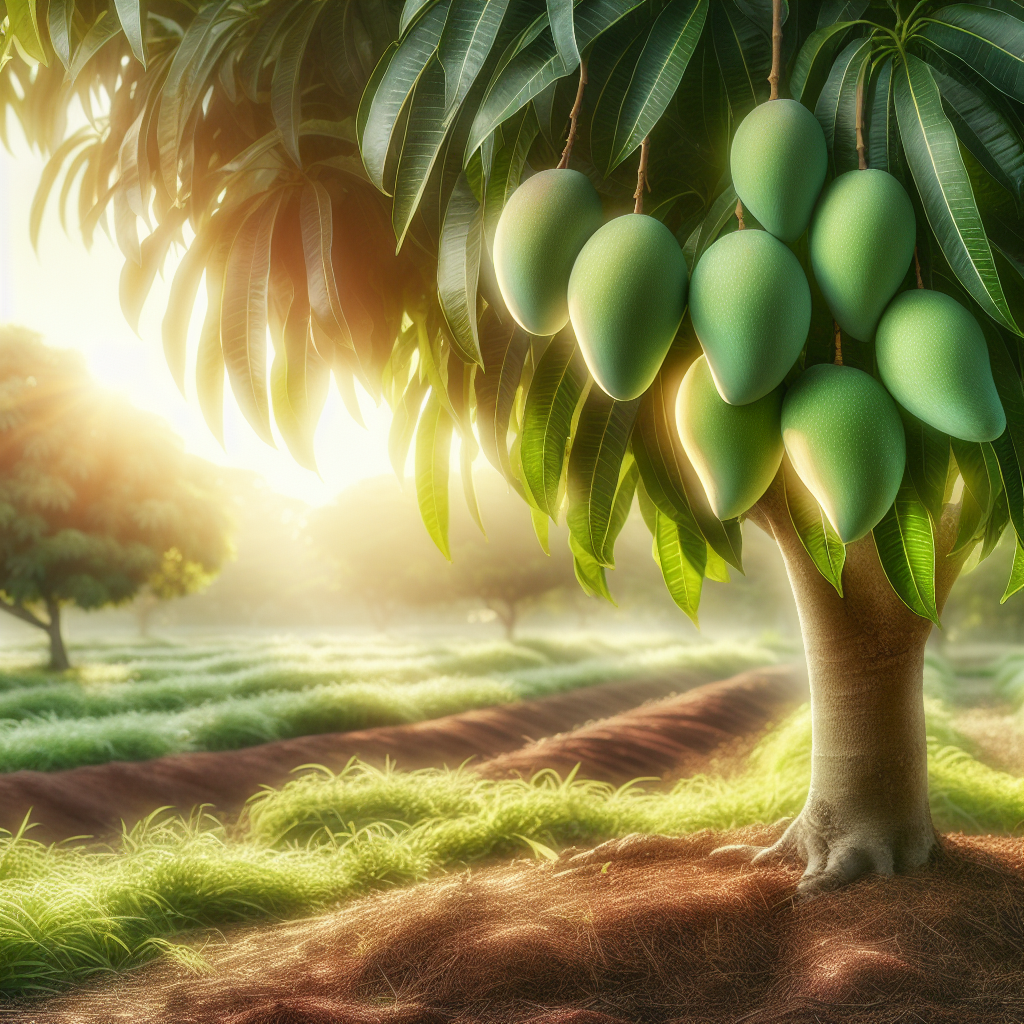
Introduction to Mango
Native to the Indian subcontinent and cultivated for more than 4,000 years, mango is both a commercial orchard crop and a treasured home-garden tree across the tropics. It belongs to the family Anacardiaceae, alongside cashew and pistachio, and its fruit quality varies enormously by cultivar, growing conditions, harvest timing, and postharvest handling. Modern growers may select from fiberless dessert types, classic aromatic Indian cultivars, large export varieties, dwarf or semi-dwarf trees for high-density systems, and polyembryonic selections used where trueness from seed matters.
For the grower, mango is not difficult because it is inherently weak; it is challenging because its performance is highly sensitive to site selection, water management, and canopy control. A tree planted in poorly drained soil may decline for years before suddenly collapsing from root disease, while a tree pushed with too much nitrogen may grow vigorously but flower poorly. Where the environment is suitable, however, mango can remain productive for decades and reward careful management with heavy crops of premium fruit.
Mango production systems range from traditional widely spaced seedling trees to intensive grafted orchards. In humid tropical zones, disease pressure often becomes the main limiting factor, especially Anthracnose on flowers and fruit. In drier subtropics, cold injury and irregular flowering may be the main constraints. Understanding the ecological rhythm of mango, a species that often prefers a dry period before flowering and moderate water availability during fruit development, is the key to consistent yields. Growers interested in related tropical orchard design may compare spacing and drainage principles with avocado.
Botanical Profile of Mango
Mangifera indica is an evergreen tree that can exceed 30 meters in height when grown from seed and left unmanaged, though grafted orchard trees are generally maintained between 3 and 8 meters for practical harvesting and pest management. The tree develops a deep taproot when established in suitable soil, along with extensive lateral roots concentrated in the upper soil profile, especially where irrigation and nutrients are applied. This dual root pattern explains why mango needs both deep, well-drained soil and careful surface moisture management.
Leaves are simple, alternate, leathery, and lanceolate. New flushes often emerge bronze, copper, red, or light green depending on cultivar and nutrient status, later hardening to dark green. The tree grows in episodic flushes rather than continuously, and the balance between vegetative flushes and reproductive growth strongly influences cropping.
Mango inflorescences are terminal panicles bearing hundreds to thousands of small flowers. Most flowers are male, while a smaller percentage are hermaphroditic and capable of setting fruit. Fruit set is naturally low; even under good conditions, a tiny fraction of flowers mature into harvestable mangoes. This is normal and not necessarily a sign of poor management.
Botanically, the fruit is a drupe with a skin color that may remain green, turn yellow, blush red, or develop multicolored overtones depending on cultivar and sunlight exposure. Flesh texture ranges from melting and nearly fiberless to firm and fibrous. Aroma compounds are highly cultivar-specific, with notes that can be resinous, floral, spicy, citrusy, or honeyed.
Cultivars are broadly divided into monoembryonic and polyembryonic types. Monoembryonic mangoes usually do not come true from seed and are therefore propagated by grafting. Polyembryonic types may produce multiple seedlings from one seed, with some nucellar seedlings genetically similar to the mother tree; these are often preferred in parts of Southeast Asia for rootstocks and home propagation. Commercial orchardists still rely primarily on grafted trees to guarantee fruit quality, tree size habit, and bearing behavior.
Flowering behavior depends on genetics and climate. Some cultivars are regular bearers, while others are prone to alternate bearing, producing a heavy crop one year and a lighter crop the next. Panicle size, fruit retention, susceptibility to internal breakdown, and ripening response are all cultivar traits worth studying before planting. In markets where niche selection matters, a cultivar such as Kulfi Mango illustrates how regional mango types can differ substantially in flavor profile and consumer preference.
Soil, pH, and Climate Requirements for Mango
Mango performs best in deep, well-drained loam, sandy loam, lateritic loam, or gravelly loam with good internal drainage. The single most important soil warning is that mango does not tolerate prolonged waterlogging. Saturated soil for even 48 to 72 hours during warm conditions can sharply reduce root oxygen, impair feeder roots, trigger leaf yellowing, and encourage Phytophthora and other root pathogens. On heavy clay sites, plant only on broad raised beds or mounds 45 to 75 cm high, and provide surface drainage channels that move stormwater away from the root zone.
Ideal soil pH is generally 5.5 to 7.5. Mango can survive in slightly more alkaline soil, but micronutrient deficiencies, especially iron, zinc, and manganese, become more common as pH rises above about 7.8. In calcareous soils, young leaves may emerge pale with interveinal chlorosis. Corrective foliar sprays can help, but long-term orchard performance is usually better on mildly acidic to neutral soils.
A productive mango site should have at least 1 to 1.5 meters of penetrable soil before any hardpan, standing water layer, or rock barrier. Root restriction can reduce drought buffering capacity and increase fruit drop during hot weather. Organic matter is beneficial, but avoid turning the planting hole into a compost sump surrounded by dense native soil; this can trap water. Instead, improve the broader planting area gradually with mulches and surface-applied compost.
Climatically, mango is best suited to tropical and frost-free warm subtropical zones. Optimal temperatures for active growth generally fall between 24 and 30°C. Trees can withstand higher temperatures if roots are healthy and moisture is available, but extreme heat above 40°C may cause flower desiccation, sunburn on exposed fruit, and reduced pollen viability. Young trees are vulnerable below about 2°C, and even mature trees may be damaged by light frost. Repeated exposure to temperatures below 10°C suppresses vegetative growth and may impair fruit development in sensitive cultivars.
A distinct dry period before flowering is advantageous in many production regions. Dry weather encourages floral induction and reduces fungal pressure on panicles. High humidity, dew, or rain during bloom can devastate fruit set by promoting Anthracnose and Powdery mildew. Conversely, severe drought after fruit set can increase fruit drop, reduce fruit size, and worsen internal disorders. Thus the ideal pattern is dry to induce flowering, then moderated irrigation to support fruit growth without creating waterlogged conditions.
Wind is another major factor. Strong hot winds can scar fruit, break panicles, and dehydrate flowers. Salt-laden coastal winds may burn leaves and reduce tree vigor. Shelterbelts can be beneficial, but they should not block all airflow in humid regions, where slight air movement helps suppress disease.
Step-by-Step Planting & Propagation
Begin by choosing the right planting material. For commercial quality and predictable bearing, use healthy, certified grafted plants from a reputable nursery. A good nursery tree usually has a straight, sturdy stem, a clearly healed graft union above the soil line, no circling roots, no trunk cankers, and dark green leaves free from scale, Mites, or nutrient stress. Avoid oversized nursery trees held too long in containers; root distortion can delay establishment.
If raising rootstocks from seed, select fully mature seeds from vigorous, disease-free fruit. Remove the husk carefully to speed germination, sow in a sterile, well-drained medium, and transplant promptly before roots coil. Veneer grafting, epicotyl grafting, and softwood grafting are all widely used depending on region and nursery expertise. Air layering is generally not preferred for commercial mango because grafted trees usually establish and perform better.
Choose a full-sun site. Mango needs at least 8 hours of direct light for strong flowering and fruit color development. Space trees according to vigor and management system. Traditional orchards may use 10 x 10 m or wider. Moderately vigorous grafted cultivars may be planted at 8 x 8 m. High-density systems can go closer, such as 5 x 5 m or 4 x 2.5 m, but only with disciplined annual pruning, nutrition control, and sometimes growth regulation. Without strict canopy management, overcrowding quickly reduces light penetration, flowering, and fruit quality.
Plant at the beginning of the rainy season where rainfall is reliable but not excessive, or in early spring where irrigation is available and frost danger has passed. In monsoonal climates, avoid planting when soils are already saturated.
To plant, dig a hole only as deep as the root ball and 2 to 3 times as wide. In poorly drained land, build a mound first and plant on top of it. Do not bury the graft union. Set the tree so the root flare is slightly above surrounding soil level. Backfill with native soil rather than heavily amended material, firm gently, and water thoroughly to settle air pockets.
Apply a mulch ring 8 to 10 cm deep over a radius of 60 to 100 cm, but keep it 15 to 20 cm away from the trunk to prevent collar rot and rodent damage. Install a stake only if the site is windy; ties should be loose and removed once the tree is stable.
Immediately after planting, head back weak or excessively tall nursery growth if needed to encourage low scaffold formation. The goal in young mango training is a strong framework with 3 to 4 well-spaced primary limbs arising at manageable height, often 60 to 100 cm above ground for hand-managed orchards.
Care & Maintenance regimes for Mango
Irrigation should be tailored to tree age, soil texture, and growth stage. Newly planted trees need frequent but not constant moisture. In sandy soils, this may mean 10 to 20 liters every 2 to 3 days during hot weather for the first few weeks, then gradually less frequent, deeper watering. In loams, watering every 4 to 7 days may suffice. The target is moist but aerated soil in the active root zone, not persistent saturation. A practical field check is to sample soil 15 to 20 cm deep near the drip zone: it should feel cool and slightly moist, not sticky, sour-smelling, or gray from lack of oxygen.
Signs of overwatering include limp but not dry leaves, yellowing older foliage, poor flush quality, blackened feeder roots, fungal growth on mulch, and a stagnant smell in the soil. Signs of underwatering include leaf folding, browning leaf margins, premature fruit drop, undersized fruit, and hard dry soil that sheds irrigation instead of absorbing it.
As trees mature, strategic water stress is often used to encourage flowering, especially in dry subtropical production zones. Withhold irrigation after the postharvest vegetative flush has hardened, provided the tree is healthy and soil reserves are adequate. Resume light irrigation at panicle emergence or early fruit set to prevent excessive stress. Once fruit are sizing, maintain steady moisture; large swings from drought to heavy irrigation can increase splitting, jelly seed, and fruit drop.
Nutrient management should be age-based and informed by leaf and soil analysis. Young trees need modest but regular nitrogen to build canopy, along with phosphorus for establishment and potassium for stress tolerance. Excess nitrogen produces lush vegetative growth at the expense of flowering and can increase disease susceptibility. Mature bearing trees generally respond well to split applications with emphasis on potassium, balanced nitrogen, and sufficient calcium, magnesium, zinc, and boron.
A typical principle is to apply fertilizer in 2 to 4 splits per year: after harvest to support recovery flush, before flowering only if needed and not excessively, at fruit set, and during fruit enlargement. Foliar micronutrient sprays containing zinc and boron before flowering can improve panicle health and fruit set where deficiencies exist. Avoid heavy nitrogen close to flowering.
Pruning is more about canopy management than heavy structural cutting. Mango flowers on terminal shoots, so indiscriminate tip removal can reduce next season’s bloom. The best time for major pruning is immediately after harvest, allowing time for a vegetative flush to mature before the next flowering season. Remove dead, diseased, crossing, and inward-growing branches, then open the canopy enough to improve light penetration and spray coverage. In high-density orchards, annual hedging and topping are essential.
Alternate bearing can be moderated, though not always eliminated, by balanced nutrition, timely pruning, fruit thinning in very heavy years, and avoiding tree exhaustion. Some growers remove part of an excessive crop early to preserve tree reserves and improve remaining fruit size.
Mulching improves moisture retention, moderates soil temperature, and slowly contributes organic matter. Keep mulch shallow enough that the soil surface still breathes. Trunk wraps or whitewash can protect young stems from sunscald in very hot climates.
Weed management is critical during establishment. Maintain a weed-free circle around young trees at least 1 meter in diameter. Grass competition can significantly reduce early growth by stealing nitrogen and surface moisture.
For broader orchard floor ecology and living groundcover ideas, practical principles in soil health strategies can be adapted to mango systems.
Pests, Diseases & Organic Management
Anthracnose, caused mainly by Colletotrichum species, is among the most damaging mango diseases, especially in humid climates. It attacks flowers, panicles, leaves, and fruit, causing black lesions, blossom blight, and postharvest rot. Management starts with canopy opening, sanitation, and avoiding overhead irrigation during flowering. Organic programs often rely on copper-based protectants timed carefully from panicle emergence through fruit set, supplemented by biologicals where registered and effective locally.
Powdery mildew is favored by dry conditions combined with cool nights and high humidity around bloom. Symptoms include white powdery growth on panicles and young fruit, distortion, and fruit drop. Sulfur products can be effective in organic systems if used with care and not during very hot weather.
Bacterial black spot, Stem-end rot, Algal leaf spot, and Sooty mold may also occur depending on region. Sooty mold usually indicates honeydew-producing pests such as scales, Mealybugs, or Hoppers.
Common insect pests include Mango hoppers, Mealybugs, Scale insects, Fruit flies, Thrips, Seed weevils in some regions, and Mites. Hoppers damage panicles and excrete honeydew, reducing fruit set. Mealybugs can colonize shoots and fruit clusters, often in association with ants. Fruit flies lay eggs in ripening fruit, causing internal breakdown and rejection.
Organic management is strongest when built as an integrated system. Start with orchard hygiene: remove fallen diseased fruit, prune out dead wood, and destroy heavily infested plant parts. Control ants that protect Mealybugs and scales. Use sticky trunk barriers where crawling pests move upward seasonally. Encourage predators such as lacewings, lady beetles, spiders, and parasitoids by limiting broad-spectrum sprays.
Bagging individual fruit can dramatically reduce fruit fly stings, skin blemishes, and sunburn in small orchards and premium fresh-market production. Bagging should be done after fruit set when fruit are marble to egg size, using breathable bags that do not trap condensation.
Neem-based products, horticultural oils, insecticidal soaps, Beauveria bassiana, and other biologicals may fit organic programs, but their timing is critical. Oils should not be applied during high heat or mixed incompatibly with sulfur. Because mango panicles are sensitive, always test on a small portion before whole-orchard use.
Nutritional balance also influences pest and disease pressure. Excess nitrogen encourages soft, attractive growth for sucking insects and increases dense canopy humidity. Calcium and silicon nutrition, where agronomically appropriate, can help strengthen tissues indirectly.
Harvesting, Curing & Optimal Storage
Harvest timing has a major effect on flavor, shelf life, and market value. Mangoes do not reach their best quality if harvested too immature, even though they will soften and color afterward. Maturity indicators vary by cultivar but may include shoulder filling near the stem end, a change in peel background from dark green to lighter green or green-yellow, a slight flattening of the beak, pulp color transition near the seed, and the number of days from fruit set established for that cultivar in that region.
Latex handling is extremely important. When mango is detached, sap can flow onto the peel and cause sap burn, appearing as blackened or brown patches that downgrade the fruit. Commercial practice often involves clipping fruit with a short stem attached, holding fruit stem-end down to drain latex, then trimming the stem later after sap flow subsides.
Harvest by hand or with padded picking tools to avoid bruising. Never allow fruit to drop. Pick during the cooler part of the day when possible. Shade harvested fruit immediately; fruit left in sun can heat rapidly, accelerating softening and increasing postharvest disease.
After harvest, sort fruit to remove damaged, diseased, undersized, or misshapen units. Wash only if the process is sanitary and fruit can be dried promptly. In many systems, a hot water treatment or approved postharvest sanitation protocol is used for fruit fly control and disease reduction, but local regulations and cultivar sensitivity must be considered.
Curing in mango generally refers less to a long curing process, as in onions or sweet potatoes, and more to careful conditioning after harvest. Short equilibration in a clean, shaded, ventilated area allows field heat to dissipate and latex issues to settle. Ripening can then proceed at around 20 to 24°C for many cultivars. Ethylene exposure may be used commercially for uniform ripening where legal and appropriate.
For storage, mature-green mangoes are often held at 10 to 13°C depending on cultivar and intended storage period. Temperatures that are too low can cause chilling injury, especially below about 10°C for sensitive cultivars. Symptoms include uneven ripening, grayish flesh, pitting, poor color, and increased decay. Relative humidity around 85 to 90% helps reduce shriveling without causing condensation.
Fully ripe mangoes are best consumed quickly, usually within a few days under refrigeration. For local direct markets, vine-ripe or tree-mature fruit often command superior flavor and customer loyalty, but they are more delicate in handling.
Companion Planting for Mango
Because mango is a long-lived perennial tree with a broad canopy and a root zone sensitive to waterlogging, companion planting should be approached as orchard floor design rather than crowded interplanting near the trunk. The best companions support pollinators, improve soil cover, suppress weeds, reduce erosion, or provide short-term income while young trees are still small.
In the establishment phase, low-growing legumes such as sunn hemp, cowpea, or perennial peanut can function as living mulches between rows, adding biomass and helping soil aggregation. These should be mowed or terminated before they compete aggressively for water. In dry regions, keep an open weed-free basin around the tree itself and place companion species farther out, beyond the immediate young root zone.
Flowering herbs and insectary plants can support beneficial insects. Basil, marigold, coriander, dill, and native flowering strips may improve ecological balance when placed in row middles or border zones, though irrigation competition must be managed. Avoid dense, rank vegetation right against the trunk, which can harbor rodents, Mealybugs, and excess humidity.
Short-term intercrops are common in young mango orchards before canopy closure. Suitable options depend on climate and water availability but often include legumes, vegetables, or medicinal crops that do not require constant flooding. Avoid crops with heavy nutrient demand or irrigation regimes that keep the soil too wet for mango roots. Flooded intercrops are particularly unsuitable.
Good companions are those managed in service to the tree: they should never shade young mango excessively, obstruct airflow, or force frequent trunk injury from equipment. In mature orchards, the simplest and often best companion system is a managed groundcover between rows, mulch under the drip line, and carefully maintained biodiversity strips that enhance pollination and natural enemy habitat without increasing disease pressure.