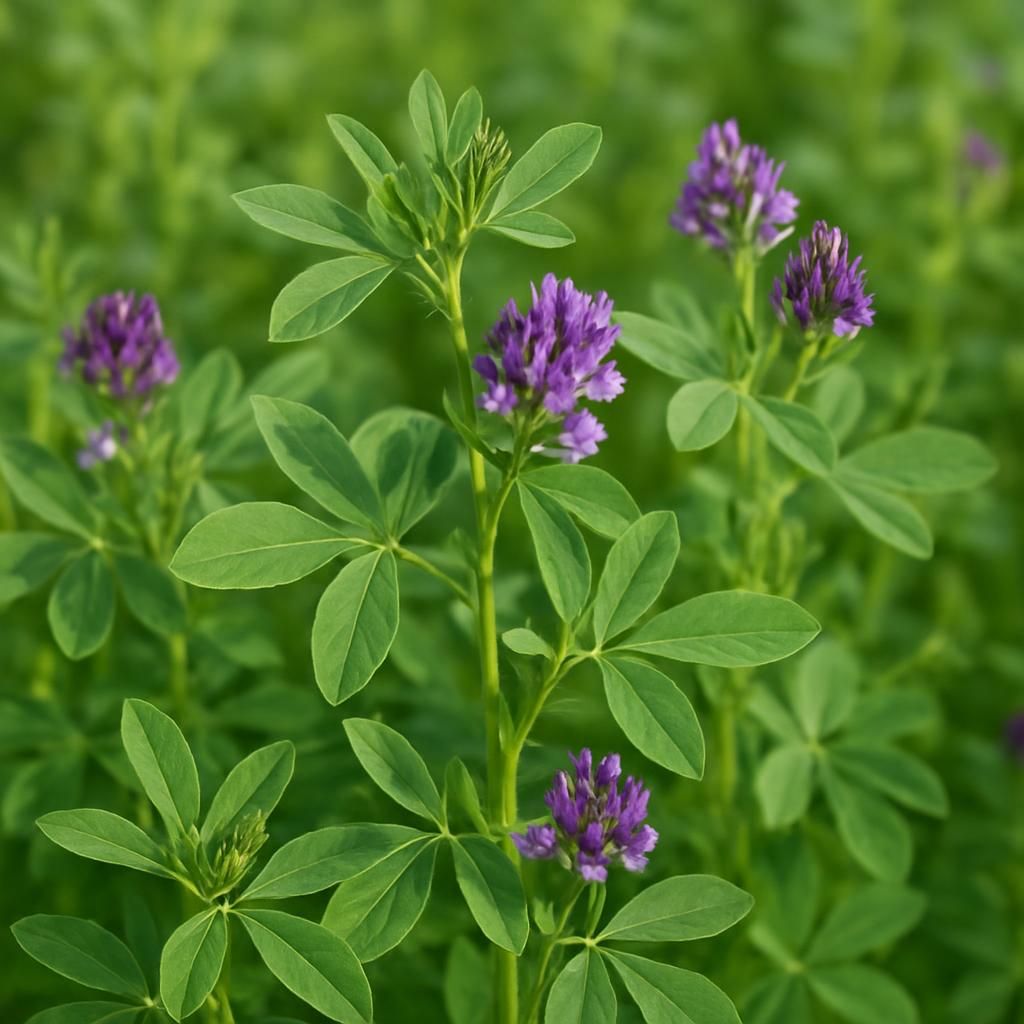
Introduction to Alfalfa
Alfalfa (Medicago sativa) is one of the most widely cultivated forage legumes globally, valued for its exceptional nutritional profile, nitrogen-fixing capabilities, and role in sustainable crop rotations. Grown primarily for hay, silage, and pasture, alfalfa provides high-quality feed for livestock while improving soil fertility through symbiotic relationships with rhizobia bacteria. Its extensive root system enhances soil structure and water infiltration, making it an essential crop for both conventional and organic farming operations seeking long-term productivity.
Beyond livestock feed, alfalfa serves as a green manure crop, a cover crop in rotations with grains such as Wheat and Corn, and a source of high-protein pellets and meal for various agricultural uses. With proper management, stands can remain productive for 4–7 years, delivering multiple cuttings per season and supporting both economic and environmental farm goals.
Botanical Profile of Alfalfa
Alfalfa belongs to the Fabaceae family and is characterized by trifoliate leaves, purple to blue flowers arranged in racemes, and a deep taproot that can extend 10–30 feet (3–9 meters) into the soil profile. The plant exhibits a crown at the soil surface from which new shoots emerge after each harvest. Its indeterminate growth habit allows for repeated cuttings throughout the growing season, typically yielding 3–6 harvests annually depending on climate and management.
The crop is tetraploid and highly outcrossing, leading to significant genetic diversity that breeders have exploited to develop varieties with improved disease resistance, winter hardiness, and forage quality. Alfalfa also fixes atmospheric nitrogen at rates of 100–250 pounds per acre (112–280 kg/ha) annually when properly inoculated, reducing the need for synthetic fertilizers in subsequent crops.
Soil, pH, and Climate Requirements for Alfalfa
Successful alfalfa production begins with selecting well-drained soils with adequate fertility. The crop performs best on deep, fertile loams but can adapt to a range of soil types provided drainage is excellent. Waterlogged conditions quickly lead to crown and root rot, while compacted or shallow soils limit root development and longevity.
| Parameter | Ideal Range | Notes |
|---|---|---|
| Soil Type | Loam to sandy loam | Excellent drainage essential |
| Soil pH | 6.5–7.5 | Below 6.0 requires liming |
| Temperature (Optimal) | 65–77°F (18–25°C) daytime | Tolerates -20°F (-29°C) when dormant |
| Annual Rainfall | 15–30 inches (380–760 mm) | Supplemental irrigation improves yields |
| Elevation | Sea level to 8,000 ft (2,400 m) | High-altitude varieties available |
Alfalfa requires full sun (minimum 6–8 hours daily) and benefits from moderate temperatures during establishment. Cold-hardy varieties are essential in northern regions, while heat-tolerant cultivars perform better in arid and semi-arid zones. Soil testing prior to planting is critical to correct deficiencies in phosphorus, potassium, boron, and sulfur.
Step-by-Step Planting & Propagation
Site Preparation: Conduct soil tests 6–12 months before planting. Apply lime if pH is below 6.5 and incorporate recommended phosphorus and potassium. Eliminate perennial weeds through tillage or herbicide application.
Seed Selection & Inoculation: Choose certified seed of regionally adapted varieties with appropriate fall dormancy and pest resistance. Inoculate seed with Sinorhizobium meliloti rhizobia immediately before planting unless fields have a recent history of alfalfa.
Seeding Rate & Depth: Drill 15–25 pounds per acre (17–28 kg/ha) of pure live seed at a depth of ¼–½ inch (6–13 mm). Use higher rates on heavy soils or when broadcasting. Ensure good seed-to-soil contact with a cultipacker or roller.
Timing: Plant in early spring or late summer/early fall when soil temperatures reach 50–65°F (10–18°C). Avoid planting during extreme heat or when frost risk is high.
Companion Seeding: In some regions, alfalfa is seeded with a nurse crop such as oats to reduce erosion and weed competition, though this must be managed carefully to avoid excessive shading.
Care & Maintenance regimes for Alfalfa
Proper fertility management and timely harvests are essential for stand longevity and high yields. Monitor soil nutrient levels annually and apply maintenance applications of phosphorus, potassium, and boron based on soil and tissue tests.
| Growth Stage | Irrigation Schedule | Fertilizer Application | Pruning/Harvest Schedule |
|---|---|---|---|
| Establishment (0–8 weeks) | Light, frequent watering to maintain moisture | 20–40 lbs P2O5/acre at planting | No harvest; clip weeds at 6–8 inches |
| Vegetative Regrowth | 1.5–2.5 inches/week (38–64 mm) | 0–20 lbs N/acre if needed | Harvest at early bloom (28–35 days) |
| Post-Harvest | Resume irrigation within 3–5 days | Top-dress K and B after 2nd or 3rd cut | Maintain 2–3 inch stubble height |
| Fall Dormancy | Reduce irrigation 3–4 weeks before frost | Apply 40–60 lbs K2O/acre if deficient | Final cut 4–6 weeks before first frost |
Weed control during establishment is critical. Use pre-plant incorporated herbicides or mechanical cultivation. Once established, alfalfa’s competitive growth suppresses most weeds. Scout regularly for insects and diseases, especially during regrowth periods.
Pests, Diseases & Organic Management
Common insect pests include Aphids, Alfalfa weevil, and Potato leafhopper. Early cutting, beneficial insect conservation, and targeted organic insecticides such as neem or spinosad provide effective control when economic thresholds are reached.
Diseases such as Phytophthora root rot, Fusarium wilt, and Verticillium wilt are managed primarily through resistant varieties and proper site selection. Avoid planting alfalfa after alfalfa (minimum 3–5 year rotation) to reduce pathogen buildup. Root-knot nematodes can be suppressed with biofumigant cover crops such as mustard or through solarization in high-value stands.
Harvesting, Curing & Optimal Storage
Harvest alfalfa at the early bloom stage for optimal yield-quality balance. Cut in the morning after dew has dried to minimize leaf loss. Allow forage to wilt to 40–60% moisture for haylage or 15–18% for dry hay before baling. Proper curing prevents heating and mold development.
Store bales in a dry, well-ventilated area elevated off the ground. Use bale wraps or tarps to protect from weather. Monitor internal bale temperatures for the first 3–4 weeks; temperatures above 130°F (54°C) indicate potential spontaneous combustion risk. Silage should be packed tightly and sealed within 24 hours to achieve anaerobic fermentation.
Companion Planting for Alfalfa
Alfalfa pairs well with cool-season grasses such as orchardgrass or tall fescue in mixed stands to improve soil coverage and reduce weed pressure. It also serves as an excellent preceding crop for Tomato, Corn, and small grains due to residual nitrogen. Avoid planting after other legumes that share similar disease and nematode issues. In organic systems, interseeding with Clover or Hairy vetch can extend soil coverage and nitrogen contributions between alfalfa rotations.
For more insights on building resilient small-farm systems, see The Hidden Power of Mulching: 8 Organic Strategies to Transform Small Farm Soil.