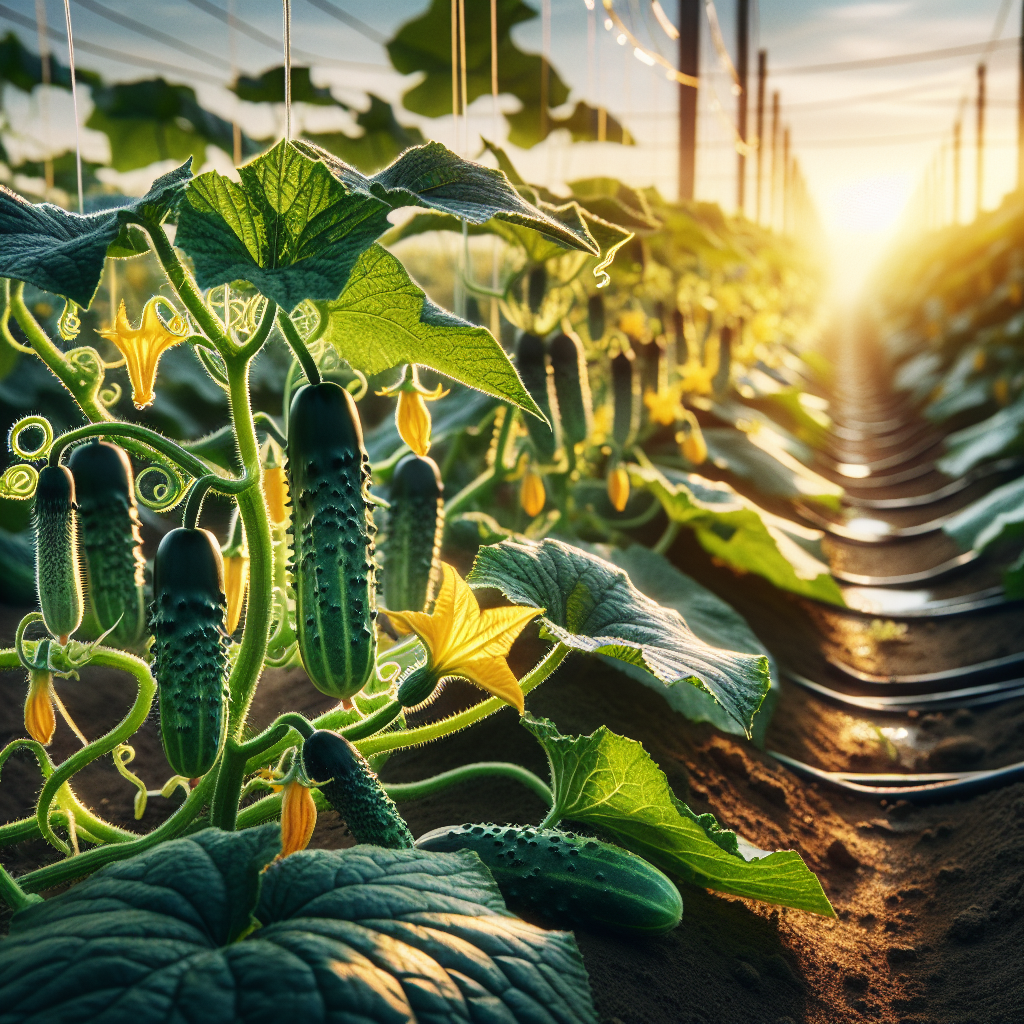
Introduction to Cucumber
An ancient crop domesticated in South Asia, cucumber has been cultivated for at least 3,000 years and spread through Persia, the Mediterranean, and eventually the rest of the world. Modern production includes slicing, pickling, burpless, greenhouse, parthenocarpic, and specialty Asian types, each with different management needs. From a grower’s perspective, cucumber is fast-growing and potentially very productive, but it is also unforgiving of root disturbance, cold soils, water stress, and foliar disease. That combination makes it a crop that rewards careful timing and disciplined crop management.
Most garden and farm cucumbers fall into two broad market classes: slicing cucumbers, which are harvested larger for fresh eating, and pickling cucumbers, which are harvested smaller and more uniformly. English or greenhouse cucumbers are usually long, thin-skinned, often seedless or nearly seedless, and commonly grown under protected cultivation. Field cucumbers are generally monoecious, bearing separate male and female flowers on the same plant, while many greenhouse cultivars are gynoecious or parthenocarpic, traits that increase productivity but may alter pollination requirements.
Cucumber fruits are botanically pepos, a specialized berry typical of the cucurbit family. Fruit quality is strongly influenced by cultivar choice, temperature, pollination quality, irrigation consistency, and harvest timing. Bitter fruit, misshapen fruit, hollow centers, pale skin, poor shelf life, and low yield usually trace back to one or more of these factors. Growers who understand the plant’s growth habit can avoid most of these problems.
Botanical Profile of Cucumber
Cucumber belongs to the family Cucurbitaceae, alongside melons, squash, and pumpkins. The species is a frost-sensitive annual vine with a shallow but wide-spreading root system concentrated largely in the top 20 to 30 cm of soil. That root architecture explains why cucumber responds quickly to moisture stress, salt buildup, shallow cultivation damage, and sudden nutrient fluctuations.
Plants produce rough, lobed leaves and climbing or sprawling stems equipped with tendrils. Internode length varies by cultivar and fertility level. Bush types exist but most commercial cultivars are vining. Flowering biology is especially important. Traditional cultivars are monoecious, producing male flowers first and female flowers later. Gynoecious cultivars produce predominantly female flowers and are often higher yielding under good management. Parthenocarpic cultivars can set fruit without pollination, which is ideal in greenhouses or insect-excluding structures.
Fruit shape, color, spine density, skin thickness, and seed development differ substantially among cultivar groups. Pickling types tend to be shorter, blockier, and more heavily warted or spined. Slicing types are longer and smoother. English or Beit Alpha types are slender, tender-skinned, and usually harvested immature. For growers comparing cucurbits, disease and training principles overlap with crops such as Zucchini, but cucumbers are generally more sensitive to high humidity foliar disease pressure and irregular watering.
Physiologically, cucumbers perform best when vegetative growth and reproductive growth stay in balance. Excess nitrogen drives lush vine growth at the expense of fruiting and often increases susceptibility to Aphids and mildew. Conversely, underfeeding can reduce leaf area so severely that fruits sunscald or fail to size properly. A successful crop maintains a vigorous but not overly rank canopy.
Soil, pH, and Climate Requirements for Cucumber
Cucumber thrives in fertile, well-drained loam or sandy loam with high organic matter and a soil pH of 6.0 to 7.0, with 6.3 to 6.8 being an especially reliable target for nutrient availability. Heavier clay soils can produce good yields if drainage is excellent and beds are raised, but poorly aerated soils sharply increase the risk of Damping-off, root rot, and nutrient lockout. Because the crop roots shallowly, soil structure in the upper profile matters more than deep subsoil perfection.
Ideal soil should be friable, moisture-retentive without becoming waterlogged, and rich in biologically active organic matter. Incorporating mature compost before planting improves aggregation, water-holding capacity, and microbial resilience. However, fresh manure should be avoided immediately before planting because it can push excessive nitrogen, increase salt levels, and introduce food safety risks where fruit contacts soil.
Temperature is one of cucumber’s biggest limiting factors. Seeds germinate best at 27 to 32°C, and emergence is slow and uneven below 18°C. Vegetative growth is most efficient around 22 to 30°C during the day and 18 to 22°C at night. Prolonged temperatures below 10 to 12°C cause chilling injury, stunting, leaf yellowing, and poor root function. Frost kills the crop. At the other extreme, sustained temperatures above 35°C can reduce pollen viability, increase flower abortion, and produce bitter or misshapen fruits, especially when paired with water stress.
Relative humidity plays a double role. Moderate humidity helps reduce plant stress, but persistently high humidity combined with dense canopies drives Downy mildew, Powdery mildew, and Angular leaf spot. Good airflow, proper spacing, and morning irrigation help lower the duration of leaf wetness. In dry climates, mulching is especially valuable to stabilize root-zone moisture and prevent fruit from developing tough skin under erratic water supply.
Cucumber needs full sun for maximum production, ideally 8 or more hours daily. Light shade in extreme heat can reduce sunscald, but too little light leads to long internodes, weak flowering, and lower fruit quality. Wind protection is useful because strong hot winds increase transpiration, desiccate leaves, and can physically damage vines and flowers.
For long-term bed productivity and resilience, sound organic matter management is invaluable; growers can deepen that foundation with soil health strategies.
Step-by-Step Planting & Propagation
Start with cultivar selection matched to end use and growing system. Choose pickling cultivars for uniform small fruits, slicing cultivars for fresh market, and parthenocarpic greenhouse cultivars for tunnels or protected structures. If growing outdoors where pollinators are active, standard monoecious or gynoecious open-field hybrids are suitable. In greenhouses, avoid mixing parthenocarpic types with heavily pollinated field types, since pollination can cause misshapen fruits in some seedless cultivars.
Prepare the bed 2 to 3 weeks before planting. Work in well-finished compost and, if needed, a balanced pre-plant fertilizer based on soil testing. Form raised beds 15 to 25 cm high in areas prone to waterlogging. Install drip irrigation before sowing or transplanting. Plastic mulch, biodegradable mulch, or thick organic mulch can improve earliness, reduce weeds, and keep fruit cleaner.
Direct seeding is often preferred because cucumber roots dislike disturbance. Sow only after soil temperatures are consistently above 18°C, with 21°C or higher being better for rapid emergence. Plant seeds 1.5 to 2.5 cm deep. In light soils, slightly deeper sowing is acceptable; in heavy soils, stay shallower. Space plants according to system:
- Bush types: 45 to 60 cm between plants.
- Trellised vining types: 30 to 45 cm between plants, 1.2 to 1.8 m between rows.
- Sprawling field types: 45 to 90 cm between plants, 1.5 to 2.4 m between rows.
For hills, sow 3 to 4 seeds per hill and thin to the strongest 1 to 2 plants after true leaves develop. Thin promptly; overcrowded seedlings compete early and remain weaker all season.
If starting transplants, sow in individual cells or biodegradable pots 2 to 3 weeks before setting out. Avoid oversized transplants; once roots circle or stems stretch, transplant shock increases. Harden off for 5 to 7 days, but do not expose young plants to cold winds or low night temperatures. Transplant when plants have 1 to 2 true leaves and soil is warm. Set them at the same depth they were growing in the tray. Water in immediately with a starter solution low in salt.
Trellising improves airflow, fruit straightness, harvest ease, and disease monitoring. Use sturdy vertical netting, strings, or cattle-panel systems. Begin training early while vines are flexible. In greenhouse culture, plants are often pruned to a single leader and clipped to overhead strings. In field trellising, lighter pruning is common, mainly to remove damaged or diseased leaves.
Pollination must be considered from the outset. Outdoor seeded cucumbers depend heavily on bees unless they are parthenocarpic. Poor pollination produces curved, tapered, or aborted fruits. Avoid spraying even organic insecticides during bloom when bees are active. If pollinator populations are low, adding flowering borders nearby can improve fruit set.
Care & Maintenance regimes for Cucumber
Steady moisture is the single most important cultural factor after temperature. Cucumber performs best when the root zone remains consistently moist but not saturated, generally around 70 to 80% of field capacity in active growth. In practical terms, soil 5 to 10 cm below the surface should feel cool and slightly moist, forming a weak ball in the hand but not oozing water. Allowing the upper profile to dry completely between irrigations can trigger bitterness, fruit abortion, and irregular growth. Conversely, constantly saturated soil excludes oxygen and leads to yellowing, edema, slowed growth, and root disease.
Young plants need lighter, more frequent irrigation until roots establish. Once vines are running and fruiting begins, water demand increases sharply. Most crops need roughly 25 to 40 mm of water per week in moderate conditions, and significantly more during hot, windy weather or in sandy soils. Drip irrigation is superior to overhead watering because it reduces leaf wetness and keeps moisture more even. Uneven irrigation often causes misshapen fruits and fluctuating fruit texture. Mulch further stabilizes the root environment and suppresses weeds.
Nutrient management should be guided by soil and tissue tests whenever possible. Cucumber is a moderate to heavy feeder, especially for nitrogen and potassium, but it is sensitive to excess salts. A practical regime is to apply a balanced pre-plant base, then side-dress or fertigate modestly once vines begin to run and again at early fruit set. Nitrogen should support continuous new leaf production without turning the crop dark, overly lush, and disease-prone. Potassium becomes especially important for fruit sizing, firmness, and overall stress tolerance. Calcium is essential for cell integrity, but many apparent calcium problems are actually caused by erratic watering that limits uptake.
Weed control is critical during the first 4 to 6 weeks, when cucumbers are establishing. Shallow cultivation is safer than deep hoeing because roots sit near the surface. After vines spread, cultivation can do more harm than good. Organic mulches such as straw, leaf mold, or shredded plant residue reduce weed pressure and prevent soil splash that spreads disease.
Training and pruning depend on system. In open-field, little pruning is required beyond removing diseased or severely damaged tissue. On trellises, gently guide vines every few days. In protected production, remove lower leaves once they age or if they impede airflow, but never strip too much canopy at once, as sudden defoliation reduces photosynthesis and can expose fruits to sunscald.
Flower and fruit monitoring should be routine. A healthy plant should move from early male bloom to active female flowering and fruit set. If vines are vigorous but setting poorly, inspect for heat stress, pollination failure, or excess nitrogen. If small fruits yellow and abort, look for inconsistent moisture, low pollinator activity, or root stress.
Pests, Diseases & Organic Management
Cucumber is highly attractive to several insect pests. Cucumber beetles are among the most serious because they feed on seedlings, flowers, and fruits while transmitting Bacterial wilt. Striped and spotted Cucumber beetles can kill young plants quickly. Floating row covers are effective early in the season, but they must be removed at flowering unless using parthenocarpic cultivars under isolation. Kaolin clay, trap cropping, and strict sanitation can reduce pressure. Hand removal may work in small plantings.
Aphids colonize undersides of leaves and growing tips, causing curling, honeydew buildup, and virus transmission. They often flare under excess nitrogen or during warm, dry weather. Strong water sprays, reflective mulches, insectary plantings, and insecticidal soap can help, but spray coverage must reach the leaf underside. Spider mites become severe in hot, dusty conditions, causing stippling and bronzing. Increasing humidity around the crop, reducing dust, and preserving predatory mites are key organic tactics.
Squash bugs and Squash vine borers are generally more severe on squash and pumpkins than on cucumber, but local pressure varies. Thrips may scar fruit and spread disease in protected culture. Whiteflies can be troublesome in tunnels and greenhouses.
Disease management starts before planting. Rotate out of cucurbits for at least 2 to 3 years where possible. Avoid planting cucumbers after cucumbers, melons, squash, or pumpkins in the same bed. Use disease-resistant hybrids whenever available, especially for Powdery mildew, Downy mildew, Cucumber mosaic virus tolerance, and Scab.
Damping-off affects seedlings in cold, wet soil and is prevented by warm planting conditions, clean media, and good drainage. Powdery mildew appears as white, dusty patches on older leaves, usually later in the season, reducing vigor and exposing fruits to sun. Downy mildew causes angular yellow lesions and gray-purple sporulation on leaf undersides, often spreading rapidly in humid weather. Anthracnose, Scab, and Angular leaf spot can scar foliage and fruit. Bacterial wilt causes sudden collapse, especially after cucumber beetle feeding. Viral diseases such as Cucumber mosaic virus and Zucchini yellow mosaic virus lead to mosaic, distortion, and stunted fruit.
Organic disease control relies on integrated methods: wide spacing, trellising, drip irrigation, early morning watering, resistant cultivars, clean tools, removal of heavily infected leaves, and destruction of crop residues after harvest. Biofungicides, copper products, sulfur, potassium bicarbonate, and neem-based materials may help depending on disease and local regulations, but they are most effective preventively rather than curatively. Never assume a foliar spray alone will rescue a poorly ventilated, overcrowded crop.
Physiological issues also matter. Bitter fruits result from stress, especially drought, heat, uneven watering, or varietal tendency. Curved fruits often come from incomplete pollination or crowding. Pale fruits may indicate low fertility or harvest delay. Hollow fruits can arise from rapid growth following stress, poor pollination, or cultivar characteristics.
Harvesting, Curing & Optimal Storage
Harvest timing strongly affects flavor, texture, marketability, and future yield. Cucumbers are harvested immature, before seeds harden and the rind thickens. A fruit left too long on the vine signals the plant to slow production, so frequent picking is essential. In peak season, harvest every 1 to 2 days for pickling types and every 2 to 3 days for slicing types. Greenhouse English cucumbers may need even more frequent harvest depending on cultivar and temperature.
Know the target size for the cultivar rather than relying on color alone. Most cucumbers are best when uniformly green, firm, and glossy to slightly matte depending on type. Yellowing usually indicates overmaturity, stress, or nutrient imbalance. Pickling cucumbers are often harvested at 5 to 12 cm depending on grade. Slicers are commonly harvested at 15 to 22 cm. Burpless and English types may be harvested longer.
Use a knife or pruners to cut fruit cleanly, leaving a short stem stub. Twisting fruit off can tear vines and create entry points for disease. Harvest during the cool part of the day whenever possible and keep fruit shaded immediately. Rough handling causes skin abrasion and shortens storage life, especially in thin-skinned cultivars.
Unlike onions or garlic, cucumber is not cured. Postharvest handling focuses on rapid cooling and moisture retention without chilling injury. The ideal storage range is about 10 to 13°C with 90 to 95% relative humidity. Below about 7 to 10°C, depending on duration and cultivar, cucumbers may develop chilling injury, seen as pitting, water-soaked areas, rapid decay, and poor flavor once rewarmed. At warm room temperatures, respiration is high and shelf life declines quickly.
Under proper storage, field cucumbers often hold for 10 to 14 days, though quality is best sooner. Thin-skinned greenhouse types generally have shorter shelf life unless shrink-wrapped or otherwise humidity-protected. Avoid storing cucumbers near ethylene-producing fruits such as ripe apples, bananas, or melons, since ethylene accelerates yellowing and tissue breakdown.
For pickling, process fruits as soon as possible after harvest because firmness declines rapidly. If temporary holding is necessary, keep fruit cool, clean, and well ventilated, but do not wash until just before use unless required for market preparation. Excess free moisture on stored fruit encourages decay.
Companion Planting for Cucumber
Companion planting works best when it solves real agronomic problems: pollination gaps, pest pressure, soil cover, or space efficiency. Good cucumber companions include dill, nasturtium, marigold, radish, lettuce, bush beans, and flowering herbs that attract hoverflies, lacewings, parasitic wasps, and bees. Dill and cilantro in flower are especially useful for beneficial insects. Low-growing greens can shade soil early in the season before cucumber vines expand, helping suppress weeds and conserve moisture.
Legumes such as bush beans may contribute modest nitrogen benefits over time while occupying different canopy niches. Radishes are often used as quick intercrops and may distract some flea beetles in mixed gardens, though they are not a guaranteed trap crop. Sunflowers can support biodiversity but should be placed so they do not shade cucumbers excessively.
Avoid crowding cucumbers with other sprawling cucurbits such as melons, pumpkins, or large squash unless spacing is generous. Shared pest and disease complexes make mixed cucurbit plantings harder to manage. Potatoes can also complicate airflow and harvest access in tight beds. Strongly aromatic herbs are sometimes recommended broadly, but their real benefit is usually through insectary function rather than any direct protective effect.
Companion planting is not a substitute for spacing, rotation, and sanitation. In professional systems, the best companions are often edge-strip flowers, insectary borders, and carefully chosen intercrops that improve access to pollinators without increasing humidity around the canopy. The most successful cucumber plantings remain those with full sun, steady moisture, a warm root zone, clean mulch or trellis support, and consistent harvesting discipline.