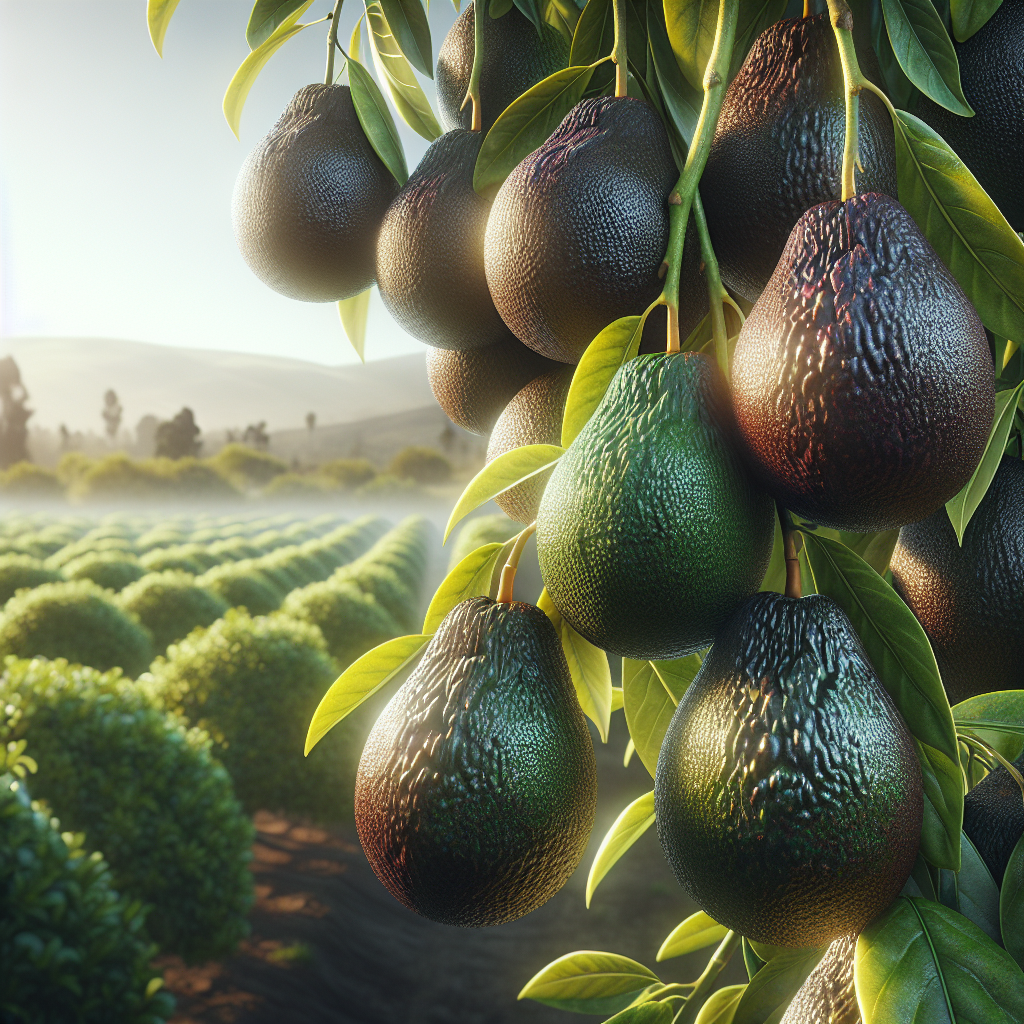
Introduction to Hass Avocado
The Hass Avocado (Persea americana 'Hass') dominates the global avocado market, accounting for over 80% of commercial production due to its superior flavor, high oil content (18-22%), and year-round availability in suitable climates. Discovered in 1926 by Rudolph Hass in La Habra Heights, California, this cultivar arose from a chance seedling and was patented in 1935. Unlike smoother-skinned varieties, Hass Avocados develop a thick, pebbly, dark green-to-black skin when ripe, protecting the buttery green flesh inside. Botanically a berry, the fruit weighs 200-300 grams on average, with a single large seed. Its nutty taste and versatility in guacamole, salads, and oils make it a staple. For growers, Hass Avocado offers high profitability but demands precise management of soil, water, and pests to achieve mature tree yields of 200-500 fruits per tree annually after 5-7 years.
Botanical Profile & Scientific Classification
Hass Avocado belongs to the Lauraceae family, genus Persea, species P. americana Mill., with 'Hass' as the cultivar. It is a type A flower type, featuring synchronized male (morning) and female (afternoon) phases over multiple days, aiding cross-pollination with type B varieties like Fuerte Avocado. Trees are evergreen, reaching 10-12 meters tall with dense, glossy green leaves (10-30 cm long). The fruit is a single-seeded pyrene, botanically a berry, with high monounsaturated fat content. Root systems are shallow and fibrous, extending 3-4 times the canopy width, making them sensitive to waterlogging. Genetically, Hass is a hybrid of Guatemalan and Mexican races, conferring cold tolerance down to -2°C briefly. Compare to Fuerte for smoother skin and earlier harvest.
Ideal Soil, pH, and Climate Requirements
Hass Avocado excels in well-draining, loamy soils rich in organic matter, avoiding heavy clays that cause root rot. Optimal soil pH is 6.0-7.0; below 5.5, aluminum toxicity stunts roots, while above 7.5, iron and zinc deficiencies yellow leaves. Test soil annually and amend with gypsum for sodic soils or lime for acidity. Climate-wise, Hass prefers USDA zones 9-11 with 15-30°C daytime averages and minimal frost. It tolerates dry summers but needs 1000-2000 mm annual rainfall or equivalent irrigation, with high humidity (60-80%) for pollination. Protect from winds over 20 km/h, which scar fruit. In marginal areas, use frost blankets; full sun (6-8 hours daily) is essential for fruit set.
Step-by-Step Planting & Propagation
Propagation
Hass Avocado is typically grafted onto dwarfing rootstocks like Dusa or VC 801 for better vigor and Phytophthora resistance. Seed propagation yields variable offspring, so avoid for commercial use. Collect scions from certified disease-free trees in winter.
Planting Steps
- Site Selection: Choose elevated, frost-free slopes with full sun. Space trees 6-8 m apart (7x7 m grid for 200 trees/ha).
- Pit Preparation: Dig 1x1x1 m holes, fill with 50% native soil + 50% compost + 100g superphosphate.
- Planting: Plant in early spring (post-frost) at same depth as nursery pot. For bare-root, soak roots 1 hour. Stake if windy.
- Initial Watering: Irrigate deeply (50-100 L/tree) immediately, then mulch 10 cm thick with wood chips to retain moisture. Grafted trees fruit in 3-5 years; expect first harvest at 200 fruits/tree.
Care & Maintenance (Specific Watering, Pruning, Fertilizing regimes)
Watering
Hass Avocado roots demand consistent moisture without saturation. Maintain soil moisture at 20-30% volumetric water content (use tensiometers at -10 to -30 kPa). Water young trees weekly (40-60 L), mature every 7-10 days (200-400 L), adjusting for evapotranspiration. Signs of overwatering: yellowing leaves, root rot (mushy black roots); underwatering: wilting, leaf drop, small fruit. Drip irrigation is ideal, delivering 800-1200 mm/year.
Pruning
Prune annually post-harvest. Remove deadwood, watersprouts, and crowded interior branches to open the canopy for light penetration. Tip-prune to 3-4 m height for harvest access. For young trees, pinch at 1 m to encourage bushiness.
Fertilizing
Apply balanced NPK (10-5-20) at 1-2 kg/tree/year, split into 3 applications (spring, summer, fall). Foliar spray micronutrients (Zn, Fe, Mn) if deficient—test leaves for <50 ppm Zn. Organic options: compost (5-10 kg/tree) + manure. Avoid excess N, which delays fruiting.
Pests, Diseases & Organic Management Strategies
Pests: Avocado thrips cause scarring; monitor with sticky traps, spray neem oil (2%) at petal fall. Persea mite leads to leaf bronzing—introduce predatory mites (Euseius hibisci). Root weevils: beneficial nematodes.
Diseases: Phytophthora root rot (water mold) is devastating; use resistant rootstocks, improve drainage, apply phosphite drenches (3-4 L/ha quarterly). Anthracnose: copper fungicides pre-rain. Laurel wilt (beetle-vectored): remove infected trees.
Organic Strategies: Companion with marigolds for nematodes; mulch suppresses weeds. See Spring Pest Patrol for integrated approaches. Biological controls: Bacillus thuringiensis for Loopers.
Harvesting, Curing & Optimal Storage
Harvest Hass Avocado when 25-30% dry matter (use refractometer) and fruit neck yields to gentle pressure—typically 9-11 months post-bloom (March-June in California). Cut with clippers, leaving short peduncle. Yields peak at 10-20 tons/ha.
Curing: Store at 20-25°C, 85-90% RH for 7-14 days to ripen. Ethylene (100 ppm) accelerates.
Storage: Ripe fruit at 5-7°C lasts 2-4 weeks; unripe at 7-10°C up to 4 weeks. Avoid below 3°C to prevent chilling injury (pitting).
Companion Planting & Intercropping
Hass Avocado pairs well with nitrogen-fixers like pigeon pea or fava beans under young trees to build soil fertility. Intercrop with annuals (bell peppers, tomatoes) in row middles for 2-3 years until canopy closure. Avoid competitive grasses; plant comfrey for mulch/dynamic accumulator. Marigolds deter nematodes; garlic repels thrips. For fall boosts, check Fall Companion Planting Guide. This enhances biodiversity, suppresses weeds, and maximizes land use.