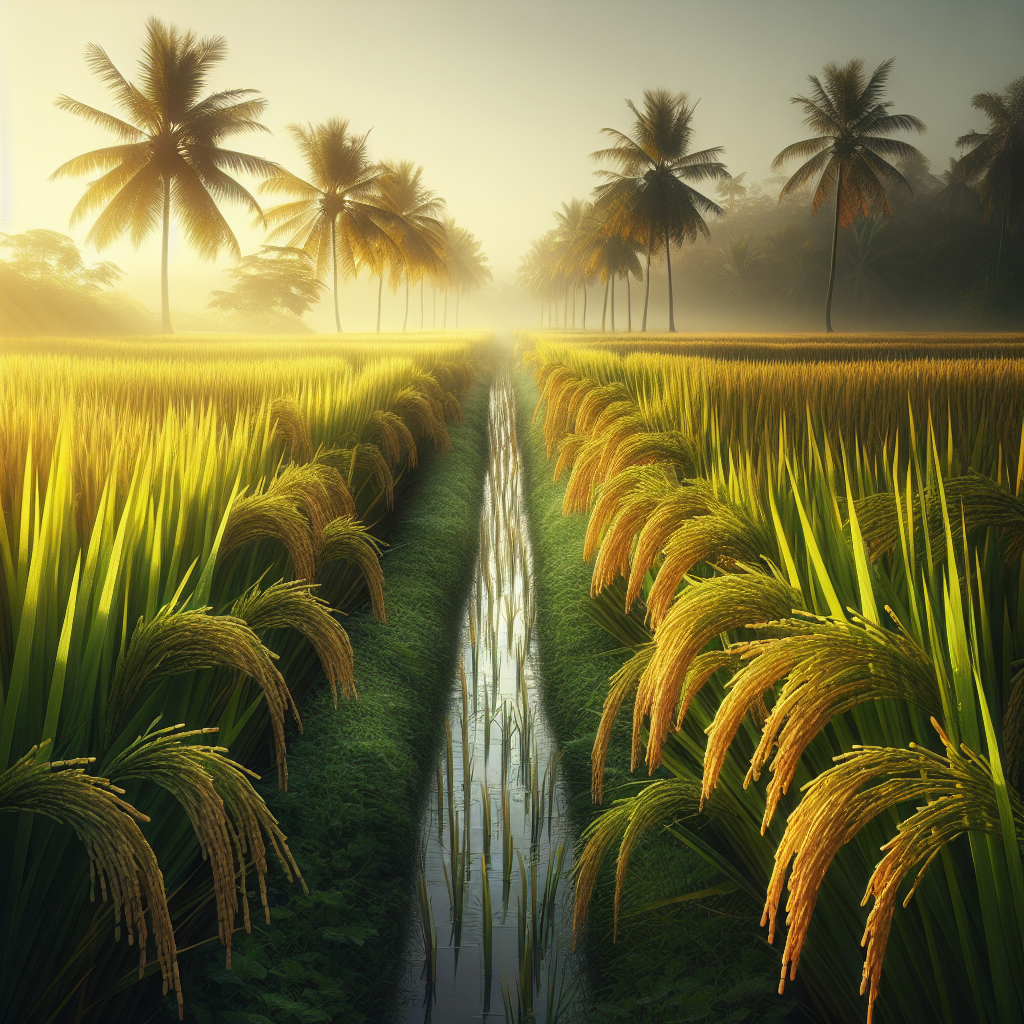
Introduction to Rice
A foundational staple for more than half the global population, rice is a warm-season annual grass grown for its starchy grains and exceptional adaptability to diverse production systems. It originated in Asia thousands of years ago, and today cultivation ranges from hand-managed terrace paddies to highly mechanized direct-seeded fields. Although many growers associate rice with standing water, the plant is not truly aquatic; rather, it is a semiaquatic cereal that tolerates flooding better than most competitors because of specialized air spaces in its tissues and root-zone adaptations.
Professional rice growing begins with understanding that not all rice is managed the same way. Broadly, systems include irrigated lowland rice, rainfed lowland rice, upland rice, and deepwater rice. Irrigated lowland rice usually delivers the highest and most stable yields because water depth, fertility, and weed pressure can be controlled. Upland rice is grown more like other grains on non-flooded soils, but it tends to face stronger weed competition and greater drought risk. Varieties also differ dramatically: indica types generally dominate tropical lowlands and often perform best under hotter conditions, while japonica types are more common in cooler zones and often produce shorter, stickier grains. Aromatic, glutinous, medium-grain, and long-grain cultivars all have distinct market targets.
Rice passes through clear growth stages: germination, seedling establishment, tillering, panicle initiation, booting, flowering, grain filling, and ripening. Each stage has different vulnerabilities. Early establishment is where weed pressure and poor leveling can ruin a stand. Panicle initiation and flowering are especially sensitive to nutrient stress, drought, and temperature extremes. Grain filling and ripening are damaged by prolonged flood stress, late nitrogen excess, lodging, and bird pressure. Growers who manage by growth stage instead of calendar date typically achieve more consistent yields and grain quality.
For comparison with another major cereal, see our Wheat guide. For broader fertility planning, review soil health strategies.
Botanical Profile of Rice
Rice belongs to the family Poaceae, the true grasses, and the genus Oryza. The primary cultivated species is Oryza sativa, while Oryza glaberrima is an independently domesticated African species still important in some regional systems and breeding programs. Oryza sativa is commonly divided into indica, japonica, and aus groups, with additional aromatic and tropical japonica classifications recognized in practical agriculture.
Morphologically, rice develops a fibrous root system, hollow culms, narrow linear leaves, and a terminal inflorescence called a panicle. Each panicle bears multiple spikelets, which mature into grains enclosed by hulls. A single plant can produce many tillers, and tillering capacity is one of the main determinants of stand density compensation and final yield. In sparse stands, high-tillering cultivars can partially make up for low plant counts; in dense stands, excessive tillering can increase disease humidity and promote lodging if fertility is too rich.
The plant’s physiology is especially noteworthy. Rice can transport oxygen from shoots to roots through aerenchyma, enabling survival in saturated soils where oxygen is limited. That does not mean perpetual deep water is ideal. During establishment, shallow water or moist soil conditions are often better than deep flooding, which can suppress weak seedlings and create uneven stands. During active tillering and vegetative growth, many lowland systems maintain 2 to 5 cm of water, occasionally rising to 5 to 10 cm depending on field conditions, soil cracking risk, and weed management goals.
Rice is generally a short-day-responsive species, though modern cultivars vary widely in photoperiod sensitivity. Traditional landraces may flower only when daylength and seasonal cues align, while improved varieties are bred for predictable maturity windows. This matters for crop planning: a photoperiod-sensitive landrace planted outside its adapted season may remain vegetative too long, produce delayed flowering, or fail to mature before cold weather or drought.
Grain quality is determined not only by variety but also by field management. High temperatures during grain filling can increase chalkiness. Late nitrogen can improve protein but may reduce milling quality if it delays maturity or promotes lodging. Water stress at flowering can sharply reduce grain set. Thus, premium rice quality is the product of genetics and precise agronomy.
Soil, pH, and Climate Requirements for Rice
Rice performs best in fertile, moisture-retentive soils with good nutrient-holding capacity. In flooded lowland systems, clay loam to silty clay loam soils are ideal because they puddle well, reduce percolation losses, and hold shallow standing water uniformly. Sandy soils can grow rice, but they usually require much more frequent irrigation, lose nutrients rapidly, and are harder to manage economically in paddy culture unless a compacted layer is present.
The ideal soil pH is generally 5.5 to 6.5, though rice tolerates a fairly broad range from about 4.5 to 7.5 depending on cultivar, soil chemistry, and water regime. In acidic soils below pH 5.0, aluminum and iron toxicity can limit root growth, while phosphorus may become less available. In alkaline soils above pH 7.5, zinc, iron, and manganese deficiencies are more common, especially in continuously flooded fields. Zinc deficiency in rice is particularly important: symptoms include stunted seedlings, bronzing, pale midribs, and patchy establishment. Corrective measures often include zinc sulfate application before planting or as an early-season treatment.
Lowland rice fields benefit from careful land leveling. Even a few centimeters of unevenness can cause one area to be too deep and another too dry. Deep spots may suppress seedlings and foster disease; shallow spots encourage weeds and moisture stress. Laser leveling is ideal for larger operations, but even smallholders should aim for a uniformly graded field with reliable bunds to hold water.
Climatically, rice prefers warm conditions throughout the growing season. Germination is best when soil or water temperatures are around 20 to 35°C, with rapid and uniform emergence commonly seen from 25 to 35°C. Below about 16°C, germination slows markedly; below 12°C, seedling growth can be poor and uneven. Vegetative growth thrives roughly between 25 and 31°C. Flowering is especially sensitive: temperatures above 35°C can reduce pollination and spikelet fertility, while cool temperatures below about 20°C at booting or flowering can also cause sterility in susceptible cultivars.
Rainfall requirements vary by production system. Rainfed rice often needs at least 1,000 to 1,500 mm of well-distributed seasonal rainfall, while irrigated systems can be grown in much drier climates if water supply is dependable. Relative humidity between 60% and 80% generally favors growth, but very humid canopies with poor airflow may intensify foliar diseases. Full sun is essential for high yield; prolonged cloudiness during reproductive stages can reduce carbohydrate accumulation and grain filling.
Step-by-Step Planting & Propagation
Rice is propagated almost exclusively by seed. The first step is selecting a cultivar adapted to your daylength, temperature regime, disease pressure, and market class. Choose certified seed whenever possible, as off-types, weed seed contamination, and seed-borne diseases can significantly reduce returns. Target high germination rates, ideally above 85%.
Begin by preparing the field according to the chosen system. In puddled transplanted rice, till the field, incorporate residues and basal amendments, then puddle the soil under wet conditions to reduce permeability and soften the seedbed. Construct or repair bunds before final leveling so the field can retain water evenly. In dry direct-seeded systems, create a firm, fine seedbed similar to other cereals, avoiding large clods that interfere with seed placement.
For nursery raising prior to transplanting, pre-soak seed for 12 to 24 hours, then incubate it in a warm, shaded place for another 24 to 36 hours until tiny radicles emerge. This pregermination shortens field establishment time. Sow seed densely in a prepared nursery bed with fertile, weed-free soil. Keep the nursery moist but not submerged for the first few days. Seedlings are usually ready for transplanting at 18 to 25 days for many modern varieties, though some systems use younger seedlings around 12 to 15 days and some traditional methods use older seedlings up to 30 days.
Transplanting should place seedlings shallowly, usually 1 to 3 cm deep. Planting too deep delays tillering and weakens establishment. In conventional spacing, place 2 to 4 seedlings per hill at 20 x 20 cm, 20 x 15 cm, or similar spacing depending on fertility, variety, and weed pressure. Wider spacing often improves tillering and airflow but may increase early weed emergence if water control is poor. In intensive management systems using young seedlings, even one seedling per hill can perform very well when soil fertility and water are carefully managed.
For direct seeding, use either dry seeding into moist soil or wet seeding into puddled fields. Sowing depth should generally be 1 to 2 cm in heavier soils and no more than 2 to 3 cm in lighter soils. Excessive depth causes weak emergence and uneven stands. Seeding rates vary widely by method and cultivar, but overly dense sowing increases disease risk, lodging, and nutrient competition. Aim for a final stand that allows rapid canopy closure without overcrowding.
After seeding or transplanting, early water management is critical. In transplanted rice, keep water shallow, around 1 to 2 cm, for several days until seedlings recover, then gradually increase to 2 to 5 cm. In direct-seeded rice, avoid immediate deep flooding unless the cultivar and method are specifically adapted to it. Instead, maintain moist soil or very shallow water to ensure oxygen access during germination and early root establishment.
Care & Maintenance regimes for Rice
Water management is the defining practice in rice culture. In irrigated lowland systems, maintain a consistent shallow flood of about 2 to 5 cm during active vegetative growth. Water deeper than 5 cm is sometimes used briefly for weed suppression, but prolonged deep water can reduce tillering, especially in short cultivars. During panicle initiation to flowering, avoid both drought and abrupt drainage, as water stress at this stage can sharply reduce the number of filled grains. About 7 to 14 days before harvest, drain the field to harden the ground, improve grain ripening, and facilitate harvest.
An increasingly important approach is alternate wetting and drying, in which the field is allowed to subside from shallow flooding to near-saturated conditions before re-irrigation. The soil should not be allowed to crack severely or dry deeply during sensitive stages. A practical indicator is to re-irrigate when the water level in a perforated field tube falls roughly 10 to 15 cm below the soil surface in suitable soils, except around flowering when continuous moisture is safer. This method can save water and reduce methane emissions while maintaining yield when carefully managed.
Nutrient management should be based on soil testing, expected yield, and residue history. Rice has high demand for nitrogen, moderate demand for potassium, and strong responses to phosphorus in deficient soils. Nitrogen is best split into multiple applications: a basal dose at planting or shortly after establishment, a second dose at active tillering, and a third around panicle initiation if needed. Applying all nitrogen upfront often leads to losses, rank growth, and lodging. Nitrogen deficiency appears as pale green to yellow leaves, reduced tillering, and stunting. Excess nitrogen produces lush dark foliage, delayed maturity, weak stems, and greater susceptibility to blast and lodging.
Phosphorus is especially important early in the season for root vigor and tiller development. Potassium supports stem strength, disease tolerance, and grain filling. Silicon, although not always listed in standard fertility programs, can be highly beneficial in rice by strengthening tissues and improving resistance to lodging and some pests and diseases. In fields with repeated straw removal, silicon depletion may become significant over time.
Weed control is most critical during the first 20 to 45 days after establishment. Common rice weeds include barnyardgrass, sedges, weedy rice, sprangletop, and various aquatic broadleaf species. In transplanted systems, puddling and standing water give rice a competitive advantage, but weeds still emerge in gaps and shallow spots. Mechanical cono weeders, hand weeding, stale seedbed techniques, mulch in upland systems, and careful water timing all support non-chemical control. The most dangerous competitor in many regions is weedy rice, which closely resembles cultivated rice and contaminates harvests; prevention through clean seed, machinery sanitation, and field hygiene is essential.
Lodging prevention depends on variety choice, balanced nitrogen, sufficient potassium, moderate plant density, and avoiding late-season overirrigation. Watch canopy color and height closely. If stems elongate rapidly and lower internodes feel soft while the crop is dark green and top-heavy, lodging risk is rising.
Pests, Diseases & Organic Management
Rice faces a broad complex of insects, pathogens, nematodes, vertebrate pests, and physiological disorders. The most effective management strategy is integrated and preventive rather than reactive.
Among insects, stem borers, leaf folders, rice hispa, planthoppers, gall midge, and rice bugs are major problems depending on region. Stem borer damage often appears as deadhearts in the vegetative stage, where the central shoot dries and pulls out easily, or whiteheads during reproductive growth, where panicles emerge empty and pale. planthoppers can cause hopperburn, visible as yellowing and browning patches that collapse quickly in dense stands. Excessive nitrogen and continuous flooding often favor these outbreaks by creating soft, humid canopies.
Organic management begins with habitat balance and monitoring. Avoid overfertilization, remove alternate grassy hosts around field edges, encourage spiders, dragonflies, parasitoid wasps, frogs, and ducks where culturally appropriate, and use light traps or pheromone traps where validated locally. Neem-based products may suppress some soft-bodied insects and early larval populations, but they work best when used preventively and as part of a broader program.
Major diseases include rice blast, bacterial leaf blight, sheath blight, brown spot, false smut, and tungro in affected areas. Blast is one of the most destructive, producing diamond-shaped lesions on leaves and potentially infecting nodes, collars, and panicles. It tends to flare under high humidity, frequent leaf wetness, cool nights, and excessive nitrogen. bacterial leaf blight often causes yellowing from leaf tips and margins, with wavy lesion edges; wounds from storms or rough handling can increase infection. sheath blight thrives in dense, highly fertilized stands with poor airflow.
Organic and low-input disease management relies on resistant varieties, seed health, balanced nutrition, wider spacing where disease pressure is chronic, timely drainage, residue management, and avoiding unnecessary canopy humidity. Seed treatment using hot water or approved biological inoculants can help reduce seed-borne issues in some systems. Compost teas and microbial products have mixed results and should not replace resistant genetics and sound field hygiene.
birds, rats, and snails can also be severe. golden apple snail in some regions can devastate young seedlings, especially in newly flooded fields. Hand collection, duck integration, trapping, synchronized community planting, and shallow early water can reduce losses. rats often require coordinated area-wide control because isolated action rarely succeeds.
Harvesting, Curing & Optimal Storage
Rice is ready to harvest when about 80% to 85% of the grains on the panicle have turned straw-colored and grain moisture is typically around 20% to 24%. Harvesting too early produces immature, chalky grain with poor milling recovery. Harvesting too late increases shattering, lodging, bird damage, and weathering losses. A practical field cue is that the upper panicle grains are hard and mature while only a small fraction of lower grains remain slightly green.
Drain the field 1 to 2 weeks before harvest so the soil firms and the crop ripens evenly. In small-scale systems, harvest with sickles in the cool morning to reduce shattering. In mechanized systems, combine settings must be adjusted for variety, grain moisture, and straw condition to minimize broken grain and unthreshed panicles.
Thresh promptly after cutting. Delayed threshing in damp bundles can raise grain temperature and encourage mold or discoloration. Clean grain well to remove chaff, weed seeds, and empty spikelets. Drying is the most critical postharvest step. For safe storage of paddy rice, dry grain to about 13% to 14% moisture for medium-term storage, and closer to 12% if storage will be extended in warm, humid climates. Grain dried unevenly or too slowly is vulnerable to fungi, off-odors, and insect infestation.
Sun drying remains common but requires active management. Spread grain in thin layers, usually 2 to 5 cm deep, on clean tarps or drying floors and stir frequently. Avoid overdrying under intense afternoon heat, which can increase fissuring and lower head rice yield after milling. Mechanical low-temperature drying provides better uniformity and quality where available.
Store paddy in cool, dry, well-ventilated conditions using rodent-proof bins, sealed containers, or clean woven sacks stacked on pallets above the floor. Relative humidity in the store should be kept low enough to prevent grain reabsorption of moisture. Inspect regularly for weevils, moths, rodents, and condensation. If storing milled rice instead of paddy, be even more careful: the removal of the husk and bran makes the grain less protected and more vulnerable to rancidity, breakage, and insect attack.
Companion Planting for Rice
In traditional and ecological systems, rice is often integrated rather than merely interplanted. True companion planting in flooded paddies can include azolla, duckweed-managed systems, border legumes, and rice-fish-duck arrangements. Azolla, a floating fern associated with nitrogen-fixing cyanobacteria, can suppress weeds, reduce evaporation, add organic matter, and contribute modest nitrogen when incorporated. Its success depends on nutrient balance and controlled coverage so it does not excessively shade very young rice.
On paddy bunds and field margins, low-growing legumes and insectary plants can be highly useful. Sesbania, mung bean in suitable rotations, marigold, and flowering herbs adapted to the local climate can support pollinators and beneficial insects while stabilizing bunds against erosion. In upland rice, companion or relay systems with legumes may improve ground cover and soil fertility, but they must be managed to avoid early competition for light and moisture.
Rice-fish systems are among the most productive ecological partnerships. Fish can help consume mosquito larvae, some weeds, and certain invertebrate pests while adding nutrient cycling through waste. Ducks in some systems assist with snail and weed suppression, though they must be introduced at the right crop stage so they do not uproot young seedlings.
The best companions for rice are therefore functional rather than ornamental: species or livestock that help fix nitrogen, suppress weeds, recycle nutrients, stabilize water edges, or reduce pest pressure. Any companion must be chosen with water depth, field access, harvest logistics, and local regulations in mind. In highly managed commercial systems, the practical equivalent of companion planting is often a well-designed rotation with legumes, green manures, or dryland crops to break pest cycles and improve soil structure between rice crops.