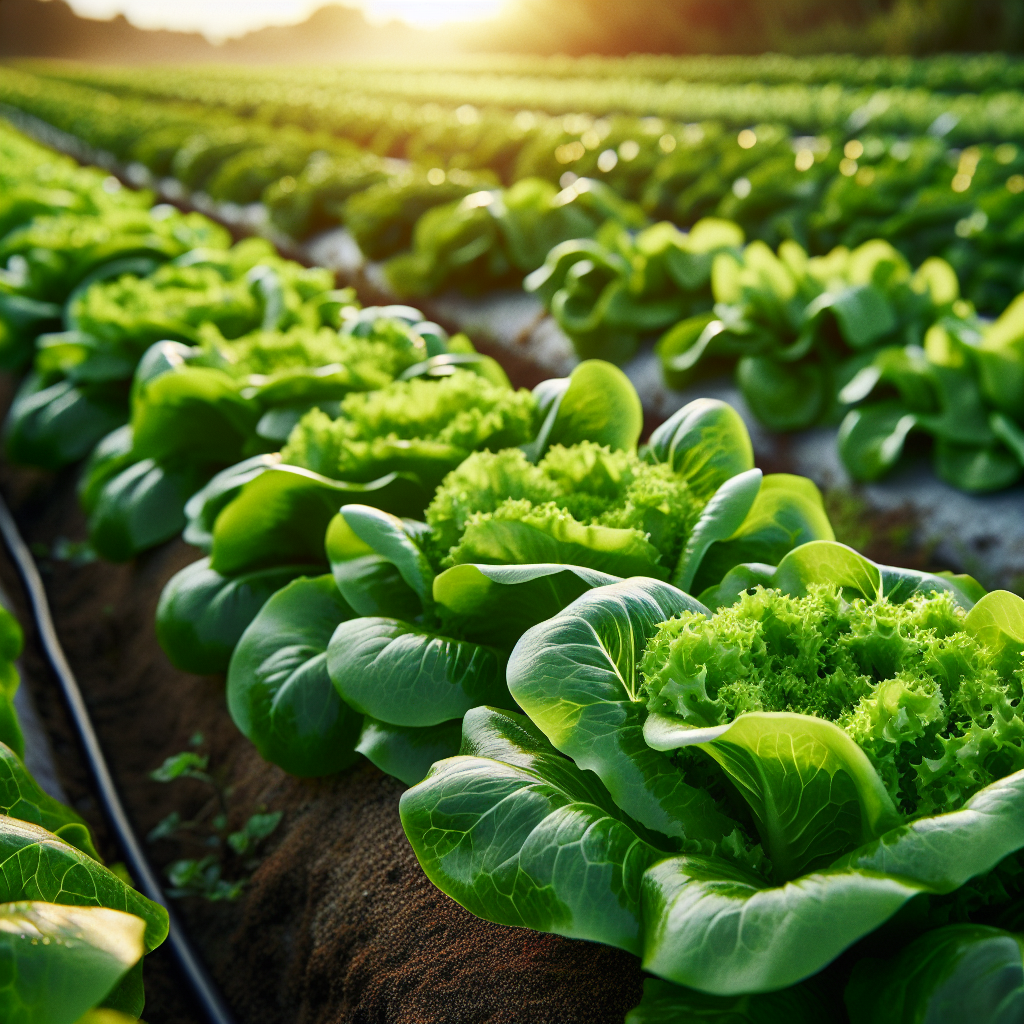
Introduction to Lettuce
One of the oldest cultivated salad greens in the world, lettuce has been grown for thousands of years, likely descending from wild prickly lettuce relatives in the Mediterranean and Near East. Ancient Egyptians are believed to have selected early forms first for oilseed use and later for edible leaves, while Roman and medieval growers expanded the crop into the many heading and loose-leaf forms known today. Modern lettuce production spans backyard beds, intensive market gardens, hydroponic systems, and large-scale commercial farms because the crop is fast, profitable, and highly responsive to skilled management.
Lettuce is a classic cool-season annual grown primarily for its leaves or heads. Quality is highest when growth is fast and uninterrupted, which produces tender leaves, mild flavor, and attractive color. Any stress that slows growth or pushes the plant toward reproduction can quickly reduce marketability. Heat encourages bolting, irregular irrigation causes bitterness and tough texture, and excess fertility can create lush but disease-prone growth.
From a production standpoint, lettuce is not one single type but a group of forms with distinct field behavior. Leaf lettuce matures fastest and is forgiving for cut-and-come-again harvests. Romaine or cos types form upright elongated heads and tend to tolerate moderate heat better than butterhead. Butterhead types produce soft, loosely folded heads with exceptional eating quality but can be delicate in transport. Crisphead, including iceberg, typically requires the most precise conditions, especially consistent cool temperatures and steady moisture, to form dense heads. Stem lettuce, less common in many regions, is grown for its enlarged stem.
Because lettuce has a shallow root system and short crop cycle, it reflects management errors almost immediately. That sensitivity is exactly why experienced growers can achieve such high quality: when soil structure, irrigation, spacing, and temperature are optimized, lettuce grows quickly and predictably. In diversified systems, it also fits well into succession planting and intercropping plans, especially alongside crops such as onion. For broader mixed-planting strategy, see this companion planting guide.
Botanical Profile of Lettuce
Lettuce belongs to the family Asteraceae, the same broad family as sunflower, chicory, endive, and dandelion. Its scientific name, Lactuca sativa, reflects the milky latex found in cut stems and leaves, a characteristic common in the genus. The plant is generally cultivated as an annual, though biologically it passes from vegetative growth into flowering and seed production if allowed to mature fully.
The plant begins as a rosette of leaves arising from a very short stem. Depending on cultivar, those leaves may be flat, savoyed, frilled, deeply lobed, heavily blistered, or smooth. Pigmentation ranges from pale green to dark emerald to red-bronze, often influenced by both genetics and light intensity. Head-forming types gradually stack leaves around the compressed stem to make either a loose butterhead, an upright romaine heart, or a dense crisphead.
Roots are fibrous, relatively shallow, and concentrated largely in the top 15 to 25 cm of soil, though some may extend deeper in friable ground. This shallow rooting explains why lettuce is highly sensitive to surface drying, salinity spikes, and nutrient imbalances. It also means the crop responds especially well to fine tilth, high organic matter, and frequent light-to-moderate irrigation rather than long dry intervals followed by flooding.
If exposed to increasing day length, heat, drought stress, or age-related signals, lettuce shifts from vegetative growth to bolting. The central stem elongates rapidly, leaves become narrower and often more bitter, and flower stalks emerge. Like many Asteraceae, the flowers are composite heads, usually yellow, and are followed by small dry fruits commonly called seeds in cultivation. Seed viability is best when stored cool and dry, but lettuce seed can lose vigor faster than many large-seeded vegetables if kept in hot, humid conditions.
Cultivar choice matters greatly. Loose-leaf types may mature in 25 to 40 days for baby leaf and 40 to 55 days for full size. Butterhead often takes 55 to 70 days. Romaine typically falls in the 60 to 75 day range. Crisphead may require 70 to 90 days and often performs best where nights remain cool. Modern breeding has improved bolt resistance, downy mildew resistance, tipburn tolerance, and adaptation to summer or winter production, but no cultivar is immune to poor timing.
Soil, pH, and Climate Requirements for Lettuce
Lettuce performs best in fertile, well-drained, moisture-retentive soil with a fine crumb structure. Ideal textures are sandy loam to silty loam enriched with mature compost or well-decomposed organic matter. Heavy clay can produce acceptable crops if drainage is improved and beds are raised, but compacted soil commonly leads to stunting, shallow rooting, and increased disease pressure. Extremely sandy soils can produce crisp, clean lettuce, yet they require more frequent irrigation and careful fertility management because nutrients leach quickly.
The ideal soil pH is generally 6.0 to 7.0, with 6.2 to 6.8 being especially reliable for nutrient availability and root health. Below about pH 5.8, calcium and magnesium availability may become less balanced, and stress symptoms can intensify. In alkaline soils above about 7.2, micronutrient issues such as iron chlorosis may appear, especially in cool wet conditions. A pre-plant soil test is strongly recommended because lettuce has a short season and little time to recover from hidden nutrient problems.
Nitrogen drives rapid leafy growth, but balance is crucial. Too little nitrogen results in pale foliage, slow head development, and low yield. Too much can create soft, weak tissue, nitrate accumulation, and higher susceptibility to aphids, rot, and tipburn under rapid growth conditions. Phosphorus supports early root establishment, especially in cool soils. Potassium helps regulate water balance and leaf quality. Calcium is essential for preventing internal leaf edge necrosis known as tipburn, a common physiological disorder in rapidly growing heads where calcium transport to inner leaves cannot keep up with expansion.
Temperature is the defining environmental factor for lettuce. Optimal germination typically occurs around 15 to 22°C, though many seeds will germinate outside that range. Problems begin when soil temperatures rise too high; some cultivars show thermodormancy above about 27 to 30°C, meaning seeds may fail to germinate until the soil cools. For vegetative growth, daytime temperatures around 15 to 21°C and nights around 7 to 13°C produce excellent texture and flavor. Prolonged heat above 24°C increases bolting risk and can cause bitterness, loose heads, or poor heart formation.
Lettuce tolerates light frost better than heat, especially hardened plants, but severe freezing can damage leaf tissues and market quality. Relative humidity should be moderate with good airflow. Constantly wet foliage combined with cool weather favors downy mildew, Botrytis, and bacterial diseases, while very low humidity and erratic moisture can worsen edge burn and slow growth.
Sun exposure should be full sun in cool seasons, but in warm climates afternoon shade can significantly improve quality. Shade cloth of 20 to 30 percent is often enough to lower canopy temperature without excessively reducing growth. In hot regions, many professional growers rely on late fall, winter, and early spring production windows instead of trying to force summer lettuce in open fields.
Step-by-Step Planting & Propagation
Lettuce is propagated almost exclusively by seed. Direct sowing is common for leaf lettuce and baby leaf production, while transplants are often preferred for head lettuce because they improve spacing precision, reduce seed waste, and shorten field occupancy.
Start by preparing a smooth, level seedbed free of clods and undecomposed residues. Lettuce seed is small and should not be buried deeply. Fine tilth is critical because uneven emergence from crusted or rough soil can reduce stand uniformity and harvest timing.
For direct sowing, place seed about 0.3 to 0.6 cm deep. In cool, moist soil, shallower placement is usually better. In slightly drier conditions, seed may be covered a bit more, but deep sowing often leads to weak or failed emergence. Rows for full-size production are often spaced 25 to 45 cm apart depending on equipment and cultivar. Within-row spacing can range from 15 to 30 cm for head lettuce and 10 to 20 cm for larger leaf types. For baby leaf, sow much more densely in bands or close rows and harvest young.
If raising transplants, sow into plug trays using a sterile, fine-textured medium with excellent drainage. Maintain consistent but not saturated moisture. Seedlings usually emerge within 2 to 7 days under suitable conditions. Provide bright light immediately after emergence to avoid stretching. Ideal seedling temperatures are cooler than for warm-season crops; roughly 15 to 18°C after emergence encourages compact, sturdy plugs. Overheated nursery conditions often produce leggy plants that establish poorly.
Transplant when seedlings have 3 to 4 true leaves and a well-knit root plug, usually 2 to 4 weeks after sowing depending on conditions. Harden plants for several days by slightly reducing water and exposing them gradually to outdoor conditions, but do not stress them severely. Plant so the crown sits just above the soil line; burying too deep increases rot risk.
Succession sowing is one of the most important techniques for continuous harvest. In cool weather, sow every 7 to 14 days. In transitional seasons, choose bolt-resistant cultivars for later plantings and cold-tolerant cultivars for winter slots. Professional growers often stagger varieties as well as planting dates to maintain steady supply.
After sowing or transplanting, irrigate gently but thoroughly to settle the soil and ensure root-zone contact. Floating row cover can improve early establishment by reducing wind stress, excluding some pests, and slightly moderating temperature, though it should be vented or removed before heat builds excessively.
Care & Maintenance regimes for Lettuce
Successful lettuce culture depends on uninterrupted growth. The crop has little tolerance for stop-start development, so irrigation, fertility, and canopy management must be steady from establishment through harvest.
Moisture management is the single most important routine task. Lettuce prefers consistently moist soil, roughly comparable to 70 to 80 percent of field capacity in the active root zone, not waterlogged but never allowed to dry deeply. In practical terms, the top 2 to 3 cm of soil may begin to lose surface moisture between irrigations, but the root zone below should remain evenly damp. When squeezed, soil should hold together lightly without dripping. If it becomes powdery, pale, and loose at root depth, the crop is already under stress. Drought stress leads to bitterness, slower leaf expansion, tougher texture, and bolting. Overwatering causes oxygen deprivation, shallow rooting, yellowing, edema-like blistering, and increased bottom rot.
Drip irrigation is preferred because it keeps foliage dry and delivers water efficiently to the shallow root zone. Frequent short irrigations are usually better than infrequent heavy ones, especially in sandy soils. During cool weather, 12 to 25 mm of water per week may suffice depending on rainfall and soil type. In warmer, windy, or protected conditions, needs may rise substantially. The goal is uniformity, not simply volume.
Fertilization should emphasize early availability without excess. Many growers incorporate compost plus a balanced pre-plant fertilizer, then provide one or two light side-dressings of nitrogen once plants are established. For organic production, blood meal, feather meal, fish-based fertility, or well-managed compost programs are common tools. Rapidly available nitrogen should be used cautiously late in the crop cycle because sudden lush growth can trigger soft tissue and tipburn, particularly in heading types.
Weed control is essential during the first half of the crop cycle because lettuce competes poorly. Shallow cultivation works well before plants spread, but cultivate carefully because roots are near the surface. Organic mulches can help conserve moisture and suppress weeds in wider-spaced plantings, though they may also shelter slugs if conditions are damp. In market-garden systems, stale seedbed techniques and flame weeding before emergence can improve stand cleanliness.
Temperature moderation is often overlooked. In spring and fall, low tunnels or row covers can speed growth. In late spring or hot climates, shade cloth, wider spacing for airflow, and careful variety selection become more important than pushing fertility. Lettuce exposed to heat stress often develops elongated stems before obvious bolting is visible, so monitoring plant architecture is useful.
Tipburn prevention requires managing growth rate and calcium transport rather than merely adding calcium blindly. Keep moisture even, avoid overloading with nitrogen, maintain reasonable spacing, and favor cultivars less prone to internal burn in warm conditions. Fast-growing romaine and crisphead under hot weather are especially susceptible.
Pests, Diseases & Organic Management
Lettuce attracts a predictable group of pests, most of which become worse under either lush overfertilized growth or prolonged damp conditions. Integrated management should rely on sanitation, crop rotation, airflow, resistant cultivars, beneficial insects, and regular scouting rather than reactive spraying alone.
Aphids are among the most common pests, especially green peach aphid and lettuce aphid. They cluster in leaf folds and hearts, contaminate marketable product, and can spread viruses. Outbreaks are favored by excessive nitrogen and sheltered canopies. Encourage beneficial insects such as lady beetles, lacewings, hoverflies, and parasitic wasps, and use insecticidal soap or neem-based products only with careful coverage and label compliance. Once aphids are deep inside heading lettuce, control becomes difficult, so early detection is critical.
slugs and snails are major problems in moist fields, mulched beds, and protected structures. They chew irregular holes and leave contamination. Reduce hiding sites, irrigate early in the day rather than at night where possible, use iron phosphate baits in organic systems, and maintain good perimeter sanitation.
leafminers create winding tunnels in foliage, reducing appearance. flea beetles and cutworms may attack young plants. Row covers are especially useful during establishment, provided plants are not trapped under excessive heat.
downy mildew is one of the most important diseases worldwide. It often appears as pale angular lesions on upper leaf surfaces with white to gray sporulation underneath in cool humid conditions. Resistant cultivars are invaluable because pathogen races change over time. Avoid overhead irrigation late in the day, improve spacing and airflow, rotate fields, and remove crop residues promptly.
bottom rot, usually caused by Rhizoctonia solani, affects outer leaves in contact with wet soil. Sclerotinia drop causes sudden collapse with cottony fungal growth and black sclerotia. Botrytis can attack senescing tissue in humid environments. These diseases are encouraged by poor airflow, saturated soils, and repeated lettuce or related crops in the same ground. Raised beds, drip irrigation, clean cultivation, and rotation out of susceptible leafy crops for at least 2 to 3 years help reduce risk.
bacterial leaf spot and soft rots become serious when foliage remains wet and plants are injured. Handle plants gently, avoid working in fields when leaves are wet, and cool harvested heads quickly. Viruses such as lettuce mosaic can be introduced through infected seed or aphid transmission, making certified seed and vector management essential.
Physiological disorders also matter. Tipburn, bolting, bitterness, and misshapen heads are often not infectious but management related. Professionals distinguish disease from disorder by pattern: if symptoms follow weather swings, uneven irrigation, or fertility spikes across a field, physiology may be the main cause.
Harvesting, Curing & Optimal Storage
Lettuce is harvested at several market stages, and timing strongly influences flavor, shelf life, and value. Baby leaf is cut young when leaves are tender, often 20 to 35 days from sowing. Loose-leaf types for bunching or whole-plant harvest are taken before stems elongate and before outer leaves become coarse. Romaine, butterhead, and crisphead should be harvested when the head or heart is fully formed but still compact, succulent, and free from bolting.
Harvest in the coolest part of the day, ideally early morning after field heat is low but leaves are dry enough to avoid excessive surface moisture. Cut plants with a clean, sharp knife just above the soil line. Remove damaged, diseased, or heavily soiled outer leaves in the field if marketing standards require trimming. Minimize bruising because wounded tissue quickly turns brown and invites decay.
Unlike curing crops such as onion or garlic, lettuce is not cured. It should move rapidly from field heat removal into washing, draining, packing, and cold storage. Hydrocooling or prompt refrigeration dramatically extends shelf life. The optimum storage temperature is 0 to 2°C with very high relative humidity, around 95 to 98 percent, to prevent wilting. At these conditions, many lettuces hold for 1 to 3 weeks depending on type, maturity, and handling. Leaf lettuces are generally more perishable than dense crispheads.
Do not store lettuce with ethylene-producing fruits such as apples, pears, or ripening tomatoes because ethylene accelerates russet spotting and senescence. Maintain airflow in storage but avoid dehydration. Perforated liners, clean crates, and rapid cold chain management are standard professional practices.
Signs of overmature harvest include elongated stem core, bitterness, latex exudation from cut surfaces, loose heads, and increased susceptibility to internal browning. For processing or salad mix production, harvest uniformity matters as much as size because mixed maturity leads to inconsistent texture and shorter shelf life.
Companion Planting for Lettuce
Lettuce is especially useful in companion planting because it is shallow rooted, relatively compact, and quick to mature. It can occupy the soil surface while slower or taller crops are still developing, making it a strong candidate for intensive bed systems and diversified gardens.
Good companions include alliums such as onions and chives, which may help confuse some pest movement while using a different rooting pattern from lettuce. Carrots, radishes, and beets can also pair well because they exploit different soil zones and allow efficient use of bed space. Brassicas can work alongside lettuce in cool seasons if spacing preserves airflow. Herbs like cilantro and dill may attract beneficial insects that help suppress aphids.
Lettuce also benefits from partial shade cast by taller crops in warm conditions. For example, strategic placement near trellised cucumbers or on the east side of taller summer plantings can lower afternoon heat stress. However, too much shade reduces head formation and can increase humidity-related disease, so the aim is filtered or time-limited shade rather than deep cover.
Avoid crowding lettuce with aggressively spreading crops that compete for light and moisture. Large vining cucurbits, dense tomato canopies, or vigorous brassica plantings can trap humidity and limit access for harvest. Companion systems should always be planned around sanitation and harvest practicality, not folklore alone.
For production planning, lettuce excels as an intercrop, border crop, or succession filler. It can be planted between slow-maturing rows, harvested before neighboring crops fully occupy the space, and used to maintain living cover on productive beds. In well-managed systems, this improves land efficiency without substantially increasing disease pressure, provided irrigation and spacing are adjusted to the needs of each species.