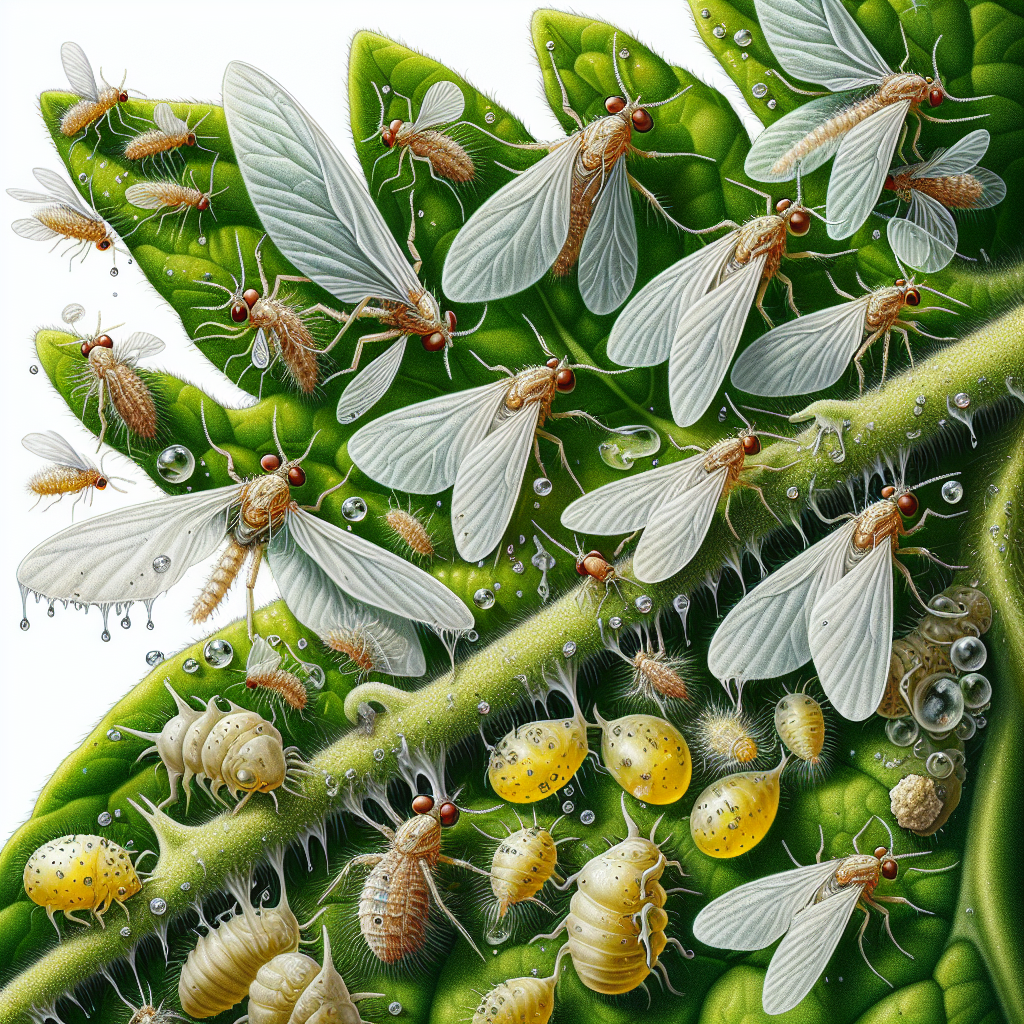
Introduction to Whiteflies
Whiteflies are among the most notorious pests in agriculture, affecting over 600 plant species worldwide. These small, white, moth-like insects belong primarily to the Aleyrodidae family, with key species including the greenhouse whitefly (Trialeurodes vaporariorum) and the silverleaf whitefly (Bemisia tabaci). Resembling tiny moths at rest, adult whiteflies measure just 1-3 mm long, with powdery white wings and a yellowish body. They thrive in greenhouses, fields, and home gardens, particularly in warm, humid environments.
As sap feeders, whiteflies insert piercing mouthparts into plant leaves to extract nutrients, weakening plants and transmitting debilitating viruses. Their rapid reproduction—females lay up to 400 eggs—can lead to explosive infestations within weeks. Economic losses from whiteflies exceed billions annually, impacting vegetable, ornamental, and fruit crops. Early identification and integrated management are essential to minimize damage and avoid chemical dependency. This definitive guide equips growers with diagnostic tools, lifecycle insights, organic controls, and prevention tactics for sustainable whitefly management. For more on common invaders, check Spring Pest Patrol: Organic AI Strategies to Shield Your Crops from Common Invaders.
Identifying Symptoms & Damage
Whitefly damage manifests in stages, starting subtly before escalating to severe defoliation. Initial signs include leaf yellowing and wilting, as nymphs and adults siphon sap from the undersides of tender leaves. Look for clusters of tiny white insects fluttering upward when plants are disturbed—a hallmark diagnostic cue.
Key symptoms:
- Honeydew excretion: Sticky, sugary residue coats leaves, fostering black sooty mold that blocks photosynthesis.
- Leaf curling and yellowing: Lower leaves turn chlorotic, progressing upward.
- Stunted growth: Plants appear dwarfed with reduced yields; tomatoes show irregular ripening.
- Viral transmission: Whiteflies vector viruses like tomato yellow leaf curl virus (TYLCV), causing mottled leaves and fruit deformation.
Inspect undersides of new growth with a hand lens: eggs appear as yellow specks, crawlers as mobile yellow specks, and pupae as flat, white scales with red eyes. Differentiate from Aphids by white waxy coating and flight response. Severe infestations drop leaves prematurely, slashing yields by 50-80% in crops like tomato and cucumber. Monitor weekly using yellow sticky traps to quantify adults per leaf.
Lifecycle and Progression of Whiteflies
Understanding the whitefly lifecycle enables precise intervention timing. Complete development spans 20-30 days at 25-30°C, accelerating in heat. Females lay 50-400 eggs singly or in arcs on leaf undersides over 1-2 months.
Stages:
- Eggs (4-10 days): Pale yellow, stalked ovals hatch into crawlers.
- Crawlers/Nymphs (mobile, then sessile; 6-20 days): First instar crawlers move briefly, then settle to feed and molt four times, secreting wax.
- Pupae (4-10 days): Non-feeding, scale-like stage with emerging adult eyespots.
- Adults (5-45 days): Winged, highly mobile; mate within hours and oviposit.
Populations explode with overlapping generations, up to 15 per year in tropics. Pupae resist sprays, demanding systemic or residual treatments. Lifecycle shortens below 16°C or above 37°C, but optimal 27°C yields peak infestation. Scout for crawlers first—they're vulnerable—then target pupae. For detailed crop impacts, see Tomato (crop).
Environmental Triggers & Risk Factors
Whiteflies exploit specific conditions for outbreaks. High temperatures (24-32°C) and humidity (60-80%) accelerate reproduction, favoring greenhouses and tropics. Stressed plants from drought, nutrient imbalance, or overcrowding emit volatiles attracting females.
Risk factors:
- Poor ventilation: Stagnant air in tunnels or indoors promotes buildup.
- Weedy borders: Alternate hosts like nightshades harbor populations.
- Over-fertilization: Excess nitrogen boosts tender growth.
- Introduction via transplants: Infected seedlings spread biotypes.
Regions like Florida, California, and Mediterranean basins report chronic issues due to mild winters. UV-absorbing mulches deter settling, while reflective surfaces confuse adults. Companion planting with repellents like marigold reduces risk. Monitor Soil Health Mastery: 5 Proven Strategies for Small Farms to Build Fertile Ground Without Breaking the Bank for stress mitigation.
Organic Control & Treatment Plans
Organic management integrates cultural, biological, and mechanical tactics for 80-95% control without residues. Avoid broad-spectrum sprays preserving predators.
Immediate Actions:
- Yellow sticky traps: 1 per 2m² catches adults; add detergent for adhesion.
- Water blasts: High-pressure sprays dislodge nymphs weekly.
- Pruning: Remove infested tips, destroy promptly.
Biological Controls:
- Predators: Release Encarsia formosa (parasitoid wasp, 1-2/week), Delphastus pusillus (lady beetle), and predatory mites. Achieve 90% suppression in greenhouses.
- Neem oil: 0.5-2% weekly disrupts feeding/oviposition.
- Insecticidal soaps: Potassium salts (1-2%) smother crawlers; apply evenings.
Treatment Plan:
- Scout: <1 adult/leaf = monitor; >5 = act.
- Week 1: Traps + soap drench undersides.
- Week 2: Release predators + neem.
- Rotate: Alternate soaps, oils, spinosad (OMRI-approved).
- Systemic: Apply Beauveria bassiana fungi for translaminar action.
For eggplant, combine with row covers. Efficacy peaks targeting crawlers; reapply post-rain.
Preventing Whiteflies in the Future
Prevention outperforms cure, targeting lifecycle breakpoints. Implement IPM from planting:
- Resistant varieties: Choose TYLCV-tolerant Roma Tomato.
- Mulches: Silver plastic reflects UV, repelling 70%.
- Row covers: Exclude adults until flowering.
- Sanitation: Weed, rogue infected plants, disinfect tools.
- Crop rotation: Avoid solanaceae sequences.
Enhance biodiversity with trap crops like cabbage and companions (thai-basil). Monitor with apps for thresholds. Quarantine new plants 2 weeks. Long-term: Boost soil health to foster resilient crops. Learn more in Why Companion Planting Feels Like Guesswork for Small Farms - And How AI Makes It Foolproof.
Crops Most Affected by Whiteflies
Whiteflies devastate vegetables, ornamentals, and field crops. Top targets:
- Solanaceae: Tomato, eggplant, bell pepper—yield losses to 100% via viruses.
- Cucurbits: Cucumber, squash, zucchini—honeydew/sooty mold.
- Brassicas: Broccoli, cauliflower, kale—stunting.
- Leafy greens: Lettuce, spinach—chlorosis.
- Others: Beans, sweet potato, cotton, poinsettias.
Tropicals like cassava, sugarcane, and soybeans suffer in fields. Greenhouses amplify on ornamentals. Tailor strategies per crop; e.g., overhead irrigation for strawberry.