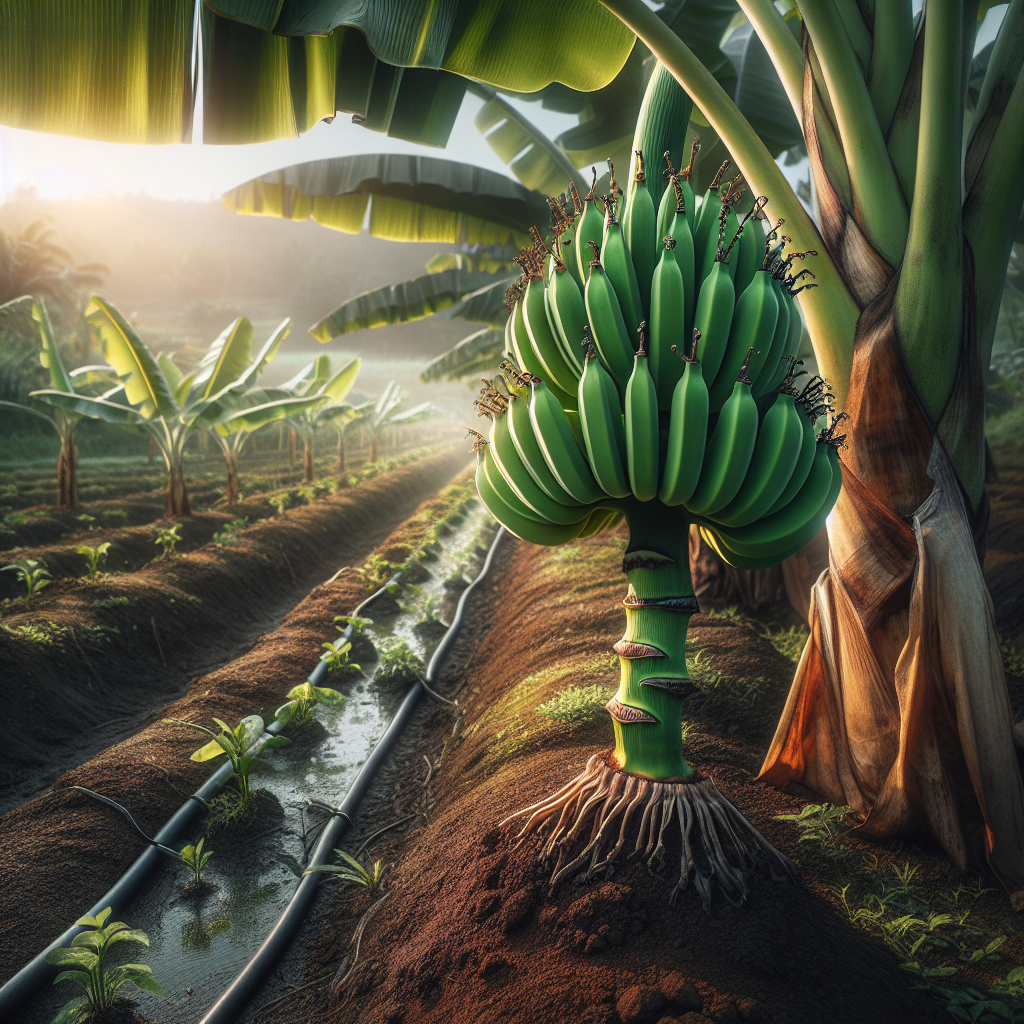
Introduction to Banana
Among the world’s most important fruit crops, banana occupies a unique place in agriculture because it is simultaneously a staple food, dessert fruit, livestock feed source, shade plant, and smallholder cash crop. The genus Musa likely originated in Southeast Asia and the western Pacific, then spread through trade, migration, and colonial plantation systems into Africa, Latin America, and nearly every humid tropical region. Today, bananas are produced in backyard gardens, mixed agroforestry systems, and highly managed export plantations.
What growers often call a “banana tree” is not a woody tree at all. It is a perennial herb with a corm underground and a fleshy above-ground pseudostem. That distinction matters in cultivation: bananas respond less like orchard trees and more like a heavy-feeding, moisture-loving giant grass. Yield, fruit quality, and disease pressure are all closely tied to how well the root zone is managed.
Commercial bananas are often seedless triploids, and many dessert cultivars are propagated vegetatively. This means vigor, sanitation, and planting material quality are critical from the very beginning. Cultivar choice also shapes management. Dessert bananas such as Cavendish types differ from cooking bananas and plantains in fruit use, canopy architecture, wind tolerance, and cropping cycle. If you want a smaller cultivar for home gardens, see Dwarf Cavendish.
From a practical perspective, successful banana production depends on five fundamentals: frost-free warmth, consistent soil moisture without waterlogging, very high potassium and nitrogen nutrition, wind protection, and proactive disease prevention. When these are right, banana can be one of the most rewarding perennial crops in the tropics and subtropics.
Botanical Profile of Banana
Bananas belong to the family Musaceae and the genus Musa. Most edible bananas are hybrids and polyploid selections derived mainly from Musa acuminata and Musa balbisiana, with genomic groupings commonly described as AA, AAA, AAB, ABB, and related combinations. These letters indicate ancestral contribution and often predict agronomic behavior. Cultivars with stronger balbisiana background are frequently more tolerant of drought and certain stresses, while acuminata-rich dessert bananas often produce sweeter fruit of thinner texture.
The plant develops from a corm, sometimes called a rhizomatous base, from which roots and suckers emerge. The root system is fibrous, with most active feeder roots concentrated in the top 30 to 60 cm of soil, though roots can extend deeper in loose, well-structured ground. Because the majority of nutrient uptake occurs in the upper root zone, mulch, moisture stability, and topsoil fertility are central to production.
The pseudostem is composed of tightly packed leaf bases rather than wood. Depending on cultivar and growing conditions, plants may reach 1.5 to over 7 meters in height. Leaves are large, elongated, and easily shredded by wind; minor leaf tearing is normal and does not always indicate poor health. However, severe shredding reduces photosynthetic area and can diminish bunch filling.
Each pseudostem is monocarpic: it flowers once, fruits once, and then dies back. The inflorescence emerges from the center as a terminal flower stalk bearing female flowers first, then neutral or sterile flowers, and finally male flowers under purple to maroon bracts. The female flowers develop into the hands and fingers of the banana bunch. In many edible cultivars, fruits form by parthenocarpy, meaning they develop without pollination and contain only vestigial seeds.
After the mother plant fruits, one or more suckers from the corm replace it. The best production systems maintain a ratoon sequence: one fruiting mother, one follower, and one young sword sucker. This generational management is a defining feature of professional banana culture and strongly affects spacing, uniformity, and annual yield.
Soil, pH, and Climate Requirements for Banana
Banana performs best in deep, fertile, well-drained soils rich in organic matter. Ideal textures are loam, sandy loam, or clay loam with good structure and no prolonged saturation. Although banana needs abundant water, it is highly vulnerable to oxygen deprivation around the roots. In compacted or poorly drained soils, roots suffocate, nutrient uptake declines, plants become stunted, and risks of corm rot and Fusarium increase sharply.
A desirable soil depth is at least 75 cm, though deeper soils support stronger anchorage and larger bunches. Hardpans, shallow bedrock, or persistent perched water tables limit root exploration and increase toppling risk. Where drainage is marginal, raised beds or mounds 30 to 60 cm high are often better than flat planting.
The preferred pH is generally 5.5 to 7.0, with optimum productivity often seen around 6.0 to 6.5. Bananas tolerate mildly acidic conditions better than strongly alkaline soils. At pH below about 5.2, calcium, magnesium, and phosphorus availability may become limiting, and aluminum toxicity can suppress roots. At pH above 7.5, micronutrients such as iron, manganese, and zinc become less available, often causing chlorosis. Soil testing before planting is highly recommended. If pH is too low, apply agricultural lime well before planting; if too high, rely on organic matter, targeted micronutrient correction, and careful fertilizer placement.
Climate is the decisive factor in banana production. The crop thrives in tropical and humid subtropical zones with average temperatures of 26 to 30°C. Growth slows significantly below 16°C, leaf emergence is reduced under 14°C, and chilling injury can occur even without frost. Actual frost can destroy leaves and severely damage the pseudostem. Heat above 38°C is also stressful, especially if paired with low humidity and hot wind, causing leaf scorch, reduced fruit fill, and sunburn.
Rainfall of 1,500 to 2,500 mm per year, well distributed, is suitable, but irrigation can substitute where rainfall is seasonal. Bananas are poor candidates for long drought cycles. Even brief moisture deficits during rapid vegetative growth or bunch filling can reduce hand number, finger length, and fruit weight. Aim to keep the active root zone consistently moist, roughly comparable to 60 to 80% of field capacity in mineral soils. In practical field terms, soil at 15 to 20 cm depth should feel cool and crumbly, not dusty and not sticky-smeared. If squeezed in the hand, it should hold shape lightly but break apart with gentle pressure.
Wind is a major yield constraint. Sustained winds shred leaves; gusts can snap pseudostems or uproot heavily fruited plants. Windbreaks, contour planting, and propping are essential in exposed sites. High humidity benefits bananas, but constant leaf wetness without airflow can intensify foliar disease. A balance between humidity and ventilation is ideal.
Step-by-Step Planting & Propagation
Most bananas are propagated vegetatively from sword suckers, peepers, corm bits, or tissue-cultured plantlets. Sword suckers are preferred over water suckers because they have narrow, upright juvenile leaves and are physiologically better connected to the corm, usually producing stronger subsequent plants. Water suckers, with broad leaves early on, tend to be weaker and less productive.
Start with disease-free planting material. This is non-negotiable. Never take suckers from mats showing wilting, corm discoloration, bunchy top symptoms, severe nematode damage, or poor vigor. If using field-dug suckers, trim roots, remove excess outer tissue, and pare the corm to expose clean, white tissue. Any reddish-brown streaking, foul odor, or internal decay suggests infection. Some growers dip pared suckers in hot water or a biological treatment to reduce nematodes and surface pathogens.
Tissue-cultured plants provide uniformity and can be cleaner than field suckers, but they require hardening off before field establishment. Young lab-derived plants should spend time in nursery conditions with filtered light, regular but not excessive moisture, and gradual exposure to sun and wind.
Prepare planting holes large enough to loosen the root zone thoroughly, commonly 45 x 45 x 45 cm to 60 x 60 x 60 cm depending on soil quality. In depleted soils, mix removed topsoil with mature compost or well-rotted manure, but avoid packing fresh manure directly against the corm. Where drainage is poor, plant on mounds instead of in depressions.
Spacing depends on cultivar height, fertility, and production system. Dwarf dessert bananas may be planted at roughly 2 x 2.5 m to 2.5 x 2.5 m. Medium to tall cultivars may need 3 x 3 m or wider. Closer spacing can increase early yield per hectare but also raises humidity, foliar disease pressure, and nutrient competition. In mixed systems, spacing may be adjusted for intercrops and access lanes.
Plant at the onset of the rainy season or when irrigation is available. Set suckers or plantlets so the corm sits firmly in contact with moist soil, with the crown just above surrounding soil level to prevent rot. Firm gently but do not compact aggressively. Water in immediately to settle air pockets.
Mulch around the plant with 8 to 15 cm of organic material such as chopped leaves, straw, composted residues, or dried grass, keeping a small gap around the pseudostem base to reduce rot. Mulch stabilizes soil temperature, suppresses weeds, and conserves moisture. For broader fertility planning and organic matter building, see soil health tips.
In the first 8 to 12 weeks, protect young plants from water stress and strong winds. Remove weeds within at least a 50 to 75 cm radius so the establishing root system is not forced to compete. If planting in cooler subtropics, warm microclimates near walls, slopes, or reflective surfaces can improve establishment.
Care & Maintenance regimes for Banana
Banana is a high-demand crop and rewards disciplined management. Irrigation should be frequent enough to prevent swings between drought and saturation. Young plants need light, regular watering until roots spread; mature plants with active bunches have the highest demand. In hot weather on light soils, irrigation may be needed 2 to 4 times weekly; on heavier soils, less often but more carefully monitored. Drip or micro-sprinkler systems are preferable because they maintain even soil moisture without prolonged flooding.
Overwatering is often misunderstood. The issue is not total water applied but lack of aeration. Signs include persistent surface wetness, sour-smelling soil, yellowing lower leaves despite adequate fertility, weak pseudostems, slow leaf emergence, and blackened or rotting roots. Underwatering, by contrast, shows as dull bluish or folded leaves, dry cracking mulch, reduced leaf size, delayed emergence of the cigar leaf, and poor fruit filling.
Nutrient demand is very high, particularly for nitrogen and potassium. Nitrogen drives canopy production and rapid leaf emergence, while potassium is essential for water regulation, disease tolerance, fruit filling, and bunch quality. Deficient potassium often causes yellowing and scorching along older leaf margins and weak bunches with poorly filled fingers. Phosphorus is needed in moderate amounts, while calcium, magnesium, sulfur, zinc, and boron are also important for healthy growth.
A common professional approach is split application of fertilizers every 4 to 8 weeks during active growth rather than large infrequent doses. Organic systems may use compost, well-rotted manure, poultry manure in moderated amounts, banana trash mulch, wood ash in limited potassium-correcting use where pH allows, and approved mineral amendments. Excessive nitrogen without enough potassium produces lush but soft growth that is more vulnerable to wind and some diseases.
Desuckering is one of the most important routine operations. Maintain only the desired succession, usually the mother plant, one follower, and one young sword sucker. Remove unwanted suckers cleanly at soil level and destroy the growing point if necessary to prevent regrowth. If mats become overcrowded, bunch size declines, airflow worsens, and disease pressure increases.
Deleafing should be conservative. Remove only dead, broken, or severely diseased leaves. Healthy leaves are the factory that fills the bunch. Excessive pruning reduces yield. After flowering, some growers remove the male bud once the last hand has set, especially where this helps reduce pest harboring, but this is cultivar- and region-dependent.
Propping and support are often essential once bunches begin to fill. Use bamboo poles, forked supports, or twine systems to prevent lodging. Bagging bunches with perforated sleeves can reduce insect scarring, improve appearance, and slightly modify the microclimate around fruit, but ventilation must remain adequate.
Weed control should prioritize mulching and shallow manual removal rather than deep cultivation, because banana roots are close to the surface. Cover crops and groundcovers may help if managed so they do not compete excessively with young plants.
Pests, Diseases & Organic Management
Banana is vulnerable to a range of serious pests and diseases, many of which are best managed through prevention, sanitation, and planting material hygiene rather than rescue treatments.
Banana weevil is among the most damaging pests. Adults lay eggs near the corm, and larvae tunnel inside, weakening the plant, reducing nutrient flow, and predisposing it to toppling. Symptoms include poor vigor, yellowing, reduced bunch size, and tunnels visible when corms are cut open. Clean planting material, removal of crop residues that harbor adults, pseudostem trapping, and the use of entomopathogenic fungi are key organic tactics.
Plant-parasitic nematodes, especially burrowing and Lesion nematodes, attack roots and corm tissue, reducing uptake and causing instability. Above-ground symptoms resemble drought and nutrient deficiency: stunting, poor response to fertilizer, and lodging even in modest wind. Organic management includes hot-water-treated or tissue-cultured planting material, heavy mulching to encourage biological activity, crop sanitation, and avoiding replanting immediately into infested banana ground without remediation.
Aphids are important not only for sap feeding but because they vector Banana bunchy top virus in regions where it occurs. Bunchy top symptoms include dark green streaking on petioles and midribs, narrow upright leaves, rosetted growth, and severe stunting. Infected plants are not curable and should be rogued out promptly. Control aphid populations, eliminate infected plants, and never propagate from suspect mats.
Sigatoka leaf spot diseases, including Yellow Sigatoka and Black Sigatoka, are major foliar threats. They begin as streaks or spots on leaves and progress to necrosis, reducing photosynthetic capacity and severely affecting bunch filling. Organic suppression relies on wide enough spacing, removal of heavily infected leaves, improved airflow, balanced nutrition, resistant cultivars where available, and careful irrigation timing to reduce prolonged leaf wetness.
Fusarium wilt, or Panama disease, is among the most feared banana diseases. It is soil-borne, persistent, and spread through infected planting material, soil movement, water, footwear, and tools. Typical signs include yellowing of older leaves, splitting of the pseudostem base, wilting despite adequate soil moisture, and internal vascular discoloration in the corm and pseudostem. There is no practical cure in the field. Prevention is essential: strict sanitation, certified clean planting material, drainage management, and avoiding movement of contaminated soil. Once confirmed, affected mats should be isolated and destroyed according to local extension guidance.
Bacterial soft rots and Corm rots occur under excessively wet, poorly aerated conditions or after injury. Good drainage, clean cutting tools, and avoiding burying fresh organic waste tightly against the stem reduce risk.
Birds, bats, squirrels, and other vertebrates may damage ripening fruit. Timely harvest and physical bunch protection are the main solutions.
The best organic banana protection strategy is integrated: start clean, feed and water evenly, maintain airflow, sanitize tools, remove infected tissues early, and keep the plantation floor managed but not bare.
Harvesting, Curing & Optimal Storage
Bananas are usually harvested mature-green rather than tree-ripe, especially for transport and market handling. The correct harvest stage depends on distance to market, cultivar, and intended use. Maturity indicators include full angular development of fingers, rounding of fruit edges, plumpness of the central fingers, and the number of days elapsed since flowering, which varies with temperature and cultivar.
For local consumption, fruit can be allowed to develop more fully on the plant. For shipping, harvest earlier but still physiologically mature. Immature bananas do not ripen properly and may remain thin, rubbery, and low in sugar.
Use a sharp, clean knife and harvest carefully to avoid latex staining and bruising. Typically one worker supports the bunch while another cuts the pseudostem partially and lowers the bunch gently. Handle bunches on padded surfaces if possible. Dehanding, washing, grading, and packing should be done in shade.
Although bananas do not undergo “curing” in the root-crop sense, they do benefit from careful postharvest conditioning. Wash off latex and field debris, allow surfaces to dry, and keep fruit cool but not chilled. The ideal storage range for mature-green bananas is generally around 13 to 14°C with high relative humidity, about 90 to 95%. Below about 12°C, chilling injury can occur, causing peel browning, smoky discoloration, poor ripening, and off-flavors.
Ripening is triggered naturally by ethylene and can be managed commercially in ripening rooms. For home-scale ripening, keep bananas at room temperature, ideally 18 to 24°C, away from direct sun. To accelerate ripening, place them in a paper bag with ethylene-producing fruit such as apples. Once ripe, refrigeration slows further softening but may darken the peel.
Cooking bananas and plantains may be harvested at different stages depending on intended culinary use. Very mature green fruit is ideal for frying and boiling; more advanced ripeness suits roasting and sweet preparations.
Companion Planting for Banana
Banana fits well into tropical polycultures and agroforestry systems when companion plants are chosen to complement its high water demand, partial shade, and heavy feeding habit. Good companions either occupy a different root zone, provide beneficial ground cover, repel pests, or generate additional yield without intense competition.
Low, non-aggressive legumes can improve soil cover and contribute nitrogen cycling, though they should not smother young plants. Sweet potato is often used as a living mulch on suitable sites, but it must be watched so it does not overrun the mat. Aromatic herbs and alliums near the perimeter may help diversify the system, while shade-tolerant crops can occupy interrows during early establishment.
Ginger is a particularly useful companion in humid tropical gardens because it enjoys rich soil, filtered light once the banana canopy develops, and similar mulching practices; see the Ginger guide for compatible cultural considerations. Taro, turmeric, and some leafy greens can also be integrated in wetter tropical homesteads if airflow is maintained.
Avoid companions that are strongly competitive, allelopathic, or prone to sharing major soil-borne disease issues in poorly drained settings. Large woody plants planted too close can rob moisture and light, while aggressive grasses may outcompete banana roots unless carefully controlled.
The best banana companion strategy is dynamic. In the first year, use low covers and short-duration intercrops while sunlight reaches the soil. As the canopy closes, transition toward shade-tolerant species and maintain an organic mulch cycle using chopped banana leaves and spent pseudostems. This mimics natural nutrient recycling and helps keep the plantation floor biologically active, cool, and moisture-retentive.