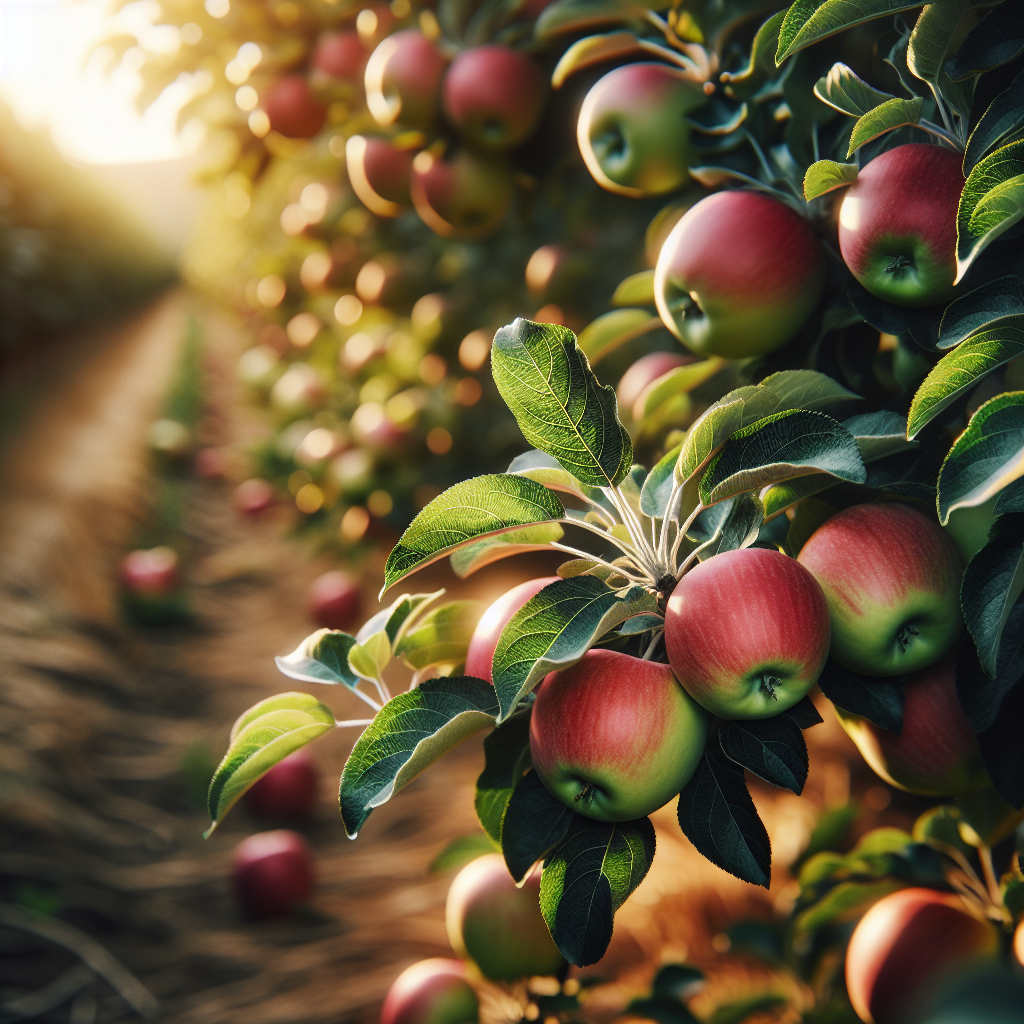
Introduction to Apple
A well-managed apple planting can remain productive for decades, but high-quality fruit does not happen by accident. Apples are a classic temperate orchard crop requiring careful attention to winter chill, spring frost risk, rootstock selection, training system, crop load balance, and pest pressure. The species has been cultivated for thousands of years, with origins tied to Central Asian wild apples, especially Malus sieversii, and has since diversified into thousands of named cultivars ranging from dessert apples to cider, baking, and processing types.
Modern apple production spans backyard gardens, high-density commercial orchards, heritage orchards, and integrated agroecological systems. Fruit quality is shaped by light exposure, calcium balance, leaf-to-fruit ratio, and timely irrigation more than many beginners realize. Whether growing a few trees or establishing a professional block, success comes from understanding that apple trees are long-term investments: a mistake in site choice, spacing, or cultivar selection can affect yield and fruit quality for 20 years or more.
Botanical Profile of Apple
Apple belongs to the family Rosaceae, which includes pear, quince, peach, plum, cherry, and many other economically important fruits. Botanically, the edible portion is a pome, formed largely from floral tissue surrounding the true ovary. The tree is typically deciduous, entering winter dormancy and breaking bud after sufficient chill accumulation and warming temperatures.
Key botanical characteristics include:
- Growth habit: small to medium-sized tree, though final size depends heavily on rootstock.
- Leaves: simple, alternate, serrated, usually oval with slight pubescence on young growth.
- Flowers: five-petaled, white to pink, borne in clusters on spurs and short shoots.
- Pollination: most cultivars are self-incompatible and require pollen from a compatible cultivar that flowers at the same time.
- Fruiting habit: many apples bear on spurs that persist for several years; pruning must preserve productive fruiting wood while renewing structure.
Rootstock profoundly influences tree size, precocity, anchorage, disease tolerance, and adaptability to soil conditions. Dwarfing rootstocks such as M.9 produce compact trees that fruit early and are ideal for high-density systems, but they usually require staking and excellent management. Semi-dwarf rootstocks like M.26 or MM.106 produce somewhat larger trees with wider spacing. Vigorous rootstocks such as MM.111 tolerate poorer soils and drought better but delay bearing and require more space.
Cultivars differ in chill requirement, bloom time, disease susceptibility, skin finish, acidity, soluble solids, texture, and storage ability. For comparison with another pome-fruit orchard crop, see Pear. Apples are generally more widely adapted than pears, but many premium cultivars are more disease-prone and require tighter management.
Soil, pH, and Climate Requirements for Apple
Apples perform best in deep, well-drained loam or sandy loam with moderate water-holding capacity and good aeration. Heavy clay can work if drainage is improved and trees are planted on berms or raised rows, but prolonged root-zone saturation is one of the fastest ways to weaken or kill young trees. Apple roots need oxygen; if water stands in the planting zone for more than 24 to 48 hours after rainfall, root stress, Phytophthora crown rot, and poor establishment become likely.
Ideal soil parameters:
- pH: 6.0 to 6.8 is optimal.
- Organic matter: 3% to 5% is excellent for moisture retention and microbial activity.
- Drainage: internal drainage should be strong enough that roots do not remain anaerobic.
- Effective rooting depth: at least 60 to 90 cm, preferably deeper.
At pH below 5.5, calcium and magnesium may become limiting and aluminum toxicity may impair root development. At pH above 7.2, iron, manganese, and zinc deficiencies become more common, especially on calcareous soils, leading to chlorosis in young foliage. Correct pH before planting whenever possible; post-plant correction is slower and less effective.
Climate matters as much as soil. Apples are fundamentally temperate trees and most cultivars need a period of winter chill, often roughly 500 to 1,200 chill hours depending on variety. Low-chill apples exist and can be grown in mild-winter regions, but standard high-quality cultivars often perform poorly where winters are too warm. Insufficient chill leads to delayed and uneven bud break, weak flowering, poor fruit set, and irregular leafing.
Temperature guidelines:
- Dormancy: cold winter conditions are beneficial, though extreme midwinter lows can damage sensitive cultivars or trunks.
- Bloom: flowers are highly vulnerable to frost; temperatures below about -2.2°C can injure open blossoms.
- Fruit development: warm days and cool nights often improve color development and flavor.
- Summer heat: sustained temperatures above 35°C can cause sunburn, poor color, reduced fruit size, and heat stress.
Rainfall of 750 to 1,200 mm annually can support orchards, but distribution is critical. Dry summers with irrigation are often better for disease control than humid summers with frequent rain. Excessive humidity and leaf wetness dramatically increase scab, mildew, and rot pressure. Air drainage is also essential: avoid frost pockets where cold air settles in spring.
Wind exposure deserves special attention. Strong winds reduce pollinator activity during bloom, scar fruit, and can uproot dwarf trees on weak rootstocks. Windbreaks help, but they should not block all air movement or create disease-prone stagnant humidity.
For broader orchard soil-building principles, see soil health strategies.
Step-by-Step Planting & Propagation
Most apples are propagated by grafting named cultivars onto specific rootstocks. Seed propagation is unsuitable for true-to-type production because apple seedlings are genetically variable and may produce inferior fruit after a long juvenile period. For reliable results, plant grafted nursery trees from reputable sources.
Step 1: Choose suitable cultivars and rootstocks. Select cultivars adapted to your chill zone, disease pressure, market purpose, and harvest window. Confirm cross-pollination compatibility and overlapping bloom periods. Also choose rootstock based on soil type, irrigation reliability, desired tree size, and support system.
Step 2: Prepare the site 6 to 12 months ahead. Test soil for pH, phosphorus, potassium, calcium, magnesium, and organic matter. Correct pH with lime or sulfur before planting. Rip compacted layers if present. Remove perennial weeds thoroughly because young apple trees compete poorly with grass and aggressive weeds during establishment.
Step 3: Plan spacing according to system. Typical spacing ranges widely:
- Dwarf high-density: 0.9 to 1.5 m between trees, 3 to 4 m between rows.
- Semi-dwarf: 3 to 4.5 m between trees, 4.5 to 6 m between rows.
- Standard trees: 6 to 9 m between trees and rows.
High-density systems produce earlier and often more marketable fruit per hectare, but they demand trellising, fertigation precision, and advanced pruning discipline.
Step 4: Plant during dormancy. Bare-root trees are usually planted in late winter to early spring while fully dormant, once soil is workable and before bud break. Container trees can be planted over a wider window, though cool-season planting is still best in temperate climates.
Step 5: Dig the hole correctly. Make the hole wide enough to spread roots naturally, but do not dig excessively deep. The graft union should remain 5 to 10 cm above the final soil line, especially on dwarfing rootstocks. If planted too deeply, the scion can root above the graft, negating dwarfing effects and causing excessive vigor.
Step 6: Backfill with native soil. Avoid heavily amending only the planting hole with compost or rich media, which can create a bathtub effect or discourage roots from moving into surrounding soil. Water thoroughly after planting to settle soil and eliminate air pockets.
Step 7: Head and train the young tree. Feathered nursery trees may be trained immediately into central leader, tall spindle, or open-center systems depending on orchard design. In many modern orchards, central leader or tall spindle systems are preferred for light interception and early production.
Step 8: Install support and protection. Dwarf apples usually need permanent stakes or trellis. Use tree guards where rodents, rabbits, or sunscald are concerns. Deer fencing is often essential.
Propagation details for advanced growers:
- Bench grafting is commonly done in late winter using whip-and-tongue grafts.
- Bud grafting or chip budding is often done in summer.
- Scion wood should be disease-free and collected during dormancy.
- Rootstocks must be matched for vigor and site tolerance.
Care & Maintenance regimes for Apple
Apples require disciplined annual management. Neglect rarely kills a mature tree quickly, but it greatly reduces fruit size, flavor, color, and storage quality.
Water management is one of the most critical factors. Young trees need consistently moist, not saturated, soil during the first two to three years. A practical target is to keep the main root zone moderately moist to roughly field capacity in the upper 20 to 40 cm of soil. In loam soils, this often means deep irrigation when the top 5 to 8 cm begins to dry, rather than light daily watering. During establishment, many sites need 15 to 25 liters per tree once or twice weekly depending on temperature, soil texture, and rainfall. Sandy soils may require smaller, more frequent irrigations; clay soils require less frequent but carefully monitored watering.
Signs of underwatering:
- wilting or cupping leaves during hot afternoons that persist into evening
- poor shoot extension
- small fruit and excessive fruit drop
- premature leaf yellowing in severe cases
Signs of overwatering:
- persistently wet soil with sour smell
- weak, pale foliage
- poor root anchorage
- dark, decaying feeder roots
- increased susceptibility to crown and root rots
During fruit sizing, moisture stress reduces cell expansion and final fruit size. However, constant oversupply late in the season can also dilute flavor and worsen disorders in some systems. Regulated irrigation must be cultivar- and climate-specific; in most home and small-farm settings, even moisture is best.
Mulching improves establishment and suppresses weeds. Apply 5 to 10 cm of wood chips or coarse organic mulch around the tree, but keep mulch 10 to 15 cm away from the trunk to prevent collar rot and rodent habitat. A vegetation-free strip beneath trees is especially important in the first years.
Nutrition should be based on soil and leaf analysis, not guesswork. Young trees need enough nitrogen for canopy development, but excess nitrogen delays fruiting, promotes fire blight susceptibility, and produces overly vigorous, shaded growth. Mature bearing trees generally benefit from moderate nitrogen timed before or around early growth flush, while phosphorus and potassium should be adjusted according to test results. Calcium is especially important for fruit firmness and storage quality; low-calcium fruit is more prone to bitter pit, cork spot, and storage breakdown.
Pruning has several goals:
- establish structure
- maintain light penetration
- renew fruiting wood
- balance vegetative growth and cropping
- remove dead, diseased, and crossing branches
Winter pruning stimulates vigor and shapes framework. Summer pruning can improve light and reduce excessive shoot growth, but overdoing it weakens trees. Fruit quality depends on light: apples in shaded interior canopy are smaller, greener, less sweet, and more disease-prone. Aim for a canopy where dappled light reaches much of the tree interior.
Thinning is non-negotiable for quality apples. Trees often set far more fruit than they can size properly. Hand-thin or chemically thin so that fruits are spaced roughly 15 to 20 cm apart on branches, usually leaving one fruit per cluster. Proper thinning improves fruit size, color, return bloom, and reduces limb breakage. It also helps prevent biennial bearing, where a heavy crop one year suppresses flowering the next.
Pollination planning is equally important. Most apples need another compatible cultivar within pollinator flight range, usually no more than 15 to 30 m away for consistent set in small orchards. Honeybees, mason bees, and wild pollinators are all valuable. Avoid insecticide sprays during bloom.
Pests, Diseases & Organic Management
Apple is vulnerable to a broad suite of pests and diseases, and effective management depends on prevention, sanitation, resistant cultivars, and precise timing.
Common diseases include apple scab, powdery mildew, fire blight, cedar-apple rust, sooty blotch, flyspeck, bitter rot, black rot, and Phytophthora crown/root rot. Among these, apple scab is often the defining disease in humid climates. It causes olive-brown lesions on leaves and fruit, leading to cracking, defoliation, and unmarketable harvests. The fungus overwinters on fallen leaves, so autumn sanitation and urea-assisted leaf decomposition can reduce inoculum.
powdery mildew thrives in moderate humidity without free water and appears as white fungal growth on shoots and leaves. fire blight, caused by Erwinia amylovora, is one of the most serious bacterial diseases, especially on susceptible cultivars and vigorous young growth. Infected shoots often look scorched and may bend into a shepherd’s crook.
Organic and low-input management strategies:
- choose resistant or tolerant cultivars whenever possible
- prune for airflow and rapid drying of leaves and fruit
- remove mummified fruit and diseased wood
- sanitize fallen leaves in scab-prone orchards
- avoid excess nitrogen that promotes lush, blight-susceptible growth
- use copper, lime sulfur, sulfur, kaolin clay, biologicals, or approved organic fungicides/insecticides as part of a preventive program where permitted locally
- sterilize pruning tools when cutting fire blight strikes
For fire blight, prune 20 to 30 cm below visibly infected tissue during dry weather, disinfecting tools between cuts. Do not prune during wet conditions when bacteria spread easily. Rootstock choice matters because some are more vulnerable to blight or collar disorders.
Major insect pests include codling moth, apple maggot, plum curculio, aphids, leafrollers, spider mites, scale insects, and borers. codling moth larvae tunnel into fruit, causing classic wormy apples. apple maggot creates internal brown trails. aphids distort leaves and can reduce tree vigor, while mites stipple foliage and weaken photosynthesis in hot, dry conditions.
Integrated organic management relies on:
- pheromone traps for monitoring codling moth
- bagging individual fruit in small plantings
- sticky traps for apple maggot where appropriate
- dormant oil for scale and overwintering eggs
- horticultural oils and insecticidal soaps for aphids and mites
- beneficial insect conservation through flowering understory and reduced broad-spectrum spraying
- timely collection of dropped fruit to break pest life cycles
Rodents can girdle trunks in winter under mulch or snow cover. Use guards and keep vegetation low around trunks. Deer browse can destroy young orchards unless exclusion fencing is installed.
Harvesting, Curing & Optimal Storage
Harvest timing strongly affects flavor, texture, storage life, and disease incidence. Apples do not all ripen at once, and maturity should be judged by a combination of background color change, seed color, ease of separation from the spur, taste, starch conversion, and days from bloom typical for the cultivar.
A mature apple usually lifts and twists off with moderate ease; if it resists strongly, it may be immature. However, relying only on drop or color can be misleading, especially with red cultivars that color before internal maturity. Commercial growers often use starch-iodine tests, firmness readings, and soluble solids measurements to identify the optimal harvest window.
Harvest carefully:
- pick during cool, dry conditions if possible
- avoid pulling spur wood off branches
- never stack fruit roughly in deep containers
- separate bruised, insect-damaged, cracked, or diseased fruit immediately
Unlike onions or garlic, apples are not cured in the same sense, but they do benefit from prompt cooling after harvest. Remove field heat quickly. Ideal storage temperature for most dessert apples is close to 0 to 2°C with 90% to 95% relative humidity. Low humidity causes shriveling; higher temperatures accelerate softening, loss of acidity, greasiness, and decay.
Storage potential varies greatly by cultivar. Early-season apples may last only one to three weeks, while late-season storage cultivars can last several months under refrigeration. Controlled-atmosphere storage further extends life by lowering oxygen and adjusting carbon dioxide, but this is usually beyond home scale.
Common storage disorders include:
- bitter pit: sunken dark spots linked to calcium imbalance
- superficial scald: skin browning during prolonged storage in susceptible cultivars
- internal browning: often associated with poor storage conditions or overmaturity
- blue mold and gray mold: postharvest fungal rots entering through wounds
Store only clean, sound fruit. Even one decaying apple can spread rot rapidly in a bin or cooler. Wrap premium fruit individually or store in shallow ventilated trays for best quality retention.
Companion Planting for Apple
Companion planting around apple trees should support pollination, beneficial insects, soil cover, and orchard floor balance without creating excessive competition. The best companions are usually low-growing, non-aggressive species with shallow or manageable root systems.
Useful companions include flowering insectary plants such as yarrow, alyssum, dill, fennel grown carefully at row edges, chives, and clovers. Chives and alliums may help confuse some pests while also attracting pollinators when flowering. White clover can serve as a living groundcover in some orchard systems, fixing nitrogen and supporting beneficial insects, though it must be managed so it does not compete excessively with young trees or attract vole habitat near trunks. For useful allium crop principles, see Garlic.
Good companion functions:
- attract pollinators during and around bloom periods
- support predatory wasps, hoverflies, lacewings, and beetles
- reduce erosion and improve soil aggregation
- suppress some weeds when used as managed groundcovers
Avoid planting highly competitive grasses right up to the trunk, especially during establishment. Also avoid dense, rank vegetation that holds moisture and reduces air flow in humid climates, as this can worsen disease pressure and provide rodent shelter.
A practical orchard-floor strategy is to maintain a mulch or weed-free strip 0.6 to 1.2 m wide beneath the tree row, with companion flowers and managed cover crops in the alleyways. This approach reduces competition where roots are establishing while still delivering biodiversity benefits.
Herbs like thyme, oregano, and low mints can work in drier climates if kept from overtaking the tree basin. Comfrey is sometimes planted nearby for biomass and nutrient cycling, but it should be placed where its vigorous growth will not interfere with trunk access or harbor pests. In commercial systems, the best “companion planting” is often a deliberately designed understory that balances pollinator support, equipment access, moisture control, and rodent suppression.
In the end, excellent apple production is a matter of balance: enough vigor but not too much, enough crop but not overcropping, enough water but no root-zone saturation, and enough biodiversity to support resilience without sacrificing sanitation. Growers who master those balances consistently produce cleaner trees, more regular annual yields, and apples with superior texture, flavor, and storage life.