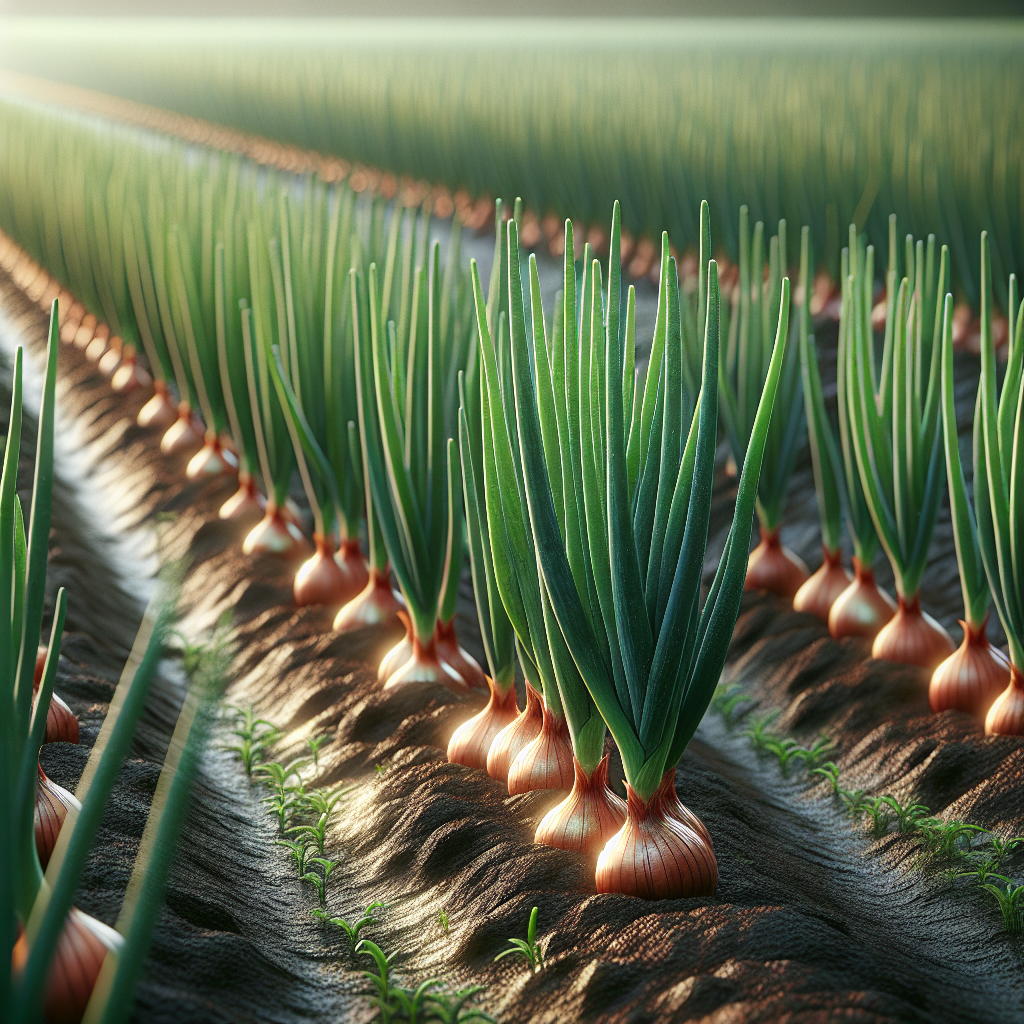
Introduction to Onion
Among the oldest cultivated vegetables, onion has been grown for thousands of years across Asia, the Middle East, Europe, and later the Americas. It is prized not only for pungency, sweetness, and storage potential, but also for its adaptability to small gardens, market farms, and large commercial systems. The crop is economically important because it stores well, ships well when properly cured, and serves as a base ingredient in countless cuisines.
For growers, the central lesson is that onion performance is determined less by luck than by precision. Bulb size and quality are heavily influenced by day length, temperature, root-zone aeration, nutrient balance, weed control, and planting material. Unlike sprawling crops that can recover from a rough start, onions have narrow upright leaves and shallow root systems, so early setbacks often permanently reduce final bulb size. A weak seedling rarely turns into a premium bulb.
Onions are commonly grouped into short-day, intermediate-day, and long-day types. This is not a minor catalog detail; it is the foundation of bulb formation. When the plant experiences the correct number of daylight hours for its type, it shifts from leaf production into bulbing. If the day-length class does not match the region, plants may bulb too early and stay small, or fail to bulb properly at all. Flavor also varies by cultivar, with some bred for fresh sweet use and others for stronger flavor and long storage.
Growers usually produce onions in three ways: from seed, from transplants, or from sets. Seed-grown onions often have the best storage life and widest cultivar selection. Transplants give a head start and more uniform maturity. Sets are convenient but can bolt more readily if exposed to chilling followed by warm growth conditions. For related allium production systems, see our Garlic guide.
Botanical Profile of Onion
Onion belongs to the Amaryllidaceae family, subfamily Allioideae. The species Allium cepa is a biennial by life cycle but typically grown as an annual for bulb harvest. In its first year, the plant produces leaves and stores carbohydrates in a swollen bulb composed of modified leaf bases. If exposed to vernalizing cold and then returned to favorable conditions, it can enter reproductive growth in the second season, sending up a hollow flowering scape topped by a spherical umbel.
The root system is fibrous, sparse, and shallow, with the majority of roots often concentrated in the upper 15 to 30 cm of soil. This limited rooting depth is a major reason onions are sensitive to both drought and waterlogging. The foliage is cylindrical to slightly flattened, glaucous green, and covered with a waxy cuticle that helps reduce water loss. Each new leaf contributes directly to bulb size; as a rule of thumb, more healthy leaves before bulbing generally mean a larger mature bulb, because each leaf corresponds to a ring within the bulb.
Bulb color may be yellow, white, or red/purple, depending on cultivar and pigmentation. Skin thickness, pungency, soluble solids, and storage life differ widely. Sweet onions typically have higher water content, lower pungency, and shorter shelf life, while strong storage onions tend to have firmer bulbs and tighter neck closure.
Botanically, what consumers call the onion “bulb” is not a true root structure but a compressed stem plate bearing fleshy leaf bases. The dry outer wrapper layers protect the inner scales and are critical for storage. A thick neck at harvest often signals incomplete maturity or excess late nitrogen, both of which reduce storability.
Onion flowering is insect-pollinated, especially by bees and flies. Seed production requires isolation from other flowering onion types to preserve varietal purity. Because the crop is photoperiod-sensitive, plant breeders classify cultivars carefully by latitude adaptation. Long-day onions generally suit higher latitudes, intermediate-day types fit middle zones, and short-day onions perform best in lower latitudes and mild winter regions.
Soil, pH, and Climate Requirements for Onion
Onions perform best in deep, friable, well-drained soils with high fertility and excellent tilth. Sandy loams and silt loams are often ideal because they allow good root penetration, uniform bulb expansion, and easier harvesting. Heavy clay soils can grow onions, but they increase the risk of crusting, compaction, misshapen bulbs, and basal rot if drainage is poor. In dense soils, even short periods of saturation can deprive shallow roots of oxygen and set the crop back.
The ideal soil pH is generally 6.0 to 6.8, with 6.2 to 6.5 being especially favorable for nutrient availability and root health. Onions can tolerate slightly more alkaline soils, but micronutrient availability may decline above pH 7.2, especially zinc, manganese, and iron. In acidic soils below pH 5.8, root growth weakens, nutrient uptake becomes less efficient, and disease pressure may rise. Liming should be done well ahead of planting so pH stabilizes before crop establishment.
Because onions have modest root systems, they respond strongly to soil organic matter that improves moisture retention without causing waterlogging. Well-decomposed compost incorporated before planting can improve structure, but fresh manure should be avoided or applied only to a previous crop. Fresh, nitrogen-rich organic matter can encourage excessive vegetative growth, thick necks, and increased disease risk.
Temperature requirements shift by growth stage. Seed germination is possible from roughly 10 to 35°C, but most uniform emergence occurs around 18 to 24°C. Vegetative growth is strongest under cool to mild conditions, generally 13 to 24°C. Bulb enlargement proceeds best with warm days and increasing day length appropriate to the cultivar. Extreme heat can cause stress, leaf tip burn, and reduced bulb sizing, especially if paired with irregular irrigation.
Climate adaptation depends heavily on day length. Short-day onions typically begin bulbing when days reach about 10 to 12 hours, intermediate-day types at about 12 to 14 hours, and long-day onions at roughly 14 to 16 hours. Planting the wrong class is one of the most common reasons growers harvest golf-ball-sized onions despite otherwise good management.
Wind exposure matters more than many growers realize. Strong desiccating winds increase transpiration and can twist or abrade young foliage, reducing early vigor. Sites with full sun are essential; onions require high light intensity for strong leaf growth and dry-down at maturity. Shade reduces photosynthesis and bulb size.
For growers building resilient fertility programs, broader field preparation principles in this soil health article are especially relevant to onions because of their sensitivity to compaction and uneven moisture.
Step-by-Step Planting & Propagation
Start by selecting the correct day-length type for your latitude and season. This decision should come before choosing bulb color or flavor profile. In cool temperate areas with long summer days, long-day cultivars are usually required. In subtropical and mild winter areas, short-day types are generally the standard. Intermediate-day onions are useful in transitional regions.
If sowing from seed, begin indoors or in a protected nursery 8 to 12 weeks before field transplanting, depending on climate. Use a fine, sterile, free-draining seed-starting mix and sow shallowly, about 0.5 to 1 cm deep. Keep the medium consistently moist but never saturated. A properly moist tray feels evenly damp and cool to the touch; water should not pool at the bottom or create algae on the surface. Germination usually occurs within 7 to 14 days.
Seedlings are ready for transplanting when they are pencil-thin or slightly less, usually 15 to 20 cm tall. Before transplanting, harden them off for 5 to 7 days by gradually exposing them to outdoor conditions while slightly reducing water, without allowing wilting. Some growers trim seedling tops to about 10 to 12 cm to reduce transplant shock and ease handling.
Direct seeding is common in mechanized systems and can produce excellent storage onions, but it demands precise weed control. Prepare a smooth, firm seedbed. Sow in rows 25 to 45 cm apart, placing seed 1 to 2 cm deep depending on soil texture. In lighter soils, slightly deeper placement is acceptable; in heavy soils, shallower sowing improves emergence. Thin seedlings to final spacing once established.
For large bulb production, final in-row spacing of 7.5 to 10 cm is common. Closer spacing, around 5 to 7 cm, yields more medium-sized bulbs. Wider spacing can produce very large onions but may reduce total marketable number. Transplants should be set shallowly so the basal plate is just in the soil and the neck remains above excessive burial. Planting too deeply can distort bulb formation and delay maturity.
Onion sets are planted with the pointed end up, just barely covered with soil. Sets are useful for quick establishment, especially in home gardens, but they should be selected small and firm. Large sets are more likely to bolt because they are physiologically older.
In mild climates, onions may be fall-planted to overwinter and bulb in spring. In cold climates, spring planting is typical as soon as the soil can be worked. The goal is to maximize early leaf growth before the day-length trigger initiates bulbing. If planting is too late, the crop forms bulbs before sufficient leaf area develops, resulting in undersized onions.
Mulch can be used after establishment to suppress weeds and moderate soil moisture, but it should not smother young seedlings or trap excessive humidity around the necks. Organic mulches are most useful in warm or dry regions; in cool wet climates, they can sometimes prolong leaf wetness and increase disease pressure.
Care & Maintenance regimes for Onion
Moisture management is critical from emergence through bulb enlargement. Onions need steady, moderate soil moisture because their shallow roots cannot mine deeper reserves efficiently. Aim to keep the top 15 to 20 cm of soil uniformly moist, not fluctuating between dust-dry and saturated. As a practical benchmark, many field-grown onions perform best with about 25 to 40 mm of water per week from rain or irrigation, adjusted for temperature, soil type, and growth stage.
In sandy soils, smaller and more frequent irrigations are often necessary because water drains quickly beyond the root zone. In loams, fewer but deeper irrigations may suffice. A simple field test is to squeeze soil from 10 cm depth: it should hold together lightly without dripping. If it crumbles instantly, the crop is getting too dry; if it forms a slick, shiny mass or smells sour, it is too wet. Overwatering signs include yellowing lower leaves unrelated to maturity, stunted growth, soft bulbs, algae or moss on soil, and increased disease outbreaks. Underwatering shows up as bluish foliage, leaf tip dieback, slowed leaf emergence, and premature bulbing.
Nitrogen is essential early, when the crop is building leaf area. However, timing matters. Moderate nitrogen during establishment and vegetative growth supports larger bulbs because every healthy leaf contributes to bulb scale development. Too much nitrogen late in the season produces lush tops, delayed maturity, thick necks, and poor storage life. A common professional approach is to apply part of the nitrogen pre-plant and the remainder in one or two side-dressings before bulbing begins. Once bulbs are sizing well, reduce or stop nitrogen applications.
Phosphorus supports early rooting, particularly in cool soils where availability is limited. Potassium improves stress tolerance, bulb firmness, and storage quality. Sulfur plays an important role in flavor compounds and pungency, though excessive sulfur can intensify sharpness beyond market preference in sweet types.
Weed control is one of the most important maintenance tasks because onions are poor competitors. Their narrow leaves cast little shade, and weeds quickly steal moisture, nutrients, and light. The first 6 to 8 weeks after emergence are especially critical. Use shallow cultivation only, as deep hoeing can damage roots and reduce yield. Flame weeding before crop emergence is used in some systems, but post-emergence care must be precise.
Leaf health should be preserved as long as possible before natural maturity. Avoid unnecessary handling when foliage is wet. If irrigation is overhead, water early enough that leaves dry quickly. Drip irrigation reduces leaf wetness, conserves water, and helps limit foliar diseases.
Bolting prevention depends on cultivar choice, planting timing, and planting material. Exposure of juvenile plants or oversized sets to prolonged chilling can trigger flowering. Once an onion bolts, bulb quality declines and storage potential drops sharply. Remove bolting plants promptly if producing for bulb storage.
Pests, Diseases & Organic Management
Thrips are among the most serious onion pests worldwide. They rasp leaf tissue and suck plant fluids, causing silvery streaking, reduced photosynthesis, curling, and lower bulb yield. Heavy infestations are favored by hot, dry weather. Organic management includes conserving beneficial insects, using reflective mulches where practical, maintaining good field hygiene, and applying approved products such as insecticidal soaps or spinosad in rotation when thresholds are exceeded. Coverage inside the leaf axils is essential because Thrips hide deep in the foliage.
Onion maggot can devastate young stands. The larvae feed on roots and basal tissues, causing wilting, yellowing, and plant collapse. Crop rotation is important, especially avoiding repeated allium plantings in the same area. Fine mesh row covers can protect newly planted beds if installed before egg-laying begins, though they must be used only where the pest has not overwintered in the soil beneath.
Cutworms may clip seedlings at the soil surface. Good weed management before planting and collars or barriers in small-scale production can reduce losses.
Common diseases include Downy mildew, Purple blotch, Botrytis leaf blight, Neck rot, Fusarium basal rot, White rot, and Bacterial bulb rots. Downy mildew often appears in cool, humid conditions as pale lesions and fuzzy grayish growth, leading to leaf collapse. Purple blotch creates sunken purplish lesions, especially after leaf injury or prolonged wetness. Botrytis blight causes tip dieback and white speckling that can coalesce under humid conditions.
White rot is one of the most destructive soilborne allium diseases. It causes yellowing, wilting, root destruction, and white fluffy fungal growth with black sclerotia near the bulb base. Once established, it can persist in soil for many years, making prevention far better than attempted cure. Never move contaminated soil or infected bulbs between fields.
Organic disease management relies on integration rather than a single input. Use long rotations, ideally 3 to 5 years away from onions and related alliums in fields with disease history. Plant only clean seed, transplants, or sets. Maintain wide enough spacing and airflow for faster drying. Avoid excessive nitrogen, which promotes lush susceptible tissue. Irrigate early in the day and prioritize drip systems where feasible. Remove cull piles from production areas because they harbor pathogens and insect pests.
Biofungicides based on Bacillus or Trichoderma species may help as preventive tools, especially in nursery production and low-pressure systems, but they work best when combined with sanitation and climate management. Copper-based products may suppress some bacterial and fungal problems, though repeated use should be judicious to avoid soil accumulation.
Harvesting, Curing & Optimal Storage
Bulb maturity is signaled when tops soften and begin to fall naturally, usually after the plant has completed bulb filling. Most growers harvest when 50 to 80 percent of tops have fallen, depending on weather risk and market destination. Waiting for complete collapse in wet conditions can increase disease and skin damage, while harvesting too early leads to poor curing and shorter storage.
Stop irrigation roughly 1 to 2 weeks before harvest, depending on soil and climate, to encourage skin development and reduce disease pressure. In very light soils or extreme heat, do not allow bulbs to sun-scald or dehydrate excessively before lifting.
Lift bulbs carefully to avoid bruising or cutting the basal plate. Bruised onions are far more likely to decay in storage. After lifting, cure them in a warm, dry, shaded, well-ventilated place. Ideal curing conditions are often around 24 to 32°C with strong airflow for 10 to 14 days, though the exact duration depends on neck thickness and humidity. Properly cured onions develop dry outer skins and tight necks that do not feel fleshy when squeezed.
If curing outdoors, avoid direct intense sun for prolonged periods, especially in very hot climates, because bulbs may scald. Windrows can work in dry conditions, but rain or heavy dew during curing can compromise quality.
After curing, trim tops to about 2.5 to 4 cm above the bulb unless storing braided onions, and trim roots closely without damaging the basal plate. Grade out any thick-necked, split, bruised, insect-damaged, or diseased bulbs; these should be used first and never mixed with long-term storage lots.
Storage temperature depends on intended use. For long storage, cured onions keep best near 0 to 2°C with low relative humidity around 60 to 70 percent and good air circulation. In home or farm-scale ambient storage, aim for cool, dry, dark, and airy conditions. The worst environment is warm and humid, which stimulates sprouting and rot. Sweet onions, because of higher water content and thinner skins, generally store for a much shorter period than pungent storage cultivars.
Do not store onions in sealed plastic bags or in the same enclosed space as potatoes without excellent ventilation, as moisture and gases can shorten shelf life for both crops.
Companion Planting for Onion
Onions fit well into diversified plantings because their upright habit occupies little lateral space and their aroma may help confuse certain pests, though companion planting should be viewed as a supportive tactic rather than a substitute for crop rotation and scouting.
Good companions include carrots, beets, lettuce, spinach, strawberries, and many brassicas. Carrot and onion pairings are especially popular because the scent of each crop can help mask the other from specialist pests. Onions can also edge beds effectively without heavily shading neighboring vegetables.
They are often grown near tomatoes and peppers in kitchen gardens, though spacing should still preserve airflow and access for harvest. Avoid crowding onions beneath dense canopies, as reduced light and extended leaf wetness can shrink bulb size and raise disease pressure.
Legumes are sometimes listed as poor companions in traditional gardening lore, but the practical concern is usually competition and differing fertility or irrigation preferences rather than direct incompatibility. More important is avoiding repeated allium planting in the same soil, which compounds disease and pest carryover.
When designing a mixed bed, prioritize companions that leave onions with full sun, low root disturbance, and manageable weed pressure. Shallow-rooted, fast crops like lettuce can be harvested before onions fully size, allowing efficient space use. Keep taller species on the north side in the Northern Hemisphere so the onion canopy remains fully exposed.
For professional growers, the best “companion” strategy is often ecological: intersperse with crops that break pest cycles, maintain pollinator habitat nearby for seed production fields, and build rotations that keep alliums out of the same ground for several years. In other words, onion success comes less from magical plant pairings and more from thoughtful system design.