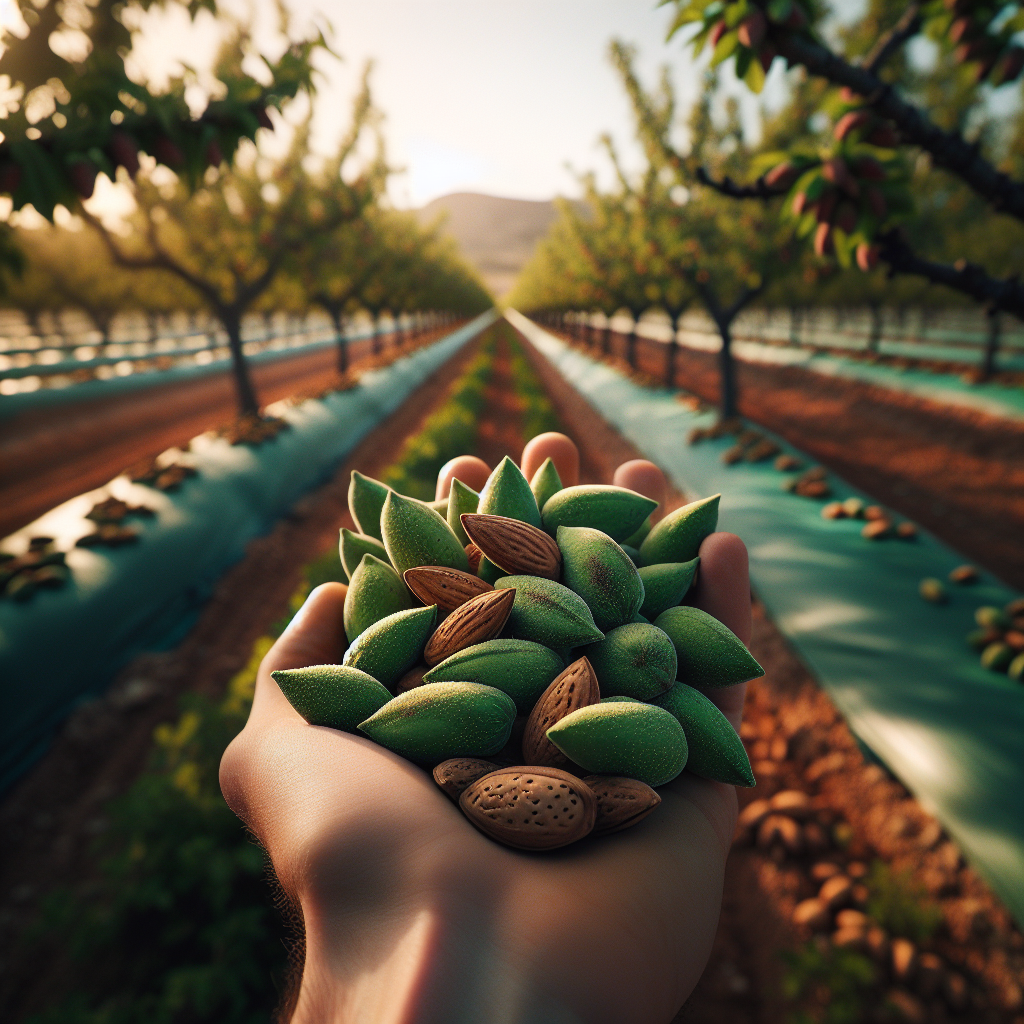
Introduction to Almond
A classic orchard crop of West and Central Asian origin, almond has been cultivated for thousands of years and spread through the Mediterranean basin before becoming one of the world’s most commercially important tree nuts. Although commonly called a nut, the edible portion is the seed inside a leathery hull and hard shell, making almond botanically a drupe rather than a true nut.
Commercial production is concentrated in regions with cool winters, dry springs, hot summers, and low harvest-time rainfall. This climate pattern allows reliable winter dormancy, strong bloom, low disease pressure during nut maturation, and clean drying after harvest. Almond trees are rewarding but unforgiving: they bloom very early, making them vulnerable to frost, and they perform poorly where soils are heavy, shallow, saline, or chronically wet.
For growers, almond is best understood as a precision orchard crop rather than a casual fruit tree. Proper site selection, cultivar pairing, rootstock choice, irrigation scheduling, canopy management, and harvest timing make the difference between a light, disease-prone planting and a long-lived, profitable orchard. In mixed orchards, growers often compare water and pruning strategies with closely related stone fruits such as Peach, because many physiological principles overlap.
Botanical Profile of Almond
Belonging to the family Rosaceae and genus Prunus, almond is classified as Prunus dulcis. It is closely related to peach, apricot, plum, and cherry. In fact, almond and peach are so closely allied that some rootstocks and many pest-management strategies are shared across the two groups.
The tree is deciduous, typically reaching 4 to 10 meters in height depending on cultivar, rootstock, pruning system, and soil vigor. Young trees have smooth bark that becomes more fissured with age. Leaves are narrow, lanceolate, finely serrated, and medium green. Flower buds are borne mostly on short spurs and on one-year-old wood, while vegetative growth extends from terminal and lateral buds.
Bloom occurs very early, often before leaf-out. Flowers are white to pale pink, with five petals and numerous stamens, and they are highly attractive to pollinators, especially honeybees. Most traditional almond cultivars are self-incompatible, meaning they need compatible pollen from another cultivar flowering at the same time. As a result, orchard design must include pollinizer rows or interplanted pollinizer trees plus managed bee colonies during bloom. Some modern cultivars are self-fertile, but even these often benefit from insect movement and cross-pollination under commercial conditions.
The fruit develops as a drupe with three main parts: an outer green hull, a woody shell, and the edible kernel. Hulls split as nuts mature. Shell hardness varies by cultivar, ranging from paper-shell types that crack easily to hard-shell types with greater pest resistance but more difficult processing. Kernel traits also differ: shape, skin color, oil content, blanching quality, flavor, and susceptibility to doubles all matter in variety selection.
Almond trees typically begin bearing modestly in year 3 or 4 after planting, enter commercial production around years 5 to 7, and can remain productive for 20 to 30 years or more when well managed. Alternate bearing is less severe than in some tree crops, but heavy crop years can still reduce return bloom if nutrition, water, and pruning are mismanaged.
Soil, pH, and Climate Requirements for Almond
Deep, well-drained soil is the single most important edaphic requirement. Almond roots need oxygen as much as moisture. The ideal profile is at least 1.5 to 2 meters deep, friable, and free of restrictive hardpan, dense clay lenses, or prolonged seasonal waterlogging. Sandy loams, loams, and gravelly loams with excellent drainage are preferred. Clay soils can support almond only if they are deep, structured, and never saturated for extended periods.
The target soil pH is generally 6.0 to 7.5, though almond can tolerate mildly alkaline conditions up to around 8.0 if micronutrient nutrition is carefully managed. Once pH rises much above this, iron, zinc, and manganese deficiencies become more common, especially in calcareous soils. Chlorosis in alkaline conditions often appears as yellowing between veins on young leaves while veins remain greener.
Salinity tolerance is moderate at best. Almond is more sensitive than some drought-adapted tree crops suggest. High electrical conductivity in the root zone reduces growth, leaf function, and kernel fill. Sodium hazards also degrade soil structure and infiltration, compounding stress. If irrigation water is marginal, frequent monitoring of soil EC, sodium adsorption ratio, and leaching fraction is essential.
Climatically, almond thrives in Mediterranean and warm temperate regions with:
- 200 to 500 chilling hours, depending on cultivar
- mild to cool winters sufficient for dormancy release
- low frost risk during bloom
- warm, dry summers for kernel development
- minimal rainfall near hull split and harvest
The greatest climatic danger is spring frost. Almond flowers and young fruitlets are among the earliest in commercial orchards, so even short exposures to damaging temperatures during bloom can wipe out a crop. Open blossoms may be damaged around -2 to -3 degrees C, and younger flower stages tolerate only slightly more cold. Low-lying frost pockets should be avoided completely.
Heat is also important. Nut fill and carbohydrate accumulation are best under warm summer conditions with full sun. Trees need at least 6 to 8 hours of direct sunlight daily, though full commercial performance comes with all-day exposure. Shading reduces flower bud formation, weakens spur productivity, and increases disease humidity within the canopy.
Wind can cause problems at bloom, during shoot growth, and near harvest. Strong, desiccating winds reduce bee activity, interfere with pollination, cause twig breakage, and increase water demand. However, stagnant humid sites are also unsuitable because they favor foliar and blossom diseases.
Before planting, carry out a full soil analysis including texture, pH, organic matter, EC, sodium, calcium, magnesium, boron, and chloride, plus a physical assessment of infiltration and drainage. For broader orchard-floor planning and long-term fertility, see soil health tips.
Step-by-Step Planting & Propagation
Commercial almonds are rarely grown from seed except for breeding or rootstock production. Seedlings are genetically variable and unsuitable when uniformity, shell type, bloom timing, and kernel quality matter. Standard practice is to plant grafted or budded nursery trees on selected rootstocks.
Step 1: Choose the right cultivar system. Select cultivars based on bloom time, chill requirement, disease pressure, shell hardness, market destination, and whether self-fertility is needed. In traditional orchards, pair at least two compatible cultivars with overlapping bloom. Pollinizer design may involve every second or third row, or alternating trees within rows in smaller orchards.
Step 2: Match rootstock to site. Rootstocks influence vigor, anchorage, tolerance to calcareous soils, nematodes, replant conditions, and wet feet. Peach-almond hybrid rootstocks often provide vigor and adaptability, while some plum-based rootstocks offer improved tolerance to heavier or wetter soils. No rootstock makes almond truly tolerant of chronic waterlogging.
Step 3: Prepare the site thoroughly. Deep-rip compacted layers before planting if subsoil conditions allow shattering. Correct drainage issues before trees go in. Install irrigation infrastructure ahead of planting. In perennial orchards, pre-plant weed eradication is worth the effort because perennial weeds are much harder to manage around young trunks.
Step 4: Plant during dormancy. Bare-root trees are typically planted from late fall through winter in mild climates, or in late winter/early spring where winters are severe. Container trees can be planted more flexibly, but dormant-season establishment remains best because root growth can begin before top growth accelerates.
Step 5: Space correctly. Traditional spacing may range from 5 x 5 meters to 7 x 7 meters depending on vigor, rootstock, and machinery. High-density systems are possible with careful pruning and irrigation but require more management. Ensure enough room for light penetration, sprayer access, and mechanical harvest if planned.
Step 6: Plant at proper depth. Set the tree so the graft union stays clearly above the soil line, typically 10 to 15 cm above final grade. Planting too deeply invites crown problems and rootstock suckering. Spread roots naturally in the planting hole; do not bend them upward into a confined pit.
Step 7: Water in immediately. After planting, irrigate deeply enough to settle soil around the roots and eliminate air pockets. The soil should be moist through the initial root zone but not muddy or continuously saturated. In a loam, aim for moisture extending roughly 30 to 45 cm deep after the first irrigation.
Step 8: Head and train the young tree. Many growers head nursery trees at planting to establish scaffold branches at the desired height. Open-center and modified central-leader systems are both used, though local practice and mechanization strongly influence the choice.
Propagation by budding or grafting is done in nurseries using selected scion wood. T-budding in active growth or dormant chip budding are common methods. Hardwood cuttings are not the normal propagation route for commercial almond cultivars.
Care & Maintenance regimes for Almond
Irrigation must be precise because almond is both drought-sensitive during key phenological stages and highly intolerant of poor aeration. The highest water demand usually occurs from leaf-out through kernel fill, especially during rapid shoot growth, nut sizing, and hot summer weather. Drip and micro-sprinkler systems are preferred because they allow controlled application and fertigation.
As a practical rule, maintain soil moisture in the active root zone at moderate, even levels rather than cycling between drought and saturation. In coarse soils, this may mean frequent shorter irrigations; in loams, less frequent but deeper applications. The goal is to avoid depletion beyond about 40 to 50% of plant-available water during nut development. Tensiometer or capacitance-probe scheduling is far superior to watering by guesswork.
Signs of underwatering include dull gray-green foliage, reduced shoot extension, smaller leaves, increased nut drop, poor kernel fill, and early hull split. Severe stress can reduce return bloom the following season. Signs of overwatering include persistent wet soil, sour odor in the root zone, yellowing leaves despite adequate fertility, weak root growth, increased Phytophthora risk, and excessive rank vegetative growth with soft tissues.
Nutrition should be based on leaf analysis and yield targets. Nitrogen is the main driver of canopy growth and productivity, but excess nitrogen can increase hull rot, reduce tissue strength, and create imbalanced growth. Nitrogen is often split from spring through early summer rather than applied all at once. Phosphorus is needed especially in deficient soils but is less often limiting in established orchards. Potassium becomes critical as yields rise because it supports nut fill, water relations, and tree resilience.
Micronutrients deserve close attention. Boron is particularly important in almond for pollen tube growth, fruit set, and kernel development. Both deficiency and toxicity are possible, so use soil and tissue tests before correction. Zinc deficiency appears as small leaves, shortened internodes, and rosetting. Iron chlorosis is common on calcareous soils.
Pruning strategy changes with tree age:
- Years 1 to 3: build scaffold structure, spacing, and branch angles.
- Years 4 to 7: balance framework development with early cropping.
- Mature years: remove dead, diseased, rubbing, shaded, and unproductive wood while maintaining light distribution.
Almond fruits best on healthy spurs and productive one-year wood exposed to good light. Dense canopies reduce spur renewal and increase fungal disease pressure. Pruning should aim to maintain sunlight penetration into the middle and lower canopy, not merely reduce tree size.
Weed management is especially important around young trees because grass and broadleaf weeds compete aggressively for moisture and nitrogen. Maintain a weed-free strip along the row, ideally with organic mulch kept away from the trunk, shallow mechanical cultivation where appropriate, or carefully managed cover crops between rows. Avoid piling mulch against bark because it encourages crown rot and rodent damage.
Pollination management is central to yield. Place bee hives in the orchard shortly before 10 to 20% bloom so pollinators are active during peak flower receptivity. Avoid insecticide applications during bloom and minimize orchard disturbance when bees are foraging. Cool, windy, or rainy weather during bloom can sharply reduce nut set even when pollinizers are present.
Pests, Diseases & Organic Management
Almond faces a complex pest and disease spectrum that varies by region, humidity, cultivar, and orchard hygiene. Preventive management is more effective than rescue treatment.
Key insect and mite pests may include navel orangeworm, peach twig borer, aphids, scale insects, spider mites, ants, and borers. navel orangeworm is especially damaging where mummy nuts are left in trees after harvest. The larvae invade split nuts, feeding on kernels and encouraging fungal contamination.
Organic and low-input suppression begins with sanitation. Remove or destroy mummy nuts during dormant season, ideally leaving very few nuts in the canopy by bloom. Timely harvest also reduces pest carryover. Trunk bands, mating disruption where available, beneficial insects, and habitat management can help suppress pest populations.
Mites often flare in dusty orchards or after disruptive broad-spectrum sprays. Reduce road dust, conserve predators, and monitor leaf stippling and bronzing before populations become severe. Ant control may be necessary where they protect honeydew-producing insects or feed on nuts.
Major diseases include blossom blight, brown rot, shot hole, anthracnose, leaf rust, bacterial canker, crown gall, hull rot, and root/crown rots caused by Phytophthora. Wet bloom weather greatly increases blossom disease risk. Trees with dense, shaded canopies and poor air movement are much more vulnerable.
The most important organic disease principles are:
- choose resistant or regionally adapted cultivars where possible
- plant only in well-drained soils
- prune for airflow and light penetration
- avoid overhead irrigation during bloom and pre-harvest periods
- keep nitrogen balanced, not excessive
- sanitize mummified fruit and infected debris
- protect pruning wounds where disease pressure is high
hull rot is often associated with heavy canopies, excessive nitrogen, and over-irrigation near hull split. If shoots suddenly wilt near harvest while hulls are splitting, review late-season fertility and irrigation practices. Slight regulated deficit irrigation at the correct stage is sometimes used commercially to reduce hull rot risk, but it must be done carefully to avoid harming kernel fill or next year’s buds.
Root diseases are the most devastating in poorly drained sites. If water stands after irrigation or rain for more than 24 to 48 hours in the root zone, almond health will decline rapidly. Chronic root stress predisposes trees to gumming, sparse canopies, leaf yellowing, and eventual collapse.
rodents can girdle young trunks, especially where weeds or heavy mulch provide cover. Use guards, mow alleyways, and monitor regularly. birds may take some nuts in small plantings, though large commercial losses are usually secondary to insect and sanitation issues.
Harvesting, Curing & Optimal Storage
Harvest timing is based on hull split, shell hardening, kernel maturity, and weather. In most regions, almonds are harvested when a high percentage of nuts show a clean hull split and the hull begins to dry. Delaying too long increases exposure to insects, mold risk, weather damage, and nut drop.
In commercial systems, trees are often mechanically shaken so nuts fall to a clean orchard floor to dry before pickup. In small orchards, nuts may be hand-picked or knocked onto tarps. The orchard floor should be dry, firm, and free of debris if ground drying is used.
Immediately after harvest, remove hulls as soon as practical. Leaving hulled fruit in warm piles encourages heating, discoloration, and fungal growth. Proper curing reduces kernel moisture to a safe storage range, generally around 6% or lower for long-term storage, depending on shell status and storage method.
For small-scale curing, spread almonds in a single thin layer in a warm, dry, shaded, well-ventilated place. Direct blazing sun can overheat kernels in some conditions, while enclosed humid spaces encourage mold. Stir regularly and protect from dew. Shell-on nuts usually take longer to dry than shelled kernels.
A practical dryness test is to sample several nuts from different batches. Kernels should be crisp, not rubbery, and shells should feel dry and brittle. If in doubt, use a moisture meter designed for nuts or have samples tested, especially for market sales.
Storage conditions depend on whether nuts are in-shell or shelled. In-shell almonds store longer because the shell offers added protection. Ideal storage is cool, dry, dark, and protected from insects and rodents. For quality retention:
- keep relative humidity low
- avoid temperature fluctuation
- store away from strong odors because kernels absorb smells
- use airtight containers once fully dry
Almonds are rich in oil, so rancidity becomes a risk under warmth, light, and oxygen exposure. Refrigeration significantly extends shelf life for shelled kernels; freezing extends it further. Any batch showing mold, off odors, or insect contamination should be discarded.
Companion Planting for Almond
In orchard systems, companion planting is less about crowding plants under the canopy and more about building a functional ecosystem around the tree row and alleyways. The best companions support pollinators, beneficial insects, erosion control, soil structure, and nutrient cycling without creating excessive competition for water.
Useful companions include low-growing flowering species that bloom before, during, or after almond flowering to sustain pollinator populations over a longer season. Examples may include clovers, phacelia, alyssum, vetches, and regionally adapted wildflower mixes. These can provide nectar resources for bees and habitat for parasitoids and predatory insects.
Leguminous covers such as subterranean clover or vetch can contribute nitrogen over time, though they should not be viewed as a full substitute for measured orchard nutrition. Their greatest value often lies in improved soil cover, reduced erosion, and biological activity. For diversified systems, review general companion planting ideas.
Avoid aggressive companion plants directly in the tree root zone, especially in young orchards. Deep-rooted perennial grasses, invasive mints, or thirsty shrubs can outcompete trees during establishment. Anything that shades the trunk, holds moisture against bark, or harbors rodents should be excluded from the immediate trunk area.
A practical layout is to maintain a clean 0.5 to 1.5 meter strip along the tree row, depending on tree age and irrigation design, while sowing managed cover crops in the alleyways. In dry climates, mow or terminate covers before they consume too much spring moisture. In irrigated orchards, choose low-competition species and monitor tree water status carefully.
Good companion planting for almond therefore means ecological support without root-zone interference: flowers for bees, habitat for natural enemies, legumes for biological contribution, and groundcovers that improve infiltration while preserving harvest access and orchard sanitation.