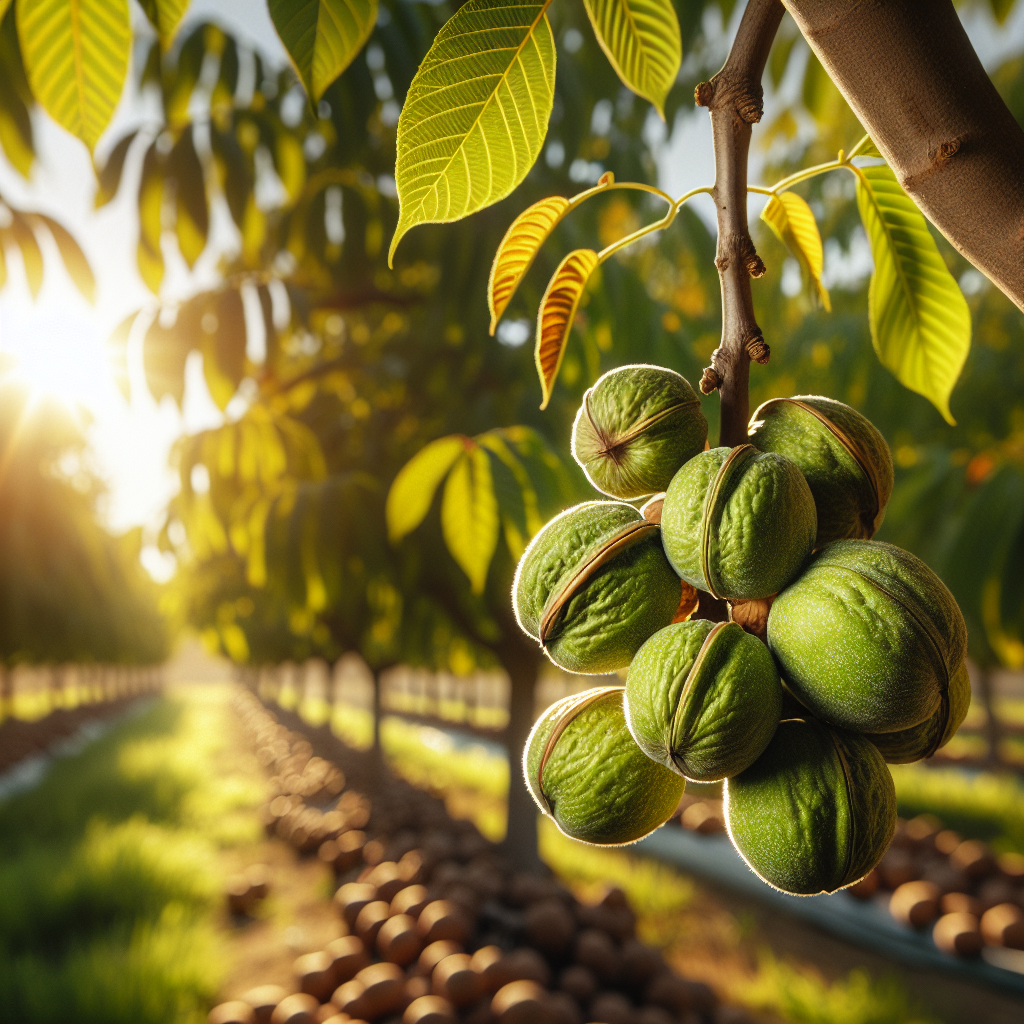
Introduction to Walnut
Walnuts have been cultivated for over 4,000 years, originating from the mountainous regions of Central Asia and Persia, where ancient traders spread them along the Silk Road to Europe and beyond. Today, Juglans regia, the English or Persian walnut, dominates commercial production in California, Chile, and China, generating billions in global trade. These trees are not just nut producers; their timber is valued for high-end furniture, and their husks yield natural dyes. Growing walnuts requires long-term commitment—trees take 4-7 years to bear nuts—but a mature tree can produce 50-100 pounds annually for up to 100 years. Key cultivars like 'Chandler,' 'Howard,' and 'Hartley' offer disease resistance and high yields, with 'Chandler' leading U.S. production due to its late-leafing trait that dodges spring frosts. Success hinges on site selection, as walnuts are allelopathic, exuding juglone toxin that inhibits nearby plants. This guide equips you with professional strategies for orchard establishment and maintenance.
Botanical Profile of Walnut
Juglans regia belongs to the Juglandaceae family, characterized by pinnately compound leaves with 5-9 lanceolate leaflets, each 3-5 inches long, emitting a distinctive aromatic scent when crushed. Trees reach 30-50 feet tall with a broad, rounded canopy, featuring furrowed, gray-brown bark. Monoecious with imperfect flowers, pollen-producing catkins emerge in early spring, while pistillate flowers form in clusters at twig tips. Pollination is anemophilous, relying on wind; cross-pollination boosts yields, so plant at least two cultivars within 50-100 feet. Nuts develop inside green husks that split in fall, revealing the corrugated shell encasing the kernel. Root systems are deep taproots with lateral spreads up to 50 feet, demanding space—allow 30-40 feet between trees in orchards. Photoperiodic and deciduous, walnuts enter dormancy post-harvest, with chilling requirements of 700-1,600 hours below 45°F (7°C) for bud break. Cultivars vary: 'Franquette' excels in cooler climates with excellent drying qualities, while 'Tulare' yields massive nuts but is frost-sensitive.
Soil, pH, and Climate Requirements for Walnut
Walnuts thrive in deep, well-drained loamy soils with pH 6.0-7.5; avoid heavy clays prone to waterlogging, which causes root rot. Test soil for drainage by digging a 2-foot hole, filling with water—if it drains slower than 1 inch/hour, amend with sand or raised beds. Optimal texture is 20-30% clay, 40-50% silt, 20-30% sand, rich in organic matter (3-5%). Juglone sensitivity means avoiding compacted or contaminated sites. Climate-wise, walnuts demand USDA zones 7-9, with 800+ chill hours; summers need 80-95°F days for nut fill, winters mild to prevent bark splitting. Annual rainfall of 30-40 inches suffices, but supplement in dry areas. Frost pockets doom early-leafing varieties—select late-leafing like Chandler for safety. Heat units (DD50 >2,500) drive maturation; monitor via local ag stations. For more on subtropical nuts, see our Pecan guide. Irrigation is critical: maintain 50-75% field capacity (check via tensiometer at 24-inch depth). Signs of deficiency include yellowing leaves (nitrogen) or stunted growth (zinc).
Step-by-Step Planting & Propagation
Propagate walnuts primarily via grafting onto Juglans nigra or J. hindsii rootstocks for Paradox hybrids, which resist Phytophthora root rot—seedlings are genetically variable and slow. Collect scion wood in dormancy (December-February), 1-year-old pencil-thick. For seeds, stratify fresh nuts at 34-41°F for 90-120 days. Site prep: deep rip to 4-5 feet, incorporate 10-20 tons/acre compost, pre-plant fumigate if nematodes present. Plant bare-root trees February-March in northern hemisphere, at 24-30 feet spacing (12x12 for high-density). Dig holes 3x root spread, position graft union 2-3 inches above soil, stake firmly. Water-in with 5-10 gallons/tree, mulch 4-6 inches deep (avoid trunk). Initial pruning: head to 30-36 inches, select central leader. Grafted trees bear in 3-5 years vs. 7+ for seedlings. For small farms, dwarf rootstocks like RX1 reduce vigor by 20-30%. Monitor establishment: new growth >12 inches/year indicates health. See Soil Health Mastery for amendment tips.
Care & Maintenance regimes for Walnut
Fertilize post-harvest: apply 0.5-1 lb nitrogen/tree/year 1-3, scaling to 0.2 lb/canopy lb by maturity—split into 3 applications (March, May, July). Use soil/petal tests; excess N delays harvest. Irrigate deeply: 30-40 inches/year via drip/micro-sprinklers, ET-based (replace 0.8-1.0 crop ET). Soil moisture: 20-30 kPa tension at 2-4 feet depth; overwatering shows yellow leaves, root rot—wilting without recovery signals underwatering. Prune annually in dormancy: thin to 40-50% light penetration, remove watersprouts, maintain 3-5 scaffolds. Thin nuts June-July if >50/nutlet cluster to boost kernel quality. Wrap trunks first 3 winters against sunscald. Weed control: mow alleys, use pre-emergents like simazine under canopy. Track phenology: bud swell to harvest spans 180-220 days. Mature trees need zinc foliar sprays (3-5x/year at 0.5% ZnSO4) if leaves <25 ppm Zn—deficiency causes 'little leaf' rosetting.
Pests, Diseases & Organic Management
Codling moth (Cydia pomonella) tunnels nuts—monitor with traps, apply Bt kurstaki at 200-400 DD base 50°F. Walnut husk fly: yellow sticky traps, spinosad sprays at husk split. Aphids vector diseases—hort oil dormant sprays. Diseases: Xanthomonas blight—copper sprays at bud swell; Phytophthora—avoid wet soils, phosphite drenches. Anthracnose (Gnomonia)—prune for airflow, lime sulfur dormant. Organic: release Trichogramma wasps for moths, kaolin clay barriers, neem for Aphids. Juglone deters some pests naturally. Scout weekly: >5% infested husks triggers action. Resistant cultivars like 'Howard' reduce inputs. For broader organic tips, explore Spring Pest Patrol. Integrated Pest Management (IPM) cuts costs 30-50%.
Harvesting, Curing & Optimal Storage
Harvest when 90% husks split and nuts drop (September-October), hull color darkens. Shake trees mechanically or pole small ones; collect within 2-3 days to prevent mold. Yield peaks at 6-8 tons/acre. Dehusk immediately via hydroshaker or roller—dry to 8% moisture in aerated bins at 95-100°F for 3-5 days, turning daily. Crack when shell moisture <4%; kernel moisture 4-5% ideal. Store kernels at 0-2°C, <65% RH in sealed bins—shelf life 12-18 months. Reject >1% defectives. Quality grading: U.S. No. 1 light amber halves fetch premium. Post-harvest, rake debris to break pest cycles.
Companion Planting for Walnut
Walnuts' juglone (from roots/leaves) inhibits solanaceous plants (tomato, potato), apples, and pears—avoid within 50-80 feet drip line. Tolerant companions: fava beans (nitrogen-fix), annual grasses, clover cover crops. Plant comfrey or dandelion at edges for dynamic accumulators. Between rows: peaches, plums, or Asian pears at 40+ feet. Brassicas like cabbage tolerate marginally. Cover crops suppress weeds, build soil—see Fall Companion Planting Guide. Juglone degrades in 2-4 weeks post-fall leaf drop, allowing spring planting. Interplant young orchards with lettuce or peas until canopy closes.