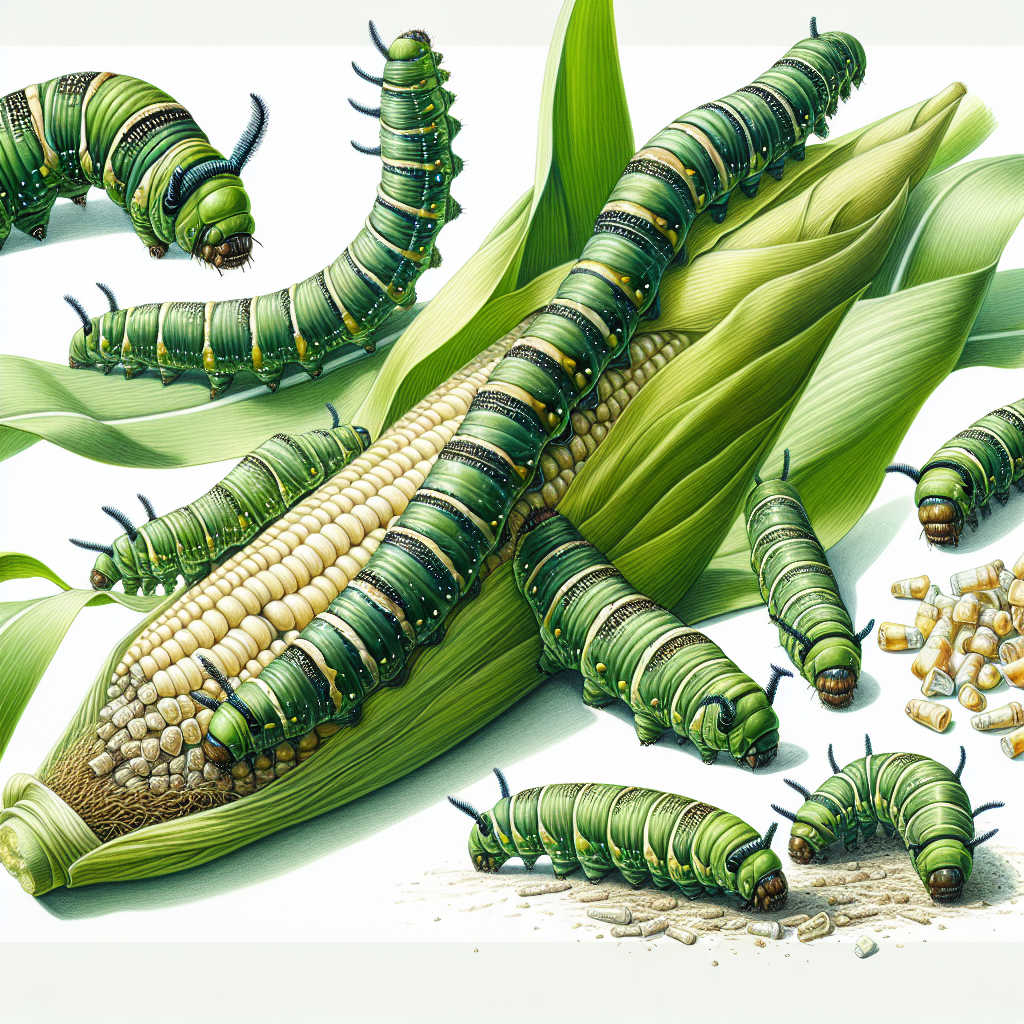
Introduction to Armyworms
Armyworms represent one of the most notorious pest threats in agriculture, earning their name from the destructive 'armies' of caterpillars that migrate across fields in search of food. Primarily species from the genus Spodoptera, such as the fall armyworm (Spodoptera frugiperda) and beet armyworm (Spodoptera exigua), these nocturnal larvae target a wide range of crops, stripping leaves and causing rapid defoliation. Native to the Americas but now global invaders due to trade and climate shifts, armyworms can wipe out entire plantings overnight, leading to yield losses of 30-100% in severe infestations.
Understanding armyworms is crucial for timely intervention. Adults are moths with wingspans of 1-1.5 inches, featuring mottled gray-brown forewings and white hindwings. Eggs are laid in clusters on leaf undersides, hatching into smooth green-to-brown caterpillars with stripes and a dark head. As they mature, they develop a greasy appearance and can grow up to 2 inches long. Their gregarious behavior amplifies damage, as hordes move together, leaving behind skeletonized plants and fecal pellets (frass). Early detection through scouting is key, as populations explode under favorable conditions. This comprehensive guide equips growers with diagnostic tools, lifecycle knowledge, organic controls, and prevention strategies to safeguard harvests. Spring Pest Patrol: Organic AI Strategies to Shield Your Crops from Common Invaders
Identifying Symptoms & Damage
Armyworms cause unmistakable damage patterns that escalate quickly. Initial signs include pinhole feeding on young leaves, progressing to large, irregular holes as larvae chew from the edges inward. Look for skeletonized foliage where only veins remain, often starting on lower leaves and moving upward. Heavy frass accumulation at the base of plants or in whorls is a telltale sign—dark green to brown pellets resembling sawdust.
In grasses like corn or wheat, larvae target whorls, creating 'windowpane' damage where leaf tissue is scraped thin. Severe infestations lead to complete defoliation, stunted growth, and lodging. On vegetables such as cabbage or tomato, expect ragged holes and head contamination with frass, reducing marketability. Differentiate from cutworms (which cut stems at soil level) or caterpillars (solitary feeders) by the marching groups and stripe patterns on armyworm larvae.
Scout at dawn or dusk when larvae are active. Use a sweep net for row crops or visually inspect 25-50 plants per field quadrant. Economic thresholds vary: 20-25% defoliation in vegetative stages or 15% in reproductive stages for corn; 25-30% for soybeans. Yellowing or wilting may mimic nutrient deficiencies or leaf spot diseases, but the presence of live larvae and frass confirms armyworms. Early diagnosis prevents escalation, saving costly interventions.
Lifecycle and Progression of Armyworms
Armyworms complete their lifecycle in 25-40 days, depending on temperature (optimal 77-86°F). Females lay 500-2000 eggs in masses of 50-100, covered in grayish scales, on leaf undersides. Eggs hatch in 2-4 days into 1st instar larvae (tiny, pale green). There are 6-7 instars; early stages (1-3) rasp leaf surfaces, while later instars (4-6) consume entire leaves voraciously.
Larvae feed for 14-21 days, then disperse to pupate 2-4 inches in soil, forming reddish-brown pupae. Adults emerge in 7-14 days, mate, and lay eggs within 1-2 nights. Multiple generations (3-6 per season) occur in warm climates. Overwinter as partially grown larvae or pupae in southern regions, migrating north on winds. Monitor with pheromone traps for adult flights, peaking every 30 days.
Lifecycle progression ties to crop stages: eggs in early vegetative, peak larval damage in V6-VT for corn. Understanding this rhythm allows predictive scouting—check fields 7-10 days after moth peaks. Disrupt at vulnerable stages: egg masses (Bt sprays), young larvae (biologicals), or adults (traps).
Environmental Triggers & Risk Factors
Armyworm outbreaks surge with specific conditions. Warm, humid weather (above 75°F, 80% RH) accelerates development, while droughts stress plants, making them susceptible. Heavy rains wash eggs off leaves but create moist soil for pupation. Wind currents carry moths hundreds of miles, introducing infestations to new areas.
Risk factors include continuous corn-soybeans rotations, late-planted fields overlapping generations, and nearby grassy weeds harboring eggs. Reduced tillage preserves pupae, and high nitrogen fertility boosts leafy growth, attracting females. Climate change extends seasons, increasing generations. Fields near rivers or fields with cutworms history face compounded risks. Monitor forecasts; outbreaks follow moth migrations tracked by USDA tools. Mitigate by diversifying plantings and cover cropping.
Organic Control & Treatment Plans
Organic management integrates cultural, biological, and mechanical tactics for sustainable control. Cultural: Hand-pick egg masses and small larvae at dusk; destroy by crushing. Use row covers on small plantings. Biological: Apply Bacillus thuringiensis (Bt) var. kurstaki at first signs—targets larvae <1 inch, reapply every 3-5 days (up to 3x). Introduce natural enemies: parasitic wasps (Cotesia spp.), birds, and ground beetles. Mechanical: Trap crops like sorghum borders lure moths; flame or vacuum devices for large larvae.
Treatment Plans:
- Scout weekly; treat at 15-20% defoliation.
- Evening sprays of spinosad or neem oil penetrate whorls.
- For outbreaks, mow borders to expose pupae.
- Rotate with non-hosts like onion to break cycles.
Avoid broad-spectrum sprays preserving predators. Success rates: 70-90% with IPM. Combine with Soil Health Mastery: 5 Proven Strategies for Small Farms to Build Fertile Ground Without Breaking the Bank for resilient plants.
Preventing Armyworms in the Future
Prevention focuses on long-term IPM. Plant early-maturing varieties resistant to defoliation, like Bt corn hybrids (though monitor resistance). Destroy volunteers and weeds (e.g., foxtail) post-harvest. Till soil lightly to expose pupae to predators/sun. Use reflective mulches or UV traps to deter moths.
Intercrop with repellents: thyme or marigold. Encourage biodiversity via hedgerows hosting parasitoids. Monitor with delta traps (10-20/100 acres), replacing lures biweekly. Time planting to avoid peak flights. Cover crops like clover suppress soil pupae. Scout adjacent fields; buffer zones reduce migration. Annual rotation reduces buildup by 50%. Track regional alerts for proactive defense.
Crops Most Affected by Armyworms
Armyworms attack over 80 hosts, prioritizing Gramineae and Solanaceae. Grasses: corn, wheat, rice, sorghum, barley, oats, rye, millet. Legumes: soybeans, peanuts, chickpeas, peas. Vegetables: cabbage, lettuce, tomato, potato, onion, beet, sweet potato. Others: cotton, sugarcane, alfalfa. Fall armyworm devastates corn whorls; beet armyworm prefers lettuce. Tailor scouting to high-risk crops.