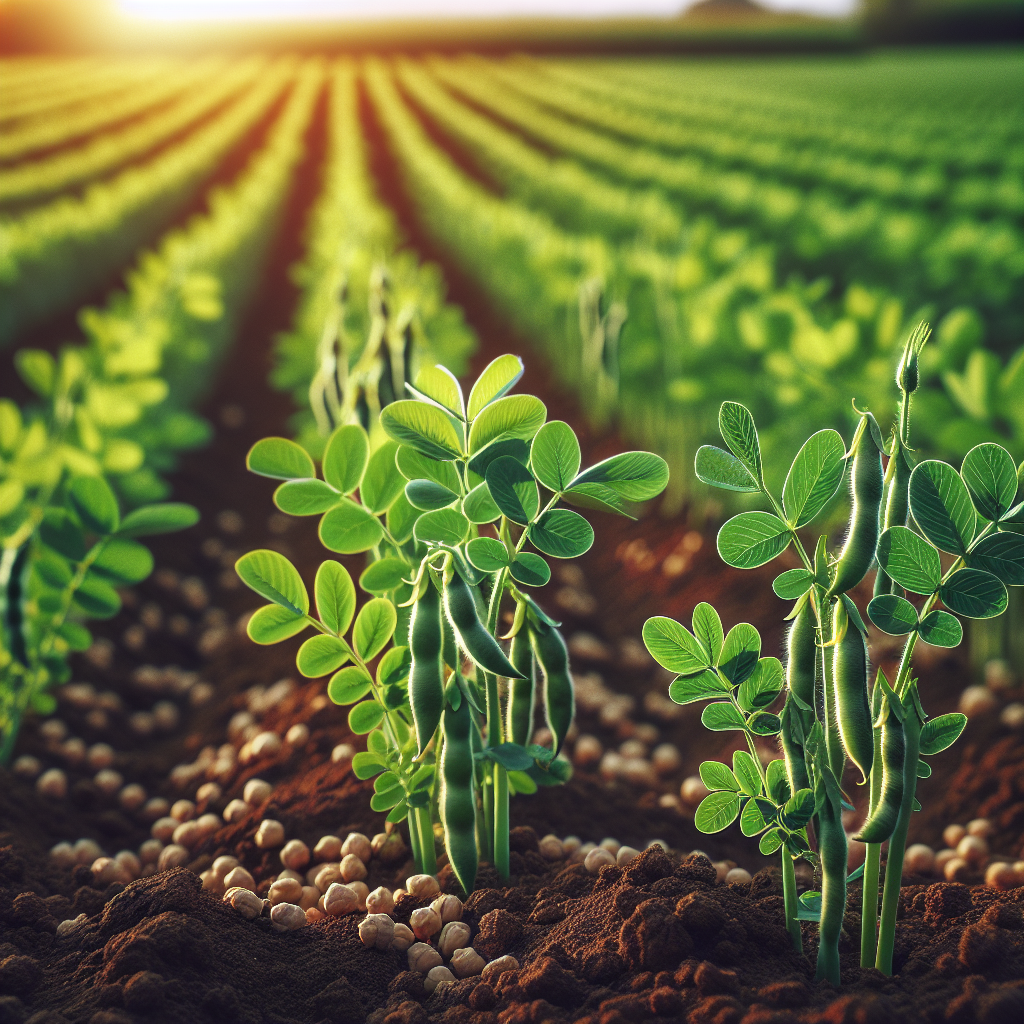
Introduction to Chickpeas
One of the oldest domesticated pulses in human agriculture, chickpeas have been cultivated for thousands of years across the Fertile Crescent, South Asia, the Mediterranean basin, and East Africa. They are grown both as a dry grain and, in some regions, as a green vegetable crop harvested at the immature seed stage. Their agronomic value is unusually high because they fit well into cereal-based rotations, improve nitrogen economy in the field, and tolerate semi-arid conditions better than many grain legumes.
Two broad market classes dominate cultivation. Desi chickpeas generally have smaller, angular, darker seeds and plants that are often more stress-tolerant and adapted to lower-input systems. Kabuli chickpeas produce the larger, cream-colored seeds common in hummus and premium export markets, but they often demand more careful disease management and slightly more favorable growing conditions. Seed size, market destination, and climate should all influence cultivar selection.
From a production standpoint, chickpeas are not difficult to grow once their main limitation is understood: they dislike waterlogging more than brief drought. Many crop failures come not from lack of fertility, but from poorly drained soil, excessive irrigation, or disease pressure in humid weather. Growers who provide airy soil, moderate moisture, and a dry ripening period usually achieve the best results.
For broader pulse rotation planning, compare with Lentils, another cool-season legume with similar rotational benefits.
Botanical Profile of Chickpeas
Chickpeas belong to the family Fabaceae and are a self-pollinated annual legume. Plants typically reach 20 to 60 cm tall, though some vigorous cultivars can exceed that under ideal conditions. Their growth habit is generally upright to semi-spreading, with branched stems covered in fine glandular hairs. These hairs exude organic acids, including malic and oxalic acids, which can give foliage a slightly sticky texture and may provide limited natural deterrence to some pests.
Leaves are pinnate, composed of many small serrated leaflets, and tend to be gray-green because of pubescence. Flowers are borne singly or in pairs, usually white, pink, purple, or pale blue depending on genotype. After pollination, each inflated pod commonly contains one or two seeds, occasionally three in some cultivars. Compared with peas or common beans, chickpea pod set is relatively modest, so final yield depends heavily on preserving plant health during flowering and pod filling.
The root system includes a pronounced taproot that can penetrate deeply in friable soils, often beyond 1 meter, supported by lateral roots in the upper profile. This architecture explains much of chickpea's drought resilience. It also explains why compaction layers, shallow hardpans, or poorly structured soils reduce performance: they restrict rooting depth and impair access to subsoil moisture.
Like other legumes, chickpeas form nodules with compatible Mesorhizobium or Rhizobium relatives, allowing biological nitrogen fixation. However, nodulation is not automatic in all fields. Where chickpeas have not been grown recently, inoculation is often worthwhile, especially in land new to pulse cultivation. Effective nodules are generally pink to reddish inside due to leghemoglobin, a sign that fixation is active.
Botanically, chickpeas are particularly sensitive at flowering. High heat, cold snaps, excess nitrogen, and water stress can all increase flower abortion. This means the crop may look lush early in the season yet still yield poorly if reproductive conditions are unfavorable.
Soil, pH, and Climate Requirements for Chickpeas
The ideal soil for chickpeas is a well-drained loam to sandy loam with good crumb structure, moderate water-holding capacity, and no prolonged standing water after rainfall. Silt loams can work very well if internal drainage is good. Heavy clays are risky unless raised beds, broad beds and furrows, or other drainage improvements are used. Root diseases become significantly more likely when the soil stays saturated for more than 24 to 48 hours.
Optimal soil pH is generally 6.0 to 8.0, with best nutrient availability and nodulation usually occurring around pH 6.5 to 7.5. Chickpeas tolerate mildly alkaline soils better than many vegetables, but highly calcareous conditions can induce micronutrient deficiencies, especially zinc or iron, visible as interveinal chlorosis on young leaves. In strongly acidic soils below pH 5.5, nodulation and root development often decline, and liming may be necessary before planting.
Moderate fertility is preferable to excessively rich soil. Chickpeas do not need heavy nitrogen applications; in fact, too much available nitrogen can suppress nodulation and encourage lush vegetative growth at the expense of pods. Phosphorus is particularly important for root growth, early vigor, and reproductive success. Potassium supports stress tolerance, while sulfur and zinc are important where soils test low.
Climatically, chickpeas are best suited to cool, relatively dry growing seasons followed by a warm, dry harvest window. Ideal temperatures for vegetative growth are roughly 18 to 26°C. Germination can begin in cooler soils, but emergence is slower below 10°C. Light frosts may be tolerated by hardened seedlings depending on cultivar and growth stage, but severe frost during flowering or pod set can reduce yield sharply. On the other extreme, temperatures above 32 to 35°C during flowering often cause poor pollination, flower drop, and reduced seed filling.
Humidity matters almost as much as temperature. Chickpeas generally perform best in low to moderate humidity with good air movement. Persistent rainfall, overhead irrigation, or dew-heavy conditions late in the season create ideal conditions for foliar diseases, especially Ascochyta blight and Botrytis gray mold. In climates with wet springs, site selection and resistant cultivars become critical.
Because chickpeas are relatively drought tolerant once established, irrigation decisions should focus on protecting early establishment and the flowering-to-pod-fill phase. The soil should remain evenly moist but never saturated. As a practical field benchmark, aim to keep moisture in the upper 15 to 30 cm of soil at roughly 60 to 80% of field capacity during establishment, then avoid severe depletion during flowering. If soil from the root zone forms a weak ball in the hand but breaks apart with light pressure, moisture is often near an acceptable range. If it smears, shines, or smells anaerobic, it is too wet.
For improving structure and long-term fertility before a chickpea crop, see soil health strategies.
Step-by-Step Planting & Propagation
Chickpeas are propagated directly from seed. They transplant poorly because the taproot is easily disturbed, so direct seeding is the standard commercial and professional practice.
Start by selecting high-quality, disease-free seed of a cultivar suited to your season length, expected disease pressure, and market class. If seedborne disease is a concern, use certified seed and consider approved biological or low-impact seed treatments where regulations allow. In fields without a recent history of chickpeas, coat seed with the appropriate legume inoculant shortly before sowing, keeping treated seed out of direct sunlight.
Prepare a fine but not powdery seedbed. The goal is uniform seed-to-soil contact with enough surface stability to resist crusting. Deep tillage is only helpful if it addresses compaction; excessive tillage can dry the seed zone and degrade structure. In reduced-till systems, chickpeas can perform well if residue does not interfere with placement and soil warming.
Plant when soil temperatures are consistently at least 8 to 10°C and the risk of severe frost has passed, or according to regional practice in post-rainy-season production zones where the crop relies partly on stored soil moisture. Depth should usually be 4 to 8 cm, with deeper placement used in lighter soils or dry seedbeds. Planting too shallow increases the risk of uneven emergence and bird damage; too deep delays emergence and weakens seedlings.
Spacing depends on whether the goal is hand harvest, mechanized dry grain production, or fresh green harvest. A common range is 25 to 45 cm between rows and 5 to 10 cm between plants within the row, giving a moderate stand density that allows airflow while achieving canopy closure. In high-disease environments, slightly wider spacing helps reduce humidity in the canopy. In drier regions, narrower rows can improve ground cover and moisture conservation.
After sowing, irrigate lightly if the seed zone is dry, but avoid saturating the bed. Seeds need oxygen as much as water, and cold wet soil often leads to poor emergence. Emergence usually occurs in 7 to 14 days depending on temperature.
During the first two weeks after emergence, inspect stand uniformity carefully. Missing sections may indicate crusting, seed rot, birds, Cutworms, or poor inoculation handling. Early replanting is only worthwhile if the stand is badly compromised and the remaining season still supports maturity.
Care & Maintenance regimes for Chickpeas
Once established, chickpeas are comparatively low-input, but the management must be precise. The first priority is irrigation discipline. The crop should never sit in waterlogged soil. During early vegetative growth, allow the upper few centimeters of soil to dry slightly between irrigations while keeping deeper rooting zones moderately moist. Frequent shallow irrigation encourages weak surface rooting and disease. A better approach is less frequent, deeper watering that wets the active root zone and then allows aeration to return.
The most moisture-sensitive stages are flowering and early pod filling. If drought stress occurs here, plants may shed flowers, form fewer pods, or produce shriveled seed. Typical symptoms of underwatering include midday wilting that persists into evening, bluish-green or dull foliage, small pods, and shortened internodes. Overwatering symptoms include yellowing lower leaves, stunted growth despite moist soil, stem base softening, and a stagnant or sour smell in the root zone. In severe cases, plants collapse from root rot even though the field appears well supplied with water.
Fertilization should be guided by soil testing. Where nodulation is expected to function well, starter nitrogen should be minimal or omitted. Excess nitrogen often creates rank plants that are slower to mature and more vulnerable to lodging and disease. Phosphorus is often the most yield-responsive nutrient, especially in cool soils, because it supports early root growth and reproductive development. Potassium is important in lighter soils or where removal has been high. Sulfur may be beneficial in low-organic-matter fields.
Weed control is especially important in the first 4 to 6 weeks, when chickpeas are not yet competitive. Mechanical cultivation is possible while plants are small, but avoid deep root disturbance. Hand weeding, stale seedbeds, mulching in small-scale systems, and crop rotation are all useful. Once the canopy closes, late-emerging weeds are less damaging, but vining or tall weeds can still interfere with harvest and reduce seed quality.
Mulch is not standard in broadacre production, but in intensive garden or small-farm settings a light organic mulch can reduce evaporation and weed pressure if it does not trap excess humidity around stems. Keep mulch a few centimeters away from the crown to reduce stem disease risk.
Because chickpeas are self-pollinating, pollinator activity is not essential for pod set, but biodiversity-friendly systems still benefit overall crop health. Avoid unnecessary foliar sprays during bloom, especially in mixed plantings.
Rotationally, chickpeas should not follow chickpeas or other susceptible legumes too frequently. A gap of at least 3 to 4 years is preferred in disease-prone areas. They fit well after cereals such as Wheat, where residue and disease cycles are managed properly.
Pests, Diseases & Organic Management
The most serious chickpea problems are often diseases rather than insect pests. Ascochyta blight is among the most destructive, causing dark lesions on leaves, stems, and pods, often with concentric patterns and tiny fruiting bodies. It spreads rapidly in cool, wet weather and can arrive on infected seed or residue. Organic management depends on clean seed, resistant cultivars, wide rotation, residue management, and avoiding overhead irrigation. Once established under favorable weather, it is difficult to stop.
Fusarium wilt causes yellowing, drooping, vascular browning, and plant death, often in patches. Unlike transient water stress, wilted plants may not recover overnight. The pathogen survives in soil for years, so prevention relies on resistant varieties, long rotation, and avoiding movement of contaminated soil.
Root rots and damping-off, including Rhizoctonia, Pythium, and Fusarium complexes, are favored by compacted, cold, or saturated soils. These typically cause poor emergence, stem lesions at the soil line, and weak stands. Good drainage, moderate seeding depth, and avoiding overly early sowing in cold wet soil are the main defenses.
Botrytis gray mold may affect dense canopies in humid conditions, especially where excessive nitrogen has produced lush growth. Powdery mildew can also occur late in the season, usually as a white coating on foliage under warm days and humid nights.
Among insects, Aphids can colonize tender growth and occasionally transmit viruses. They are often controlled naturally by lady beetles, lacewings, and hoverfly larvae if broad-spectrum pesticides are avoided. Cutworms may clip seedlings at ground level early in the season. Pod borers and Caterpillars are major threats in some regions, feeding directly on flowers and pods. Leaf miners, Thrips, and Bruchid beetles may also be important depending on geography.
Organic management should follow an integrated system:
- Use certified, disease-free seed and resistant cultivars whenever possible.
- Rotate for at least 3 years away from chickpeas, lentils, peas, and other susceptible legumes if disease pressure is known.
- Improve airflow with correct spacing and avoid overhead irrigation.
- Scout weekly from emergence through pod fill, increasing to twice weekly during humid spells.
- Remove and destroy heavily infected plants in small plots before spread accelerates.
- Encourage beneficial insects with border plantings and flowering strips.
- Use row covers only at the seedling stage if insect pressure is severe, removing them before humidity buildup becomes harmful.
- Apply approved biologicals such as Bacillus-based products or neem only when monitoring justifies intervention and local regulations permit.
Post-harvest sanitation matters. Infected residue left on the surface can be a major inoculum source next season. Equipment should be cleaned when moving from diseased to clean fields.
Harvesting, Curing & Optimal Storage
Chickpeas may be harvested green for fresh use or dry for grain, but most growers target full physiological maturity for storage. Plants are ready for dry harvest when leaves yellow and drop, stems turn tan, and pods become dry and papery. Seeds should be hard and difficult to dent with a fingernail. Depending on cultivar and conditions, maturity often occurs 90 to 120 days from sowing, though some environments require longer.
Avoid delaying harvest too long after full dryness. Pods may split in some conditions, plants can lodge, and weathered seed loses color and market quality. In humid climates, morning harvest when pods are slightly less brittle can reduce shattering, but seed must then be dried promptly.
For small plantings, pull or cut plants and place them on tarps, screens, or well-ventilated racks to finish drying under cover. Do not heap green material too deeply, or internal heating and mold may develop. For larger plantings, combine when seed moisture is typically around 13 to 18%, then dry further if necessary. Seed intended for storage should usually be reduced to about 10 to 12% moisture, and for long-term storage in warm climates, even slightly lower moisture may be safer.
Thresh gently enough to avoid cracked seed coats, especially in Kabuli types, which are more susceptible to mechanical damage. Clean seed thoroughly to remove chaff, soil, broken seed, and insect-damaged material. Even a small amount of plant debris can raise storage humidity and encourage pests.
Storage conditions should be cool, dry, and stable. Ideal storage temperatures are below 15°C where possible, with relative humidity low enough that seed does not reabsorb moisture. Use airtight food-grade containers for household scale, or clean bins and sacks in well-ventilated stores for farm scale. Protect against Bruchid beetles and rodents. Signs of poor storage include condensation inside containers, a musty odor, heating, insect exit holes, and seed coat discoloration.
If chickpeas are intended for seed rather than food, maintain varietal purity, avoid mechanical cracking, and store under low humidity to preserve germination. Seed lots should be tested before the next planting season if storage conditions were less than ideal.
Companion Planting for Chickpeas
In mixed gardens and diversified farms, chickpeas work best with crops that do not demand heavy nitrogen and do not create excessive shade or humidity. Good companions include low-growing herbs, alliums, and some root crops that occupy different soil zones and reduce direct competition. For example, onions and garlic can fit nearby because they remain relatively upright, do not overrun the chickpea canopy, and may help disrupt some pest movement patterns in small plots.
Cereals are also useful companions or rotation partners because they contrast strongly with legumes in nutrient demand and residue type. On larger farms, strip systems with cereals can reduce disease carryover and improve land use efficiency. In gardens, carrots, radishes, and leafy greens can sometimes be placed adjacent to chickpeas if spacing preserves airflow.
Avoid pairing chickpeas with aggressive, sprawling crops that trap humidity, such as oversized squash in tight beds. Also avoid dense interplanting with tall crops that shade them during flowering, since chickpeas perform best in full sun and open canopies. Heavy feeders that require constant irrigation can be poor neighbors because chickpeas prefer moderate moisture and dry-down between waterings.
Companion planting should not override disease management. If foliar disease is common in your area, prioritize wider spacing and air movement over maximum diversity in a single bed. The best companion system is one that keeps the chickpea canopy dry, roots aerated, and harvest access easy.