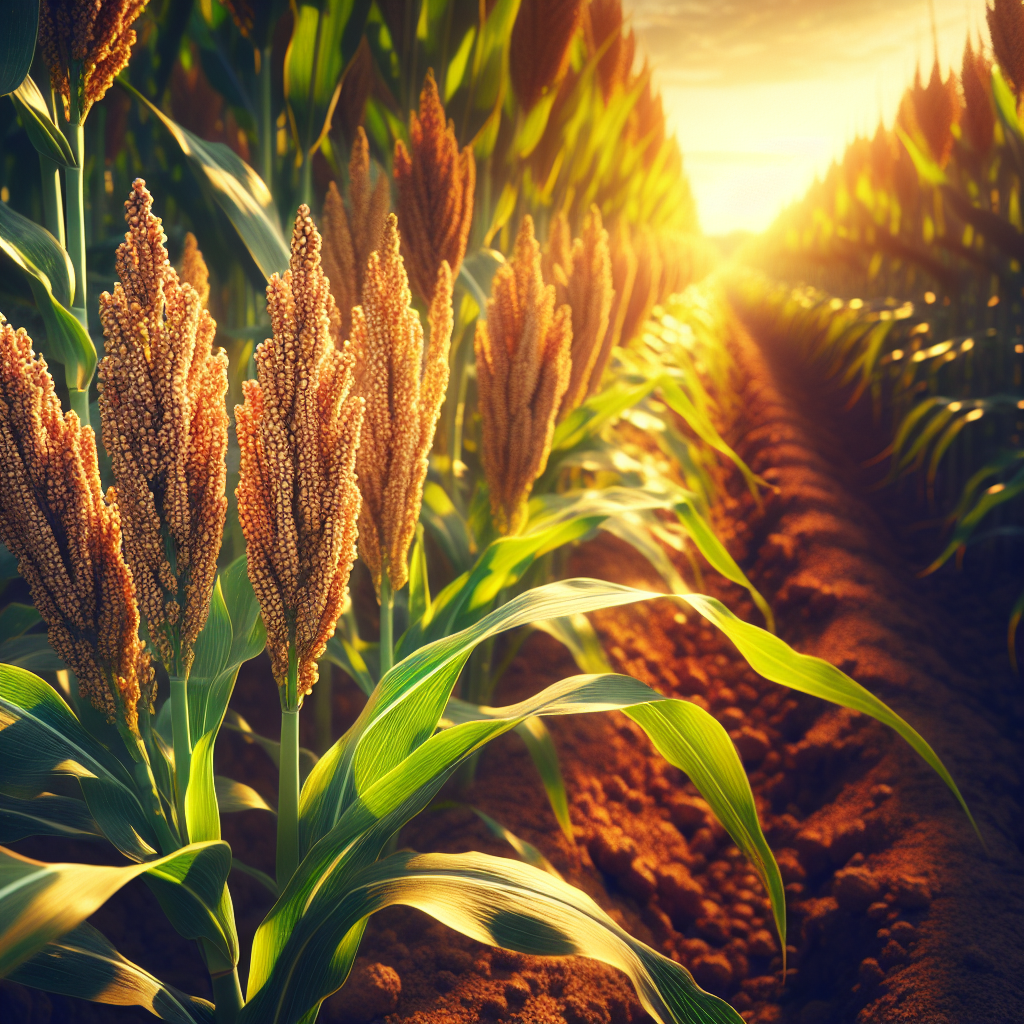
Introduction to Sorghum
A warm-season cereal with deep African origins, this crop has sustained dryland farming communities for thousands of years and remains indispensable in semi-arid agriculture. It is grown as grain sorghum for food and feed, sweet sorghum for syrup and ethanol, forage sorghum for hay and silage, and broomcorn types for fiber. Its exceptional tolerance of heat, intermittent drought, and variable soils makes it especially valuable in regions where maize yields are unreliable.
From a production standpoint, it is often considered one of the most efficient cereals in water-limited systems because it can pause growth during severe stress and resume when moisture returns. That physiological flexibility comes from waxy leaves, an extensive fibrous root system, and strong osmotic adjustment in plant tissues. Compared with Corn, it generally withstands hotter, drier field conditions better, though it typically demands careful management during stand establishment and flowering if high grain yields are the goal.
Nutritionally, grain is rich in carbohydrates, provides moderate protein, and in some cultivars contains significant antioxidants concentrated in pigmented seed coats. Tannins, however, vary by type and can affect palatability and feed value. Modern breeding has produced bird-resistant, dwarf, photoperiod-insensitive, high-yielding, and stay-green hybrids that broaden adaptation across tropical, subtropical, and warm temperate regions.
Botanical Profile of Sorghum
This species belongs to the family Poaceae, the grass family, and is a diploid annual in most field production systems, though some related sorghums and ratooned forms can behave as short-lived perennials under frost-free conditions. Plants usually range from 1 to 4 meters tall depending on type, fertility, moisture, and cultivar class. Grain sorghums are typically shorter and more lodging-resistant, while forage and sweet sorghums are taller, thicker-stemmed, and higher in biomass.
The plant produces erect culms with solid to pithy stems, broad linear leaves, a prominent waxy bloom on many cultivars, and a terminal panicle that may be compact, semi-compact, or open. The inflorescence structure matters agronomically: compact heads may retain more moisture and raise mold risk under humid conditions, while looser heads often dry faster. Seeds vary in color from white and cream to red, bronze, or brown, and kernel hardness influences milling and feed use.
Rooting is one of its defining strengths. Under favorable conditions, roots can explore well beyond 1 meter depth, although most active roots occupy the upper 60 centimeters where oxygen and nutrients are more available. The crop uses C4 photosynthesis, giving it high efficiency in bright light, warm temperatures, and water-limited environments. This is why it remains productive in settings that suppress many cool-season grains.
Sorghum is predominantly self-pollinated, but some outcrossing occurs, especially under warm, windy conditions. Flowering proceeds from the top of the panicle downward over several days. Stress at booting, anthesis, and early grain fill can sharply reduce yield through pollen sterility, poor seed set, or shriveled kernels. Certain cultivars also contain dhurrin, a cyanogenic compound concentrated in young regrowth and frost-stressed tissue, which is highly relevant in forage systems.
Soil, pH, and Climate Requirements for Sorghum
This crop performs best in well-drained loam, silt loam, sandy loam, and clay loam soils with moderate water-holding capacity and good internal drainage. It is more tolerant of temporary dryness than waterlogging. Saturated soil for more than 48 to 72 hours, especially at the seedling stage, can cause oxygen starvation, weak root development, yellowing, and stand thinning. If the field puddles easily after rain, raised beds or surface drainage are often justified.
An ideal soil pH is 6.0 to 7.5, though production is still possible from roughly 5.5 to 8.3 if nutrient imbalances are corrected. Below pH 5.5, aluminum toxicity and phosphorus fixation can restrict rooting and early vigor. In alkaline soils above about 7.8, zinc and iron deficiencies become more likely, showing as interveinal chlorosis on younger leaves. A pre-plant soil test is strongly recommended because sorghum’s reputation for toughness sometimes leads growers to under-correct limiting fertility.
Temperature is a major driver of success. Germination is best when soil temperatures at planting depth are consistently at or above 18 to 20°C, with rapid emergence occurring around 24 to 30°C. Growth slows below 16°C, and chilling injury can occur in cool soils or after cold nights. The crop thrives in air temperatures of 26 to 34°C and tolerates much higher daytime heat if roots can access subsoil moisture.
Rainfall needs vary by end use and duration. Grain production can succeed with 400 to 700 mm seasonal rainfall if distribution is favorable, while high-biomass forage and sweet sorghum may require more. The most critical moisture windows are establishment, rapid vegetative growth, boot stage, flowering, and early grain fill. Drought during vegetative growth is often survivable; drought at flowering can be devastating.
Moisture management is less about frequent irrigation and more about maintaining usable water in the root zone without creating anaerobic conditions. In practical terms, aim to keep the top 15 to 30 cm of soil evenly moist during emergence, then allow the surface to dry slightly between irrigations while deeper layers remain moist. Overwatering signs include pale leaves, reduced tillering, stunting despite adequate fertility, sour-smelling soil, blackened roots, and increased susceptibility to root rots. Underwatering shows first as leaf rolling by mid-morning, a bluish-gray cast to foliage, shortened internodes, and delayed panicle exertion.
Sorghum is well adapted to low relative humidity and strong sunlight, but persistent humidity around flowering can increase grain mold pressure. Wind tolerance is generally good, although tall sweet and forage types may lodge under high nitrogen and excessive late irrigation.
For broader cereal rotation planning, growers often compare it with other warm-season and staple grains; soil health strategies are especially useful when integrating sorghum into diversified dryland systems.
Step-by-Step Planting & Propagation
This crop is almost always established by direct seeding rather than transplanting. Begin with field preparation that creates a fine, firm seedbed. Seed-to-soil contact matters because sorghum seed is relatively small and struggles in fluffy, cloddy seedbeds. Where conservation tillage is used, residue should be evenly distributed so the planter can place seed at uniform depth into warm soil.
Select the right type and maturity class. Grain sorghum is best for dry grain harvest, sweet sorghum for stalk sugar, and forage hybrids for biomass. Match maturity to frost-free days and rainfall pattern. In shorter seasons, choose early to medium-maturing cultivars; in long, warm seasons, fuller-season types can maximize yield.
Test seed quality. Use high-vigor seed with strong germination, ideally above 85%. In cool or marginal seedbeds, vigor is often more important than lab germination alone.
Wait for proper soil warmth. Plant only when the topsoil at 5 cm depth remains above 18°C in the morning. Cold planting causes uneven emergence, seed decay, and weak seedlings vulnerable to insects and disease.
Set planting depth carefully. Sow 2.5 to 4 cm deep in medium-textured soils. In sandy soils with drying surfaces, depth can increase to 5 cm if moisture is deeper. Avoid placing seed deeper than necessary; deep seeding delays emergence and reduces stand uniformity.
Adjust spacing to production goal. For grain production, rows commonly range from 38 to 76 cm apart, with narrower spacing improving canopy closure in weed-prone fields. In-row population often targets about 120,000 to 220,000 plants per hectare depending on rainfall, soil fertility, and cultivar. Lower populations suit drier regions; higher populations fit irrigated or high-rainfall environments. For forage sorghum, rates are often higher to maximize biomass and suppress weeds.
Fertilize based on soil analysis. Place phosphorus where young roots can access it, especially in cool or low-P soils. Avoid overapplying nitrogen at planting in direct seed contact, as salt injury can reduce emergence.
Irrigate lightly after planting if needed. The goal is to wet the seed zone uniformly, not saturate the whole profile. A crusted surface after heavy irrigation or rain can impede emergence; rotary hoeing or crust-breaking may rescue a struggling stand in some systems.
Thin or replant if necessary. Uneven stands matter because stronger plants dominate weaker ones. If large gaps exceed acceptable thresholds, replanting may be more profitable than keeping a poor stand.
Propagation by ratooning is possible in frost-free regions or in forage systems after cutting, but grain yield from ratoon crops is less predictable and depends on disease pressure, moisture, and remaining season length.
Care & Maintenance regimes for Sorghum
Once established, management should focus on weed control, balanced fertility, and moisture support during reproductive stages. Early growth can be deceptively slow, making the crop vulnerable to weed competition for the first 3 to 5 weeks. The critical weed-free period usually extends from emergence through early stem elongation. Mechanical cultivation, stale seedbeds, mulch in small-scale systems, and timely inter-row cultivation are all effective if done before roots spread too widely.
Nitrogen demand varies sharply with expected yield. As a broad guide, grain sorghum may require about 60 to 140 kg N/ha total in many field systems, with higher rates under irrigation and high yield potential. Too little nitrogen causes pale green lower leaves, reduced leaf area, small panicles, and poor grain fill. Too much causes excessive vegetative growth, delayed maturity, lodging, and in forage systems can increase nitrate accumulation risk, especially after drought-breaking rains.
Phosphorus is most important early, supporting root development and tillering. Potassium improves stalk strength, water regulation, and stress tolerance, though sorghum often responds less dramatically to K than maize unless soils are deficient. Zinc deficiency is a recurring issue on calcareous or high-pH soils; symptoms include broad pale bands on young leaves and stunted plants. Sulfur deficiency may mimic nitrogen shortage but appears first on younger tissue.
Irrigation scheduling should reflect growth stage. During emergence, keep the seed zone moist but not muddy. Through vegetative growth, deep irrigation that wets 30 to 60 cm is preferable to frequent shallow watering because it encourages deeper rooting. At boot stage through early grain fill, avoid moisture stress entirely if possible. A practical target in irrigated systems is to refill the root zone when 40 to 50% of available soil water has been depleted on lighter soils, or 50 to 60% on heavier soils. Severe moisture deficit at flowering can cause poor panicle exertion, delayed anthesis, and blank heads.
Monitor the crop physically rather than relying on calendar watering alone. Healthy plants should remain turgid through most of the day. Persistent afternoon leaf rolling on multiple days indicates depletion beyond the ideal threshold. Conversely, constantly wet furrows, algae growth, and yellow lower leaves suggest excess water.
Tillage and hilling are generally minimal after establishment because crown and surface roots can be damaged by deep cultivation. In high-wind areas, moderate earthing-up around the base can improve anchorage in tall forage types.
In forage production, management must account for prussic acid and nitrates. Do not graze young plants before they reach safe height, and be especially cautious after drought, frost, or physical injury. Regrowth following cutting often has elevated cyanogenic potential. Hay curing and ensiling reduce but do not always eliminate risk; testing suspect forage is prudent.
Bird management becomes increasingly important as grain ripens. Netting is practical in small plots, while larger fields rely on synchronous planting, border management, visual deterrents, and cultivar selection. Pigmented or tannin-containing bird-resistant types may reduce losses but can affect end use.
Pests, Diseases & Organic Management
The main insect threats vary by region but commonly include shoot fly, stem borers, sorghum midge, aphids, armyworms, headworms, and cutworms. Seedlings attacked by shoot fly may show classic deadheart symptoms: the central whorl dries and pulls out easily. stem borers tunnel in stalks, weakening plants and causing lodging or deadhearts. Midge damage appears after flowering, with poor seed set and chaffy spikelets. aphids cluster on leaves and stems, causing honeydew, sooty mold, and reduced vigor.
Organic management begins with prevention. Use clean seed, rotate away from sorghum and related grasses for at least one season where pressure is high, destroy volunteer hosts, and avoid staggered planting that prolongs pest habitat. Early, uniform planting often allows the crop to escape peak populations of shoot fly or midge. Encourage beneficial insects by maintaining flowering field margins and minimizing broad-spectrum interventions.
For direct control, neem-based products, insecticidal soaps, and biologicals such as Bacillus thuringiensis can help against certain soft-bodied insects or caterpillars when timed properly. Whorl-targeted applications are more effective against larvae before they enter stems. In small-scale plantings, pheromone traps, light trapping, hand removal of egg masses, and trap cropping with other grasses may provide partial suppression.
Disease issues include anthracnose, grain mold, downy mildew, leaf blights, rust, charcoal rot, smuts, and stalk rots. anthracnose can produce red, purple, or tan lesions with black fruiting bodies on leaves and stalks. grain mold becomes serious when rainy or humid conditions persist during grain maturation, reducing seed quality and marketability. charcoal rot is often associated with hot, drought-stressed fields, where stalk tissue weakens late in the season.
The strongest organic defense is cultivar resistance combined with residue and rotation management. Select resistant or tolerant varieties whenever possible, especially in humid zones with repeated sorghum production. Use wider row spacing or moderate plant densities in disease-prone humid environments to improve airflow. Avoid late overhead irrigation during heading and grain filling, because wet panicles encourage mold development.
Seed treatments allowed under organic standards, including certain biological inoculants, can reduce damping-off and early seedling losses. Sanitation matters: remove heavily infected residues when feasible, compost only if piles reach adequate temperatures, and control Johnson grass or other alternate hosts around field edges.
Harvesting, Curing & Optimal Storage
Harvest timing depends on end use. For grain, physiological maturity occurs when kernels reach full size and a black layer forms at the base, though the grain is still too moist for safe storage. Field harvest generally begins when grain moisture drops to about 18 to 25% for combine operations, followed by drying to safe storage levels. For long-term storage, aim for roughly 12 to 13% moisture in cool conditions, and closer to 10 to 12% in warm, humid climates.
A good grain harvest should produce hard, well-filled kernels that resist thumbnail denting. Harvest too early and drying costs rise while immature kernels shrivel; harvest too late and losses from birds, lodging, weathering, and molds increase. In panicles affected by humidity, inspect for discolored, lightweight, or moldy seed before binning.
Sweet sorghum is harvested when stalk sugars peak, usually from soft dough to early hard dough in the grain, depending on processing goals. Delaying too long can reduce juice quality as stalks dry and fiber increases. For forage, ideal cutting stage depends on whether the goal is hay, green chop, or silage. Silage quality is often best from boot to soft dough stages, balancing digestibility and tonnage.
Drying should be prompt and even. Natural-air drying works in favorable climates with good ventilation, but forced-air drying is safer where humidity is high. Avoid overheating seed intended for planting, since viability drops. Clean grain before storage to remove fines and broken material that restrict airflow and harbor insects.
Stored grain should be kept in clean, dry bins or sealed containers protected from moisture reabsorption. Monitor for storage pests such as weevils and grain moths, as well as condensation near bin roofs. Temperature stratification inside bins can create moisture migration, leading to crusting and spoilage pockets. Turning grain or aerating during cool, dry weather helps maintain quality.
For hay, cure until stems are dry enough to prevent heating in the bale, but remember that very thick sorghum stems dry slowly and can trap moisture internally. For silage, proper chop length, packing density, and rapid exclusion of oxygen are essential to prevent butyric fermentation and dry matter losses.
Companion Planting for Sorghum
In broad-acre agriculture, companion planting is better understood as intercropping or rotation support rather than garden-style pairing. Sorghum integrates well with legumes that improve system nitrogen economy and ground cover. Cowpea, pigeon pea, mung bean, and some soybean systems can work well depending on rainfall and equipment. The legume helps occupy niches that sorghum leaves open early in the season, reducing weed pressure and improving land-use efficiency.
A classic smallholder strategy is alternating rows of sorghum and legumes, with row proportions adjusted for rainfall. In drier environments, keep sorghum dominant so the companion does not compete excessively for water. In wetter or more fertile fields, denser legume inclusion can improve total protein output and suppress weeds. Deep-rooted and shallow-rooted combinations are especially useful where nutrient scavenging and soil cover are priorities.
Sorghum also works well in rotation with pulses and oilseeds, reducing cereal-on-cereal disease buildup. Avoid repeatedly planting it after related grasses or in fields with severe grass weed pressure. Because sorghum releases allelopathic compounds from residues and root exudates in some systems, sensitive small-seeded follow-up crops may need a brief decomposition interval and good residue management.
For pollinator support and biological control, border plantings of flowering herbs or insectary strips can improve natural enemy activity without competing directly in the crop row. In small gardens, low-growing legumes are preferable companions because tall, sprawling plants can be shaded out by sorghum’s canopy. If the goal is living mulch, choose species that establish quickly but remain manageable under partial shade.
The best companion strategy ultimately depends on whether the production target is grain, forage, syrup, or soil improvement. In every case, the most successful pairings are those that complement sorghum’s strengths: high heat tolerance, strong vertical structure, and efficient use of intermittent moisture.