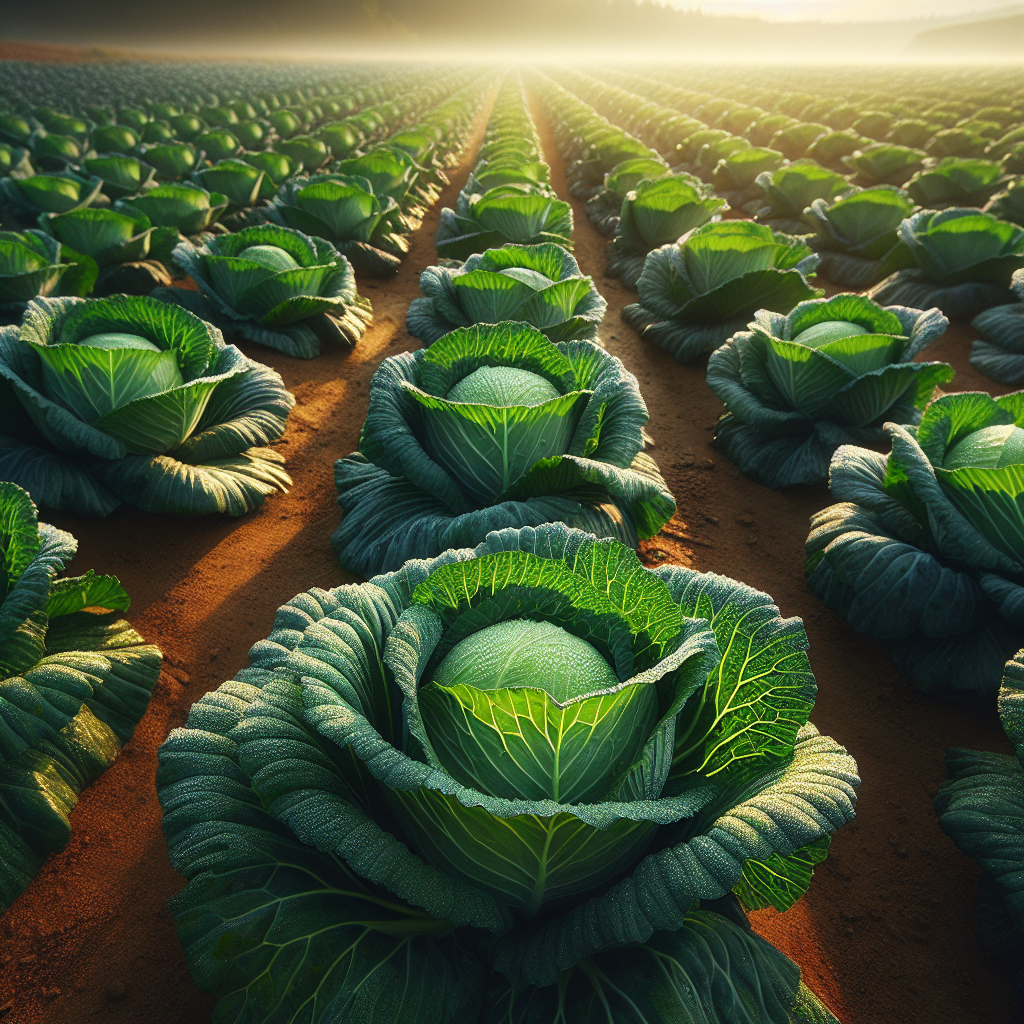
Introduction to Cabbage
Cabbage (Brassica oleracea var. capitata) stands as a cornerstone of global agriculture, cultivated for over 2,500 years since its domestication in the Mediterranean region from wild mustard plants. Historically, it fueled ancient Roman legions and became a staple in European peasant diets, evolving through selective breeding into the tight-headed varieties we know today. Modern cultivars range from crisp green heads like 'Golden Acre' for early harvests to robust red types such as 'Red Express' for color and storage longevity. This cool-season brassica excels in nutrient-dense soils, yielding heads weighing 1-10 pounds under ideal conditions, and serves as a dietary powerhouse rich in vitamins C and K, fiber, and antioxidants. Whether for fresh eating, kimchi fermentation, or coleslaw, mastering cabbage cultivation unlocks bountiful, space-efficient production even in small gardens.
Botanical Profile of Cabbage
Belonging to the Brassicaceae family, cabbage is a biennial herb grown as an annual, featuring a short, stout stem topped by a rosette of thick, waxy, blue-green leaves that form a globular head up to 25 cm in diameter. Botanically, its var. capitata distinguishes it from loose-headed cousins like kale (var. acephala), with axillary buds developing into the compact terminal bud we harvest. Leaves are obovate to elliptic, glabrous, with prominent veins and a waxy cuticle that minimizes water loss but can trap pests. Flower stalks, if allowed to bolt, produce yellow cross-shaped blooms in the second year, yielding siliques with 15-20 black seeds each. Key cultivars include early-maturing 'Early Jersey Wakefield' (60 days, pointed heads), mid-season 'Danish Ballhead' (90 days, 5-7 lb firm globes), and storage kings like 'Storage No. 6' (120 days, 10-15 lb). Root systems are fibrous and shallow, with 80% in the top 12 inches, demanding consistent moisture. Cabbage's glucosinolate content imparts its pungent flavor and pest-repelling properties, while genetic diversity offers hybrids resistant to bolting in fluctuating temperatures.
Soil, pH, and Climate Requirements for Cabbage
Cabbage demands fertile, well-drained loamy soil with high organic matter (4-6%) to support its heavy feeders status, incorporating 2-4 inches of compost or aged manure pre-planting for optimal tilth. Ideal pH is 6.5-7.0; below 6.0, molybdenum deficiency causes whiptail (thin, strap-like inner leaves), while above 7.5, Clubroot thrives—test soil annually and amend with lime or sulfur accordingly. Texture-wise, sandy loams retain moisture without waterlogging, but heavy clays need raised beds (12-18 inches high) to prevent root rot. Climate preferences lean cool: daytime temps 60-70°F (15-21°C), nights 45-55°F (7-13°C); above 75°F (24°C), heads crack and bitterness rises from rapid growth, while below 20°F (-7°C), plants survive but growth halts. Frost tolerance allows planting 4-6 weeks before last frost, with long-day varieties bolting prematurely in 16+ hour days. Full sun (6-8 hours) is essential, but light shade in hot climates prevents scorching—mulch with straw to maintain 60-70% soil moisture (field capacity: soil forms ball but crumbles easily when squeezed). For precision, use a soil probe: top 6 inches should feel like a wrung-out sponge; overwatering shows yellowing lower leaves and root edema, underwatering wilts heads midday.
Step-by-Step Planting & Propagation
Start seeds indoors 6-8 weeks pre-transplant (1/4 inch deep, 70-75°F soil, 7-10 day germination) in 72-cell trays with sterile mix, hardening off seedlings by gradually exposing to outdoors over 7-10 days. Direct sow in spring/fall rows 12-18 inches apart, 1/4-1/2 inch deep, thinning to 12-24 inches based on cultivar—'Savoy' types need wider spacing for crinkled leaves. Transplant when 4-6 true leaves form (3-4 inches tall), burying stems to first leaves to encourage adventitious roots, firming soil to eliminate air pockets. Optimal spacing: 18 inches in-row, 24-36 inches between rows for air circulation, accommodating mechanical cultivation. Seed rate: 1-2 oz per 1,000 sq ft yields 10,000 plants. For succession, plant early, mid, and late varieties every 2 weeks from February to September in temperate zones. Propagation rarely uses cuttings, but microgreens from leaf scraps offer quick secondary harvests. Fertilize at transplant with 1/2 lb 10-10-10 per 100 sq ft, side-dress nitrogen at 4-6 weeks. See our broccoli wiki for related brassica propagation tips.
Care & Maintenance regimes for Cabbage
Water deeply (1-1.5 inches/week) to 6-inch depth, aiming for consistent volumetric water content of 0.20-0.30 m³/m³—drip irrigation excels, delivering 0.5 gal/plant daily in peaks. Signs of overwatering: water-soaked leaf spots, stunted growth, slugs proliferating; underwatering: cupping leaves, bitter flavor, splitting heads. Fertilize with balanced NPK (e.g., 5-10-10) at 1 lb/100 sq ft pre-plant, sidedress 0.5 lb nitrogen/100 sq ft at cupping stage (4 weeks) and head formation (8 weeks)—excess N delays maturity, promotes loose heads. Cultivate shallowly to control weeds, mulching 3-4 inches straw post-emergence suppresses 90% competition. Blanch inner leaves in varieties prone to sunburn by tying outer leaves over heads 2 weeks pre-harvest. Monitor for bolting (tall stalk, bitter leaves) triggered by >80°F days or 14-hour photoperiod—choose bolt-resistant hybrids like 'Integro'. Hill soil around bases at 4 weeks to stabilize against wind. For fall companion planting, integrate with late-season allies to extend productivity.
Pests, Diseases & Organic Management
Common pests include Cabbage loopers (green caterpillars, skeletonized leaves)—deploy Bt kurstaki sprays weekly, handpick, or use row covers (1/4-inch mesh) from transplant until heading. Aphids cluster on stems: blast with neem oil (1 oz/gal) or introduce ladybugs (1,000/acre). Root maggots burrow into collars: use 3-inch cardboard collars at planting, rotate crops 3-4 years. Flea beetles pepper-shot holes: spinosad or yellow sticky traps. Diseases: Clubroot (galls on roots, wilting)—prevent with 14-day limed flooding pre-plant (pH 7.2+), resistant varieties like 'Badger Beauty'. Black rot (V-shaped lesions)—sanitize tools, copper fungicide. Downy mildew (yellow spots, gray mold)—improve spacing, potassium bicarbonate sprays. Alternaria leaf spot (concentric rings)—remove debris, chlorothalonil if severe. Organic IPM: scout weekly, maintain 70% ground cover to deter weeds/pests, interplant nasturtiums as traps. Crop rotation with grains like wheat breaks brassica pathogen cycles.
Harvesting, Curing & Optimal Storage
Harvest when heads are firm, 4-10 inches diameter (60-120 days per variety), cutting 1-2 inches above soil with sharp knife to leave wrapper leaves protecting stumps for potential ratoon crops. Twist gently to check density—immature heads are loose, overmature split. Yield: 4-6 heads/plant in optimal conditions. Cure in field 1-2 days for partial drying if rainy, then store at 32-40°F (0-4°C), 95-100% humidity—cellar bins or perforated bags prevent condensation rot. Red/savoy types store 4-6 months, green 2-3 months; check weekly for soft spots, trim as needed. For sauerkraut, harvest crisp autumn heads, core removal yields 10-12% salt-fermented product lasting 6+ months refrigerated.
Companion Planting for Cabbage
Dill, chamomile, and sage attract beneficial wasps parasitizing cabbage worms, boosting yields 20-30%. Onions, garlic, and celery repel Aphids/loopers via sulfur volatiles—plant 6-12 inches away. Beets and lettuce shade soil, conserving moisture without competing. Avoid strawberries (draw slugs), tomatoes (share hornworms), and pole beans (shade excessively). Nasturtium as trap crop lures Flea beetles. In polycultures, cabbage underplanted with clover fixes nitrogen, enhancing soil for rotations. Check our Soil Health Mastery for synergistic amendments.