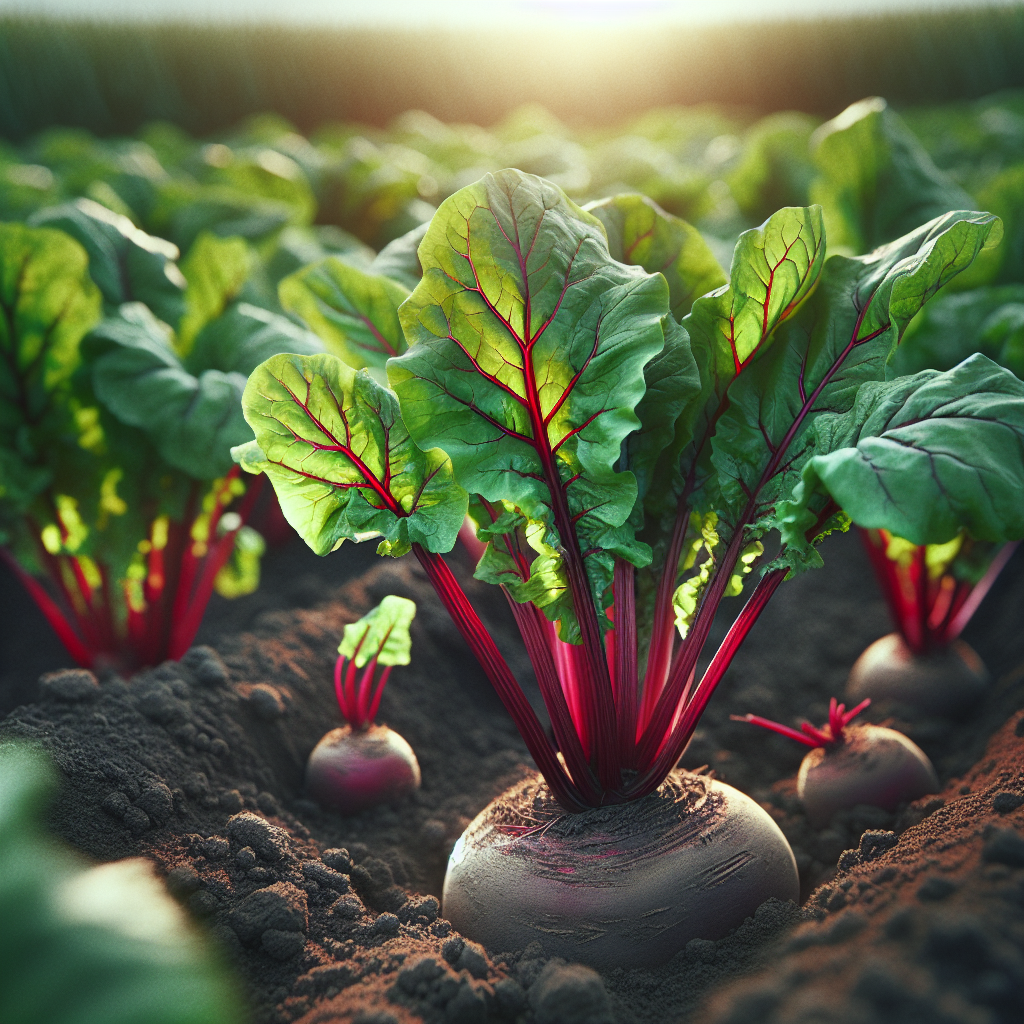
Introduction to Beet
Beet is one of the most versatile cool-season crops in the garden and on diversified farms. It is grown for both its enlarged root and its edible tops, offering value as a fresh-market bunching crop, a storage root, a baby vegetable, and a processing crop. The familiar red table beet is only one expression of a highly variable species that also includes sugar beet, mangel, and chard. This diversity explains why beet is adaptable, but it also means good management matters: varieties differ in root shape, maturity, sweetness, zoning patterns, and tolerance to heat or cold.
The modern table beet likely descends from the sea beet of Mediterranean and Atlantic coasts. Early cultivation emphasized leaves rather than roots, and the swollen storage root was selected later. Today, beet remains important because it produces quickly, can be succession sown, tolerates light frost, and stores well when harvested at the correct stage. For growers, it is a crop where small errors in spacing, irrigation consistency, or soil structure show up directly in root quality. Forked roots, woody texture, zoning, and poor sizing are usually management problems rather than bad luck.
Commercially and in home production, beets are valued for betalain pigments, earthy aroma compounds such as geosmin, and strong nutritional density. They are rich in folate, potassium, manganese, and dietary nitrates, while the greens contribute vitamins A, C, and K. Good beet production therefore depends on treating it as both a root crop and a leafy crop: healthy foliage drives root bulking, but excessive nitrogen can delay desirable root development.
Botanical Profile of Beet
Beet belongs to the Amaranthaceae family and is botanically classified as Beta vulgaris. Table beet, sugar beet, Swiss chard, and fodder beet are all forms of the same species, selected for different plant parts and uses. The edible root of table beet is technically a swollen hypocotyl-root complex rather than a pure root in the strictest botanical sense. That is why uniformity of shape depends so heavily on early growth conditions and not just underground soil texture.
Beet is usually grown as an annual, but it is naturally biennial. In the first season it forms leaves and a storage organ; in the second, after exposure to cold, it bolts and flowers. Premature bolting in the production year can be triggered by vernalization from prolonged exposure to low temperatures while plants are still juvenile, especially if seed is sown too early into cold soil. Once bolting begins, root quality declines quickly.
Leaves emerge in a rosette from a short crown. They are smooth to lightly crinkled, often with red or purple petioles depending on cultivar. Root shape ranges from flattened globe to round, cylindrical, or long tapering forms. Flesh can be deep red, dark burgundy, golden, white, or concentrically ringed. Cylindrical cultivars are favored by some market growers for slicing and reduced waste; round cultivars are common for bunching and general use.
A critical practical detail is that the "seed" of beet is usually a dried seed cluster, often called a multigerm seedball, containing more than one true seed. This is why thinning is usually necessary. Monogerm varieties exist and are especially useful in precision production systems. Growers familiar with Swiss chard relatives may notice some similar leaf traits, but beet is managed much more carefully for root uniformity.
Common table beet cultivar groups include:
- Early round reds such as 'Detroit Dark Red' types, valued for reliability and broad adaptation.
- Baby beet types selected for uniform small roots and quick maturity.
- Cylindrical beets such as 'Cylindra', ideal for slicing and roasting.
- Golden and white beets, which have milder flavor and less staining.
- Chioggia types with concentric rings, best harvested young for visual appeal.
Days to maturity generally range from 50 to 70 days for baby and bunching roots, and 70 to 90 days for larger storage roots, though temperature and spacing influence this heavily.
Soil, pH, and Climate Requirements for Beet
Beet performs best in loose, well-drained, stone-free soil with good moisture-holding capacity and enough fine tilth to allow uniform swelling. Sandy loams and silt loams are ideal, but well-structured clay loams can also produce excellent crops if drainage is good and compaction is minimized. Heavy, cloddy, or crusting soils produce misshapen roots, uneven stands, and difficult harvests.
The target soil pH is 6.0 to 7.5, with an ideal range of about 6.5 to 7.0. Beet tolerates slightly alkaline conditions better than many vegetables, but strongly acidic soils below about 5.8 increase the risk of nutrient imbalance and poor growth. Boron is particularly important in beet; deficiency is more common in sandy, low-organic-matter, or drought-prone soils and can lead to blackened internal tissue, cracked roots, and poor heart development. If boron is deficient according to a soil test, it must be corrected carefully because the margin between deficiency and toxicity is narrow.
Beets are a cool-season crop. The best root color, texture, and sweetness usually develop when daytime temperatures are around 15 to 24 C and nights are cool. Seeds can germinate in soils as low as about 7 C, but emergence is faster and more uniform from 10 to 29 C. Soil temperatures above 30 C reduce germination and can increase stand irregularity. Young plants tolerate light frosts, and mature roots can handle brief cold periods, but hard freezing of exposed crowns can reduce storage quality.
For climate adaptation:
- In temperate zones, sow in early spring and again in late summer for autumn harvest.
- In mild winter regions, sow from autumn through late winter for continuous cool-season production.
- In hot climates, prioritize shoulder seasons and use mulch to buffer root-zone heat.
Consistent moisture is essential. Beet roots should develop in soil that remains evenly moist to a depth of 10 to 20 cm during establishment and 15 to 25 cm during bulking. As a practical target, avoid letting the top 5 cm become powder dry for extended periods, but also avoid saturation that excludes oxygen. Overwatering often shows up first as pale foliage, slow growth despite wet soil, algae or moss on the surface, and roots that are bland, cracked, or prone to rot. Underwatering produces tough skins, a stronger earthy flavor, slowed bulking, and concentric stress rings.
A fertile soil with moderate nitrogen and good phosphorus and potassium is preferred. Excess fresh manure or high ammonium fertility can cause hairy roots, branching, and lush tops at the expense of root quality. It is better to grow beets after a well-manured preceding crop than to sow directly into freshly manured ground. For broader soil preparation principles, see soil health strategies.
Step-by-Step Planting & Propagation
Beets are almost always direct sown. Transplanting is possible for cell-grown plants, but it is generally inferior for root symmetry and efficiency unless used in specialty production. Direct seeding gives the straightest, smoothest roots and the least disturbance.
Prepare the bed thoroughly. Create a fine, level seedbed at least 20 to 25 cm deep, free of stones, sticks, and undecomposed organic matter. Broadforking or subsoiling before final bed shaping is useful where compaction exists. Avoid overworking wet soil, which leads to smearing and later hardening.
Pre-irrigate if soil is dry. Uniform germination depends on moisture around the seedball. If the soil profile is dry, irrigate before sowing so water reaches 10 to 15 cm deep.
Sow at the correct depth. Place seeds 1.5 to 2.5 cm deep in cool or drying conditions, and around 1 to 1.5 cm deep in moist, fine soils. Too shallow leads to poor anchorage and drying; too deep delays emergence.
Space rows and plants according to market goal. For baby beets, rows may be 20 to 30 cm apart with 5 to 7 cm between plants after thinning. For medium fresh-market roots, use 25 to 40 cm between rows and 7 to 10 cm between plants. For larger storage roots, maintain 10 to 12 cm in-row spacing. Dense stands produce smaller roots and can be useful for bunching production.
Expect slower emergence in cold weather. Germination typically takes 5 to 10 days in warm soils and up to 14 days or longer in cool conditions. Floating row cover can improve speed and protect against Flea beetles and Leafminers during establishment.
Thin decisively. Because many beet seedballs are multigerm, thinning is a quality-critical task. Thin first when seedlings are 2.5 to 5 cm tall, leaving the strongest seedlings. A second thinning may be needed if multiple plants still remain. Delayed thinning causes prolonged competition, producing elongated tops and undersized roots that never fully recover.
Succession sow. For continuous harvest, sow every 2 to 3 weeks in spring and again in late summer where autumns are long. In high summer heat, germination may be erratic unless beds are shaded lightly or kept uniformly cool and moist.
For growers targeting premium quality, precision seeding with calibrated seed can reduce labor. Pelleted monogerm seed is especially useful in mechanized or highly planned systems.
Care & Maintenance regimes for Beet
After establishment, the main priorities are even moisture, weed control, balanced nutrition, and canopy protection. Beets are not difficult, but they respond strongly to consistency.
Irrigation should be managed to keep the root zone steadily moist without long dry intervals followed by heavy soaking. A useful benchmark is about 25 to 38 mm of water per week from rainfall plus irrigation under moderate spring conditions, rising in sandy soils or warmer weather. During root bulking, water deeply enough to moisten 15 to 20 cm of soil. Drip irrigation is excellent because it reduces foliage wetness and maintains stable moisture. Overhead irrigation can work, but repeated wet foliage favors leaf disease.
Signs of correct watering include steady leaf expansion, smooth root shoulders, and uniform size progression. Signs of drought stress include midday wilting that persists into evening, dull or bluish foliage, cracking shoulders after rewatering, and stronger geosmin flavor. Signs of excess water include yellowing lower leaves, anaerobic smell in the soil, slow root enlargement, and increased root disease.
Weed control is most important during the first 4 to 6 weeks. Beet seedlings are not highly competitive, especially before the canopy closes. Use shallow cultivation only; deep hoeing can prune feeder roots and disturb swelling roots. Organic mulches can help conserve moisture and suppress weeds once seedlings are established, but keep heavy mulch from smothering tiny seedlings in cool weather.
Nutrient management should emphasize moderation. A common professional approach is to supply most phosphorus and potassium before sowing and use nitrogen sparingly. Too much nitrogen creates lush tops and delays root sizing. On average soils, a light side-dress after thinning may be enough if growth is pale or slow. If leaves are dark green and vigorous, additional nitrogen is often unnecessary.
Key nutrient observations:
- Nitrogen deficiency: pale older leaves, small canopy, slow bulking.
- Excess nitrogen: oversized tops, delayed root swelling, lower sweetness.
- Potassium deficiency: leaf edge scorch, weak stress tolerance.
- Boron deficiency: internal black spots, corkiness, cracked roots, death of growing point in severe cases.
- Magnesium deficiency: interveinal chlorosis on older leaves in light soils.
If growing for greens as well as roots, harvest outer leaves sparingly. Removing too many leaves reduces carbohydrate production and shrinks final root size. As a rule, never remove more than one-third of the foliage at one time on plants intended for root harvest.
Temperature management matters. Beets can tolerate frost, but extended heat above about 27 to 30 C reduces tenderness and can encourage fibrous texture. In warm regions, use mulch, morning irrigation, and seasonal timing to keep growth active without heat stress.
Pests, Diseases & Organic Management
Beet is generally robust, but several pests and diseases can lower root quality or marketability if not managed preventively.
Common insect pests include Leafminers, Flea beetles, Aphids, Beet webworm, and occasionally Cutworms or Armyworms. Leafminers tunnel within leaves, reducing photosynthetic area. Early row cover is one of the most effective organic tools, especially before temperatures become excessive. Remove heavily infested leaves if pressure is low. Flea beetles create tiny shot holes in young leaves and can seriously stunt seedlings; floating row cover and vigorous early growth are the best defenses. Aphids may cluster on leaf undersides and can vector viruses; strong plant vigor, beneficial insects, and insecticidal soap where appropriate provide control.
Root maggot pressure is less universal but can be serious in some regions. Good sanitation, rotation, and exclusion are important. Avoid repeatedly planting beets or related crops in the same ground.
Major diseases include Cercospora leaf spot, Downy mildew, Damping-off, Scab, and a complex of Root rots caused by waterlogged soil or pathogen buildup. Cercospora is among the most important foliar diseases in warm, humid conditions. It begins as small circular spots with tan to gray centers and reddish or purple margins. Severe infections defoliate the crop, which directly reduces root sizing. To manage organically:
- Rotate out of beet and related crops for at least 3 years where disease pressure is high.
- Maintain wide enough spacing for air movement.
- Irrigate at the soil level when possible.
- Remove heavily infected residues after harvest.
- Use resistant or tolerant cultivars where available.
- Apply approved copper or biological protectants preventively if local pressure is chronic and conditions favor infection.
Damping-off during emergence is often caused by cold, wet soils and poor airflow. Prevent it with fresh seed, clean seedbeds, good drainage, and avoiding overwatering before emergence. Scab is more common in alkaline, dry conditions and with fresh manure. Root rots increase sharply in compacted or saturated beds.
Organic disease prevention starts with rotation, sanitation, drainage, and balanced fertility. Do not plant beet after beet, chard, or sugar beet in the same area. A 3- to 4-year rotation is better if leaf spot or root disease has been significant. Nearby plantings of related crops may also harbor shared pathogens.
Harvesting, Curing & Optimal Storage
Beets can be harvested at nearly any size, but quality peaks within a fairly specific window depending on use. Baby beets are often harvested at 2.5 to 4 cm diameter. Bunching beets are commonly harvested at 4 to 6 cm. Storage beets may reach 6 to 8 cm or slightly more, but very oversized roots can become coarse depending on cultivar and growing conditions.
For fresh market bunching, harvest when roots are uniform, well-colored, and before shoulders become rough or woody. Loosen soil first to prevent tearing tops from the crown. If selling with greens attached, cool immediately after harvest because tops respire rapidly and draw moisture from the root.
For storage, harvest before hard freezes, preferably when soil is moderately moist but not wet. Lift roots gently to avoid cuts and bruises. Trim tops to about 2 to 3 cm above the crown rather than cutting flush; this helps reduce bleeding and storage rot. Do not wash if roots are destined for long storage unless they can be dried thoroughly and cooled immediately. Instead, brush off loose soil.
Beets do not require curing in the same way as onions or sweet potatoes, but they benefit from short drying and cooling after harvest. Allow surface moisture to dry in shade with good airflow, never in hot sun. Then move roots into cold storage promptly.
Optimal storage conditions are 0 to 2 C with 95 to 98% relative humidity. Under these conditions, sound roots can store for 3 to 5 months, and often longer with excellent handling. High humidity is important because beets lose water through the skin and crowns; shriveling indicates low humidity or excessive airflow. At warmer temperatures, sugars are consumed faster and sprouting risk increases.
Store only healthy roots. Discard cracked, bruised, insect-damaged, or diseased beets. In root cellars, pack in slightly damp sand, sawdust, or perforated crates to maintain humidity while allowing some air movement. Check regularly and remove any softening roots.
If storing greens separately, keep them near 0 C with very high humidity and use quickly; beet greens are much more perishable than roots. Postharvest handling standards for beet are similar in discipline to those used for other root crops such as carrot production, where gentle lifting and rapid cooling are key to long shelf life.
Companion Planting for Beet
Beet fits well into mixed plantings because it occupies a modest canopy footprint and grows mainly below the soil surface. It is especially useful in beds with crops that mature quickly or provide light shade during hotter periods.
Good companions include lettuce, onions, bush beans, cabbage-family crops, and many herbs. Lettuce pairs well because it shades the soil lightly without competing deeply, and both crops appreciate steady moisture. Onions and other alliums may help diversify pest pressure patterns and make efficient use of bed space because their root architecture differs from beet. Brassicas can also coexist well when spacing and fertility are managed carefully.
Avoid placing beet where it will be heavily shaded by tall, aggressive crops that reduce light and air movement. While some afternoon shade can help in hot climates, dense competition from sprawling or towering plants can reduce root bulking. Also avoid repeated close association with crops in the same botanical group, such as chard and spinach relatives, if disease rotation is a concern.
Companion planting should be treated as a spacing and ecology tool, not a magic solution. The best combinations are those that reduce bare soil, improve bed turnover, and simplify irrigation. A practical example is alternating beet rows with lettuce or onion in a spring bed, then following harvested beet with a summer succession crop. Diverse plantings also support beneficial insects and can reduce the visual uniformity that sometimes encourages pest buildup.
In professional systems, the most effective companion strategy is often temporal rather than purely spatial: pairing beet with crops that occupy the bed before or after it, preserving soil structure and maintaining continuous but balanced fertility. With proper rotation, moisture management, and thinning discipline, beet rewards growers with one of the most dependable, nutritious, and storage-friendly harvests in the cool-season garden.