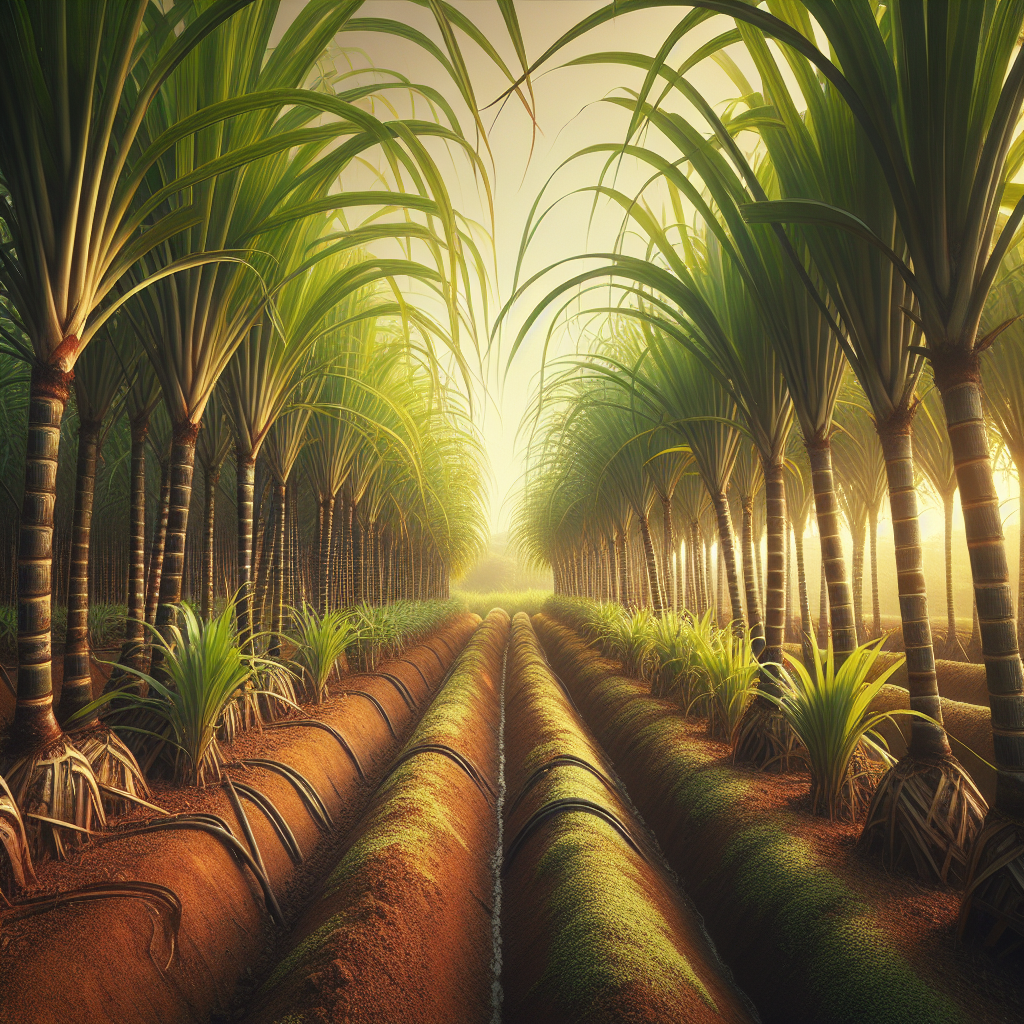
Introduction to Sugarcane
A giant C4 grass of the family Poaceae, sugarcane is one of the most efficient biomass-producing crops on earth. It is cultivated across tropical and subtropical regions for crystal sugar, fresh chewing cane, cane juice, molasses, rum, ethanol, bagasse for fuel and fiber, and tops for fodder. Modern commercial cane is not a simple species but largely a complex interspecific hybrid derived from Saccharum officinarum, S. spontaneum, S. barberi, and S. sinense, bred to combine high sucrose with vigor, disease resistance, and ratooning ability.
Historically, sugarcane domestication traces back to New Guinea and island Southeast Asia, followed by spread into India, Persia, the Mediterranean, the Americas, and Africa. Its agronomy varies by region, but the same principle holds everywhere: the crop rewards precise establishment and disciplined field management. Unlike annual cereals, cane occupies land for 10 to 24 months depending on climate and cropping system, and may be cut repeatedly from the same root system as ratoon crops. That long field life means small errors in planting depth, drainage, or seed cane health can reduce yield for more than one season.
For growers comparing tropical carbohydrate crops, cane is often evaluated alongside Cassava because both thrive in warm climates and produce substantial energy per hectare, though cane is more water-demanding and nutrient-hungry. Good field planning, soil rebuilding, and residue management are especially important; broad principles in soil health strategies apply strongly to cane systems where compaction and organic matter depletion can silently erode profits.
Botanical Profile of Sugarcane
Sugarcane is a robust, tufted perennial grass forming clumps of thick canes from underground buds on setts and ratoon stools. Mature plants commonly reach 2 to 5 meters tall, though local conditions and cultivar can push growth beyond that range. The stalk, technically a culm, is segmented into nodes and internodes. Each node bears a bud, root band, and leaf scar. These nodal buds are the basis of vegetative propagation.
Leaves are long, narrow, and arching, typically 1 to 2 meters in length with a pronounced midrib and finely serrated margins that can cut skin during field work. Leaf sheaths clasp the stem tightly, and sheath color, waxiness, internode hue, bud shape, and rind hardness are key varietal descriptors used in field identification. The inflorescence is a silky panicle, often called an arrow, but flowering is generally undesirable in commercial sugar production because it diverts resources, complicates maturity, and can reduce sugar accumulation under some conditions.
As a C4 photosynthetic plant, sugarcane uses heat and strong sunlight very efficiently, explaining its high productivity in warm environments. Sugar is stored mainly as sucrose in the parenchyma cells of the internodes. High fiber canes are preferred in some biomass systems, while chewing cane types may be selected for softer rind, lower fiber, and sweeter juice. Modern cultivars are usually chosen for a combination of traits: high tonnage, high sucrose percentage, disease resistance, erect growth, lodging resistance, adaptation to local harvest windows, and strong ratoon performance.
Rooting occurs from nodes on planted setts and later from basal nodes of the shoot system. The root system is fibrous but extensive, often concentrated in the top 60 centimeters of soil while exploring deeper layers where structure allows. This is why cane is highly responsive to deep, friable soil and very sensitive to compacted hardpans and prolonged waterlogging.
Soil, pH, and Climate Requirements for Sugarcane
Sugarcane performs best in deep, fertile, well-drained soils with high moisture-holding capacity and good aeration. Ideal textures range from loam to clay loam and silty clay loam, provided drainage is reliable. Sandy soils can grow cane, but they require more frequent irrigation and tighter nutrient management because nitrogen and potassium leach readily. Heavy clays can also be productive if fields are well-leveled and drained; otherwise, standing water suppresses root respiration and encourages sett rot, red rot, and stunted early growth.
An effective rooting depth of at least 1 to 1.5 meters is highly desirable. Hardpans, plow pans, or compacted subsoil reduce cane stool size and limit ratoon vigor. Before planting, dig soil pits or use a penetrometer if available. If roots cannot penetrate below 30 to 40 centimeters, subsoiling or deep ripping before the first planting is often justified.
The optimum soil pH is generally 6.0 to 7.5. Cane tolerates a somewhat wider range, roughly 5.0 to 8.0, but productivity falls at extremes. In strongly acidic soils below pH 5.5, aluminum and manganese toxicity may impair root growth, while phosphorus becomes less available. Liming should ideally be done several months before planting and incorporated deeply enough to benefit the rooting zone. In alkaline soils, micronutrient deficiencies, especially zinc and iron, can appear as chlorosis and poor tillering.
Climate is one of the strongest determinants of yield and sugar recovery. Cane prefers mean temperatures of 24 to 32°C during active vegetative growth. Germination of buds is best around 28 to 35°C. Below about 20°C, sprouting slows noticeably; below 15°C, growth is poor; frost can severely damage leaves and immature stalks. Ripening, however, is favored by a slightly cooler, drier finishing period with bright days and reduced vegetative flush. Excess rain late in the season can dilute juice quality and delay maturity.
Rainfall requirements vary with soil type and evaporative demand, but a total of 1,200 to 1,800 mm well distributed across the season is often ideal for rainfed systems. In drier climates, irrigation is essential. Full sunlight is critical; shading reduces tillering and sucrose accumulation. Wind can lodge tall canes, especially high-nitrogen crops with lush top growth, so shelterbelts may help in exposed sites if they do not cast significant shade.
Step-by-Step Planting & Propagation
Commercial sugarcane is almost always propagated vegetatively from stem cuttings called setts, seed pieces, or cane billets. True seed is used mainly in breeding. For farmers, the quality of planting material is one of the biggest predictors of success.
Select healthy mother cane. Choose disease-free, true-to-type stalks from a vigorous nursery or healthy field, ideally 7 to 10 months old for seed purposes. Avoid canes with red rot symptoms, smut whips, borer holes, wilt, or shriveled buds. The top third often has better bud viability, but excessively immature tissue may be weaker; many growers prefer well-developed upper-middle portions.
Prepare the land thoroughly. Plow deeply, break clods, remove perennial weeds, and level the field. In compact soils, rip or subsoil before final bed formation. Incorporate well-decomposed farmyard manure or compost at 10 to 25 tons per hectare, adjusted for soil test and availability.
Open furrows or trenches. Common furrow depth is 15 to 25 cm. In drier regions, deeper furrows help conserve moisture. In high rainfall areas, shallower planting on ridges or broad beds improves drainage. Row spacing depends on cultivar and mechanization, typically 90 to 150 cm. Narrower rows can increase early canopy closure but may complicate interculture and harvest.
Cut and treat setts. Two-budded or three-budded setts are standard. Each piece should be cut cleanly with minimal crushing. Hot-water treatment, where locally recommended, can reduce some seed-borne diseases and pests; protocols vary but often involve exposure around 50 to 52°C for a carefully controlled duration. Biological dips using Trichoderma or other approved biocontrols are often used in organic-leaning systems to suppress sett rots.
Place setts correctly. Lay them horizontally in furrows, bud side lateral or slightly upward, with slight overlap or end-to-end arrangement. Maintain consistent density. As a rough guide, planting rates often range from 35,000 to 60,000 three-budded setts per hectare depending on row spacing and varietal tillering ability.
Cover lightly at first. Use 5 to 7 cm of fine soil rather than burying too deeply. Deep burial delays emergence and raises the risk of rotting, especially in cool or wet conditions. As shoots emerge and grow, gradually earth up around the stools.
Irrigate immediately if soil is dry. The seed zone should remain evenly moist but not saturated during the first 3 to 4 weeks. Buds need oxygen as much as water. If the furrow remains anaerobic, buds blacken and fail.
Fill gaps early. Inspect emergence after 30 to 45 days. Missing hills should be replanted promptly using pre-sprouted setts or nursery-raised single-bud plants to maintain uniformity.
In some regions, single-bud chip seedlings raised in trays are increasingly used to reduce seed cane requirement and improve stand establishment. These transplants must be hardened before field setting and planted into moist soil with immediate irrigation.
Care & Maintenance regimes for Sugarcane
Sugarcane management is best understood by growth stage: germination, tillering, grand growth, and ripening.
During germination, the priority is uniform sprouting. Soil around the setts should stay moist to roughly field capacity, not waterlogged. Practically, if you squeeze a handful of soil from the seed zone, it should hold together without dripping. If it smears and shines, it is too wet; if it will not form a weak ball, it is too dry. Prolonged saturation causes sour-smelling soil, yellowing sprouts, patchy emergence, and sett decay.
During tillering, the crop rapidly produces shoots and builds canopy. Moisture stress at this stage reduces stalk population permanently. Depending on soil and weather, irrigation is commonly needed every 7 to 12 days in lighter soils and every 12 to 20 days in heavier soils. Drip irrigation allows more frequent, lower-volume applications and can improve water-use efficiency dramatically. Cane often needs 1,500 to 2,500 mm total water over the full crop cycle in hot irrigated environments. The crop should not be allowed to wilt repeatedly; rolled leaves in midday that fail to recover by evening indicate significant stress.
The grand growth phase is when elongation is fastest and nutrient demand peaks. This is not the time to let fields dry severely. Many growers target replenishing 50 to 70% of depleted available soil water before visible stress appears. Waterlogging is equally harmful. Oxygen-starved roots lead to poor uptake, pale foliage, reduced internode length, and increased susceptibility to disease. If lower leaves yellow while soil remains constantly wet, suspect drainage problems rather than nitrogen deficiency alone.
Nutrient management must be based on soil testing, expected yield, and previous crop history. As a broad commercial range, cane may remove or require roughly 100 to 250 kg N/ha, 50 to 100 kg P2O5/ha, and 100 to 250 kg K2O/ha, with substantial calcium, magnesium, sulfur, and silicon needs depending on soil reserves. Nitrogen should usually be split, with a basal component and one or more topdressings completed before peak grand growth. Late nitrogen delays ripening, lowers juice quality, and can increase lodging. Phosphorus is best placed near the root zone at planting because it moves poorly in soil. Potassium is especially important for water relations, stalk strength, and sugar transport.
Organic systems often combine compost, filter cake, press mud, green manures, biofertilizers, and crop residues. Cane trash mulching can be highly beneficial: it suppresses weeds, conserves moisture, moderates soil temperature, and returns potassium and organic matter. However, thick trash in humid zones can shelter rodents or slow soil warming, so management should fit local pest pressure.
Weed competition is most damaging in the first 90 to 120 days. Keep rows clean by shallow cultivation, hand weeding, mulching, or integrated methods. Deep cultivation near stools can prune roots and reduce yield. Earthing up after the crop is established supports stalks, suppresses weeds, and improves drainage around the crown.
Ratoon management deserves special attention. After harvest, remove trash judiciously, cut stalks close to the ground to preserve low basal buds, shave stubble if recommended locally, apply fertilizer early, and irrigate promptly to activate ratoon buds. Yields usually decline with each ratoon, but well-managed systems can profit from one to several ratoon crops depending on disease pressure and cultivar.
Pests, Diseases & Organic Management
Sugarcane hosts a wide pest and disease complex, and prevention is more effective than rescue treatment.
Major insect pests include early shoot borer, internode borer, top borer, stem borers, pyrilla leafhopper, woolly aphid, white grubs, termites, scale insects, and mealybugs. Borer injury is often recognized by deadhearts in young cane, frass near boreholes, weak stalks, and reduced juice recovery. top borer may cause bunchy top-like leaf symptoms with damaged spindle leaves. Sucking pests reduce vigor, promote sooty mold, and interfere with photosynthesis.
Organic and low-input management begins with clean planting material, field sanitation, resistant cultivars, trash management that does not favor pest carryover, and destruction of heavily infested residues. Light traps, pheromone traps where available, release or conservation of parasitoids such as Trichogramma spp., and encouragement of predators help suppress borers and sap feeders. Neem-based products can reduce some soft-bodied pests but are less reliable against concealed borers once larvae enter stems. Termite problems often worsen in drought-stressed fields with poorly decomposed organic matter and weak seed pieces.
Key diseases include red rot, smut, wilt, grassy shoot disease, ratoon stunting disease, rusts, pokkah boeng, sett rot, and mosaic viruses. red rot remains one of the most destructive fungal diseases in many cane-growing regions; split stalks may show reddening of internal tissues with characteristic white patches and a sour alcoholic smell. smut produces black whip-like structures from infected shoots. Grassy shoot causes profuse tillering, narrow chlorotic leaves, and failure to form marketable canes. ratoon stunting disease is especially insidious because external symptoms can be subtle while yields decline.
Disease control is built on resistant varieties, certified disease-free seed cane, hot-water treatment where appropriate, sanitation of cutting tools, rouging of infected clumps, and avoiding repeated ratooning in heavily affected fields. Water stagnation increases many sett and root diseases, while nutrient imbalance and excessive nitrogen can aggravate susceptibility. Rotating out of cane after several cycles can break pest and disease buildup and restore soil structure.
Rodents can also cause severe losses by gnawing stalks, especially under heavy mulch or near bunds and unmanaged field edges. Owl perches, habitat management, trapping, and coordinated community action are often more effective than isolated control.
Harvesting, Curing & Optimal Storage
Harvest timing determines both cane tonnage and sugar recovery. Cane is ready when stalks are fully grown, internodes are firm, lower leaves begin drying naturally, and juice quality tests show maturity. In practical terms, mature cane often has reduced top elongation, a drier look in the lower canopy, and a characteristic hard, ringing stalk. Laboratory indicators such as Brix, pol, purity, and reducing sugar levels are used by commercial mills, but even small growers should learn simple refractometer testing if processing for juice or jaggery.
Harvest too early and stalks contain more water and less recoverable sugar. Harvest too late and lodging, pithiness, fiber increase, pest damage, flowering, or sucrose inversion may reduce quality. For chewing cane, texture, sweetness, and appearance matter in addition to sucrose concentration.
Cut stalks as close to ground level as possible because the basal internodes often contain the highest sugar concentration. Remove tops and dry leaves promptly. Harvesting should ideally be done in cool hours to reduce respiration losses. Avoid bruising and excessive delays between cutting and crushing. Once cane is cut, sucrose gradually declines through respiration and microbial action, especially in warm conditions.
Unlike grains, sugarcane is not usually “cured” in the classic sense, but post-harvest handling matters greatly. If the cane is destined for milling, process within 24 hours when possible and preferably within 48 hours at most. Stalks stored in piles under hot sun lose moisture and sugar fast. Keep harvested cane shaded, off bare wet ground, and well ventilated. Whole stalks store better than chopped billets because exposed cut ends accelerate dehydration and microbial invasion.
For short-term storage of fresh market cane, retain some sheath protection if appearance standards allow, avoid washing unless necessary, and maintain cool humid conditions around 10 to 15°C with high relative humidity, while preventing condensation. For seed cane, select healthy mature stalks, protect from direct sun, and plant quickly; prolonged storage weakens buds. If jaggery or syrup is the end product, sanitation during crushing and boiling is critical to preserve flavor and shelf life.
Companion Planting for Sugarcane
Because sugarcane is tall, long-duration, and initially slow to cover the ground, companion planting is most useful in the early months before full canopy closure. The goal is not crowding but productive use of inter-row space, weed suppression, nitrogen support, or beneficial insect attraction.
Short-duration legumes are the classic companions. Cowpea, green gram, black gram, soybean, and peanut can fit between wide cane rows if planted early and terminated or harvested before cane shading becomes severe. These crops help cover the soil, reduce erosion, and in some systems contribute biologically fixed nitrogen, though the direct nitrogen transfer to the standing cane crop is often modest unless residues are incorporated or mulched.
Low, quick vegetables may be used in garden-scale plantings where row spacing is generous, but commercial growers should avoid companions that complicate irrigation, harbor shared pests, or delay earthing up. Aromatic border plants such as basil or marigold may help attract beneficial insects in diversified farms, though they should not interfere with movement or create shade competition in the root zone.
Avoid heavy feeders that compete strongly for water and potassium during the cane establishment phase. Also avoid companion crops known to host important cane pests or diseases in your region. In high-rainfall areas, companions should not restrict air movement around young cane or worsen humidity near the stool.
A practical pattern is to intercrop only during the first 60 to 100 days, then remove or harvest the companion before the cane enters rapid grand growth. This preserves the main crop’s yield potential while improving early land productivity. In small farms, intercropping cane with short legumes is often most successful when irrigation lines, fertilizer bands, and harvest timing are planned from the beginning rather than improvised after emergence.
When managed well, sugarcane is among the most rewarding warm-climate crops, but it is unforgiving of poor drainage, weak seed cane, and neglected early-stage management. Build the crop from the soil upward, plant only vigorous healthy setts, maintain uniform moisture without saturation, feed according to soil and growth stage, and harvest at true maturity for the best combination of tonnage and sugar quality.