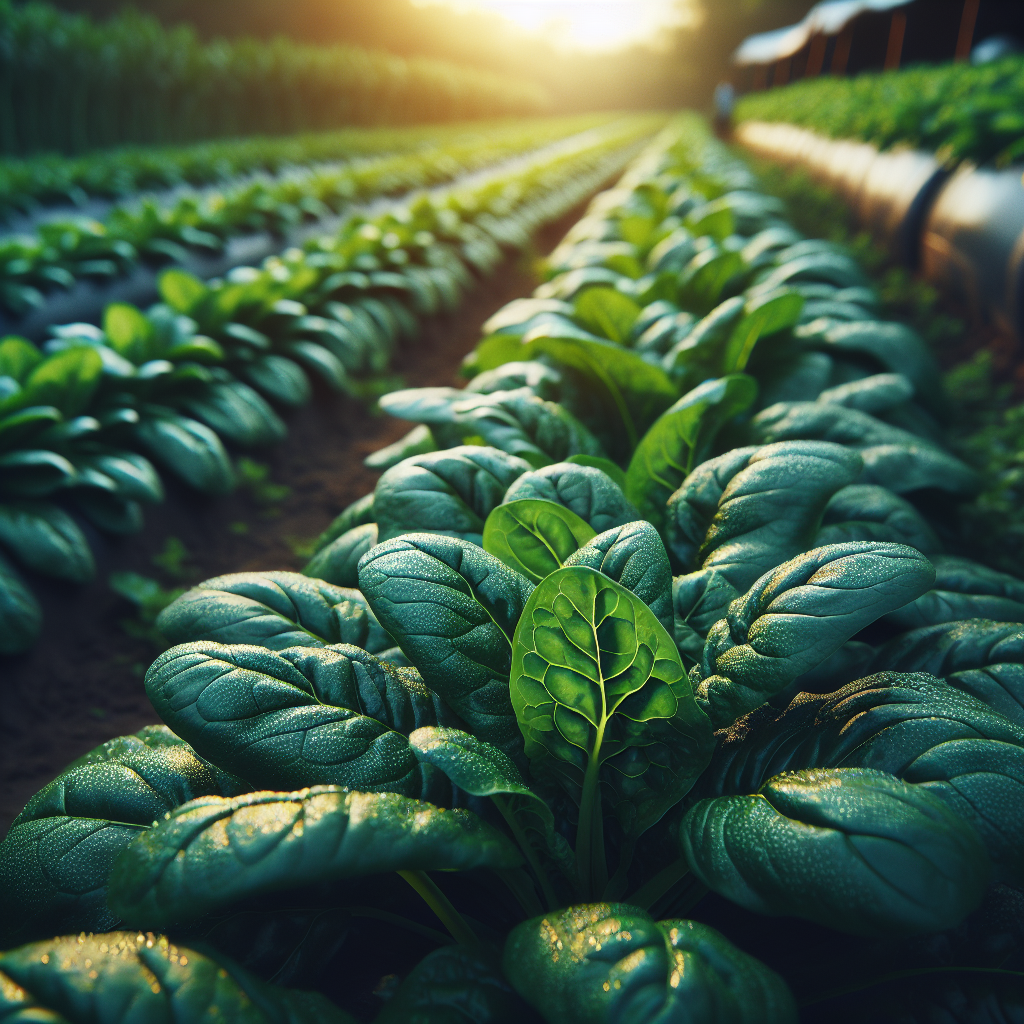
Introduction to Spinach
A classic cool-season leaf crop, spinach has been cultivated for centuries and remains one of the most important greens in both commercial and home production. Thought to have originated in ancient Persia before spreading through the Arab world into Europe and later globally, it gained prominence because it grows quickly, tolerates light frosts, and produces tender leaves rich in iron, folate, carotenoids, vitamin K, and chlorophyll.
From a production standpoint, spinach is notable for its short crop cycle. Baby-leaf spinach can be ready in as little as 20 to 30 days under ideal conditions, while bunching or full-leaf types often mature in 35 to 50 days. That speed makes it highly profitable in intensive systems, but also means mistakes show up quickly. A few days of heat, erratic irrigation, or excessive nitrogen can shift the crop from lush and marketable to stretched, bitter, diseased, or bolting.
Modern spinach falls broadly into savoy, semi-savoy, and smooth-leaf categories. Savoy types have heavily crinkled leaves and often better cold tolerance but are harder to wash. Smooth-leaf types are easier to clean and dominate baby-leaf production. Semi-savoy cultivars balance texture, disease tolerance, and harvest ease. When choosing seed, prioritize resistance packages for Downy mildew races relevant to your area, especially if you are producing in cool, humid seasons.
For growers who also raise other leafy greens, spinach occupies a niche similar to Lettuce in crop planning, but it is usually less heat-tolerant and more sensitive to waterlogging. It performs best when treated as a precision cool-weather crop rather than a generic salad green.
Botanical Profile of Spinach
Spinach belongs to the family Amaranthaceae, the same broad family that includes beets, Swiss chard, and quinoa. It is usually grown as an annual for its leaves, though botanically it is capable of progressing rapidly to flowering and seed production under long days and rising temperatures.
The plant forms a basal rosette of leaves emerging from a short stem. Leaves may be oval, spoon-shaped, arrowed, smooth, or blistered depending on cultivar. Rooting is relatively shallow and fibrous, with the majority of active roots concentrated in the upper 15 to 25 cm of soil. This shallow root zone explains why spinach responds strongly to frequent, even moisture and why crusted or compacted soil quickly reduces stand quality.
Spinach is generally dioecious, meaning male and female flowers are often borne on separate plants, though monoecious forms also occur. Once reproductive growth begins, plants elongate rapidly. Female plants often remain leafy slightly longer, while male plants may bolt and senesce faster. For leaf production, the goal is to delay reproductive transition as long as possible.
The crop is highly responsive to photoperiod and temperature. Cool temperatures and shorter days favor leaf production. Long days, combined with temperatures commonly above 21 to 24 degrees C, accelerate bolting. Some cultivars are bred for bolt resistance, but no spinach variety is fully immune under stressful spring or warm-climate conditions.
Physiologically, spinach is a moderate to heavy feeder relative to its short lifecycle, especially for nitrogen and potassium. It also has a meaningful demand for magnesium and boron, and under alkaline soils it can exhibit iron or manganese deficiency. Leaf quality depends not just on total fertility, but on balanced fertility. Excess nitrogen without adequate light or airflow often produces soft, disease-prone foliage.
Soil, pH, and Climate Requirements for Spinach
The best spinach is grown in fertile, well-drained soil with high organic matter, a fine seedbed, and reliable moisture retention without saturation. Ideal texture is sandy loam to silt loam. Heavy clay can work if raised beds, organic amendments, and careful irrigation are used, but waterlogging is a major risk. In coarse sand, germination is often uneven and leaves can become small or stressed unless irrigation is tightly managed.
The preferred soil pH is 6.5 to 7.5. Spinach tolerates slightly more alkalinity than some vegetables, but nutrient imbalances become more likely above pH 7.5, especially iron and manganese lockout. Below pH 6.2, growth can slow and root efficiency declines. If liming is needed, apply and incorporate it well before planting rather than immediately prior to sowing.
Organic matter in the 3 to 5% range is highly beneficial. It improves tilth, moderates moisture fluctuations, and supports steady nutrient release. Fully finished compost can be incorporated before planting at moderate rates, but avoid excessive fresh manure or immature compost, which can raise salt levels and create food safety concerns for a leaf crop harvested close to the soil.
Soil fertility targets vary by region, but as a practical guide, spinach performs best where nitrate nitrogen is available early, phosphorus is sufficient for rapid root establishment, and potassium is not limiting. Excess salts can inhibit germination, so fields with recent heavy fertilization should be irrigated and tested before seeding.
Climatically, spinach is a cool-season crop for temperate, Mediterranean, highland subtropical, and winter desert production systems. The optimum temperature range for vegetative growth is roughly 10 to 18 degrees C. Seed can germinate at temperatures as low as 2 to 4 degrees C, though emergence will be slow. Germination declines sharply in hot soils, especially above 27 degrees C, and may become erratic above 30 degrees C.
Established plants tolerate light to moderate frost, and many cultivars improve in flavor after cool nights because leaf sugars concentrate. However, repeated freeze-thaw cycles can damage tissue, especially in baby-leaf plantings. High heat causes narrow leaves, bitterness, reduced thickness, and premature bolting.
In humid climates, disease pressure can be intense, particularly Downy mildew and leaf spots. In these areas, spacing, morning irrigation timing, and resistant varieties are critical. A broad soil health approach can help maintain steady productivity; practical fertility and structure principles in this soil health article are especially relevant when preparing beds for fast leafy crops.
Step-by-Step Planting & Propagation
Spinach is propagated almost exclusively by seed. Direct sowing is the standard because transplanting often causes root disturbance, uneven growth, and premature bolting, though plug transplants are sometimes used in protected systems.
Prepare a fine, level seedbed. Break clods thoroughly because spinach seed is small to medium and requires intimate soil contact for reliable germination. Remove stones and undecomposed residue that interfere with shallow sowing.
Pre-irrigate if the soil is dry. The seed zone should be uniformly moist before planting, not wet and sticky. Aim for moisture in the top 3 to 5 cm that holds together when pressed but does not smear.
Sow seed 1 to 1.5 cm deep in cool, moist soil. In lighter soils or drier conditions, up to 2 cm may be acceptable. Shallower sowing improves emergence speed but increases the risk of drying out.
Space rows according to harvest style. For baby leaf, dense band sowing or rows 10 to 20 cm apart are common. For bunching spinach, rows 25 to 35 cm apart with plants thinned to 7 to 15 cm apart produce larger rosettes and better airflow.
Firm the soil lightly after sowing. Good seed-to-soil contact is essential, especially in cool weather.
Keep the seed zone consistently moist until emergence. This is not the same as saturating the bed. The goal is a continuously damp upper layer. If the surface dries and crusts, emergence can become highly uneven.
Thin seedlings early if needed. Overcrowding causes upright, weak leaves and raises disease pressure. Thinning is easiest when plants have 2 to 3 true leaves.
Succession sow every 7 to 14 days in the suitable season for continuous harvest. In spring, shorten intervals because warming weather speeds maturity. In autumn, slightly wider intervals may suffice as growth slows.
Germination usually occurs in 5 to 10 days under cool, favorable conditions, but can take longer in cold soils. In marginally warm climates, soaking seed briefly before sowing, using shade cloth, and irrigating to reduce soil temperature can improve emergence. Some growers use primed seed to improve stand establishment, especially for baby-leaf production.
For container production, use a fertile, free-draining medium with strong water-holding capacity. Containers should be at least 15 to 20 cm deep. Surface drying happens quickly in pots, so irrigation frequency rises, but avoid standing water in trays or saucers.
Care & Maintenance regimes for Spinach
Successful spinach management depends on balancing fast growth with compact, tender leaf development. The crop should never be allowed to swing between drought stress and oversaturation.
Irrigation should maintain uniformly moist soil in the top 15 to 20 cm where most feeder roots are active. As a practical field standard, the soil should feel cool and crumbly-moist, not dusty and not slick. If you squeeze a handful from root depth, it should hold together lightly and break apart with a tap. When soil becomes dry enough that the top 5 cm turns powdery, leaf expansion slows and bitterness increases. If soil remains waterlogged and oxygen-poor, roots lose vigor, lower leaves yellow, growth stalls, and plants become susceptible to Damping-off and root rots.
Young seedlings need lighter, more frequent irrigation because their roots are shallow. Mature spinach usually benefits from deeper irrigation applied before visible wilting occurs. Visible wilting is already a stress event in spinach and can trigger growth checks or bolting, especially in warming weather. Drip irrigation is preferred because it keeps foliage drier and reduces foliar disease, though overhead irrigation can be useful during germination and for cooling the crop in hot spells.
Nitrogen management should be precise. Too little nitrogen results in pale, small leaves and slow regrowth after cutting. Too much creates lush but soft tissue, elevated nitrate accumulation, and greater disease susceptibility. Split applications are generally best: a modest preplant base followed by one or two light sidedressings or fertigation events once plants are established. If leaves are dark green but brittle-soft and petioles are overly succulent, nitrogen may be too high.
Spinach benefits from steady potassium for leaf thickness, turgor regulation, and postharvest quality. Boron deficiency may cause distorted new growth or brittle tissue, while magnesium deficiency often appears as interveinal chlorosis on older leaves. Tissue testing is useful in commercial systems because deficiencies can develop quickly during rapid growth.
Weed control is crucial early. Spinach is a weak competitor during establishment due to its shallow roots and modest canopy. Use stale seedbeds, flame weeding before emergence where appropriate, shallow hand hoeing, or mulches in wider-spaced plantings. Avoid deep cultivation because root systems are close to the surface.
Temperature management is central to crop quality. In late spring, floating row cover may accelerate early growth but should be removed once daytime temperatures rise too much. Shade cloth in warm climates can reduce leaf stress and delay bolting. In tunnels or greenhouses, ventilate aggressively to keep daytime temperatures below 21 degrees C where possible.
For cut-and-come-again systems, harvest outer leaves or shear baby-leaf stands carefully above the crown. Regrowth requires residual healthy tissue and adequate fertility. Repeated cuts can be productive, but disease and leaf damage tend to accumulate, so first and second cuts are usually the highest quality.
Pests, Diseases & Organic Management
Spinach is vulnerable to a narrower pest spectrum than many warm-season vegetables, but the diseases it does get can be serious and rapidly destructive.
Aphids are common on the undersides of leaves and within the crown. They cause curling, sticky honeydew, and contamination of marketable foliage. Encourage beneficial insects, avoid excessive nitrogen, and use insecticidal soap or neem-based products when populations are building. Good spray coverage is essential because Aphids shelter deep in leaf folds.
Leaf miners are among the most significant spinach pests. Adults lay eggs on leaves, and larvae tunnel between leaf surfaces, creating pale serpentine mines that render produce unmarketable. Exclusion netting or row cover early in the crop is highly effective if installed before flies arrive. Remove infested leaves promptly and destroy crop residues after harvest.
Flea beetles may chew small shot holes in young leaves, especially in dry weather. Moisture management, row covers, and trap cropping can help. Slugs and Snails can also damage leaves in cool, wet systems; reduce habitat, irrigate early in the day, and use iron phosphate baits where allowed.
Downy mildew is the most important disease in many spinach regions. It is favored by cool, humid conditions and appears as angular yellow lesions on the upper leaf surface with gray-purple growth beneath under moist conditions. Resistant cultivars are the first line of defense, but because pathogen races evolve, resistance should be updated regularly. Space adequately, use drip irrigation, avoid prolonged leaf wetness, and rotate away from spinach and related hosts.
Damping-off affects seedlings, especially in cold, wet, poorly aerated soils. Emerged seedlings may collapse at the soil line, while ungerminated seed rots before emergence. Prevention depends on clean seed, well-drained seedbeds, moderate irrigation, and avoiding over-seeding in cool mud.
Leaf spot diseases caused by fungi such as Cladosporium or Alternaria can increase during prolonged humidity. Bacterial contamination risks also rise when soil splashes onto leaves. Mulching, careful irrigation, and sanitation reduce spread.
Root rots are usually associated with compaction, poor drainage, or over-irrigation. If plants remain stunted despite adequate fertility, inspect roots. Healthy roots should be light-colored and fibrous. Brown, sparse, or foul-smelling roots indicate anaerobic stress or disease.
Organic management works best as a system rather than a rescue approach: resistant seed, crop rotation of at least 2 to 3 years from spinach or beet-family crops where possible, balanced fertility, clean irrigation water, removal of infected residue, and strict harvest hygiene. Because spinach leaves are eaten directly, preventive management is more valuable than curative spraying.
Harvesting, Curing & Optimal Storage
Spinach is harvested at multiple market stages. Baby leaf is usually cut when leaves are 5 to 10 cm long and tender. Bunching spinach is harvested once rosettes have developed enough leaf mass, often 30 to 45 days after sowing depending on season and cultivar. Full-size leaves can be picked individually from the outside, allowing the center to continue producing if conditions remain favorable.
Harvest in the coolest part of the day, ideally early morning after field heat has dropped but once surface moisture has mostly dried. Leaves harvested hot or wet deteriorate quickly. Use clean knives or harvest tools and handle leaves gently, because bruising causes rapid blackening and decay.
Spinach does not require curing in the way bulbs or tubers do. Instead, the critical postharvest step is rapid cooling. Hydrocooling or immediate refrigeration is ideal. The target is to remove field heat as fast as possible because spinach has a high respiration rate and wilts rapidly.
For best quality, store at 0 to 2 degrees C with 95 to 100% relative humidity. Under these conditions, spinach may hold for 10 to 14 days, though baby leaf is often best used sooner. At warmer temperatures, shelf life declines sharply. Even a few hours at room temperature can significantly reduce crispness and nutritional quality.
Do not store spinach wet in sealed packages without airflow, as free moisture encourages decay. At the same time, avoid low humidity that causes wilting. Commercial packs often use perforated liners or clamshell systems to balance moisture retention and gas exchange.
Signs of overmaturity at harvest include thick petioles, coarse leaves, strong bitterness, and any sign of bolting. Once seed stalk elongation begins, eating quality drops rapidly. For processing or fresh market, remove yellow, miner-damaged, or diseased leaves immediately to prevent spread in packed product.
Food safety matters greatly because spinach is consumed raw in many markets. Use clean water for washing, sanitize harvest bins, keep animals out of production areas, and avoid harvesting after flooding or heavy soil splash events.
Companion Planting for Spinach
Spinach works well in diversified beds because it grows quickly, occupies a shallow root zone, and can fit between slower or wider-spaced crops. Good companions are those that share cool-season preferences and do not aggressively outcompete it for light or shallow moisture.
Alliums such as onions and garlic are often useful neighbors because they occupy a different canopy structure and may help reduce some pest pressure through their strong scent, though spacing should still allow airflow. Brassicas such as cabbage, kale, and broccoli can pair well in spring and fall rotations if fertility is sufficient, but avoid overcrowding because spinach dislikes deep shade once actively growing.
Peas are another strong companion in cool seasons. Their vertical habit can complement spinach if trellised on the north or east side of beds in the Northern Hemisphere to reduce shading. Radish often fits well as a quick intercrop, maturing before spinach reaches full size.
Strawberries are sometimes used at bed edges with spinach in home gardens, but the key is disease management and keeping harvest clean. Herbs with modest canopies, such as parsley or chives, can also coexist in intensive plantings.
Poor companions include crops that demand hot, dry conditions or quickly cast dense shade, such as sprawling cucurbits. Heavy feeders that require repeated cultivation close to the row may also disturb spinach roots.
In rotational terms, avoid planting spinach after or alongside close relatives like beet and chard where disease carryover is a concern. Rotate with fruiting crops, legumes, or cereal cover crops when possible. Because spinach is so responsive to bed condition, companion planning should prioritize airflow, sanitation, and shallow-root compatibility over folklore.
A practical layout for small plots is to plant spinach in 3 to 5 narrow rows between slower brassicas, harvest the spinach first, and allow the companion crop to fill the space later. This gives efficient land use without compromising spinach quality.