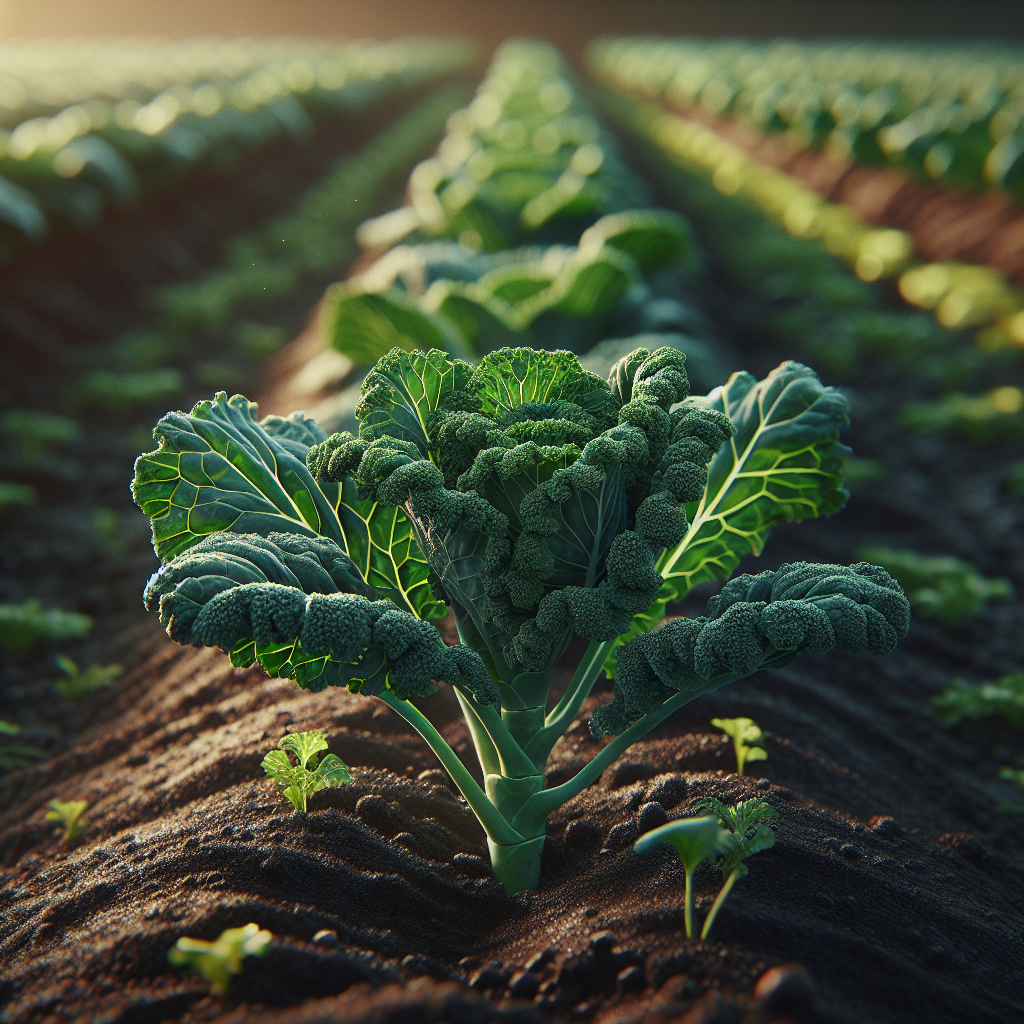
Introduction to Kale
A dependable, cold-hardy leafy crop, kale has been cultivated for centuries as one of the most resilient members of the cabbage family. Unlike heading cabbages, it produces an open rosette or upright crown of leaves, allowing repeated harvests from the same plant over a long season. This non-heading growth habit is reflected in its botanical classification, acephala, meaning “without a head.” For growers, that trait translates into flexibility: leaves can be harvested young for salad mix, mid-sized for bunching, or mature for braising, juicing, dehydration, or value-added processing.
Kale performs best in cool weather, where leaf texture is tenderer and flavor is sweeter, often because chilly conditions encourage sugar accumulation and reduce the harshness associated with rapid summer growth. It is especially valuable in market gardens and home production systems because it bridges seasonal gaps. In many temperate regions, spring plantings provide early greens before warm-season crops mature, while late-summer or autumn sowings can carry production into winter under row cover or in mild climates even with minimal protection.
Commercially and horticulturally, kale includes a range of forms: curly kale, lacinato or Tuscan kale, Russian types, and Siberian types. Although “Russian kale” often belongs to Brassica napus rather than Brassica oleracea, growers generally manage them similarly as cool-season greens. Leaf color may range from bright green to blue-green to deep purple, and texture can vary from heavily frilled to blistered and strap-like. This variation influences market preference, cold tolerance, and eating quality. Curly types often present well in bunches, while lacinato types are favored for their dark leaves, culinary versatility, and relatively smooth harvest handling.
From a nutritional perspective, kale is rich in vitamins A, C, and K, plus calcium, folate, carotenoids, and numerous glucosinolates typical of brassicas. Those same sulfur-containing compounds also help explain its distinctive flavor. Proper crop management—especially balanced fertility, irrigation consistency, and timely harvest—has a major effect on the final leaf quality sold or consumed.
Botanical Profile of Kale
Kale belongs to the Brassicaceae family, a large plant family that includes cabbage, broccoli, cauliflower, mustard, turnip, and many oilseed and forage crops. As with other members of this family, it has four-petaled flowers in a cross shape, which is why brassicas were historically referred to as crucifers. Kale itself is usually grown as an annual for leaf production, but botanically it is a biennial. In its first season it develops vegetative growth; if exposed to sufficient cold and then longer days, it may bolt in the second season, sending up a flowering stalk before setting seed.
Roots are generally fibrous and moderately shallow, with most active uptake concentrated in the upper 20 to 30 cm of soil, though roots can explore deeper under loose, well-structured conditions. This root profile explains why kale responds well to soils rich in organic matter and why it suffers quickly in compacted ground, surface drying, or waterlogging. Leaves arise from a central stem, initially in a tight rosette and later along an elongated stalk as lower leaves are harvested. Depending on cultivar, plant height may range from 30 cm to over 90 cm.
Leaf morphology is one of the key distinctions among types. Curly kale has heavily ruffled margins and dense, textured leaves. Lacinato kale, also called dinosaur or Tuscan kale, bears elongated, dark blue-green leaves with a pebbled surface. Red Russian kale has flatter, lobed leaves with purple veins and a milder flavor, especially when harvested young. Siberian and some napus types are often more cold-tolerant and may continue producing under harsher winter conditions than standard curly forms.
Because kale is closely related to cabbage, it shares many pest, disease, and rotation concerns with other brassicas. It is also susceptible to cross-pollination with compatible brassica relatives if seed is being saved. For leaf growers, however, the crop is usually harvested long before flowering.
Soil, pH, and Climate Requirements for Kale
This crop thrives in fertile, well-drained soil with high organic matter and steady moisture. The ideal texture is a loam or sandy loam that drains freely after rain yet retains enough water to avoid repeated drought stress. Heavy clay can be used successfully if improved with compost and if beds are raised enough to prevent root-zone saturation. In poorly drained fields, kale becomes vulnerable to root stress, stunting, lower leaf yellowing, and diseases such as damping-off in seedlings and bacterial or fungal decline later on.
The preferred soil pH is generally 6.0 to 7.5, with an optimal target around 6.3 to 6.8. Below pH 6.0, nutrient availability becomes less balanced and certain soilborne problems common to brassicas, particularly clubroot, become more serious. Where clubroot has been present, raising the pH closer to neutral or slightly above can reduce disease pressure. A soil test before planting is strongly recommended. Kale is a moderate to heavy feeder, especially for nitrogen, but oversupplying nitrogen without adequate potassium, calcium, sulfur, and micronutrients can produce lush, soft leaves that attract pests and store poorly.
Kale is fundamentally a cool-season crop. Best growth occurs between about 10 and 24°C, with premium quality often achieved from 12 to 18°C. Seed germination is reliable in a broad range, roughly 7 to 30°C, but the most uniform emergence usually occurs near 18 to 24°C when soil moisture is stable. Plants tolerate light to moderate frost well; many cultivars become sweeter after exposure to temperatures near or slightly below freezing. Extended heat above 27 to 30°C can cause tougher leaves, stronger flavor, slower regrowth after harvest, and an increased tendency to harbor pests such as aphids and flea beetles.
In warm climates, choose the coolest production windows: autumn through spring in subtropical areas, or winter in frost-free regions. In temperate climates, two principal windows are common: early spring and late summer for autumn production. High summer production is possible in cool coastal or highland environments but is less reliable in hot inland zones.
For moisture management, kale prefers soil that remains evenly moist but never saturated. As a working field guide, the top 5 to 7 cm of soil should feel slightly moist and cool, not powder-dry and not sticky or anaerobic. Drip-irrigated beds should be watered deeply enough that moisture reaches the main rooting zone, generally 15 to 20 cm deep, then allowed to decline slightly before the next cycle. Chronic overwatering often shows up as dull leaf color, slowed growth despite wet soil, lower leaf yellowing, edema-like blistering, or a sour smell from the root zone. Underwatering usually causes midday wilting, rigid leaves, slower expansion, bitterness, and reduced tenderness.
Step-by-Step Planting & Propagation
Direct seeding and transplanting both work well, but transplanting is often preferred for precise spacing, reduced early weed competition, and more predictable stand establishment. Direct seeding is efficient for baby-leaf production and larger field blocks where labor efficiency matters.
Start with bed preparation. Remove perennial weeds, incorporate mature compost, and work the soil only when it is friable rather than wet. A fine, firm seedbed is important for uniform emergence. Avoid fresh, undecomposed manure immediately before planting because it can contribute to nutrient imbalances and sanitation risks in leafy greens.
For transplants, sow seed 4 to 6 weeks before field setting. Use clean trays and a sterile, well-drained propagation mix. Sow seeds about 0.5 to 1 cm deep, cover lightly, and maintain even moisture without waterlogging. Seedlings should receive strong light and good airflow to prevent stretching and damping-off. Ideal transplant size is typically 7 to 12 cm tall with 3 to 5 true leaves and a compact, well-rooted plug. Harden off for 5 to 7 days before planting by gradually exposing plants to cooler temperatures, direct sun, and slightly reduced watering.
For direct sowing, place seed 0.5 to 1.5 cm deep depending on soil texture; shallower in heavier soils and slightly deeper in lighter soils. Thin early to avoid crowding. Tight spacing can work for baby leaf, but mature bunching kale needs adequate airflow and room for leaf expansion.
Typical spacing ranges are as follows:
- Baby leaf: dense sowing in bands or close rows, harvested young.
- Fresh-market bunching: 30 to 45 cm between plants and 45 to 75 cm between rows.
- Large mature plants or overwintering systems: 45 to 60 cm between plants.
Water the bed before transplanting if soil is dry. Transplant in the late afternoon or on an overcast day to reduce shock. Set plugs at the same depth they grew in the tray; avoid burying stems excessively. After planting, irrigate enough to settle soil around roots and eliminate air pockets.
Succession sowing every 2 to 4 weeks extends harvest. In many climates, spring plantings should begin as soon as the soil can be worked, while autumn crops are started in midsummer to late summer so plants establish before colder, shorter days. For growers interested in season extension, protected systems and methods similar to those described in winter sowing tips can improve scheduling in cooler regions.
Care & Maintenance regimes for Kale
Consistent growth is the key to top-quality kale. Any cycle of drought followed by heavy irrigation, or nutrient deficiency followed by corrective overfeeding, tends to produce irregular leaves, strong flavor, and variable texture. Irrigate to maintain moderate, stable moisture. A practical target is about 2.5 to 4 cm of water per week from rain or irrigation, adjusted for temperature, wind, soil type, and plant size. Sandy soils may need lighter, more frequent applications; heavier loams need deeper, less frequent watering.
Drip irrigation is generally superior to overhead watering because it keeps foliage drier, reduces foliar disease pressure, and delivers water directly to the root zone. If overhead irrigation is used, water early in the day so leaves dry quickly. In hot weather, avoid late-evening overhead irrigation that leaves foliage wet overnight.
Nitrogen drives leaf yield, but kale responds best to balanced fertility. If soil organic matter is moderate to high and pre-plant nutrition is adequate, a side-dress of nitrogen 2 to 3 weeks after transplanting and again after the first major harvest often sustains productive regrowth. Organic sources may include composted poultry manure, feather meal, blood meal, or fish-based fertilizers, used according to soil test guidance. Leaves that are pale green, small, and slow-growing often indicate nitrogen shortage; excessively dark, overly soft, or giant leaves with weak texture may indicate overfeeding.
Mulching is highly beneficial. Straw, shredded leaves, compost mulch, or biodegradable film can moderate soil temperature, reduce water loss, suppress weeds, and keep lower leaves cleaner. In cold-season production, dark mulches may help warm the soil early; in warm climates, organic mulch buffers root stress.
Weed control is most critical during establishment. Because kale develops a canopy over time, early cultivation followed by mulching often gives excellent suppression. Avoid deep hoeing close to plants, as brassica roots can be damaged near the surface.
For high-quality continuous harvest, remove older lower leaves first and preserve the growing point. Begin picking when leaves reach marketable size but are still tender. Regular harvest stimulates continued production. If plants become too tall and bare-stemmed, leaf quality may decline, and replacement through succession planting is often more efficient than holding aging plants indefinitely.
Temperature management is also part of maintenance. In unexpected heat, shade cloth of 20 to 30% can reduce stress and maintain leaf tenderness. In winter systems, row covers protect against windburn, reduce insect pressure, and moderate frost exposure. However, covers must be vented or monitored during warm spells to prevent overheating and excessive humidity.
Pests, Diseases & Organic Management
Kale attracts many of the classic brassica pests, so prevention and scouting are essential. The most common insect problems include cabbage worms, imported cabbageworm, cabbage looper, diamondback moth larvae, flea beetles, aphids, and sometimes harlequin bugs in warmer regions. slugs may also be serious in cool, damp systems.
Caterpillars chew holes in leaves and contaminate bunches with frass, directly reducing marketability. Lightweight insect netting or floating row cover is one of the most effective preventive tools when installed immediately after transplanting or seeding, before moths and butterflies lay eggs. Hand removal is feasible in small plantings. Bacillus thuringiensis var. kurstaki (Bt) is an effective organic control for young caterpillars when applied thoroughly and reapplied as needed after rain or rapid foliage growth.
flea beetles create numerous small “shot holes,” especially on young plants. Strong early growth, exclusion covers, and clean field edges help reduce damage. aphids cluster in leaf folds and on undersides, especially during cool-to-mild weather or in overfertilized plantings. They distort growth, leave sticky honeydew, and can contaminate bunches. Encourage beneficial insects, avoid excess soluble nitrogen, and wash infestations off with strong water sprays where practical. In severe organic systems, insecticidal soap can help, but coverage must be direct.
Common diseases include damping-off in propagation, black rot, downy mildew, Alternaria leaf spot, and clubroot. black rot is a bacterial disease that enters through hydathodes and wounds, often producing V-shaped yellow lesions from the leaf margin inward. downy mildew is favored by cool, humid conditions and appears as yellow patches on upper leaf surfaces with grayish growth beneath. Alternaria often causes dark concentric spots. clubroot, caused by Plasmodiophora brassicae, deforms roots and leads to stunting and midday wilt even in moist soil.
Organic disease management starts with sanitation and rotation. Do not plant kale or related brassicas in the same bed repeatedly; a 3- to 4-year rotation away from brassicas is preferable where disease pressure exists. Use disease-free seed and clean transplants. Avoid working in wet fields, which spreads pathogens. Improve airflow with correct spacing, manage weeds that harbor pests or moisture, and irrigate in ways that minimize prolonged leaf wetness. Remove and destroy heavily infected crop residues rather than incorporating them immediately when serious disease is present.
Soil pH management is especially important for clubroot. Liming acidic soils well before planting can reduce disease severity. Raised beds and excellent drainage also help. In all systems, frequent scouting is non-negotiable: inspect leaf undersides, new growth, and root health on any suspicious plants weekly, and more often during peak pest windows.
Harvesting, Curing & Optimal Storage
Kale is usually harvested in one of three ways: baby leaf, bunching leaf, or whole-plant harvest. Baby leaf is cut very young for tender salad greens. Bunching harvest is the most common for fresh market, where mature but still supple outer leaves are picked repeatedly. Whole-plant harvest may be used when uniformity, rapid field clearing, or processing is the goal.
For repeated harvest, begin once leaves are well formed and large enough for the intended market, often when outer leaves are 20 to 30 cm long depending on cultivar. Always leave the central growing point and several younger inner leaves intact so the plant can continue producing. Harvest during the coolest part of the day, ideally morning after field heat is low but once excess surface moisture has dried enough to avoid handling wet foliage.
Use clean, sharp knives or snap leaves carefully to avoid tearing stems. Remove yellow, diseased, insect-damaged, or heavily soiled leaves in the field. Gentle handling matters: bruised kale darkens faster and loses shelf appeal. Unlike bulb or curing crops, kale is not “cured” in the traditional sense. Instead, the priority is rapid field heat removal. Move harvested leaves into shade immediately and pre-cool as soon as possible.
Hydrocooling, forced-air cooling, or refrigerated storage all improve quality retention. Optimal storage is close to 0°C with very high relative humidity, ideally 95 to 100%. Under those conditions, kale may store for about 2 to 3 weeks, though quality depends strongly on cultivar, maturity, and preharvest conditions. If humidity is too low, leaves wilt and edges desiccate. If storage is too warm, yellowing accelerates and sugars are depleted faster.
For small-scale handling, bunch leaves, rinse in cold clean water if needed, spin or drain thoroughly, then pack in perforated bags or lined crates that retain humidity without trapping free water. Do not pack warm leaves into sealed containers, as condensation encourages decay. Ethylene exposure from ripening fruit can speed yellowing, so store kale away from produce such as apples, bananas, and tomatoes.
Flavor is often best after light frost, but frozen-thawed leaves can become water-soaked if hard freezes are followed by warm days. In winter harvest systems, pick once leaves have thawed naturally on the plant rather than handling them while brittle with ice.
Companion Planting for Kale
The best companion strategy combines pest reduction, space efficiency, and rotation awareness rather than relying on folklore alone. Aromatic herbs and flowering insectary plants can help support beneficial insects that prey on aphids and caterpillar eggs. Dill, cilantro, alyssum, chamomile, and yarrow are often useful nearby because they provide nectar and pollen for hoverflies, parasitic wasps, and other natural enemies.
Alliums are particularly useful companions because they occupy a different canopy architecture and may confuse some pest patterns while making efficient use of bed space. Bordering kale with onions, bunching onions, or garlic can work well in diversified gardens; for a related crop, see Garlic. Fast, shallow-rooted crops such as lettuce or radish may also be interplanted early between wider-spaced kale transplants, then harvested before the kale reaches full size.
Avoid planting kale immediately adjacent to large blocks of other brassicas if pest pressure is high, because grouped hosts can intensify infestations of loopers, imported cabbageworm, aphids, and shared diseases. Likewise, avoid tight rotations with broccoli, cauliflower, cabbage, mustard greens, and turnips, which share many pathogens and nutrient demands. Good companions are less about magical plant pairings and more about designing a system with diverse flowering resources, non-host neighbors, airflow, and disciplined rotation.
In small farms and kitchen gardens, kale also fits well after legumes that leave some residual nitrogen, or before fruiting crops that benefit from the weed suppression and bed conditioning achieved during a well-managed leafy-green cycle. When planned carefully, companion and sequence planting can extend harvest windows, improve resilience, and reduce input pressure across the entire production system.