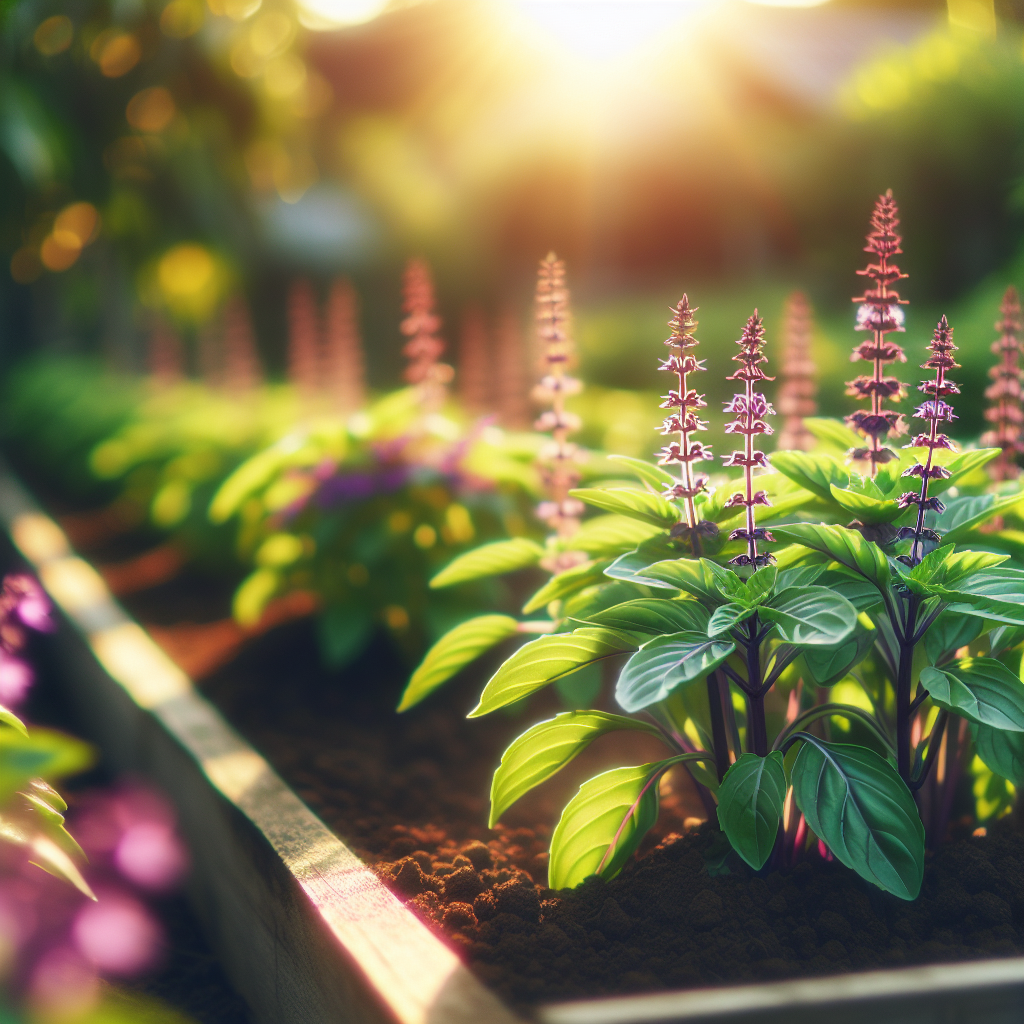
Introduction to Thai Basil
A staple herb in Southeast Asian cuisine, this basil type is grown for its narrow green leaves, purple-tinged stems, and intensely fragrant essential oils that hold flavor better under cooking than common sweet basil. It is especially valued in Thai, Vietnamese, Lao, and Cambodian dishes, where it contributes a distinctive licorice, clove, and peppery note that remains recognizable even in soups, stir-fries, and curries.
From a production standpoint, it is one of the most dependable basils for warm weather. Whereas Italian sweet basil often declines quickly under intense summer heat or intermittent drought, Thai basil remains upright, aromatic, and productive across a broader heat range. That makes it a strong choice for growers in subtropical and tropical climates, as well as temperate gardeners looking for a resilient summer herb.
Thai basil is typically grown as an annual, though in frost-free climates it can behave as a short-lived perennial. Its compact yet branching habit allows for high-density production in raised beds, field rows, greenhouse benches, and patio containers. Because leaf quality is highest before heavy flowering, crop management revolves around encouraging vigorous vegetative regrowth through regular pinching, balanced nutrition, and steady soil moisture.
Historically, Thai basil belongs to the highly diverse basil complex within the mint family, a group shaped by centuries of cultivation, selection, and local adaptation. Confusion is common between Thai basil, holy basil, and lemon basil; however, these are distinct culinary herbs with different aroma chemistry, leaf morphology, and growth habits. Thai basil specifically is recognized for its sweeter anise profile, attractive purple floral spikes, and strong post-harvest aroma retention.
For diversified growers, it also has market advantages. Bunches sell well fresh, leaves have premium culinary value, and the plant’s ornamental appeal makes it suitable for mixed herb displays. It can even fit alongside heat-loving crops such as Ghost Pepper in summer herb-and-pepper plantings where warmth and drainage are favorable.
Botanical Profile of Thai Basil
This plant belongs to the family Lamiaceae, the mint family, and is classified botanically as Ocimum basilicum var. thyrsiflora. As with many basils, taxonomy can be somewhat fluid because Ocimum species hybridize readily and have been selected across regions for aroma, stature, and leaf form. In practice, growers identify Thai basil by its purple stems, opposite leaves, compact branching habit, and ornamental purple flower spikes.
Plants usually reach 30 to 60 cm tall in dense garden culture, though highly fertile soils and long warm seasons can push them larger. The stems are square in cross-section, a classic mint-family trait. Leaves are narrower and firmer than those of Genovese basil, often 2.5 to 5 cm long, smooth-margined to lightly toothed, and borne oppositely on the stem. Their firmer texture contributes to superior performance in cooked dishes and slightly longer shelf life after harvest.
The aroma profile is driven by essential oils rich in compounds that commonly include estragole and eugenol, giving the herb its signature sweet anise, clove, and spice notes. The exact balance varies by seed line, climate, fertility, and harvest stage. Young vegetative growth tends to be sweet and clean; older flowering plants become stronger, sometimes slightly harsher, and less tender.
Flowering begins under maturity and environmental cues, especially longer days, root restriction, or stress. Inflorescences are terminal spikes with purple bracts and small lavender-to-pale-purple flowers. These are highly attractive to bees and other pollinators, which is useful in mixed farms, though flowering typically reduces leaf tenderness and can divert energy away from vegetative growth. For culinary production, flower spikes are usually pinched early and repeatedly.
Roots are relatively fine and shallow, with most active uptake occurring in the upper soil profile. This explains why the plant responds quickly to both drought and overwatering. It prefers oxygenated, crumbly soil where roots can cycle between moist and lightly aerated conditions rather than remaining saturated.
Thai basil is frost-sensitive. Tissue injury often begins around 40°F/4°C, with chilling stress causing purpling, slowed growth, and leaf spotting even above freezing. True frost can kill plants outright. Optimum vegetative growth usually occurs around 70 to 90°F/21 to 32°C, and unlike many leafy herbs, it continues producing well during hot midsummer periods if water and nutrients remain consistent.
Soil, pH, and Climate Requirements for Thai Basil
The ideal soil is fertile, well-drained, and biologically active, with enough organic matter to buffer moisture but not so much compaction or water retention that roots remain soggy. A sandy loam or loam with good aggregation is excellent. Heavy clay can work only if amended and raised for drainage; otherwise, it promotes root stress, stem blackening near the crown, and fungal disease.
A target soil pH of 6.0 to 7.0 is optimal, with 6.2 to 6.8 being particularly reliable for nutrient availability and root health. In more acidic soils below about pH 5.8, calcium and magnesium uptake may become less efficient, growth can stall, and leaves may appear smaller or less vibrant. In alkaline soils above 7.2, micronutrient uptake, especially iron and manganese, can decline, producing pale foliage and reduced vigor. Soil testing before planting is strongly recommended in commercial production.
Organic matter should be sufficient to maintain even moisture, ideally 3 to 5% in mineral garden soils. Incorporating mature compost before planting improves cation exchange, tilth, and root exploration, but avoid raw manure or excessively nitrogen-rich amendments immediately before seeding because they can encourage lush but soft growth prone to disease and weak flavor.
Thai basil thrives in full sun, with 6 to 8 or more hours of direct light daily. In very hot inland climates above 95°F/35°C, light afternoon shade can reduce stress and preserve leaf tenderness, but too much shade leads to elongated stems, wider internodes, lower oil concentration, and weaker flavor. For greenhouse or tunnel production, strong ventilation is essential; stagnant humid air encourages Downy mildew and foliar disease.
Moisture management is one of the most important variables. The root zone should remain evenly moist, never bone-dry and never waterlogged. In practical terms, the top 2 to 3 cm of soil can be allowed to dry slightly between irrigations, but deeper root-zone soil should still feel cool and faintly moist. If soil at 5 to 8 cm depth is powdery and dry, the plant is already under drought stress. If soil remains sticky, cold, and airless for days, overwatering is likely.
Signs of underwatering include midday wilting that does not recover by evening, dull leaves, slowed branching, intensified bitterness, and premature flowering. Signs of overwatering include yellowing lower leaves, persistent limpness despite wet soil, blackening at the stem base, algae or fungus gnats in containers, and a sour smell from the medium. Consistency matters more than sheer volume.
Climate-wise, this is a tropical to subtropical herb. It performs best in warm nights above 60°F/16°C and daytime temperatures from the low 70s to upper 80s°F. High humidity is tolerated better than by many basil types, but only if leaf surfaces dry reasonably fast and roots have drainage. In cool temperate climates, delay transplanting until soil is warm and nights are reliably mild. For broader soil-building principles, growers may benefit from soil health strategies.
Step-by-Step Planting & Propagation
Seed is the most common propagation method. Thai basil germinates readily when warmth is adequate, and seed-grown plants are generally uniform enough for culinary use. Start seeds indoors 4 to 6 weeks before the last frost in cold climates, or direct sow once soil temperatures are consistently above 65°F/18°C. Optimal germination usually occurs around 70 to 85°F/21 to 29°C.
Use a fine seed-starting mix with good drainage and low salinity. Sow seeds shallowly, covering with roughly 3 mm of medium or simply pressing them into the surface and dusting lightly. Keep the medium evenly moist but never saturated. Under ideal warmth, germination often occurs in 5 to 10 days. If temperatures are cool, emergence may be delayed and damping-off risk rises.
Once seedlings produce their first true leaves, ensure strong light immediately. Weak light causes stretching and fragile stems that transplant poorly. Thin or prick out seedlings so each has enough airflow and root space. Fertilize lightly after the first true leaves with a diluted balanced feed; excessive early nitrogen can create lush, floppy transplants.
Transplant when plants are 7 to 12 cm tall and have at least 2 to 3 sets of true leaves. Harden them off over 5 to 7 days by gradually increasing sun and wind exposure while avoiding cold nights. Set plants out only after danger of frost has passed and night temperatures remain above about 55°F/13°C.
Spacing depends on harvest style. For repeated bunching harvests, 20 to 30 cm between plants and 30 to 45 cm between rows is effective. For larger bushy plants intended for repeated pinching, use 30 cm spacing. In high-density baby-leaf or tip-harvest systems, closer planting is possible, but airflow must remain good.
To plant, prepare a bed free of perennial weeds and amend with finished compost. Water the bed before transplanting if dry. Set transplants at the same depth they grew in cells or pots; burying stems too deeply can increase crown rot risk. Firm the soil gently around roots and water in immediately to remove air pockets.
Propagation by cuttings is fast and very reliable. Take 8 to 12 cm non-flowering shoot tips, remove lower leaves, and place them in water or a sterile rooting medium. Keep warm and bright but out of harsh direct midday sun. Roots often form in 7 to 14 days. Once a healthy root system develops, pot up and acclimate before field planting. This method is useful for preserving especially aromatic or productive plants.
In containers, select a pot at least 20 to 25 cm wide for one mature plant, with excellent drainage holes. Use a high-quality potting mix rather than garden soil. Containers dry faster than beds, so irrigation frequency will increase, especially in hot weather.
Care & Maintenance regimes for Thai Basil
The central aim is to maintain uninterrupted vegetative growth. That means warm temperatures, strong light, moderate but steady feeding, and frequent tip pinching. If any one of those factors becomes erratic, plants tend to flower early, reduce leaf size, or become woody.
Irrigation should be deep enough to moisten the active root zone, then paused long enough for the surface to dry slightly. In garden beds, this often means watering 1 to 3 times weekly depending on soil type and weather; sandy soils may need more frequent irrigation, while loams may need less. In containers during midsummer, daily watering may be necessary. The best indicator is root-zone feel, not a calendar. Aim for moist, springy soil rather than wet, dense soil.
Mulching with straw, leaf mold, or fine compost helps regulate surface temperature, reduce evaporation, and limit soil splash that spreads disease spores. Keep mulch a few centimeters away from the stem base to prevent crown rot and stem softening.
Nutrition should favor balanced growth rather than excessive lushness. Before planting, incorporate compost and, if needed by soil test, a balanced organic fertilizer. During active harvest cycles, side-dress lightly with nitrogen every 3 to 4 weeks or use diluted liquid feeds. Too little nitrogen leads to pale, small leaves and slow regrowth; too much creates overlarge, watery foliage with reduced aroma and greater susceptibility to pests. If leaves are dark, huge, and floppy, feeding is too heavy.
Pinching is essential. Once plants are established and 15 to 20 cm tall, remove the top growing tip just above a pair of leaves. This stimulates lateral branching and a fuller canopy. Continue pinching every time stems produce 2 to 3 new node pairs. Never strip all foliage from a stem; leave enough leaves for photosynthesis and regrowth. In production systems, harvesting the top 10 to 15 cm of tender growth functions as maintenance pruning.
Flower control strongly affects quality. Remove flower spikes as soon as they appear unless seed production or pollinator support is desired. Once flowering accelerates, leaves become smaller and tougher, and flavor chemistry shifts. Repeated pinching can keep plants productive for many weeks or months.
Weed control is most important early, when plants are small and shallow-rooted. Hand weeding, stale seedbed techniques, and mulching are better than deep hoeing close to stems, which can damage roots. Avoid overhead irrigation late in the day because wet foliage overnight increases disease risk.
In protected cultivation, maintain generous plant spacing and airflow. Relative humidity that stays very high around dense foliage encourages foliar disease, especially when night temperatures are cool. Fans, venting, and careful watering timing matter greatly in tunnels and greenhouses.
For season extension, row covers can speed early establishment, but remove or vent them during hot bright days to prevent overheating. Thai basil grows quickly in warmth and can become stressed under enclosed covers if temperatures surge.
Pests, Diseases & Organic Management
Thai basil is generally robust, but it is not immune to common herb-crop problems. The most frequent insect pests include Aphids, Whiteflies, Spider mites, Thrips, Japanese beetles in some regions, and Slugs or Snails in damp gardens.
Aphids cluster on soft shoot tips and the undersides of leaves, causing curling and sticky honeydew. Whiteflies flutter when disturbed and weaken plants gradually through sap feeding. Spider mites are more common in hot, dry, dusty conditions and create stippled leaves with fine webbing on severe infestations. Thrips scar young leaves and can distort tender growth.
Organic management starts with prevention. Avoid overfertilizing with nitrogen, because extremely soft growth attracts sap-feeders. Maintain spacing and airflow, inspect the undersides of leaves weekly, and remove heavily infested tips early. A strong spray of water can reduce Aphids and Whiteflies on small plantings. In persistent cases, insecticidal soap or neem-based products can be effective if applied thoroughly and during cooler parts of the day to avoid leaf burn. Reapply according to label directions because eggs and hidden insects often survive the first treatment.
Slugs and Snails chew irregular holes, especially in mulch-heavy or overwatered beds. Water early in the day, reduce excessive shelter, hand-pick at dusk, or use iron phosphate baits where appropriate.
Disease management is especially important in humid weather. Downy mildew is among the most serious basil diseases worldwide. Symptoms often begin as yellowing between veins on upper leaf surfaces, followed by gray-purple sporulation beneath leaves, especially in humid mornings. Leaves eventually brown and collapse. Because it spreads rapidly under cool, damp, still conditions, prevention is critical: use spacing, morning irrigation, clean starts, and rapid removal of infected material. Do not compost badly infected plants unless composting temperatures are reliably high.
Fusarium wilt can cause one-sided yellowing, vascular browning, and plant collapse. It is soilborne and difficult to control once established. Use clean seed, rotate away from basil and related susceptible crops for several years, and avoid moving contaminated soil between beds.
Leaf spots caused by fungal or bacterial pathogens may appear after overhead watering or storm splash. Remove lower crowded foliage, water at soil level, and harvest regularly to improve airflow. Root rots and damping-off occur in saturated media, poorly drained soils, or trays with excessive moisture. Prevention depends on sterile propagation practices, drainage, and not sowing too densely.
Sanitation is one of the most effective organic tools. Remove crop debris, disinfect trays, avoid working among wet plants, and rotate sites when possible. Healthy, steadily growing Thai basil can outpace minor pest pressure, but stressed plants decline quickly.
Harvesting, Curing & Optimal Storage
Harvest timing has a major effect on flavor concentration, tenderness, and shelf life. The best culinary harvest usually begins when plants are 20 to 30 cm tall and well branched, before significant flowering. Morning harvest after dew has dried but before peak afternoon heat gives the highest turgidity and best bunch quality.
Use clean scissors or pruners to cut tender stem tips 10 to 15 cm long, making cuts just above a leaf node so dormant buds below can branch. Avoid harvesting more than one-third to one-half of the plant at once if continued regrowth is desired. Repeated light harvests produce better quality than occasional severe stripping.
For fresh-market bunches, remove damaged or yellow leaves immediately and keep stems shaded. Field heat should be removed quickly. Thai basil is chilling-sensitive, so extremely cold storage can blacken leaves. Ideally store around 50 to 55°F/10 to 13°C with high relative humidity, roughly 90 to 95%, and gentle airflow. At lower temperatures near typical refrigerator conditions, leaves may develop dark water-soaked patches and lose aroma.
For short home storage, stems can be placed in a jar of water at cool room temperature out of direct sun for a day or two, loosely tented with a bag if air is dry. Alternatively, wrap dry leaves lightly in paper towel and place in a perforated bag in the warmest part of the refrigerator, though chilling injury remains possible.
Drying is possible but not ideal if the goal is premium Thai basil flavor, because the volatile aromatic profile is diminished compared with fresh use. If drying, harvest just before flowering, rinse only if necessary, dry surface moisture thoroughly, and use low temperatures with good airflow. Leaves should become crisp without browning. Store dried material in airtight opaque containers away from heat and light.
Freezing preserves flavor better than drying. Leaves may be chopped and frozen in small portions, or blended with a little water or oil and frozen in cubes. This is practical for processing surplus harvests.
The term curing is less formal for basil than for seed crops or bulbs, but post-harvest conditioning still matters. Keep harvested stems out of sun, avoid compression in harvest bins, and never wash bunches unless required, because free moisture accelerates decay. Gentle handling is especially important since bruised basil blackens rapidly.
If seed saving is desired, allow select plants to flower fully and mature seed heads until they dry on the plant. Cut spikes, dry them further in a paper bag, then thresh and clean the seeds. Keep only seed from healthy, true-to-type plants, noting that cross-pollination among basils can reduce varietal purity.
Companion Planting for Thai Basil
This herb fits well into diversified vegetable systems because it enjoys many of the same conditions as warm-season crops: fertile soil, consistent moisture, and full sun. Good companions include peppers, tomatoes, eggplants, okra, and other heat-loving vegetables. These combinations simplify irrigation scheduling and bed planning.
Near tomatoes, basil is often valued for efficient space use and easy harvest access rather than mythical dramatic flavor transfer. The practical advantages are real: basil occupies the lower canopy zone early, attracts pollinators when allowed to bloom, and provides an additional marketable product from the same bed. In mixed kitchen gardens, compact herbs also help suppress open soil between larger plants.
Thai basil also pairs well with alliums and leafy greens if spacing preserves airflow. Onions, garlic, and chives do not usually compete heavily above ground and can create a diverse planting matrix. However, avoid crowding it with very tall, dense crops that shade it for long periods, or with sprawling species that trap humidity around stems.
Because flowers attract bees and beneficial insects, allowing a few plants to bloom at bed edges can support pollinator activity in nearby fruiting crops. This can be useful in pepper and tomato systems, while the main basil crop is still kept pinched for leaf quality.
Less suitable companions include plants that demand constantly wet soil, such as some water-loving greens, or heavy shade-casting species such as vigorous corn plantings in tight blocks. Thai basil prefers moisture consistency, not saturation, and its aromatic oil production declines noticeably under reduced light.
In containers, pair it with similar warm-season herbs that share drainage and light needs, but avoid overcrowding. One basil plant with one compact pepper can work in a large pot; several aggressive herbs together often leads to root competition and uneven growth.
When used intentionally, companion planting for Thai basil is less about folklore and more about matching microclimate, irrigation rhythm, canopy architecture, and harvest logistics. Select neighbors that keep the bed sunny, warm, and well ventilated, and the crop will remain productive and aromatic deep into the season.