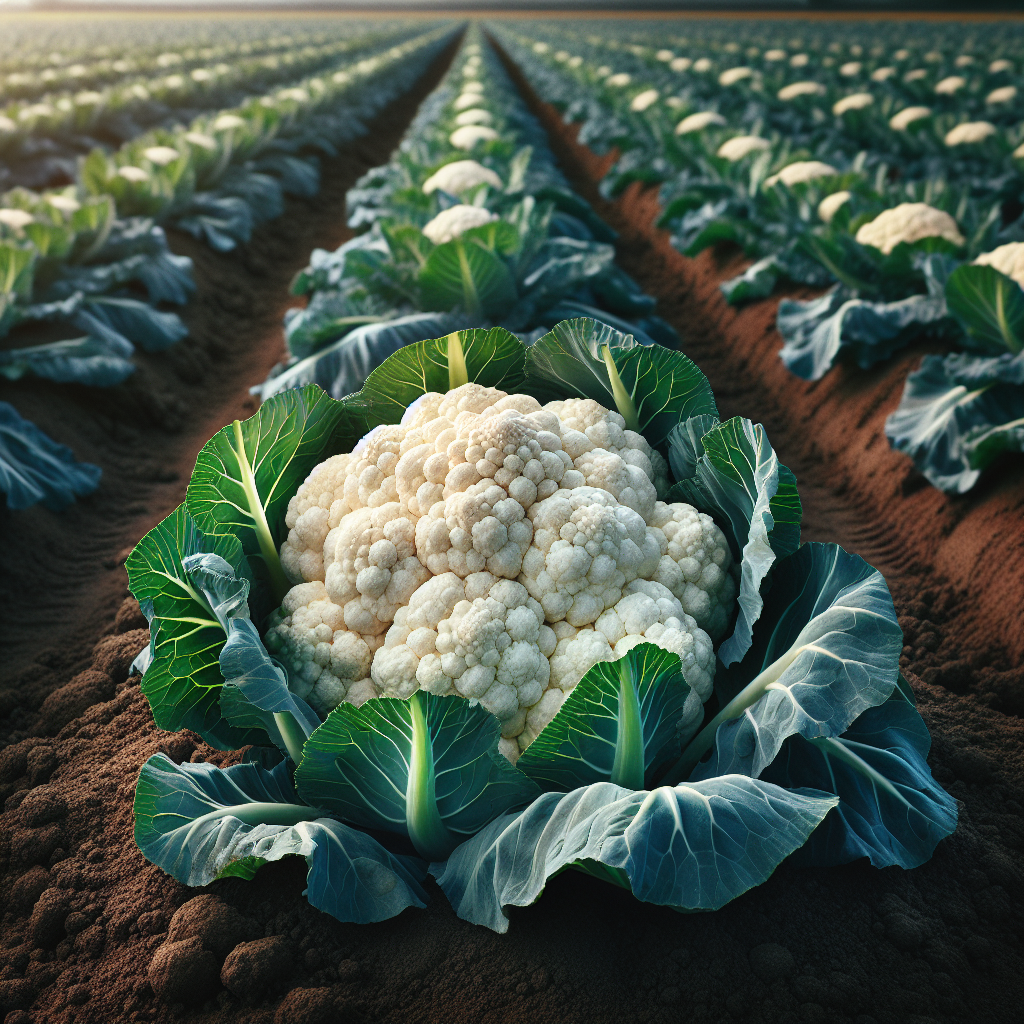
Introduction to Cauliflower
Cauliflower is one of the most exacting members of the brassica family and a classic test of a grower’s consistency. Unlike leafy brassicas that tolerate minor stress with only modest yield loss, cauliflower reacts quickly to setbacks in temperature, nutrition, spacing, or irrigation by producing undersized heads, loose curds, ricey surfaces, discoloration, or premature bolting. For that reason, it is often considered less forgiving than cabbage or kale, yet with precise management it can be one of the most valuable cool-season vegetables in both market gardens and field-scale production.
Its edible portion is the immature inflorescence meristem, commonly called the “curd” or “head.” In standard white cauliflower, surrounding wrapper leaves help shade the curd, preserving its pale color. Modern breeding has expanded the category to include self-blanching white hybrids, green sprouting types, purple anthocyanin-rich forms, orange beta-carotene selections, and Romanesco types with their striking fractal spirals. Although all are managed similarly, maturity windows, heat tolerance, and curd structure vary significantly by cultivar, so seed selection is not a trivial decision.
Historically, cauliflower likely arose from Mediterranean brassica populations and was refined over centuries through selection for enlarged floral tissues. Today it is grown across temperate, subtropical, and highland tropical regions, but it performs best where daytime temperatures are cool and steady rather than erratic. Commercial success depends on matching the cultivar to the season: early varieties for cool spring harvests, heat-tolerant hybrids for shoulder seasons, and storage-oriented types for autumn production.
For growers managing other brassicas, cauliflower fits well into rotation systems with crops such as Broccoli, though disease carryover within the brassica family must be taken seriously. Good soil structure, a balanced fertility plan, and disciplined irrigation are the foundation of marketable heads.
Botanical Profile of Cauliflower
Cauliflower belongs to the species Brassica oleracea, the same species that includes cabbage, broccoli, kale, Brussels sprouts, and kohlrabi. The varietal designation botrytis refers to the clustered, flower-like architecture of the edible curd. It is generally grown as an annual vegetable, though biologically it is a biennial that would flower and set seed after vernalization if left in the ground long enough.
The plant forms a compact to moderately spreading rosette of broad, waxy, blue-green leaves arising from a short stem. As the plant transitions from vegetative growth to reproductive development, the apical meristem proliferates into a dense pre-floral mass. The harvested head is therefore not a fruit or a true flower, but a hypertrophied, arrested inflorescence composed of undeveloped floral tissues. If harvest is delayed, the curd loosens, elongates, and eventually produces yellow flowers.
Rooting is relatively shallow compared with deep-rooted field crops, with the majority of active feeder roots concentrated in the top 20 to 30 cm of soil. This makes cauliflower especially sensitive to short-term drying, oxygen deprivation in waterlogged soils, and nutrient fluctuations in the surface profile. Growth is fastest when roots can expand through friable, humus-rich soil with stable moisture.
Cultivars are often grouped by days to maturity and seasonal adaptation:
- Early types: typically 55 to 70 days from transplant under favorable conditions; useful for spring or mild autumn production but often less tolerant of stress.
- Midseason types: around 70 to 90 days; usually the most versatile.
- Late or overwintering types: longer development, often selected for cool autumn or winter finishing in mild climates.
- Self-blanching types: leaves naturally wrap the curd, reducing the need for manual blanching.
- Colored and Romanesco types: excellent for specialty markets but sometimes slightly less uniform than mainstream white hybrids.
Because curd initiation is strongly tied to plant age and environmental cues, cauliflower can “button,” meaning it forms a tiny head before sufficient vegetative framework develops. This usually results from stress: over-aged transplants, prolonged cold after transplanting, root check, or nitrogen deficiency.
Soil, pH, and Climate Requirements for Cauliflower
Cauliflower performs best in fertile, well-drained loam or clay-loam soils with high organic matter and excellent moisture-holding capacity. Ideal soil pH is 6.5 to 7.2. It can grow at pH 6.0 to 7.5, but below about 6.3 the risk of clubroot rises sharply, and the availability of calcium, molybdenum, and other nutrients becomes less favorable. In acidic soils, liming several months before planting is strongly recommended, especially where brassicas are grown regularly.
The crop has a relatively high demand for nitrogen, potassium, calcium, and boron, but it is sensitive to imbalances. Excessive nitrogen early can produce lush leaf growth and delayed maturity, while nitrogen deficiency causes pale foliage, slow canopy development, and small heads. Calcium deficiency can contribute to tipburn in inner leaves, while boron deficiency may cause brown curd, hollow stem, internal browning, or stem cracking. Molybdenum deficiency, more common in acidic soils, can cause distorted strap-like leaves known as whiptail.
Target a soil rich in stable organic matter, ideally above 3 to 4%, with enough aggregation to avoid crusting. Cauliflower roots need oxygen as much as water. If the soil remains saturated for more than 24 to 48 hours, root respiration declines, nutrient uptake falters, and diseases such as damping-off and root rots become more likely. Raised beds are especially useful in heavy soils or rainy climates.
Temperature is the single most important climate variable. The best curd quality generally occurs when plants grow vegetatively at 15 to 20°C (59 to 68°F) and head development finishes under cool, steady conditions around 12 to 18°C (54 to 64°F). Sustained heat above 25°C (77°F) can cause loose curds, leafiness in the head, uneven development, and bitter flavor. Severe heat combined with moisture stress is a common cause of riceyness, where the curd surface becomes granular and fuzzy as flower parts begin to separate.
Young plants can tolerate light frost, especially hardened transplants, but repeated cold exposure below about 4°C (39°F) after transplanting may trigger premature curd initiation in sensitive cultivars. Mature heads tolerate cool weather well, yet severe freezing can damage wrapper leaves and curd tissue. In mild winter climates, cauliflower is often a prime autumn-to-winter crop.
Full sun is ideal, with at least 6 to 8 hours of direct light daily. In hot regions, the crop benefits from the coolest available season rather than shade. Air circulation matters too: dense, humid canopies favor foliar diseases, but excessively windy exposed sites can stress transplants and increase evapotranspiration.
Step-by-Step Planting & Propagation
Cauliflower is propagated almost exclusively from seed. Direct seeding is possible in very favorable conditions, but transplanting is preferred for uniform spacing, reliable stand establishment, and more precise scheduling.
Select the right cultivar for the season. This is fundamental. Use heat-tolerant or tropical-adapted hybrids for warmer shoulder seasons, and classic cool-season types for autumn production. Check the breeder’s days-to-maturity range and whether the cultivar is self-wrapping.
Start seedlings in trays or modules 4 to 6 weeks before field planting. Use a sterile, well-drained propagation mix with pH around 6.0 to 6.5. Sow seeds 0.5 to 1 cm deep. Maintain germination temperatures around 18 to 24°C (64 to 75°F). Seedlings usually emerge in 4 to 10 days.
Grow sturdy, not oversized, transplants. Ideal transplants are 10 to 15 cm tall with 4 to 6 true leaves, a stocky stem, and a well-knit root plug. Over-aged seedlings are a major cause of buttoning. Avoid letting roots circle tightly in undersized cells.
Harden off for 5 to 7 days before transplanting. Reduce water slightly, increase airflow, and expose plants gradually to outdoor conditions, but do not allow wilting. Severe hardening checks growth and may reduce final head size.
Prepare the field thoroughly. Incorporate compost or well-finished organic matter ahead of planting. Pre-plant fertility should include phosphorus and potassium based on soil test results, plus moderate starter nitrogen. Beds should be level or slightly crowned for irrigation uniformity.
Transplant into moist soil. Set plants at the same depth they grew in the tray. Water in immediately to eliminate air pockets. In bare-ground systems, common spacing is 45 to 60 cm between plants and 60 to 75 cm between rows. Tighter spacing increases uniformity and may suit smaller head markets; wider spacing supports larger heads.
Use mulch where beneficial. Organic mulch suppresses weeds and buffers soil moisture, but in cool wet conditions it may delay soil warming. Plastic mulch can improve weed control and earliness in some systems, though brassica flea beetles and temperature management must be considered.
Install row covers if pest pressure is expected. Insect netting or floating covers are highly effective against flea beetles, cabbage worms, and aphid colonization during establishment, provided edges are sealed well.
For succession planting, stagger sowings every 1 to 2 weeks within the suitable seasonal window. This is especially useful for market growers seeking continuous harvest. For more scheduling ideas in mixed plantings, see companion planting tips.
Care & Maintenance regimes for Cauliflower
Moisture management is where many cauliflower crops are won or lost. The root zone should remain consistently moist but never saturated. As a practical target, aim to keep the top 15 to 20 cm of soil evenly damp, roughly around 60 to 80% of field capacity. In the field, this means soil squeezed in the hand forms a weak ball that holds briefly without oozing water. If the surface dries to dust and the top few centimeters become powdery between irrigations, the crop is being stressed. If footprints remain shiny, sticky, or water pools after irrigation, the soil is too wet.
Most crops require about 25 to 40 mm of water per week under cool conditions, rising to 40 to 50 mm in lighter soils, windy sites, or during rapid head expansion. Drip irrigation is preferred because it keeps foliage dry, improves fertilizer efficiency, and limits foliar disease. Overhead irrigation can be useful for establishment or frost mitigation but increases disease risk if used late in the day.
Signs of underwatering include bluish cast to leaves, midday wilting that does not recover quickly, slowed growth, and small, tight heads. Repeated stress often results in bitterness and coarse texture. Signs of overwatering include yellow lower leaves, stunted growth despite wet soil, edema-like blistering, shallow rooting, and greater incidence of root disease. A crop that is alternately flooded and dried is especially prone to physiological disorders.
Fertility should be split rather than front-loaded. A common professional approach is:
- Pre-plant: compost plus base phosphorus and potassium according to soil test.
- Starter at transplanting: a modest, root-zone-accessible nutrient source.
- Side-dress 2 to 3 weeks after transplanting: mainly nitrogen.
- Side-dress again at early canopy expansion or just before curd initiation: nitrogen plus potassium if needed.
Total nitrogen requirements vary by soil and yield target but often fall in the range of 120 to 180 kg/ha in commercial systems. Organic growers can supply this with composted manures, pelletized fertilizers, blood meal, feather meal, fish-based inputs, or legume-rich rotations, but the key is synchronizing mineralization with crop demand.
Keep weeds controlled from transplanting through canopy closure. Cauliflower is a poor competitor early on, and even moderate weed pressure can reduce head size and uniformity. Shallow cultivation is preferable because feeder roots are near the surface. Once the canopy closes, weed pressure usually declines.
Manual blanching may be necessary for non-self-wrapping white cultivars. When the curd reaches roughly 5 to 8 cm across, gather outer leaves loosely over the head and secure them with a rubber band, clip, or soft tie. Do not bind too tightly; trapped moisture without airflow can encourage rot. Check every few days because heads can enlarge rapidly in cool, favorable weather.
Monitor crop uniformity closely. If plants vary significantly in vigor, investigate irrigation distribution, soil compaction, pH variability, transplant quality, or localized pest injury. Precision in these details has an outsized effect on final market grade.
Pests, Diseases & Organic Management
Because cauliflower is a brassica, it attracts the familiar pest complex associated with that family. Prevention, exclusion, crop rotation, and regular scouting are more effective than reacting late.
Key insect pests include cabbage worms (imported cabbageworm, cabbage looper, diamondback moth larvae), flea beetles, aphids, cutworms, root maggots, and occasionally thrips or whiteflies in warmer climates. Caterpillars chew foliage and contaminate heads with frass. Even small infestations near harvest can reduce marketability sharply. flea beetles are most dangerous to young transplants, causing shot-hole damage that stunts establishment. aphids often hide in wrapper leaves and within curd crevices, making heads unsalable.
Organic management starts with exclusion. Fine insect netting or floating row cover applied immediately after transplanting is among the most effective tools, especially against flea beetles, cabbage worms, and aphids. Rotate away from brassicas for at least 3 years where possible. Destroy crop residues promptly after harvest so pests do not continue breeding in the field.
Bacillus thuringiensis var. kurstaki (Bt) is highly effective against young caterpillars when applied on time. Spinosad can also be useful in organic systems, but should be used judiciously to protect beneficial insects. aphids can often be suppressed by strong biological control if broad-spectrum sprays are avoided; where intervention is necessary, insecticidal soaps or horticultural oils may help, provided coverage reaches hidden colonies and temperatures are suitable.
Major diseases include damping-off, black rot, downy mildew, Alternaria leaf spot, clubroot, bacterial soft rot, and wirestem. black rot, caused by Xanthomonas campestris pv. campestris, is especially destructive in warm, wet conditions and often enters through hydathodes on leaf margins, creating V-shaped yellow lesions. downy mildew thrives in cool, humid weather. clubroot causes swollen, distorted roots and severe wilting despite adequate soil moisture.
Disease prevention priorities are:
- Use certified, disease-free seed and healthy transplants.
- Rotate out of brassicas for 3 to 4 years, longer if clubroot is present.
- Maintain soil pH above about 6.8 in clubroot-prone fields.
- Avoid overhead irrigation late in the day.
- Space adequately for airflow.
- Sanitize trays, tools, and harvest equipment.
- Remove or incorporate residues quickly after harvest.
Physiological disorders are common and often mistaken for disease. Buttoning usually traces back to stress or old transplants. Riceyness is linked to heat or erratic growth. Leafy curd can result from excess nitrogen, high temperatures, or cultivar mismatch. Purple tinting may occur under cool conditions due to anthocyanin expression and is not always harmful, though severe discoloration can reduce market appeal. Browning inside the stem or curd often points to boron deficiency or moisture irregularity.
Harvesting, Curing & Optimal Storage
Harvest timing is critical because cauliflower moves quickly from prime to overmature. A marketable head should be firm, compact, dense, and of the expected size for the cultivar, with a smooth to finely textured surface and no sign of separation between curd segments. White types should be creamy white to bright white depending on cultivar and blanching success. If the curd begins loosening, elongating, or showing individual floral development, harvest immediately.
Use a sharp knife to cut the head with several wrapper leaves attached, as these protect the curd from bruising and dehydration. Handle gently; cauliflower bruises more easily than many growers expect, and pressure marks often become apparent only after storage. Harvest during the coolest part of the day whenever possible.
Unlike onions, garlic, or curing squash, cauliflower is not cured in the traditional sense. Instead, postharvest quality depends on immediate field heat removal. Hydro-cooling, forced-air cooling, or rapid transfer to cold storage is ideal. The target storage temperature is 0 to 1°C (32 to 34°F) with 95 to 98% relative humidity. Under these conditions, quality may hold for about 2 to 4 weeks, depending on cultivar and preharvest stress. Without rapid cooling, heads yellow, soften, and dehydrate quickly.
Avoid storing cauliflower with ethylene-producing fruits such as apples, pears, or ripe tomatoes. Ethylene accelerates yellowing and senescence. Good airflow in storage is essential, but excessive air speed can dry exposed curds. Pack in perforated film or maintain high humidity to limit moisture loss.
For short-term household storage, keep unwashed heads in the refrigerator crisper in a breathable bag. If storing cut florets, expect much shorter shelf life and faster discoloration. Freezing is possible after blanching, though texture changes compared with fresh market heads.
Seed production is specialized and usually not undertaken by general growers because cauliflower cross-pollinates readily with related Brassica oleracea crops and requires careful isolation.
Companion Planting for Cauliflower
Companion planting around cauliflower should be approached as a pest-management and space-efficiency strategy rather than folklore. Because cauliflower is nutrient-hungry and shallow-rooted, the best companions are those that do not strongly compete for the same resources during the same growth window.
Useful companions include:
- Aromatic herbs such as dill, mint in containers, thyme, sage, and chamomile near but not crowding the bed. These can help diversify habitat for parasitoid wasps and predatory insects.
- Alliums such as onions or garlic planted on bed edges or in adjacent rows. Their upright habit uses space efficiently and may reduce overall pest pressure in mixed plantings.
- Low-growing lettuce or spinach as short-duration intercrops early in the season before cauliflower reaches full size. These shallow, quick crops can increase bed productivity if fertility and irrigation are adequate.
- Celery in some intensive garden systems, where similar moisture preferences can simplify irrigation management.
Poor companions include other heavy brassicas planted continuously nearby, because they concentrate pest pressure from caterpillars, aphids, and root-feeding flies while increasing disease carryover. Strawberries are also not ideal in tight association due to differing bed management needs. Pole beans or tall shading crops can reduce light and airflow if positioned too closely.
The most important companion principle is rotation. Do not follow cauliflower with another brassica in the same ground if you can avoid it. Alternate with legumes, alliums, cereals, or unrelated leafy crops to break pest and disease cycles and diversify nutrient use. Trap cropping with mustard or other sacrificial brassicas may work in advanced systems, but it must be managed carefully so it does not become a pest nursery.
A well-designed cauliflower block often includes insectary strips nearby, drip irrigation for precise moisture, and clean pathways to reduce mud splash and disease spread. Companion planting works best when it supports these agronomic fundamentals rather than replacing them.