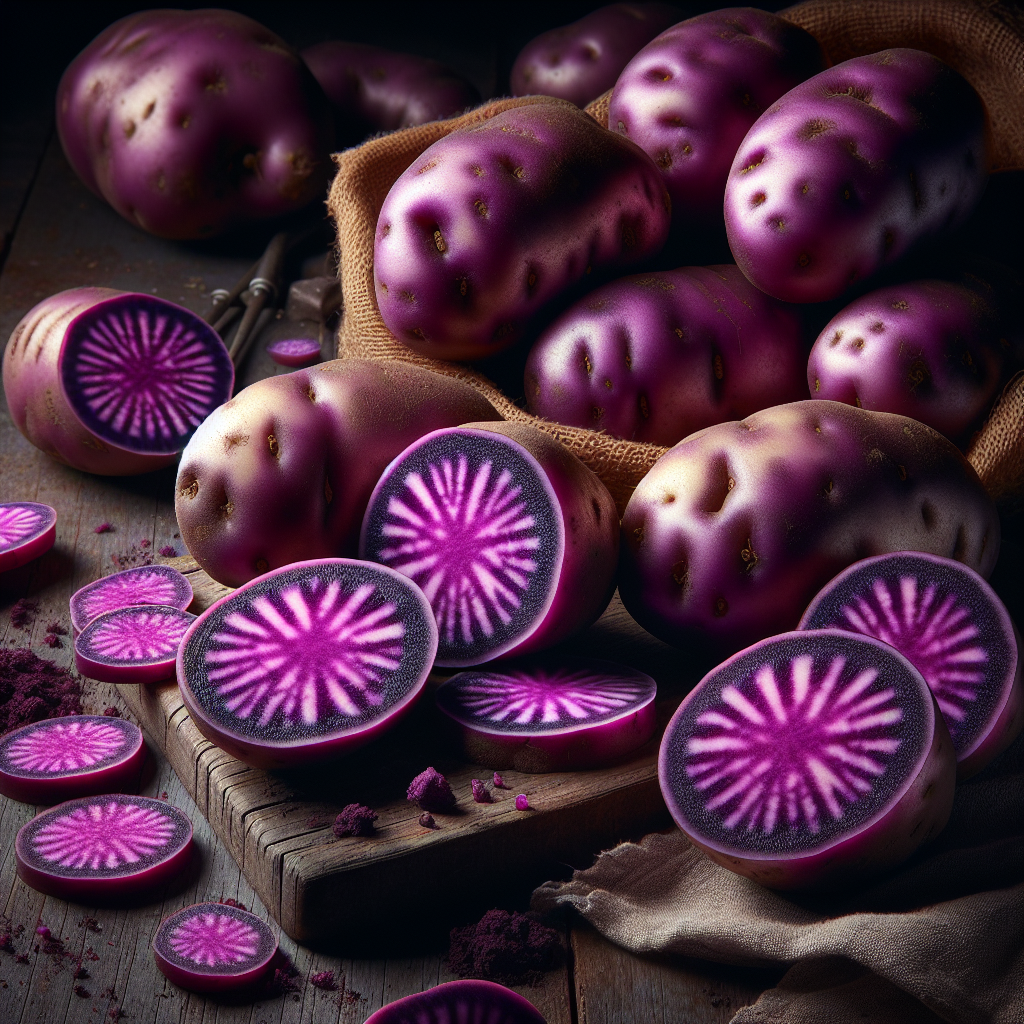
Introduction to Purple Majesty Potato
The Purple Majesty Potato stands out as one of the most visually stunning and nutritionally superior varieties in the potato family. Originating from selective breeding programs focused on colored-flesh potatoes, this heirloom gem features deep purple skin that extends throughout its creamy, moist interior, thanks to high levels of anthocyanins—powerful antioxidants linked to reduced inflammation and improved heart health. With tubers averaging 4-6 inches long and weighing 6-8 ounces, Purple Majesty offers exceptional yields of 20-30 tons per acre under optimal conditions, making it a favorite for small-scale farmers targeting premium markets like farmers' markets, restaurants, and health food stores.
Unlike standard white-fleshed potatoes, Purple Majesty brings a unique buttery texture and subtly sweet, earthy flavor that shines in roasting, mashing, or salads without fading during cooking. Its vibrant hue retains well, adding dramatic color to plates. Growers appreciate its disease resistance compared to some heirlooms, though it demands vigilant care against common potato foes. For those diversifying beyond traditional spuds like Russet Burbank Potato or Yukon Gold Potato, Purple Majesty combines profitability with visual appeal. Discover more on companion planting to maximize your yields.
This comprehensive guide equips professional growers, homesteaders, and market gardeners with proven techniques for cultivating Purple Majesty from seed tuber to storage. Expect maturity in 90-110 days, with plants reaching 24-36 inches tall, producing abundant medium-green foliage.
Botanical Profile of Purple Majesty Potato
Purple Majesty belongs to the Solanaceae family, classified as Solanum tuberosum 'Purple Majesty', a colored-flesh selection derived from Andean landraces domesticated over 8,000 years ago. Botanically, it's a herbaceous perennial grown as an annual, with compound pinnate leaves, white flowers featuring purple anthers, and rhizomatous tubers rich in anthocyanins (up to 10 times more than white varieties). Tubers are oblong to fingerling-shaped, with smooth, deep indigo skin and matching flesh that bleeds minimal color when cut.
The plant's upright, bushy habit resists lodging, with stems bearing 8-12 nodes before tuber initiation. Stems are angular, green to purple-tinged, supporting 10-15 stems per hill. Flowers are self-fertile but rarely set viable seed; propagation relies on tubers. Nutritionally, it boasts 150% more antioxidants than standard potatoes, plus high vitamin C, potassium, and fiber. For general potato cultivation insights, see the Potato (crop) wiki page.
Genetically stable, Purple Majesty exhibits intermediate dormancy (8-10 weeks), allowing sequential harvests. Its anthocyanin profile includes petunidin and malvidin glycosides, contributing to its pH stability (5.5-6.5 optimal flesh pH). Yields peak in fertile, well-drained soils with consistent moisture.
Soil, pH, and Climate Requirements for Purple Majesty Potato
Purple Majesty thrives in loose, well-drained loamy soils with high organic matter (4-6% minimum). Ideal texture is sandy loam to silt loam, avoiding heavy clays prone to compaction. Incorporate 2-4 inches of compost or aged manure pre-planting to boost tilth and microbial activity. Soil pH should range 5.8-6.5; test and amend with elemental sulfur for high pH or dolomitic lime for acidity below 5.5.
Climate-wise, it's cool-season adapted, preferring daytime temps of 60-70°F (15-21°C) and nights above 45°F (7°C). Frost-tolerant sprouts emerge at 40°F (4°C), but optimal tuber bulking occurs below 75°F (24°C); heat above 85°F (29°C) stresses plants, causing knobby tubers and reduced set. It handles light frosts (-2°C) post-emergence but protect pre-sprout. In zones 3-9, plant 2-4 weeks before last frost. Full sun (6-8 hours) is essential; partial shade reduces yields by 20-30%.
For small farms, rotate with peas or clover to suppress soil pathogens. Mulch with straw (4-6 inches) conserves moisture and moderates soil temps. Irrigate to maintain 1-1.5 inches water weekly, avoiding waterlogging to prevent root rot.
Step-by-Step Planting & Propagation
Seed Selection and Preparation: Source certified, disease-free Purple Majesty seed tubers from reputable suppliers. Cut into 1.5-2 oz pieces with 2-3 eyes each; dust cuts with sulfur or hydrogen peroxide (1:10 dilution) to prevent rot. Green sprouts 0.5-1 inch long in warm (60°F) storage 2 weeks pre-planting.
Site Preparation: Till to 12 inches deep, removing rocks and incorporating 2-3 lbs/100 sq ft 5-10-10 fertilizer or organic equivalent (e.g., bone meal, kelp). Form 8-12 inch high, 30-inch wide ridges for drainage.
Planting: Space pieces 10-12 inches apart, 4 inches deep, eyes up, in rows 30-36 inches apart. Early spring planting (soil 45-55°F) yields best; cover lightly. Hill soil around stems at 6, 12, and 18 inches growth.
Propagation Alternatives: True seed rare; use tissue culture for elite stock. Chitting (pre-sprouting) boosts emergence by 15%. For containers, use 5-10 gallon pots with 1-3 tubers.
Care & Maintenance regimes for Purple Majesty Potato
Irrigation: Consistent moisture critical—drip irrigate to field capacity every 4-7 days, reducing during late bulking to enhance skin set. Deficit irrigation post-flowering increases anthocyanins by 10-15%.
Fertilization: Sidedress 4-6 weeks post-plant with 1 lb/100 sq ft nitrogen (e.g., blood meal). Foliar feed micronutrients (calcium, magnesium) biweekly. Avoid excess N to prevent lush tops over tubers.
Hilling and Mulching: Hill three times, burying stems to prevent greening. Apply 4-6 inches organic mulch post-hilling for weed suppression and temperature control.
Weeding: Shallow cultivate until hilling; mulch thereafter. Hand-pull persistent weeds.
Monitor growth: Expect 50% ground cover by week 6. Desiccant (e.g., diquat) 2 weeks pre-harvest for vine kill in commercial settings.
Pests, Diseases & Organic Management
Key Pests: Colorado potato beetle defoliates rapidly—handpick adults/larvae, use Bt kurstaki weekly. Aphids vector viruses; blast with water or neem oil. Flea beetles pitfall traps and row covers. Wireworms and cutworms managed with crop rotation and beneficial nematodes.
Diseases: Early blight shows concentric rings—remove debris, apply copper fungicide. Late blight demands vigilant scouting; use resistant varieties nearby and Mancozeb alternated with chlorothalonil. Common scab prevented by pH 5.2-5.5 and moisture consistency. Black scurf (Rhizoctonia) controlled via seed treatment and rotation.
Organic Strategies: Companion with horseradish or marigolds. Neem/azadirachtin for pests; Serenade (Bacillus subtilis) for diseases. Learn more in Spring Pest Patrol. Destroy volunteers to break cycles.
Harvesting, Curing & Optimal Storage
Harvest at 90-110 days when vines yellow; dig carefully with forks to avoid skinning. Yields 1-2 lbs/plant. Cure tubers 2 weeks at 55-65°F, 90% humidity to heal skins. Store at 38-40°F, 90-95% RH, dark—lasts 6-8 months with <5% loss.
Selective harvest new potatoes at 60 days for premium sales. Grade by size: small (1-2 oz), medium (3-6 oz), large (>6 oz). Avoid refrigeration to prevent sweetening.
Companion Planting for Purple Majesty Potato
Pair Purple Majesty with nutrient accumulators like beans to fix nitrogen, deterring Mexican bean beetle. Horseradish repels Colorado potato beetle; marigold suppresses nematodes. Avoid tomato and eggplant to prevent shared pests/diseases like Verticillium wilt. Cabbage and onion enhance growth; nasturtiums trap aphids. Interplant peas early for trellis support. Check Fall Companion Planting Guide for seasonal tips.