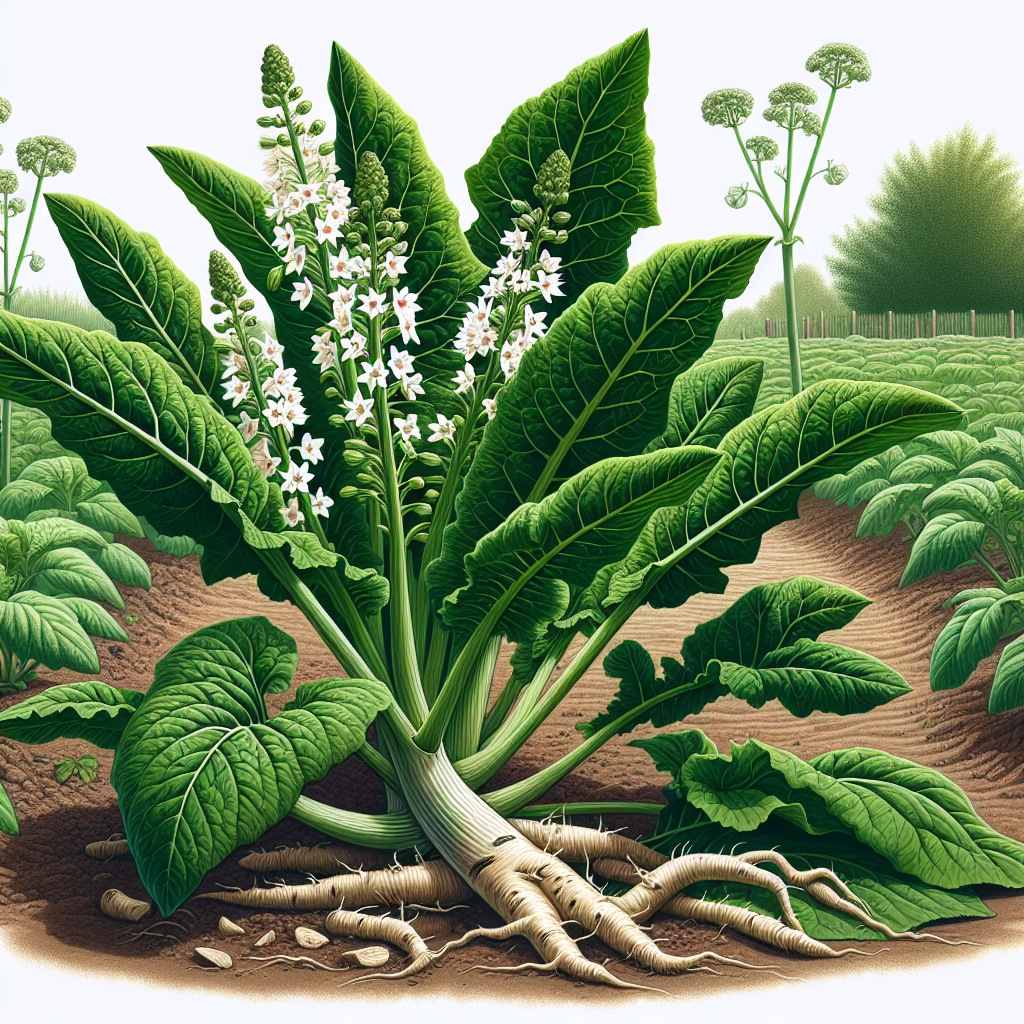
Introduction to horseradish
Horseradish (Armoracia rusticana), a member of the Brassicaceae family, is not your typical pest—it's a robust perennial plant originating from southeastern Europe but now widespread as a noxious weed across North America, Europe, and beyond. Often planted intentionally for its pungent roots used in condiments, it quickly escapes cultivation due to its tenacious rhizomes that spread laterally up to 3 feet per season. This "pest" invades vegetable gardens, orchards, and field crops, forming dense colonies that smother desirable plants by competing for water, nutrients, and light. Unlike annual weeds, horseradish regenerates vigorously from even tiny root fragments, making it a persistent challenge for organic farmers and home gardeners alike.
Recognizing horseradish early is crucial; its large, dock-like leaves emerge in spring, reaching 2-3 feet tall with crinkled edges and a coarse texture. By summer, it produces white, four-petaled flowers resembling wild mustard, followed by seed pods that aid dispersal. The real menace lies below ground: thick, branched rhizomes that store energy and fragment easily during tillage, spawning new plants. In agricultural settings, uncontrolled horseradish can reduce yields by 30-50% in affected potato fields or cabbage patches. This guide equips you with professional diagnostics, lifecycle knowledge, and battle-tested management plans. For more on integrated weed strategies, check this Spring Pest Patrol blog.
Identifying Symptoms & Damage
Spotting horseradish infestations requires attention to both above- and below-ground signs. Foliage appears in early spring as basal rosettes of long, lance-shaped leaves (12-24 inches long, 4-8 inches wide) with toothed or wavy margins, similar to curly dock but with a distinct horseradish aroma when crushed—pungent and sharp, like wasabi. Leaves are hairless, dark green, and arranged in a basal cluster, transitioning to a flowering stalk up to 4 feet tall by mid-summer. Flowers are small (½ inch), white, cross-shaped, clustered in elongated racemes; they rarely set viable seed in many regions due to sterility, but vegetative spread dominates.
Damage manifests as competition: horseradish shades out low-growing crops like strawberry or lettuce, depriving them of sunlight. Its shallow feeder roots (top 12 inches) steal nitrogen and moisture, stunting nearby plants. Excavate suspect areas to confirm: creamy-white rhizomes, 1-2 inches thick, snake horizontally 12-18 inches deep, branching profusely with small buds. Even 1-inch fragments regrow. In perennial crops like asparagus, it invades beds, reducing spear production. Differentiate from similar weeds: unlike garlic (bulbous, garlicky smell) or radish (annual taproot), horseradish rhizomes are scaly, forked, and aromatic. Scout in spring and fall when foliage is prominent; use a shovel for confirmatory digs. Associated issues include harboring aphids or flea beetles, which then migrate to crops.
Lifecycle and Progression of horseradish
Horseradish is a herbaceous perennial hardy in USDA zones 3-9, with a lifecycle tuned for persistence. It overwinters as dormant rhizomes, breaking bud in early spring (March-April in temperate zones) when soil warms to 45°F. Vegetative growth explodes, producing 20-50 leaves per plant by May-June. Flowering occurs June-July, but seed production is low (often infertile clones); primary reproduction is vegetative via rhizome tips and fragments.
By late summer, energy shifts underground: rhizomes thicken (up to 1.5 inches diameter), storing starches for winter survival. Plants senesce in fall, leaves yellowing after frost, but roots remain viable for years. A single plant can produce 50-100 linear feet of rhizome annually, with buds sprouting new shoots. Progression stages:
- Dormancy (Winter): Rhizomes 6-18 inches deep survive freezing.
- Emergence (Spring): Shoots appear 2-4 weeks before most crops.
- Vegetative (Summer): Rapid top growth, lateral rhizome extension.
- Maturity (Late Summer-Fall): Rhizome bulking, bud formation.
Disturbance like tilling accelerates spread by creating fragments. In no-till systems, it forms clumps up to 6 feet wide. Lifecycle spans 2-10+ years per clone, outlasting annual crops. Monitor progression with seasonal digs: spring for young shoots, fall for thickened roots.
Environmental Triggers & Risk Factors
Horseradish thrives in full sun, moist loamy soils (pH 6.0-7.5), but tolerates clay, sand, and poor fertility. Key triggers include:
- Soil Disturbance: Tilling, plowing, or flooding fragments rhizomes, sparking outbreaks. Avoid in infested fields.
- Moisture: Prefers consistent water (1-2 inches/week); wet springs boost emergence by 40%.
- Nitrogen Availability: High-N soils from manure or legumes fuel growth; it competes well against corn or wheat.
- Introduction Vectors: Often via contaminated rootstock, mulch, or equipment. Garden centers sell it unwittingly.
- Climate: Cool summers (<80°F) and mild winters favor persistence; drought stresses but doesn't kill established stands.
Risk factors: Recent planting near wild areas, flooding from nearby streams, or alkaline soils. It invades disturbed sites post-construction or harvest. Companion crops like onion may suppress mildly, but beet or turnip rotations exacerbate spread via similar niches. Climate change with wetter springs heightens risks in northern latitudes.
Organic Control & Treatment Plans
Eradicating horseradish demands persistence; no single method suffices—integrate cultural, mechanical, and biological tactics. Step 1: Survey and Quarantine. Map infestations, restrict movement to prevent spread.
Mechanical Control (Primary):
- Dig exhaustively in spring/fall when soils are moist. Use a spading fork to extract every rhizome piece (>¼ inch). Sift soil through ¼-inch mesh. Repeat every 2-3 weeks for 1-2 years; success rate 80-90% with diligence.
- Smother with heavy black plastic or cardboard (6+ mil, 12+ months). Solarize in summer: clear plastic traps heat, killing rhizomes at 120°F+.
Cultural Controls:
- Dense mulching (8-12 inches straw/woodchips) starves plants. Mow weekly to exhaust roots (no energy from photosynthesis).
- Crop rotation: Plant competitive cover crops like clover or sorghum sudangrass to outcompete.
Organic Herbicides/Bio-controls:
- Vinegar (20-30% acetic acid) + citrus oil sprays burn foliage; repeat 3-5x. Effective on young shoots.
- Flame weeding for tops, followed by digging.
- Biological: Grazing pigs or goats devour tops; introduce mustard biofumigants.
Integrated Plan:
| Stage | Action | Frequency |
|---|---|---|
| Spring | Mow + dig shoots | Weekly |
| Summer | Solarize/mulch | Continuous |
| Fall | Deep dig + vinegar | Biweekly |
| Year 2 | Monitor + spot-treat | Monthly |
Avoid tilling; it worsens spread. For carrot fields, combine with root-knot nematodes management.
Preventing horseradish in the Future
Prevention beats cure: source clean stock, inspect equipment, and quarantine new plants. Plant barriers like deep-rooted perennials or trenches (2 feet deep). Maintain soil health to favor crops—balanced fertility reduces weed vigor. Scout annually; remove seedlings instantly. In orchards, use landscape fabric under apple trees. Educate on clean mulch; solarize new beds. Long-term: diverse rotations with suppressants like rye or buckwheat. Monitor adjacent wild areas; buffer with mowed strips. Certified organic fields: document controls for compliance. Success metric: zero regrowth after 2 years.
Crops Most Affected by horseradish
Horseradish plagues cool-season crops and perennials:
- Root/Tuber Crops: Potato, sweet potato, carrot—rhizomes tangle harvests.
- Brassicas: Cabbage, broccoli, kale—shared soil preferences.
- Perennials: Asparagus, strawberry—invades beds.
- Grains/Forages: Wheat, corn—reduces tillering.
Yields drop 20-60%; mechanical harvest clogs with roots.