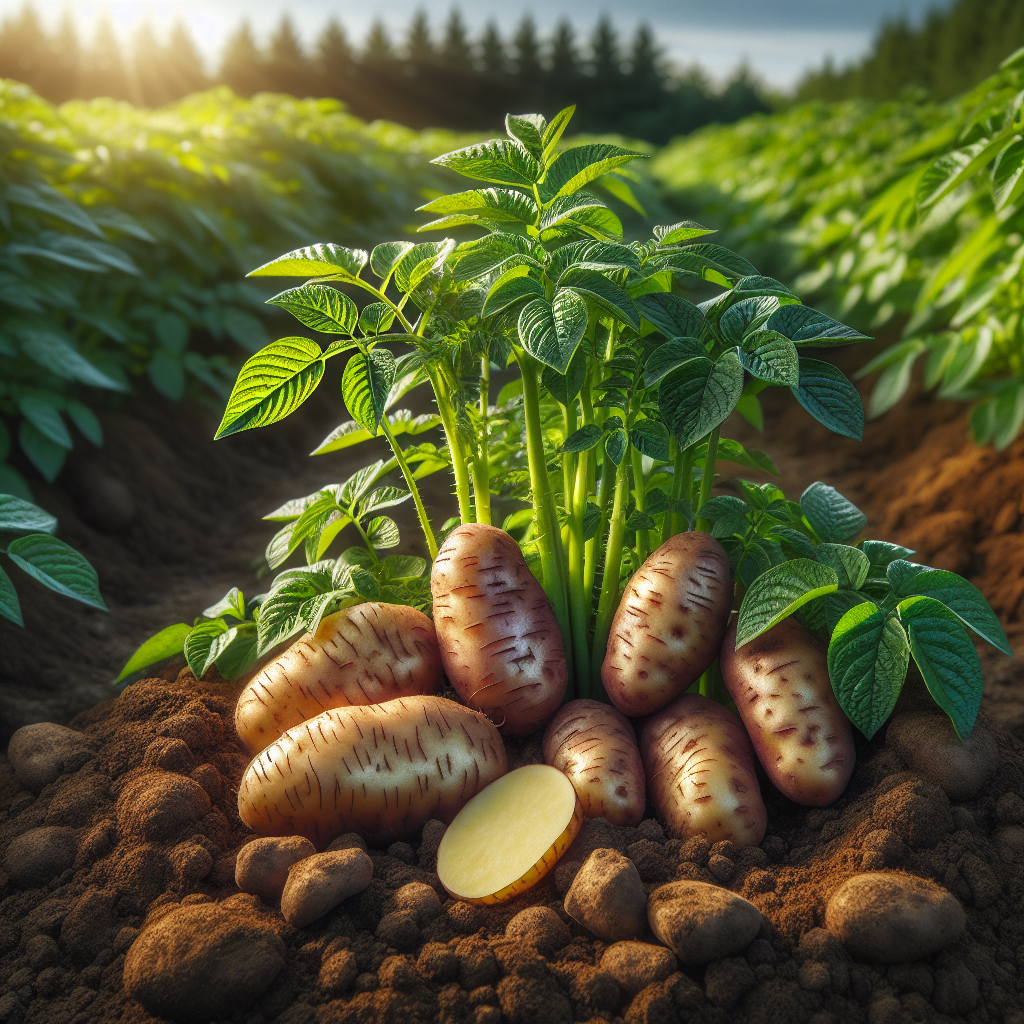
Introduction to Russet Burbank Potato
Developed from a seedling selection by Luther Burbank in the late 19th century, this cultivar became one of the most commercially important potatoes in North America because of its reliable shape, high solids, and suitability for baking and frying. Its long dormancy and excellent storage life made it especially valuable to large-scale growers and processors, while its coarse russeted skin and white flesh set the standard for what many consumers think of as a “classic potato.”
This is a late-season potato, typically requiring about 110 to 135 days to maturity depending on climate, seed source, and management intensity. It is not the easiest potato for beginners because it responds strongly to irrigation gaps, nutrient imbalance, heat stress, and tuber defects such as hollow heart, second growth, knobs, and sugar-end issues. However, under careful management it produces large, marketable tubers with strong culinary quality. For broader background on the crop species, see Potato.
Botanical Profile of Russet Burbank Potato
This cultivar belongs to the nightshade family, Solanaceae, and is a clonally propagated selection of Solanum tuberosum. Like other cultivated potatoes, it is technically a stem-tuber crop rather than a root crop. The edible tuber is a swollen underground stem bearing eyes, each of which contains buds capable of producing new shoots.
Plants are typically upright to semi-upright, with compound leaves and white to pale lavender flowers in some environments, though flowering intensity varies with temperature and day length. Russet Burbank forms long to oblong tubers with a netted, russeted tan-brown skin and white flesh. The skin finish is one of its identifying commercial traits, but good russeting depends on genetics interacting with soil texture, tuber maturity, and moisture conditions.
Its growth cycle can be divided into five management-relevant phases: sprout emergence, vegetative growth, tuber initiation, tuber bulking, and maturation. Tuber initiation usually begins when stolon tips start swelling, often shortly after canopy establishment under favorable temperature and moisture conditions. During initiation and early bulking, stress has disproportionate effects on final tuber number and uniformity. Later, during bulking, stable water and potassium nutrition strongly influence size distribution and internal quality.
Russet Burbank is prized for high specific gravity and relatively high dry matter, which is why it is preferred for fries and baked potatoes. High dry matter means less water in the tuber, producing a fluffy baked texture and crisp fried finish. The trade-off is that the cultivar can be more sensitive to inconsistent growing conditions than some fresh-market varieties. Compared with red or yellow potatoes, it often needs a longer season and more precise cultural control to deliver top-grade tubers.
Soil, pH, and Climate Requirements for Russet Burbank Potato
Loose, deep, stone-free soil is essential. The best results come from sandy loam or loam with excellent drainage, high organic matter, and enough tilth for tubers to expand evenly without deformity. Heavy clay can produce misshapen tubers, rough skin, lenticel swelling, and higher risk of rot under wet conditions. Extremely sandy soils can work well if irrigation and fertility are tightly managed, but they dry out fast and can increase scab risk if moisture fluctuates around tuber set.
Ideal soil pH is generally 5.2 to 6.2. A slightly acidic range helps reduce Common scab severity, especially compared with neutral or alkaline ground. If pH rises above about 6.5, scab pressure often increases markedly. Avoid liming immediately before a potato crop unless soil tests show a severe deficiency that cannot be managed otherwise. If calcium is needed, gypsum is often a better option because it supplies calcium without significantly increasing pH.
Target soil organic matter in the moderate range, ideally around 3% to 5% for mineral soils, though good results are possible outside that band with proper management. Excessively fresh manure should never be applied immediately before planting because it can encourage scab, unbalanced nitrogen release, and poor skin finish. If manure is used, incorporate it in the preceding crop cycle.
Cool growing conditions are preferred. Best emergence usually occurs when soil temperatures at planting depth are at least 45 to 50°F (7 to 10°C), with rapid establishment near 55 to 65°F (13 to 18°C). Vegetative growth is vigorous in cool weather, and tuber bulking is best when daytime temperatures remain around 60 to 75°F (16 to 24°C) and nights are cool. Sustained soil temperatures above about 70°F (21°C) can suppress tuber initiation, while prolonged air temperatures above 85°F (29°C) reduce tuber quality, increase physiological disorders, and stress the canopy.
This cultivar performs best in temperate climates with a frost-free growing period long enough to support full bulking. It is less suited to hot tropical lowlands unless grown during the coolest available season at elevation. Full sun is non-negotiable; a dense, healthy canopy is needed to produce the carbohydrate reserves required for large tubers.
Step-by-Step Planting & Propagation
Propagation is done with certified disease-free seed tubers, not botanical seed. Certified seed is especially important because Russet Burbank can accumulate and express viral, bacterial, and fungal problems that sharply reduce yield and storage life. Select seed pieces that are firm, healthy, and free of soft spots, discoloration, shrinkage, or elongated weak sprouts.
Whole seed tubers about the size of a small egg are ideal. Larger tubers can be cut into seed pieces weighing roughly 1.5 to 2.5 ounces (40 to 70 grams), each with at least one strong eye and preferably two. Use a sanitized knife and cut pieces so they have enough stored energy to support emergence. After cutting, allow seed pieces to suberize for 1 to 3 days in a well-ventilated area at about 50 to 60°F (10 to 16°C) with high relative humidity but no free moisture. The cut surface should dry and form a corky protective layer before planting.
Pre-sprouting, also called chitting, can improve stand establishment in shorter seasons. Place seed tubers in bright indirect light at cool room temperatures until short, sturdy green-purple sprouts form. Avoid long white sprouts, which break easily during planting.
Prepare beds or ridges deeply. Subsoil compacted layers if needed so roots and stolons can penetrate freely. Final seedbed texture should be fine enough for good seed-soil contact but not powdery. Incorporate phosphorus and potassium according to soil test before planting, with only part of the nitrogen applied up front.
Plant 2 to 4 weeks before the last expected frost if soils are workable and not waterlogged. Seed pieces are usually placed 3 to 5 inches (7.5 to 12.5 cm) deep in the row, then gradually hilled as plants grow. In cool wet soils, shallower initial placement can improve emergence; in lighter drier soils, slightly deeper planting helps moderate moisture stress.
Typical spacing for large Russet Burbank tubers is 10 to 12 inches (25 to 30 cm) between plants and 30 to 36 inches (75 to 90 cm) between rows. Closer spacing increases tuber number but may reduce average size. Wider spacing can encourage oversized tubers and hollow heart if fertility and irrigation are excessive.
Once shoots reach 6 to 8 inches (15 to 20 cm) tall, hill soil around the stems, leaving only the upper foliage exposed. Repeat as needed until the ridge is 8 to 12 inches (20 to 30 cm) tall. Hilling prevents greening, protects developing tubers from sun exposure, improves drainage, and increases the volume of loose soil available for bulking.
Care & Maintenance regimes for Russet Burbank Potato
Water management determines quality more than almost any other factor. Maintain evenly moist soil, especially from tuber initiation through bulking. A useful practical target is to keep soil moisture near 65% to 80% of field capacity in the main root zone, avoiding both saturation and severe drying. In field terms, the soil should feel cool and slightly moist when squeezed, forming a weak ball in loam but not releasing water. During active bulking, many plantings need about 1 to 1.5 inches (25 to 38 mm) of water per week from rain plus irrigation, adjusted for soil type and evapotranspiration.
Water stress early can reduce tuber number. Water stress during bulking often causes knobby growth, growth cracks, stem-end defects, and irregular size. Rewatering after drought can trigger second growth, where tubers resume growth unevenly and develop misshapen lobes. Overwatering is equally damaging. Signs include persistently saturated ridges, swollen white lenticels on tubers, yellowing lower leaves without dry soil, slow canopy metabolism, and increased Soft rot or Blackleg risk. Drip irrigation offers good control, but furrow or overhead systems can also work if scheduled carefully.
Nitrogen must be balanced. Too little reduces canopy size and final yield; too much delays maturity, weakens skin set, and can increase hollow heart or poor fry color. A moderate program often works best, with roughly 25% to 40% of seasonal nitrogen at planting and the rest side-dressed before row closure. Actual rates vary widely by soil test, yield target, and organic matter, but overapplication is a common mistake with Russet Burbank. Phosphorus supports early root and stolon development, while potassium is critical for tuber bulking, water relations, and internal quality. Sulfur, magnesium, calcium, boron, manganese, and zinc may also matter depending on soil analysis.
Avoid excessive late nitrogen after tuber set unless tissue testing clearly supports it. Late luxuriant vines can keep the crop immature when harvest should be approaching, compromising skin set and storability.
Weed control is most important before canopy closure. Potatoes are initially weak competitors, but once the foliage covers the row middles, weeds decline naturally. Shallow cultivation early is effective, but avoid damaging stolons or roots. Mulch can help in garden-scale systems, though in wet climates it may raise slug and rot pressure.
Monitor canopy condition weekly. Uniform dark green foliage, moderate vigor, and steady expansion indicate balanced nutrition. Very pale leaves may suggest nitrogen deficiency, while excessively lush, soft, dark foliage often signals too much nitrogen or persistent high moisture. Leaf rolling can occur from heat, water imbalance, or virus infection, so diagnosis should consider field history and distribution pattern.
Crop rotation is essential. Do not plant potatoes or related solanaceous crops in the same ground more than once every 3 to 4 years if possible. This reduces carryover of scab, Verticillium, Rhizoctonia, nematodes, and volunteer plants. Diverse rotations that include cereals or grasses are especially valuable.
For broader soil-building approaches that support tuber crops, see soil health strategies.
Pests, Diseases & Organic Management
Colorado potato beetle is among the most serious insect threats. Adults are yellow-orange with black stripes; larvae are soft-bodied, red to orange, and voracious. Hand-picking works in small plots, but timing is crucial. Remove egg masses from leaf undersides before hatch. Organic spinosad or Bacillus thuringiensis var. tenebrionis can help when larvae are small. Crop rotation and destroying volunteer potatoes reduce carryover populations.
Aphids are important not only for feeding damage but also as virus vectors. Even low populations can spread potato viruses. Encourage beneficial insects, avoid excessive nitrogen that creates lush aphid-attracting growth, and use reflective mulches or insecticidal soaps where practical.
Wireworms tunnel into tubers, especially in fields recently converted from grass. Use bait stations before planting to assess risk. Avoid planting potatoes directly after sod where Wireworms are known problems.
Common scab causes corky, rough lesions on tubers. It is favored by higher pH and dry soil during tuber initiation. Keep soil consistently moist during the 2 to 4 weeks after tuber initiation begins, and avoid fresh manure or recent liming.
Rhizoctonia can cause stem canker, poor emergence, and black scurf on tubers. Plant only healthy seed, avoid cold wet planting conditions, rotate crops, and encourage rapid emergence through good seedbed preparation.
Late blight is the most feared foliar disease in humid cool weather. Water-soaked lesions, white sporulation under moist conditions, and rapid canopy collapse require immediate action. Use certified seed, allow good airflow, avoid prolonged leaf wetness when possible, and apply approved copper-based organic protectants preventively in high-risk weather rather than after severe infection is established.
Early blight produces concentric ring lesions on older leaves and is often worse when plants are nutritionally stressed. Balanced fertility, good rotation, sanitation, and protective sprays such as copper or biologicals can reduce severity.
Blackleg and Soft rot are bacterial issues associated with infected seed and wet handling conditions. Symptoms include blackened stems, slimy tissue, foul odor, and collapsing plants. Prevention depends heavily on clean seed, well-drained soil, and careful harvest handling.
Verticillium wilt contributes to premature vine decline, especially in short rotations. Symptoms can resemble natural senescence but appear uneven and early. Rotation and soil health are the main tools.
Organic management works best as a system: certified seed, long rotation, airflow, careful irrigation, sanitation, resistant or clean neighboring crops, and prompt removal of cull piles. Cull piles are major disease reservoirs and should never be left to sprout near production fields.
Harvesting, Curing & Optimal Storage
Russet Burbank is usually harvested for full maturity rather than as a new potato. For storage or processing, wait until vines naturally senesce or are deliberately killed and skins have set firmly. Skin set is tested by rubbing the tuber with your thumb; if the skin peels easily, it is not ready. Many growers mow or desiccate vines 2 to 3 weeks before harvest to improve skin set and reduce disease transfer from foliage to tubers.
Harvest only when soils are relatively dry and temperatures are moderate. Very wet harvest conditions increase rot and smear soil onto tubers; very hot conditions can lead to sunburn and pulp temperature injury. Handle gently. Bruising, shatter injury, and cuts may not be obvious immediately but will shorten storage life and increase shrinkage.
After harvest, cure tubers at about 50 to 60°F (10 to 16°C) with 85% to 95% relative humidity and good airflow for 10 to 14 days. This allows minor wounds to heal and skins to toughen. Do not wash tubers intended for long storage unless they can be dried rapidly and marketed soon.
For long-term storage, lower temperatures gradually after curing. Fresh eating and seed storage often perform well around 38 to 40°F (3 to 4°C) with high humidity. However, tubers intended for frying may require slightly warmer storage, often around 45 to 50°F (7 to 10°C), because colder storage encourages reducing sugar accumulation, which darkens fry color. Relative humidity should generally remain around 90% to 95% to limit shrinkage, but airflow must prevent condensation.
Keep storage completely dark to prevent greening and glycoalkaloid formation. Inspect regularly and remove any soft, sprouting, or diseased tubers. Russet Burbank is famous for strong storage potential, but only if harvested mature, cured properly, and stored with stable temperature and humidity.
Companion Planting for Russet Burbank Potato
Useful companion plants are those that either help with pest distraction, improve beneficial insect activity, or occupy nearby space without competing heavily for the same root zone. Onion is one of the most practical companions because its pungent foliage may help confuse some pests while occupying a relatively narrow band in adjacent beds. Garlic offers a similar benefit and fits well at plot margins rather than directly within dense potato rows.
Nasturtium is valuable as a trap and pollinator-support plant in mixed gardens, drawing attention away from the main crop and increasing beneficial insect activity nearby. Thyme can serve as a low-growing aromatic border that supports predatory insects and makes efficient use of edge space.
Keep companions in bordering strips or separate rows rather than crowding the potato hill itself. Potatoes need aggressive hilling, cultivation, and access for scouting, so companions should never interfere with ridge formation, harvest, or air movement. Avoid companion schemes that place other heavy feeders or close relatives such as tomatoes, peppers, or eggplants beside potatoes, since they share major pests and diseases.