Introduction to Garlic
A foundational crop in kitchen gardens, market gardens, and field-scale production, garlic is one of the oldest cultivated plants and has been grown for food, medicine, and ritual use for thousands of years across Asia, the Mediterranean, and later nearly every temperate farming region on earth. Unlike many annual vegetables that are started from true seed, commercial and household garlic is usually propagated vegetatively from individual cloves, which means varietal performance, bulb size, disease carryover, and storage quality are all heavily influenced by the quality of planting stock.
Garlic is generally grouped into hardneck and softneck types. Hardneck garlics, botanically closer to wild ancestral forms, produce a central flowering stalk called a scape and typically form fewer, larger cloves arranged in a ring. They often excel in cold-winter climates and are favored for complex flavor, though they usually store for a shorter period. Softneck garlics usually do not form a stiff scape, produce more cloves per bulb, braid well after curing, and often store longer, making them common in commercial trade. There are also specialty forms such as rocambole, porcelain, purple stripe, artichoke, silverskin, and the oversized Elephant Ear Garlic, which is actually more closely related to leek than true garlic.
From a production standpoint, garlic rewards careful planning. It is not difficult, but it is unforgiving of poor drainage, low fertility, compacted soil, and contaminated seed stock. For growers seeking dense, marketable bulbs, the crop’s long season means that success is often decided months before harvest—especially at planting, when root initiation, winter establishment, and spacing determine final bulb size.
Botanical Profile of Garlic
Garlic belongs to the Amaryllidaceae family and the genus Allium, which also includes onions, leeks, and chives. The plant forms a compound bulb made up of individual cloves enclosed in papery wrappers. Each clove is a modified storage leaf attached to a basal plate, and when planted it produces adventitious roots from the basal plate and leaves from the apical meristem.
The growth cycle proceeds through several distinct phases. First comes root initiation, ideally in cool soil after planting. This is followed by leaf production, during which the plant builds its photosynthetic engine. Bulb initiation begins in response to daylength and temperature, with longer days and warming spring conditions shifting the plant from vegetative growth into storage organ enlargement. Final bulb sizing depends on how many healthy green leaves are present at the onset of bulbing, because each leaf roughly corresponds to one wrapper or clove-supporting structure in the mature bulb.
Hardneck garlic often produces a seed stalk, or scape, that curls or straightens depending on cultivar group. Although true seed can be produced under some conditions, it is rarely used in ordinary cultivation due to genetic variability and the time required to rebuild marketable bulbs. Most growers remove scapes once they curl to redirect energy toward bulb enlargement. Softneck types generally remain more flexible aboveground and are better adapted to regions with milder winters or warmer, drier curing conditions.
Garlic has a relatively shallow root system compared with deep-rooted crops. Most feeder roots remain in the upper 15 to 30 cm of soil, which explains why the crop responds strongly to consistent surface moisture, weed-free beds, and loose, friable topsoil. It is also highly sensitive to oxygen deprivation around the roots; saturated soils quickly lead to stunting, yellowing, and bulb diseases.
Soil, pH, and Climate Requirements for Garlic
Few factors matter more to garlic than soil structure. The ideal soil is loose, deep, well-drained, and rich in stable organic matter, such as a sandy loam or silt loam with excellent aggregation. Heavy clay can grow garlic successfully only if it is improved with organic matter, shaped into raised beds, and managed to prevent standing water. Bulbs expanding in compacted ground often become misshapen, smaller, and more prone to rot.
The preferred pH is about 6.0 to 7.0, with 6.5 often considered close to optimal. Below pH 5.8, nutrient availability begins to shift unfavorably, root growth can suffer, and some soils show higher disease pressure. Above about 7.2, micronutrient tie-up may lead to pale foliage or sluggish growth. A pre-plant soil test is strongly recommended. Garlic has a moderate-to-high demand for nitrogen early in the season, along with adequate phosphorus for rooting and potassium for stress tolerance, bulb quality, and storage performance.
Climate adaptation depends on garlic type. In most temperate systems, garlic is planted in autumn so cloves can establish roots before winter dormancy and resume vigorous spring growth. Hardneck types usually require substantial cold exposure, often 4 to 8 weeks or more below about 7 to 10°C, to properly vernalize and form well-segmented bulbs. Softnecks generally need less chilling and perform better in warmer winter regions. In subtropical and mild-winter climates, growers often select low-chill softneck strains or refrigerate planting stock for a controlled period before planting.
Ideal temperatures for early vegetative growth are cool, roughly 12 to 24°C. Bulb development is generally favored by increasing daylength and temperatures in the 18 to 27°C range. Prolonged heat above 32°C, especially when paired with drought stress, can accelerate maturity before bulbs reach full size. Conversely, excessively warm winters may reduce uniform sprouting and impair bulb formation in cultivars that need stronger cold exposure.
Moisture management should be precise rather than casual. Garlic prefers evenly moist soil, commonly around 60 to 80% of field capacity during active vegetative growth. In practical terms, the root zone should feel cool and slightly moist but never greasy, sticky, or anaerobic. If a squeezed handful of soil forms a tight, shiny ball that does not crumble, it is likely too wet. If the top 5 to 7 cm becomes powdery and dry between irrigations during spring leaf growth, yield loss is likely. Water stress during leaf production reduces final bulb size because the crop cannot replace lost photosynthetic capacity later.
Sites with full sun are best. Garlic tolerates light shade, but reduced light intensity often translates into smaller bulbs and slower drying after rain, which increases disease risk. Good airflow is also essential, especially in humid climates.
Step-by-Step Planting & Propagation
Begin with certified disease-free planting stock whenever possible. Because garlic is clonally propagated, pathogens such as basal rot, White rot, mites, and viruses move easily from one generation to the next. Select large, healthy bulbs with intact wrappers; planting small cloves nearly always produces smaller bulbs, even under ideal fertility.
Break bulbs into cloves only shortly before planting, ideally within 24 to 48 hours. Leaving cloves separated for too long increases desiccation and can weaken emergence. Keep the papery skin intact on each clove, and discard damaged, moldy, or unusually light cloves. Reserve the largest outer cloves for production and use the tiny inner cloves for kitchen use rather than planting.
Prepare beds deeply, loosening soil at least 20 to 25 cm. Incorporate well-finished compost but avoid fresh manure, which can promote excess vegetative growth, uneven maturity, and bulb disease. Raised beds are especially useful in rainy climates or heavier soils. For professional-scale planting, shape beds so water drains away rapidly after storms.
Planting time varies by region, but the general target is 4 to 6 weeks before the ground freezes hard in cold climates, or during the coolest reliable planting window in mild climates. The goal is root establishment without excessive top growth before winter. If planted too early, lush leaves may be winter-damaged; if planted too late, poor rooting can reduce bulb size.
Place cloves upright with the basal plate down and the pointed tip up. Plant depth should usually leave the top of the clove 2.5 to 5 cm below the soil surface in moderate climates, or 5 to 7 cm deep in colder areas where frost heaving is a concern. Typical spacing is 10 to 15 cm between cloves and 20 to 30 cm between rows for garden-scale production. For premium large bulbs, wider spacing around 15 cm in-row is often worth the lower plant density. Tight spacing increases total yield per area but often reduces average bulb size.
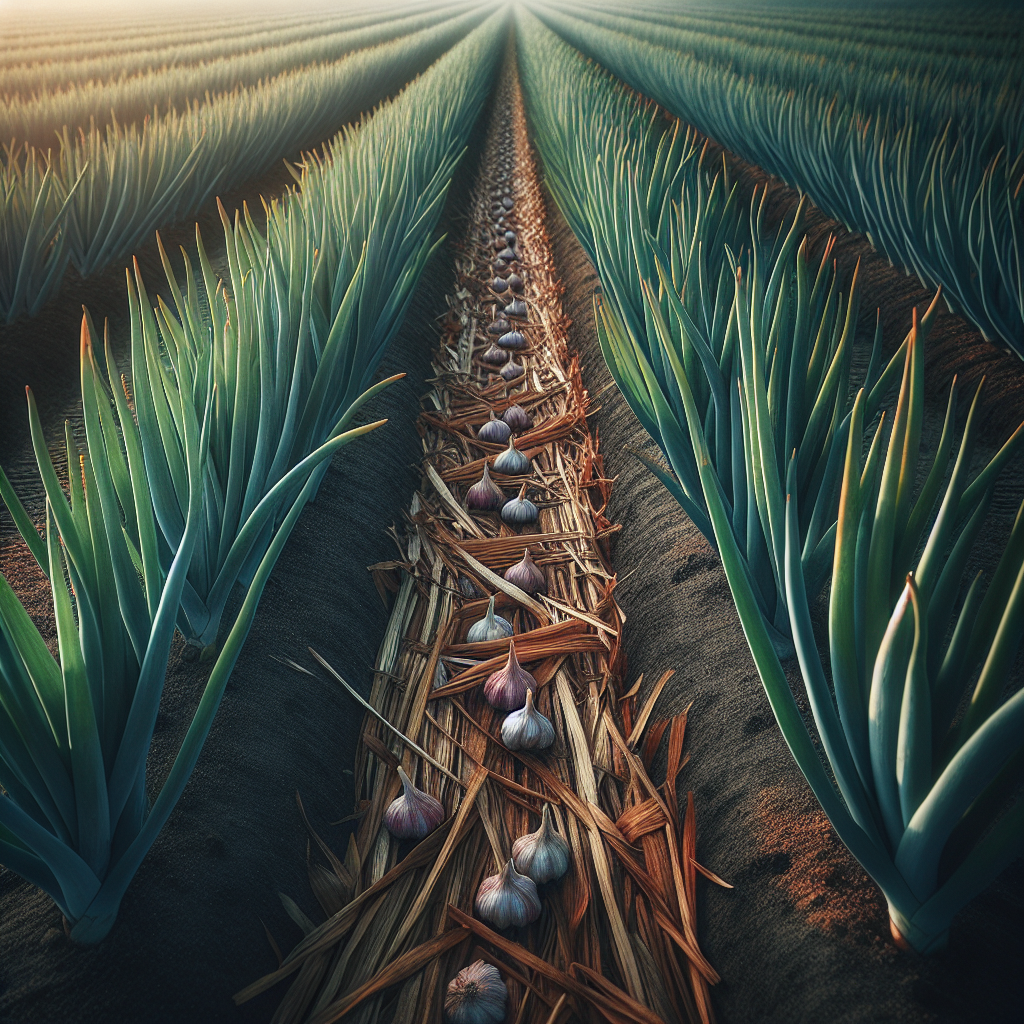
After planting, irrigate enough to settle the soil and initiate root growth. Apply mulch once the soil has cooled, especially in cold-winter systems. Clean straw, chopped leaves, or other weed-free organic mulch 5 to 10 cm thick helps buffer temperature swings, suppress winter weeds, conserve moisture, and reduce soil splashing onto foliage. In spring, pull mulch slightly back from the row if soils remain cold and wet.
Propagation is almost always by cloves, though bulbils from hardneck scapes can be used for disease reduction and multiplication. Bulbils are genetically similar to the parent but require additional seasons to size up into marketable bulbs. This is a useful technique for preserving prized cultivars when clove stock is limited.
For growers refining whole-farm soil quality, the bed-building principles outlined in soil health strategies align particularly well with garlic’s need for drainage, organic matter stability, and consistent tilth.
Care & Maintenance regimes for Garlic
The strongest garlic crops are managed in phases. From planting until winter dormancy, the focus is root establishment. During late winter and early spring, the emphasis shifts to protecting foliage, feeding steady vegetative growth, and suppressing weeds. Once bulbing begins, consistency becomes more important than aggressiveness.
Irrigation should be regular but not excessive. During active spring growth, garlic commonly needs about 25 to 40 mm of water per week from rainfall plus irrigation, with the exact amount determined by soil type, temperature, wind, and mulch coverage. Sandy soils may need lighter, more frequent watering, while loams hold moisture longer. The ideal is to keep the root zone uniformly moist to a depth of roughly 15 to 20 cm. Drip irrigation is preferred because it limits leaf wetness and reduces foliar disease pressure.
Watch for moisture signals carefully. Underwatering appears first as dull, blue-green, or gray-green leaves, reduced vigor, and early yellowing of lower foliage. Severe drought can trigger premature bulb maturation with undersized cloves. Overwatering often causes yellowing that resembles nutrient deficiency but is accompanied by limp plants, sour-smelling soil, poor anchorage, and sometimes basal decay. In saturated beds, roots lose oxygen and plants stop growing long before obvious rot is visible.
Nitrogen is most important from emergence through early bulb initiation. A common professional approach is to apply a balanced pre-plant fertility program based on soil testing, then side-dress nitrogen in late winter or early spring as growth resumes. Multiple light applications are often safer than one heavy dose. Excess late nitrogen after bulbing starts can produce oversized necks, delayed maturity, softer bulbs, and reduced storage life. Potassium and sulfur are particularly relevant to pungency, tissue strength, and storage quality, though sulfur needs vary with soil reserves and organic matter turnover.
Weed control is critical because garlic is a poor competitor. Its narrow, upright leaves cast limited shade, and early weed competition can substantially reduce bulb size. Keep beds clean by shallow cultivation, hand weeding, stale seedbed methods, or mulch. Avoid deep hoeing near plants because garlic roots are shallow and easily damaged.
In hardneck garlic, scape removal usually occurs when the stalk has made one curl but before it fully straightens. Removing scapes can improve bulb size by redirecting assimilates. However, do not remove them too early before sufficient elongation, as this may not capture the full yield benefit. Scapes themselves are a marketable specialty crop.
Crop rotation is non-negotiable in serious production. Avoid planting garlic or closely related Alliums in the same ground for at least 3 to 4 years, and longer if White rot, stem nematodes, or serious bulb diseases have appeared. Rotating with unrelated crops reduces inoculum pressure and interrupts pest cycles. Beds that previously held heavy-feeding crops but remain well structured are often suitable, but avoid fields recently amended with fresh, high-salt manures.
Pests, Diseases & Organic Management
Garlic is naturally pungent and somewhat pest-suppressive, but it is far from immune to attack. The most significant problems often come from soilborne diseases, storage rots, and hidden pests that hitchhike in planting stock.
Onion thrips are among the most common foliar pests, especially in hot, dry conditions. They rasp leaf tissue and suck sap, producing silvery streaking, stippling, and reduced photosynthesis. Heavy infestations can sharply reduce bulb size. Organic management includes reflective mulches, avoidance of drought stress, encouraging beneficial insects, and targeted use of approved materials such as insecticidal soaps or spinosad where permitted. Good spray coverage within leaf axils is essential.
Bulb mites can damage cloves and roots, especially in storage or in fields planted with infested stock. They often exploit already weakened tissue. Sanitation, certified seed stock, crop rotation, and proper curing are the main controls. Stem and bulb nematodes are even more serious; they cause swollen, distorted, spongy tissue and poor stand establishment. Once present, they can persist and spread with planting material. Hot-water treatment is sometimes used on seed stock by experienced growers, but temperature and duration must be exact to avoid damaging viability.
White rot, caused by Sclerotium cepivorum, is one of the most destructive garlic diseases. Symptoms include yellowing, wilting, and a white fluffy fungal growth with tiny black sclerotia around the bulb base. These survival structures can remain viable in soil for many years, making prevention far more effective than attempted cure. Never move contaminated soil or seed stock between fields. Long rotations help but may not fully eliminate risk once established.
Fusarium basal rot causes root decline, basal plate decay, and poor storage performance, especially in warm soils or injured bulbs. Penicillium and other storage molds invade bruised or poorly cured bulbs. Botrytis and Downy mildew may affect foliage in humid conditions, reducing photosynthetic leaf area and indirectly reducing bulb size. Bacterial soft rots usually follow injury, excess moisture, or poor curing.
Organic disease management starts with exclusion: clean seed stock, rotation, drainage, sanitation, and careful handling. Avoid overhead irrigation late in the day, especially in humid weather. Remove and destroy visibly diseased plants rather than composting them if serious soilborne pathogens are suspected. Maintain balanced fertility; lush, overfertilized plants with thick necks often cure poorly and rot more readily.
Garlic can contribute to diversified pest management systems because of its odor profile and flowering scapes, but it should not be treated as a magical repellent. Thoughtful polyculture design is more reliable; for related bed-planning concepts, see our Onion guide, since onions and garlic share many rotational and disease-management considerations.
Harvesting, Curing & Optimal Storage
Harvest timing determines both eating quality and storage life. Pull too early and bulbs remain small with thin wrappers and low dry matter. Harvest too late and wrappers split, cloves separate, and bulbs become more vulnerable to disease and dehydration.
The classic field indicator is leaf senescence. For many garlic types, harvest begins when roughly one-third to one-half of the leaves have browned while 4 to 6 green leaves remain. Those remaining green leaves correspond to wrappers still protecting the bulb. If nearly all leaves have died back before lifting, wrapper loss and splitting are more likely. Hardneck cultivars often mature slightly earlier than softnecks, but local observation matters more than rigid calendar dates.
Loosen bulbs with a fork or undercutter rather than pulling forcefully by the stem, especially in compacted soils. Freshly harvested bulbs bruise easily, and damaged basal plates or broken necks shorten storage life. Shake off loose soil gently but do not wash bulbs intended for storage.
Curing should happen in a shaded, warm, well-ventilated area out of direct sun. Ideal curing conditions are often around 24 to 30°C with strong airflow and moderate humidity. Bundle plants loosely or lay them on racks so air can move around all sides. Depending on weather and neck thickness, curing takes about 2 to 4 weeks. Bulbs are properly cured when outer wrappers are dry and papery, roots are crisp, and neck tissue has dried down.
After curing, trim roots and cut stems, or braid softneck types if desired. Grade bulbs carefully. Set aside any with mechanical damage, thick succulent necks, mold, missing wrappers, or signs of softness for immediate use rather than storage.
Storage conditions vary somewhat by intended use. For long-term storage as bulbs, a cool, dry, dark, well-ventilated environment is best. Many growers aim for 0 to 4°C with 60 to 70% relative humidity for extended storage, or around 15 to 18°C in household conditions if refrigeration is not practical. Avoid the warm-intermediate range with poor airflow and high humidity, which often promotes sprouting or mold. Softnecks generally store 6 to 9 months under good conditions; hardnecks often store 3 to 6 months, though porcelain types can sometimes hold longer.
Do not store garlic in sealed plastic or in damp cellars without ventilation. Condensation is a common silent cause of spoilage. Inspect stored bulbs monthly and remove any soft, moldy, or sprouting bulbs promptly.
Companion Planting for Garlic
Garlic fits well into diversified gardens and small-farm systems because it occupies beds through cool seasons, has a relatively upright habit, and can offer modest pest-deterrent effects through its sulfur compounds and strong aroma. It is especially useful along bed edges or within planned rotations where disease carryover to other Alliums is not an issue.
Good companion crops include leafy greens such as lettuce and spinach, brassicas such as cabbage and broccoli, and many herbs. Because garlic is planted in fall in many regions, it can be paired spatially or sequentially with fast spring crops that finish before garlic canopy expansion peaks. Interplanting with low-growing crops should still preserve airflow and allow access for weeding and harvest.
Garlic is often said to discourage aphids, some beetles, and browsing animals, but these effects are situational rather than guaranteed. More reliable benefits come from using garlic in a whole-system design: border rows, staggered harvest windows, and odor diversity in mixed plantings. Straw-mulched garlic beds can also support beneficial predatory insects by moderating soil temperatures and preserving habitat continuity.
Avoid close, repeated association with other Alliums in the same bed year after year, not because they are poor companions in growth habit, but because they share pests and diseases. Rotational separation is more important than visual diversity. Also be cautious near legumes if your main goal is high biological nitrogen fixation under tightly managed systems; garlic’s antimicrobial root-zone effects are sometimes discussed in companion folklore, but field outcomes are inconsistent and generally minor compared with the bigger drivers of soil moisture, spacing, and fertility.
In practical terms, the best companion planting strategy for garlic is to combine it with crops that appreciate similar moisture control, do not overshadow it, and do not belong to the Allium family. That makes it an excellent component in cool-season diversified beds, especially where weed suppression, careful irrigation, and disciplined crop rotation are already part of the management plan.