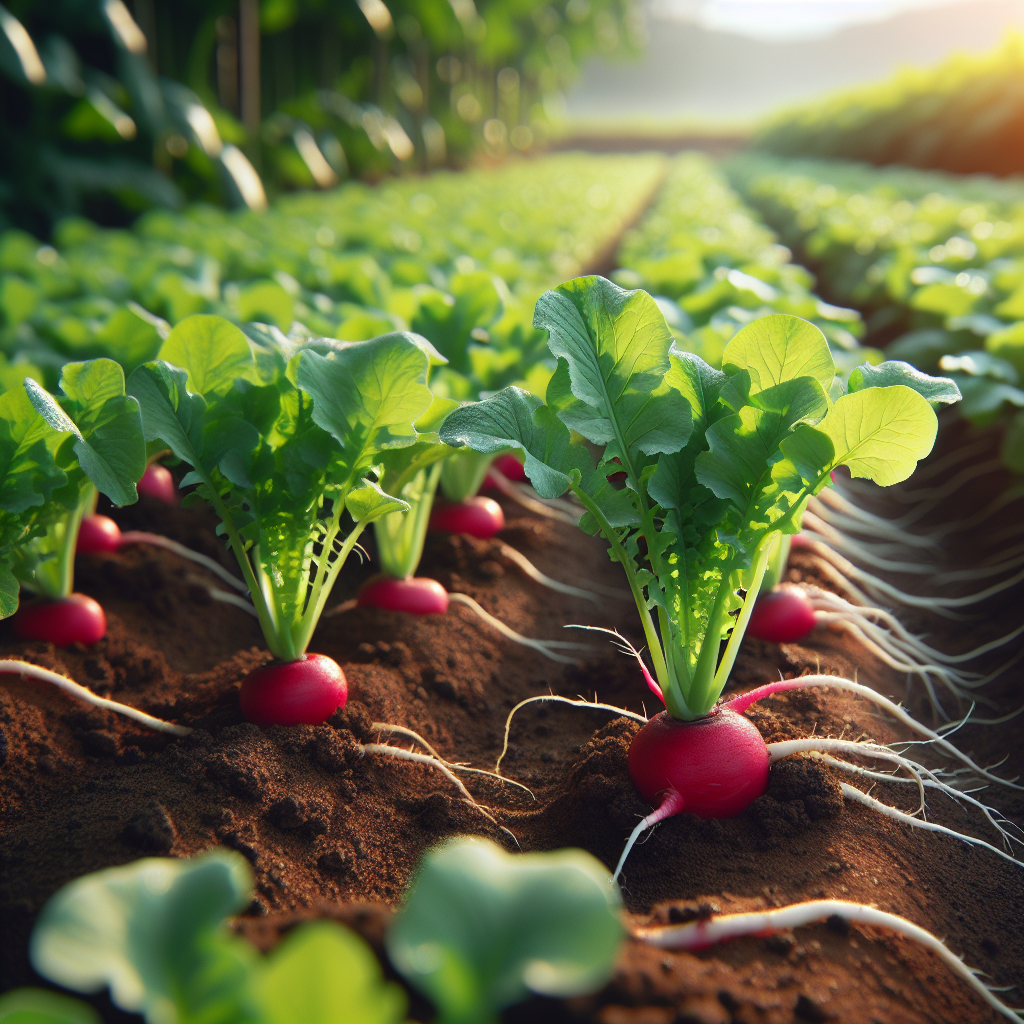
Introduction to Radish
Among root vegetables, radish stands out for speed, reliability, and diversity. It has been cultivated for thousands of years across Asia, the Mediterranean, and Europe, and today it includes a wide range of forms: small red globe radishes, elongated white icicle types, black Spanish radishes, and large Asian daikon types. Although many growers think of radish as a simple beginner crop, high-quality production depends on precise management. Texture, pungency, uniformity, and resistance to splitting all hinge on short but critical windows of moisture, fertility, and temperature.
Radish is usually grown for its swollen hypocotyl-root structure, though the leaves, seed pods, and microgreens are also edible. The crop is highly responsive to environmental stress. A few days of heat, drought, crowding, or nutrient imbalance can shift roots from crisp and mild to woody, pithy, cracked, or excessively hot. That sensitivity is exactly why professional growers value disciplined scheduling and close observation.
In market gardening, radish is often used as a quick-turn crop between slower plantings, a bunching crop for fresh sales, or a companion and trap crop around brassicas and cucurbits. For growers designing mixed beds, compare spacing and succession strategies with crops like lettuce, which shares similar cool-season scheduling. For broader bed-planning ideas, see fall companion planting.
Botanical Profile of Radish
Radish belongs to the Brassicaceae family, the same botanical family as cabbage, mustard, kale, broccoli, and turnip. It is generally classified as an annual or biennial depending on purpose and climate. In food production, it is usually grown as an annual for the edible root before flowering. If left in the ground or exposed to the right vernalization conditions, it bolts, producing branched flowering stalks with four-petaled flowers typical of brassicas, followed by seed pods called siliques.
Botanically, the harvested portion is not a true root alone. The edible swelling develops from both the upper root and hypocotyl tissue. This explains why root shape and shoulder formation are so influenced by sowing depth, soil compaction, and temperature. Leaves form a basal rosette and are usually rough, slightly hairy, and lobed to varying degrees depending on cultivar.
Major production classes include:
- Spring or salad radishes: small, fast maturing, usually 20 to 35 days. Common shapes are globe, oval, and short cylindrical.
- Summer radishes: somewhat more heat tolerant but still best in moderate conditions.
- Winter radishes: larger, slower, denser, and better suited to storage, typically 50 to 80 or more days. These include daikon and black radish types.
- Rat-tail or podding radishes: grown for edible seed pods rather than swollen roots.
Flavor comes largely from glucosinolates and related sulfur compounds, which intensify under stress. This is why radishes grown too slowly in heat or under erratic irrigation often become sharper and less marketable. Root color can be red, pink, purple, white, black, green, or bicolored, while flesh may be white, translucent white, or rose-tinted depending on cultivar.
Soil, pH, and Climate Requirements for Radish
Radish performs best in loose, stone-free, well-drained soil with high biological activity and even moisture-holding capacity. The ideal texture is sandy loam or fine loam with enough organic matter to retain moisture but not so much undecomposed residue that roots fork or become misshapen. Heavy clay can produce stunted, blunt, or cracked roots unless deeply loosened and finely prepared. Very light sandy soils can work well for shape and harvest ease, but they require tighter irrigation control because roots become pungent and spongy when growth is interrupted.
The optimal soil pH is generally 6.0 to 7.0, with best nutrient availability and root quality around 6.2 to 6.8. Below pH 5.8, nutrient imbalance and poor microbial activity can reduce growth and increase stress sensitivity. Excessively alkaline soils can contribute to micronutrient issues, especially where irrigation water is also high in bicarbonates.
Radish is a classic cool-season crop. Ideal air temperatures for rapid, tender root development are about 10 to 18°C (50 to 65°F). Germination begins at low temperatures, often as low as 4°C (40°F), but is fastest near 18 to 24°C (65 to 75°F). Once seedlings emerge, prolonged temperatures above 24°C (75°F) increase the risk of bolting, hollow centers, pithiness, and strong flavor, particularly in small spring cultivars. Winter types tolerate a broader range and often size up well in cool autumn conditions.
For best results, soil moisture should stay consistently moderate, roughly equivalent to 60 to 80% of field capacity in the active root zone. In practical terms, the top 5 to 10 cm of soil should feel cool and slightly moist, not dusty and not sticky. If a squeezed handful barely holds together then crumbles with a tap, moisture is usually close to ideal. If it forms a slick ball and leaves water on the hand, the soil is too wet. Waterlogged conditions reduce oxygen around the enlarging root, leading to slow growth, translucent tissues, disease pressure, and uneven sizing.
Sun exposure should be full sun in cool periods, though in warm regions light afternoon shade can improve quality. In climates with intense spring heat, radish often performs best in very early spring, late autumn, or winter production windows. Long daylength combined with warmth accelerates bolting in sensitive cultivars.
Step-by-Step Planting & Propagation
Radish is almost always direct-seeded. Transplanting is not recommended for root production because any disturbance to the taproot axis can cause misshapen roots, growth checks, or poor bulbing.
Prepare the bed thoroughly. Break up soil to at least 15 to 20 cm deep for small radishes and 25 to 35 cm for daikon and large winter types. Remove stones, large clods, and fresh woody debris. Rake to a fine, level tilth.
Incorporate mature compost lightly if needed. Use only well-finished compost. Fresh manure or incompletely decomposed organic matter can cause branching, excessive top growth, and increased pest attraction. Radish does not need heavy feeding and often performs poorly in overly rich, high-nitrogen ground.
Mark rows or bands. For salad radishes, sow rows 15 to 20 cm apart, or use broad-bed sowing with lines spaced 10 to 15 cm apart. For daikon, allow 25 to 45 cm between rows depending on final size.
Sow shallowly and evenly. Plant seeds about 1 to 1.5 cm deep in cool or medium soils. In crust-prone soils, stay shallow but ensure reliable moisture. Typical in-row spacing after thinning is 2.5 to 5 cm for small radishes, 5 to 8 cm for medium types, and 10 to 20 cm for large winter radishes.
Firm the seedbed gently. Good seed-to-soil contact is essential for uniform emergence. Uneven emergence leads directly to mixed root size at harvest.
Irrigate immediately after sowing. Apply a gentle but complete watering to moisten the top 5 to 8 cm of soil. Do not flood. If the surface dries before emergence, germination becomes uneven.
Thin early. Once seedlings have their first true leaves, thin to the final spacing. Delay in thinning causes competition stress, elongated roots, and tops that outgrow the root.
Succession sowing is one of the most important professional practices for radish. Because quality declines rapidly if roots remain in the ground too long, plant small batches every 7 to 10 days during favorable weather rather than one large block. Spring radishes can go from perfect to overmature in less than a week. Winter radishes are more forgiving but still benefit from staged sowings for a consistent market window.
Typical seeding windows:
- Early spring: as soon as soil can be worked.
- Autumn: often the best season in many temperate regions due to cooling temperatures.
- Mild winter regions: continuous or near-continuous production.
- Hot summer regions: use heat-tolerant cultivars cautiously, with shade and irrigation support, or shift production out of peak heat.
Care & Maintenance regimes for Radish
Successful radish care is mainly about steady growth without interruption. The crop matures quickly, so even short stress periods leave a visible mark on quality.
Irrigation should be frequent enough to avoid sharp wet-dry cycles. Small salad radishes usually need the root zone moistened to about 10 to 15 cm deep. Large daikon and winter types need deeper wetting, often 20 to 30 cm. As a rule, aim for approximately 2.5 cm of water per week from rainfall plus irrigation in cool conditions, increasing slightly in sandy soils or windy weather. Split this into multiple lighter irrigations rather than one heavy soaking if soils are prone to crusting.
Signs of underwatering include:
- Slow enlargement despite healthy leaf color
- Stronger, harsher pungency
- Fibrous or pithy texture
- Surface cracking after rewatering
- Elongated, narrow roots instead of rounded shoulders
Signs of overwatering include:
- Yellowing lower leaves with little root expansion
- Soft, translucent root tissue
- Fungal odor or anaerobic smell in soil
- Surface algae or persistent soil slickness
- Increased damping-off or root rot in seedlings
Mulch can help in warm or drying conditions, but apply it carefully. A very thin layer of clean straw or fine compost between rows helps buffer moisture without cooling the soil excessively or harboring slugs. For direct-seeded beds, wait until seedlings are established before mulching.
Fertility should be restrained and balanced. Excess nitrogen produces lush tops and poor roots. If soil is reasonably fertile, radish may need little or no additional feeding beyond preplant compost and a balanced base amendment. In lower-fertility soils, a modest preplant application of balanced organic fertilizer is sufficient. Phosphorus supports root development, while potassium improves tissue strength and water regulation. Avoid heavy side-dressing with nitrogen once plants are growing.
Weed control is important mainly during the first two to three weeks. Because radish seedlings emerge quickly but are shallow-rooted, they compete poorly with dense weed pressure. Use shallow hoeing or hand weeding to avoid disturbing the enlarging roots.
For greenhouse or tunnel production, ensure strong ventilation. Protected culture can produce beautiful roots in cold periods, but excess heat under cover rapidly causes bolting and exaggerated top growth. Vent early on sunny mornings.
Pests, Diseases & Organic Management
Radish shares many pest and disease issues with other brassicas. Preventive crop hygiene, quick rotations, and physical exclusion are far more effective than rescue treatments.
Common insect pests include flea beetles, cabbage root maggots, aphids, cutworms, and leafminers. flea beetles are especially problematic on young radish leaves, creating tiny shot holes that can slow seedling establishment. Their feeding is usually more damaging on foliage than roots, but severe pressure can reduce vigor enough to compromise bulb formation. Floating row covers applied immediately after sowing are one of the best organic controls, provided they are sealed well at the edges.
Cabbage root maggot larvae tunnel into roots, causing scarring, browning, wilting, and rot entry points. This is most common in cool, moist spring conditions where brassicas are grown repeatedly. Rotating away from brassicas for at least 2 to 3 years, using exclusion netting, and avoiding fresh brassica residue near new plantings all help reduce pressure.
aphids colonize leaves and flowering stems, particularly if radishes are held too long or become drought-stressed. Strong water sprays, beneficial insects, and avoidance of excess nitrogen are effective management tools.
Key diseases include damping-off, downy mildew, white rust, Alternaria leaf spot, clubroot, and bacterial soft rot. damping-off is most serious at emergence in overly wet, poorly aerated seedbeds. Use clean seed, well-drained media, and avoid overwatering. clubroot is a major soilborne brassica disease in acidic, wet soils; roots become swollen and distorted, leaves wilt in heat, and growth stalls. Keep pH above 6.5 where clubroot is known to occur, improve drainage, and rotate for several years.
downy mildew appears as yellow angular leaf lesions with grayish growth underneath in humid conditions. Good airflow, drip irrigation, and morning watering reduce disease duration. bacterial soft rot commonly follows injury, cracking, or insect feeding, especially in warm wet conditions.
Organic management principles:
- Rotate away from all brassicas, not just radish.
- Use insect netting or row covers at planting.
- Keep beds weed-free, especially of mustard-family weeds that host pests.
- Maintain steady moisture to avoid stress-induced susceptibility.
- Remove overmature or damaged roots promptly.
- Sanitize tools and wash harvest bins to reduce bacterial spread.
- Use resistant or season-appropriate cultivars when possible.
Harvesting, Curing & Optimal Storage
Harvest timing determines market quality more than any other single factor. Small spring radishes are usually ready 20 to 35 days from sowing, depending on cultivar and temperature. Begin checking once shoulders are visible at the soil surface and roots approach the expected diameter. Do not rely on leaves alone; vigorous tops do not guarantee a finished root.
Harvest when roots are firm, glossy, and characteristic in size for the cultivar. For globe types, this may be 2 to 3.5 cm across. If left too long, they often become spongy, pithy, overly hot, or cracked, especially after fluctuating moisture. Long-rooted and winter types can remain in the ground longer, but quality is still best before tissues become coarse.
Use a harvest strategy suited to soil conditions. In loose soil, bunching radishes can be pulled directly by hand. In tighter soils, undercut with a knife, fork, or harvest blade to avoid snapping roots and tearing shoulders. Harvest in the cool of morning for best crispness.
For bunching sales, wash roots gently in cool water, trim excessively long root tails if needed, and remove damaged leaves while keeping an attractive top set. Hydro-cooling or prompt chilling after harvest dramatically improves shelf life. Ideal postharvest conditions are near 0 to 2°C (32 to 36°F) with 95 to 100% relative humidity. Under those conditions, small radishes with tops removed can store around 2 to 4 weeks, while some winter radishes store significantly longer.
Radishes are not usually cured the way onions or sweet potatoes are. Instead, the goal is rapid field heat removal and high humidity retention. Tops should be removed for storage unless selling in bunches for immediate use, because leaves continue to transpire and draw moisture from the root. Pack in perforated plastic, lined crates, or high-humidity coolers to prevent shriveling.
Storage problems and causes:
- Shriveling: low humidity or delayed cooling
- Soft breakdown: bacterial infection, bruising, or too-warm storage
- Blackened tissue: chilling injury is uncommon near freezing, but freeze-thaw damage can darken roots
- Strong bitterness: overmaturity or preharvest stress rather than storage alone
Large winter radishes such as black radish and daikon can sometimes be stored in cool root-cellar conditions, packed in damp sand or held in perforated bags, provided temperatures remain just above freezing and humidity stays high.
Companion Planting for Radish
Radish works well in companion systems because it matures quickly, occupies little time in the bed, and can serve multiple functional roles. It is often interplanted with slower crops to mark rows and provide an early harvest before the main crop expands. This is especially useful with carrots, parsnips, and some salad greens, where radish emerges faster and helps define the planting line for early weeding.
Radish is also used as a trap or distraction crop in some systems, particularly around brassicas, because flea beetles may attack radish foliage readily. However, this tactic works only if the radish is monitored closely and not allowed to become a pest reservoir. In biointensive and market-garden plantings, radish pairs well with lettuce, spinach, peas, cucumbers, and beets when seasonal timing aligns.
Good companions include:
- Carrots: radish breaks the soil crust and is harvested before carrots need the space.
- Lettuce and spinach: similar cool-season preferences and shallow root competition is manageable with spacing.
- Peas: peas provide a light canopy as temperatures rise, while radish finishes early.
- Cucumbers: in some systems radish is used early before vines spread, though pest interactions should be watched.
Use caution planting radish repeatedly among other brassicas such as cabbage, kale, broccoli, and turnip, since they share the same pest and disease complex. Avoid dense multispecies plantings that reduce airflow in humid periods, as wet foliage encourages mildew and leaf spot.
For soil-building systems, daikon-type radishes are especially valuable as biodrilling crops. Their strong taproots penetrate compacted layers, improve infiltration, and leave biopores after decomposition. When used as a cover crop, they are seeded more densely than table radishes and managed for root penetration rather than market harvest. In that role, they can improve structure ahead of spring vegetables, though timing matters to avoid volunteer seed and nutrient loss.
The best companion planting with radish is not simply about crop friendship; it is about matching growth rates, harvest windows, and shared irrigation needs. If the bed stays evenly moist, weed-free, and cool, radish rewards the grower with one of the fastest, most profitable, and most satisfying harvests in the garden or field.