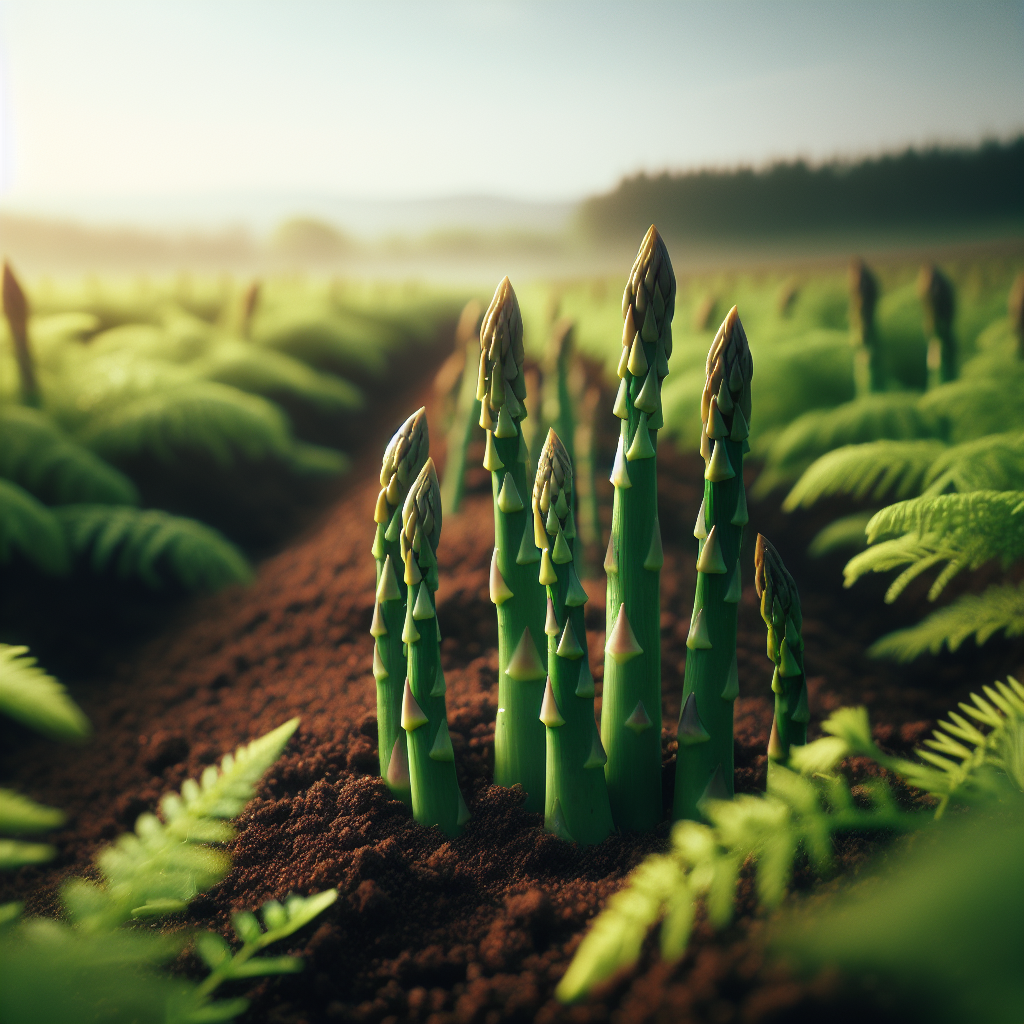
Introduction to Asparagus
A mature asparagus planting is one of the most rewarding permanent vegetable crops a grower can establish. Unlike annual vegetables that must be replanted every season, asparagus forms a perennial crown and root system that stores carbohydrates each year and pushes up edible spears in spring. This perennial habit is both its greatest strength and the reason careful planning matters so much: mistakes in drainage, weed control, bed placement, or early overharvesting can reduce yields for many years.
Asparagus has been cultivated since antiquity in the Mediterranean region and was valued by Greeks and Romans both as a food and for medicinal use. Modern production is centered in temperate regions where winters provide dormancy and spring temperatures trigger uniform spear emergence. Green asparagus is most common, but purple cultivars and blanched white asparagus are also commercially important. White asparagus is not a separate species; it is produced by excluding light from emerging spears so chlorophyll does not develop.
For market gardeners, homesteads, and diversified farms, asparagus offers a premium early-season crop when few other field vegetables are ready. It is particularly attractive where growers can dedicate land long term and maintain rigorous weed management. Because its root system penetrates deeply and crowns remain in place for decades, asparagus rewards thorough pre-plant preparation more than almost any other vegetable.
Botanical Profile of Asparagus
Asparagus belongs to the family Asparagaceae. The edible crop is produced from underground crowns made up of compressed stems, buds, fleshy storage roots, and fibrous feeder roots. The young shoots that emerge from the crown are the spears harvested for market. If left uncut, those spears elongate, branch, and develop into tall fern-like stalks that photosynthesize through the growing season and recharge the crown for the next year.
Botanically, the feathery structures often called leaves are actually cladodes, modified stems that perform photosynthesis. True leaves are reduced to tiny scales. This matters in crop management because apparently delicate fern growth is the primary energy-producing canopy of the plant; if disease, hail, insects, or premature cutting destroy the fern, next year's spear size and yield decline.
Asparagus is generally dioecious, meaning male and female flowers are borne on separate plants, though some plants can be functionally mixed or variable. Traditional open-pollinated populations contain both sexes. Female plants produce red berries containing seed, while male plants devote more energy to spear production and typically yield more marketable shoots. For this reason, many modern cultivars are all-male hybrids. Common cultivar groups include Jersey series types such as 'Jersey Giant', 'Jersey Knight', and 'Jersey Supreme', valued for vigor, rust tolerance, and high spear production. Purple cultivars such as 'Purple Passion' produce larger diameter spears with higher sugar content and lower fiber when harvested young. In colder regions, cultivar winter hardiness should be considered carefully.
Spear diameter is not simply a varietal trait; it reflects crown age, carbohydrate reserves, soil fertility, spacing, and harvest pressure. Thick spears from healthy crowns are usually desirable in fresh markets, but excessively deep planting, nutrient imbalance, or repeated stress can reduce emergence and thin the stand over time. Growers familiar with perennial systems such as Artichoke will recognize the same basic principle: harvest must never exceed the plant's ability to restore reserves.
Soil, pH, and Climate Requirements for Asparagus
Asparagus performs best in deep, well-drained, friable soils with high organic matter and excellent subsoil aeration. Sandy loams and loamy soils are ideal because they warm quickly in spring, allow easy spear emergence, and reduce the risk of crown rot. Heavy clay soils can support asparagus if they are deeply improved and drained, but waterlogging is one of the fastest ways to shorten plantation life. If water stands for more than 24 to 48 hours after rain, crown losses become likely, especially in cool soil.
The preferred soil pH is 6.5 to 7.5, with an optimum near neutral. Below about pH 6.2, asparagus becomes more vulnerable to poor nutrient availability and reduced vigor; liming is usually advised before planting rather than after establishment because incorporation becomes difficult once crowns are in place. Soil testing should be done at least several months before bed establishment so phosphorus, potassium, sulfur, calcium, and magnesium can be corrected in the full root zone. Since asparagus roots can explore well below 60 cm, shallow amendment alone is not enough.
Deep tillage or broadforking to at least 30 to 45 cm before planting is often worthwhile where compaction exists. Incorporate mature compost, well-decomposed manure, or other stable organic matter, but avoid fresh manures that may encourage weed pressure or create excessive soluble salts. Excess nitrogen before establishment can stimulate weak top growth at the expense of durable crown development.
Climatically, asparagus is best adapted to temperate regions with cold or cool winters and mild to warm springs. Dormancy is important for consistent spring spear flushes, though the crop can also be managed in Mediterranean and some subtropical highland climates. Ideal spear production occurs when soil temperatures rise into the range of about 10 to 18 C and air temperatures are cool to moderate. Warm spells above 25 C accelerate spear elongation, meaning harvest frequency must increase or spears become overmature quickly.
Frost tolerance is nuanced. Established crowns survive severe winter cold when fully dormant, but emerged spears can be damaged by spring freezes. Light frosts may only scar spear tips, while harder freezes can turn spears water-soaked, twisted, and unmarketable. Beds in frost pockets should be avoided. In hot climates, prolonged summer stress can reduce fern longevity and deplete crowns unless irrigation and mulching are excellent.
Asparagus is also moderately salt sensitive, especially during establishment. Irrigation water with high soluble salts can impair emergence and burn roots. If using marginal water, monitor electrical conductivity and leach salts during dormant periods where drainage permits. Building long-term soil structure is fundamental; resources on soil health are especially relevant before planting a permanent asparagus block.
Step-by-Step Planting & Propagation
Commercial and serious home growers usually establish asparagus from one-year-old crowns rather than seed because crowns shorten the time to first harvest and create more uniform stands. Seed propagation is still useful for breeding, nursery production, or budget-conscious growers willing to wait longer.
Start with site selection. Choose a full-sun location receiving at least 8 hours of direct light daily. Avoid low, wet ground and avoid land with entrenched perennial weeds such as bindweed, bermudagrass, nutsedge, couch grass, or dock. Because the bed may remain in place for two decades, eradicate perennial weeds before planting. This step is not optional.
Prepare the bed months in advance if possible. Remove existing vegetation, test soil, correct pH, and incorporate phosphorus and potassium deeply according to test results. Raised beds are advantageous in marginal soils because even 15 to 25 cm of elevation improves drainage and spring warming.
For crown planting, dig trenches 20 to 30 cm deep and about 30 to 40 cm wide. In heavier soils, use the shallower end of that range; in lighter sandy soils, slightly deeper planting is acceptable. Create a low ridge of soil in the bottom of the trench. Spread each crown over the ridge like a spider, with roots fanned outward and buds pointing up. Space crowns 30 to 45 cm apart within the row for home gardens and fresh-market production; closer spacing can increase early yield but may reduce long-term spear diameter. Row spacing is typically 1.2 to 1.8 m, depending on equipment and weed management strategy.
Cover crowns initially with 5 to 8 cm of fine soil, not the full trench depth. As shoots emerge and grow, gradually backfill the trench over several weeks until level. This approach prevents planting too deeply all at once while still positioning crowns where they are protected and moisture is stable.
If planting from seed, sow indoors in modules 10 to 12 weeks before the last spring frost, or direct sow into a nursery bed after soil warms. Seeds germinate best around 24 to 29 C and may benefit from soaking for 12 to 24 hours before sowing. Transplant robust seedlings to a nursery row or final site once danger of hard frost has passed. Crown-grade plants from seed usually require a full year before transplanting to the permanent bed, making this effectively a two-stage system.
After planting, irrigate deeply enough to settle soil around roots. During establishment, keep soil consistently moist but not saturated. A practical target is moisture similar to a wrung-out sponge in the top 15 to 20 cm, with deeper layers also moist to encourage root extension. If squeezed soil forms a sticky ribbon and smells sour, it is too wet; if soil falls away dusty and crowns are sprouting weakly, it is too dry.
Mulching with clean straw, shredded leaves, or composted bark can suppress weeds and moderate soil temperatures, but avoid piling wet mulch directly over emerging spears in early spring, as this can increase disease pressure and delay warming.
Care & Maintenance regimes for Asparagus
The first two years determine the future of the planting. In year one, the objective is crown establishment, not harvest. Allow all spears to develop into fern after emergence. In year two, very light harvest may be possible for 1 to 2 weeks if plants are vigorous and spear diameter is strong, but many growers still avoid cutting entirely. Full harvest typically begins in year three.
Irrigation should be managed by season. During spear production, asparagus needs steady moisture for uniform emergence and tender texture. Roughly 25 to 40 mm of water per week from rainfall plus irrigation is often sufficient in loam soils, though sandy soils may require more frequent applications. During fern growth, total water demand may rise, especially in hot weather. Moisture stress during summer reduces carbohydrate accumulation in crowns and results in fewer, thinner spears the following spring.
Overwatering signs include yellowing lower fern, reduced vigor despite wet soil, blackening near the crown, soft roots, and a sour anaerobic smell. Underwatering shows up as reduced spear number, small spear diameter, premature fern yellowing, and dry soil below 10 to 15 cm. The ideal pattern is deep, infrequent irrigation that wets the root zone rather than frequent shallow sprinkling.
Nutrition should be based on soil tests, but asparagus commonly benefits from split feeding. Apply compost or a balanced fertilizer in early spring just before spear emergence, then a second nitrogen-focused feeding immediately after the harvest period ends so fern growth can recharge the crowns. Typical commercial nitrogen recommendations often total 50 to 100 kg N/ha annually depending on soil organic matter, stand age, and yield expectations. Excessive nitrogen late in the season is undesirable because it can produce lush, weak fern more prone to disease and winter injury.
Weed control is absolutely central. Young asparagus competes poorly, and perennial weeds are especially destructive because cultivation around crowns is limited. Hand weeding, stale seedbed preparation, organic mulches, shallow mechanical cultivation between rows, and landscape fabric in some systems can all help. Never cultivate deeply over crowns; damaging buds reduces future spear numbers.
Fern management matters in autumn. Once ferns yellow fully after frost or natural senescence, they can be cut to ground level and removed to reduce overwintering inoculum of foliar diseases and pests. In disease-prone areas, do not leave infected fern debris in the bed. In cold regions, a light winter mulch after the soil has cooled can reduce heaving, but remove or loosen it early enough in spring to allow warming and clean spear emergence.
Harvest management is part of maintenance. In a mature bed, stop harvest when spear diameter declines markedly, when newly emerging spears become thin like pencils or less, or after 6 to 8 weeks in most home and market plantings. Continuing beyond this point weakens crowns. A disciplined stop date often increases long-term profitability more than squeezing out a few extra bunches.
Pests, Diseases & Organic Management
Asparagus beetles are the signature insect pests of this crop. The Common asparagus beetle and Spotted asparagus beetle feed on spears and fern, causing scarring, crooked growth, and reduced photosynthetic area. The Common asparagus beetle is particularly damaging because larvae skeletonize fern, weakening crowns for the following season. Organic management includes diligent scouting from spear emergence onward, hand removal in small plantings, destruction of volunteer or unmanaged asparagus nearby, and preservation of beneficial insects. Neem-based products, spinosad, and pyrethrin may have a place in organic systems if timed carefully and used according to label, but direct cultural control and sanitation remain foundational.
Cutworms can clip emerging spears at soil level, while Slugs may scar low spears in damp mulched systems. In dry regions, Aphids occasionally colonize fern and may contribute to stress. Monitoring should be weekly during active growth, with extra attention during warm spells when pest development accelerates.
Among diseases, crown and root rots caused by Fusarium species are the most serious long-term threat. Fusarium oxysporum f. sp. asparagi and related pathogens are favored by stress, poor drainage, repeated overharvest, nutrient imbalance, and declining soil structure. Symptoms include weak emergence, thin spears, one-sided fern dieback, reddish-brown discoloration in crown tissue, and progressive stand decline. There is no simple cure once a bed is heavily infested, so prevention is essential: plant disease-free crowns, use tolerant cultivars, avoid poorly drained soils, maintain balanced fertility, and do not injure crowns through deep cultivation.
Asparagus rust is another important disease, especially in humid regions. It appears first as orange pustules and later darker lesions on fern, reducing photosynthesis and leading to early defoliation. Good airflow, resistant cultivars, residue removal, and avoiding excess nitrogen help reduce outbreaks. Purple spot, caused by Stemphylium species, can mark spears and fern during wet weather. While often cosmetic on spears, repeated severe infection reduces plant vigor.
Organic disease management relies on prevention more than rescue. Key steps include wide spacing for airflow, drip irrigation instead of frequent overhead watering, prompt removal of infected fern after senescence, crop hygiene, and maintenance of high but not excessive soil organic matter. Copper-based products or biofungicides may offer partial suppression in some systems, but they are no substitute for site selection and stress reduction.
Wildlife can also be an issue. Rabbits may nibble emerging spears, and deer can browse fern or early shoots heavily. Fencing is often the most reliable nonchemical solution where browsing pressure is high.
Harvesting, Curing & Optimal Storage
Harvest begins when spears reach marketable size, usually 15 to 22 cm tall depending on market preference. Tight tips are the key quality marker; once tips begin to loosen or branch, texture declines rapidly. Spears may be snapped by hand near the natural break point or cut with a clean knife slightly below the soil surface. Cutting can give a longer spear, but careless deep cutting risks injuring adjacent buds that would otherwise become future spears.
In cool weather, harvest every 2 to 3 days may be adequate. In warm weather, daily harvest is often necessary because spears can elongate several centimeters in a single day. Missing harvest windows leads to oversized, fibrous stems and reduced market quality. For white asparagus, ridged soil or opaque coverings exclude light, and spears are cut before they emerge fully and green.
Do not wash harvested spears excessively if long storage is intended. Instead, cool them immediately. Asparagus has one of the highest respiration rates among vegetables, so postharvest cooling must be rapid. Hydro-cooling or immediate transfer to near-freezing storage greatly preserves tenderness and sugar content. The ideal storage temperature is 0 to 2 C with 95 to 100% relative humidity. At these conditions, high-quality spears can often hold for 2 to 3 weeks, though best flavor and texture are retained with much shorter marketing windows.
If refrigeration is limited, stand bunches upright with the cut ends in shallow clean water and cover loosely to reduce dehydration. However, this is only a short-term solution. Signs of declining quality include limpness, tip opening, dull color, loss of sheen, pithiness, and sour or fermented odor. Free water left on bundles in warm conditions encourages bacterial breakdown.
The term curing is not commonly applied to asparagus the way it is for onions or garlic. Instead, the professional emphasis is on field heat removal, hydration balance, and cold-chain integrity. Trim ends only if necessary for uniform bunching, keep bundles shaded at all times, and never allow harvested spears to sit in the sun. Even one hour of heat exposure can noticeably reduce sweetness and shelf life.
Companion Planting for Asparagus
Because asparagus occupies ground permanently, companion planting should be approached strategically rather than romantically. The best companions are shallow-rooted, non-aggressive, seasonally compatible plants that do not compete heavily for nutrients or shade the fern. In the establishment phase, quick crops such as lettuce, spinach, or some early herbs can be grown between wide rows, but they should be removed before asparagus fern expands and should not interfere with irrigation or weeding.
Historically, tomatoes were often recommended as companions for asparagus, partly due to old observations about mutual pest suppression. While the evidence is mixed under modern conditions, interplanting annuals such as Tomato guide crops near young asparagus should still be done cautiously because dense summer canopies can reduce airflow and complicate bed access. More useful than close intercropping is adjacent planting that supports beneficial insects without crowding the crowns.
Excellent companion choices along bed margins include calendula, alyssum, dill, coriander, and yarrow, all of which can attract predatory insects and pollinators while staying largely out of the asparagus root zone if managed carefully. Straw mulch with border flowers can also improve habitat for natural enemies of asparagus beetles.
Avoid planting asparagus with highly competitive perennials, tall sprawling cucurbits, or nutrient-hungry crops that require frequent deep cultivation. Do not place it where aggressive mint-family herbs, horseradish, or invasive groundcovers can migrate into the crown zone. Also avoid repeated adjacency to crops sharing similar disease-management constraints if irrigation and airflow are poor.
For diversified farms, the best companion strategy is often ecological rather than literal: pair asparagus beds with flowering insectary strips, maintain clean paths, keep weeds suppressed, and use neighboring crops that do not cast prolonged shade. In this way, asparagus can remain the dominant perennial in its space while still benefiting from a biologically rich farm layout.