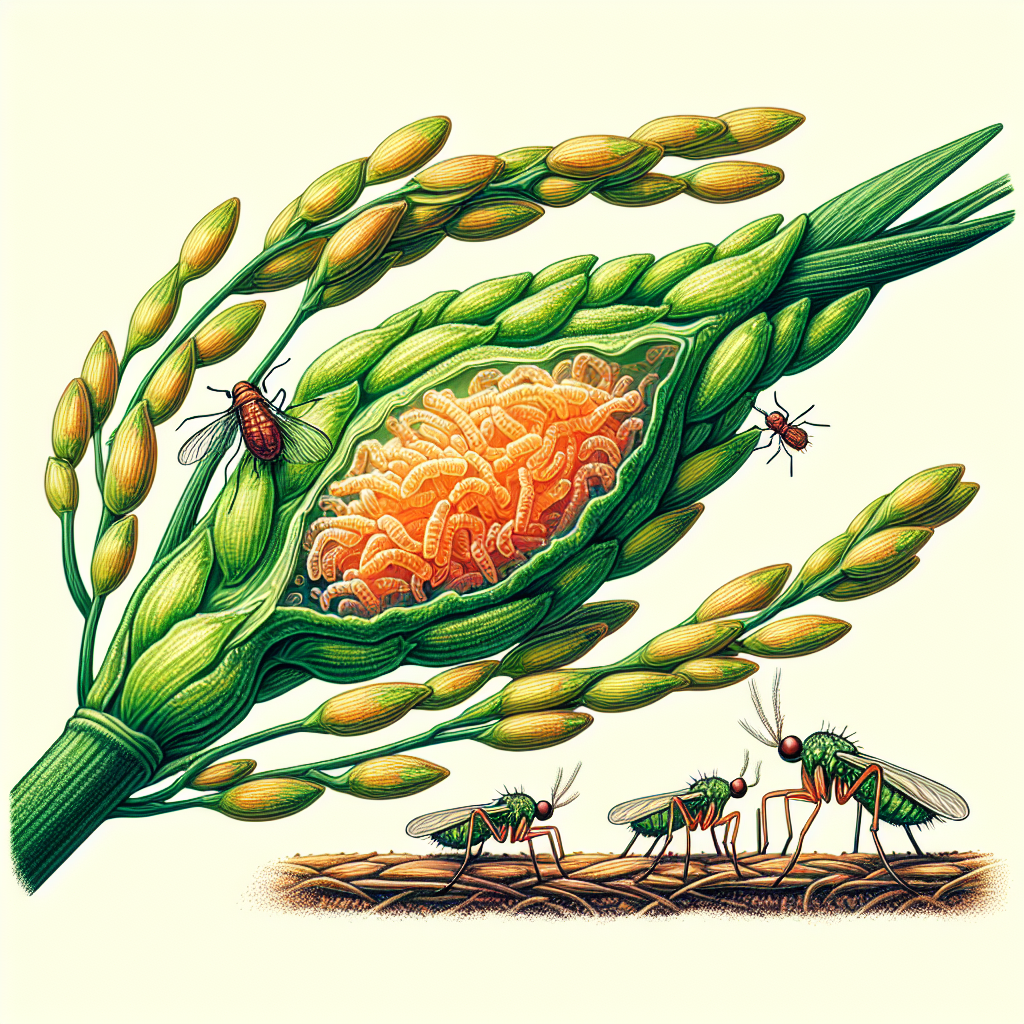
Introduction to gall midge
Gall midges, belonging to the family Cecidomyiidae, represent a diverse group of minuscule flies notorious for their plant-manipulating larvae that provoke the formation of galls—abnormal swellings on leaves, stems, buds, flowers, or roots. These pests, often no larger than 1-3 mm as adults, can devastate crops by disrupting growth, reducing photosynthesis, and compromising fruit quality. Over 5,000 species exist worldwide, but agricultural threats include the wheat midge (Sitodiplosis mosellana), rice gall midge (Orseolia oryzae), and maize gall midge (various Lasioptera spp.), each targeting specific hosts with precision.
Farmers encounter gall midges in warm, humid climates where multiple generations per season amplify infestations. Early detection is crucial, as larvae feed internally within galls, evading surface sprays. This comprehensive guide equips you with professional diagnostics, lifecycle knowledge, organic controls, and prevention protocols to minimize losses. By integrating cultural, biological, and targeted organic methods, yields can be protected without synthetic chemicals, aligning with sustainable agriculture practices. For small farms, timely scouting paired with Spring Pest Patrol: Organic AI Strategies to Shield Your Crops from Common Invaders can transform pest management.
Identifying Symptoms & Damage
Gall midge damage manifests as distinctive galls: swollen, blister-like structures filled with feeding larvae. On leaves, these appear as silvery or reddish pustules, often along veins; on stems, elongated swellings; on buds, deformed 'blind buds' that fail to open; and on roots, nodular galls resembling root-knot nematodes. Affected tissues yellow, wilt, or drop prematurely, stunting plants and slashing yields by 20-70% in severe cases.
Scout during vegetative stages: examine 20-50 plants per field quadrant under magnification (10x hand lens). Larvae are orange-white, legless maggots (0.5-2 mm) inside galls, pupating to form silk cocoons. Adults emerge as mosquito-like flies with long antennae, laying eggs in batches of 10-50 on tender tissues. Differentiate from aphids (honeydew producers) or mites (stippling) by gall presence and internal feeding. Secondary signs include sooty mold on excretions or thrips co-infestation exacerbating damage.
Economic thresholds vary: for corn, 10% bud infestation; for rice, 5 galls per tiller. Document with photos for IPM tracking. Accurate ID prevents misdiagnosis with leaf spot diseases or powdery mildew, ensuring precise intervention.
Lifecycle and Progression of gall midge
Gall midges complete 3-8 generations annually, synchronized with host phenology. Adults (1-3 mm, delicate, 7-10 day lifespan) emerge at dawn, mating immediately. Females oviposit 50-200 eggs on young tissues within hours; eggs hatch in 2-4 days into mobile first-instar larvae that burrow, injecting saliva to induce galls.
Second-third instars (7-14 days) feed on hypertrophied cells, growing to full size before dropping to soil for pupation (5-10 days). Overwinter as diapausing pupae or larvae in soil cocoons, emerging in spring triggered by 10-15°C soil temps. Progression: eggs (translucent, 0.1 mm) → larvae (orange maggots) → pupae (brown, silken) → adults. Monitor with sticky traps (yellow, 1 per 0.5 ha) capturing 5-10 adults/midge/week signals action.
Generational overlap in tropics accelerates outbreaks; in temperate zones, 2-3 cycles. Lifecycle duration: 14-30 days at 25°C. Understanding this enables predictive scouting, targeting vulnerable 'windows' like seedling or panicle stages.
Environmental Triggers & Risk Factors
Gall midges thrive in 20-30°C with 70-90% RH, favoring dense canopies retaining moisture. Risk spikes post-rainy spells, promoting egg survival. Susceptible varieties (e.g., susceptible wheat cultivars), continuous monocropping, and excessive N-fertilizers (lush growth) heighten vulnerability. Poor drainage, high plant density (>300k/ha for rice), and adjacent volunteer hosts serve as reservoirs.
Climate change extends seasons, boosting generations. Weed hosts like grasses harbor pests; irrigation timing affects emergence. Assess fields: history of sorghum midge indicates risk. Soil pH 6-7 optimal; compacted soils trap pupae, aiding survival. Mitigate by crop rotation (2-3 years non-hosts like legumes), balanced nutrition, and airflow via spacing.
Organic Control & Treatment Plans
Integrated Organic Management (IOM) prioritizes non-chemical tactics. Cultural: Rogue infested plants early; destroy post-harvest residues via deep plow (20 cm) exposing pupae to predators/sun. Rotate with non-hosts like cabbage or potato. Biological: Release predators like ladybugs (consume larvae) or parasitoids (Platygaster spp., 50-80% control). Conserve ground beetles via mulch.
Organic Sprays: Neem oil (0.5-2%) or spinosad (OMRI-approved, 0.2 ml/L) at egg hatch, 7-10 day intervals, 3 apps max. Insecticidal soap disrupts adults. Trap Crops: Plant early susceptible corn borders, flame at peak infestation. Microbial: Beauveria bassiana (1x10^9 spores/ml) on foliage/soil.
Treatment Plan: Week 1: Scout, apply neem if 5% eggs. Week 2: Introduce parasitoids (500/ha). Week 3: Spinosad if larvae >10%. Monitor 80% reduction target. Avoid bloom to protect pollinators. Combine with Soil Health Mastery: 5 Proven Strategies for Small Farms to Build Fertile Ground Without Breaking the Bank for resilient plants.
Preventing gall midge in the Future
Prevention hinges on lifecycle disruption. Select resistant varieties (e.g., gall midge-resistant rice hybrids). Time planting to miss peak emergence (post-rainy season). Maintain 40-50 cm spacing for ventilation; avoid over-fertilization (N<120 kg/ha). Clean equipment/seed (hot water 52°C, 10 min). Border hedges of marigold or nasturtium repel adults.
Soil solarization (6 weeks summer, 50-60°C kills pupae). Monitor with pheromone traps (1-2/ha). Post-harvest: flood fields 10 cm, 2 weeks drowning pupae. Scout volunteers weekly. Long-term: diverse rotations (wheat-soybeans-fallow). Educate laborers on hygiene. Annual risk mapping integrates weather data for proactive defense.
Crops Most Affected by gall midge
Gall midges plague cereals foremost: wheat (orange wheat blossom midge), rice (Asian gall midge, 10-30% losses), corn (maize midge), sorghum (sorghum midge). Vegetables include onion (onion bulb midge), pepper (pepper midge), tomato. Fruits: mango (mango blossom midge), citrus. Others: soybeans, potato, sugarcane. Grasses/ornamentals also susceptible. Regional hotspots: Asia (rice), Americas (maize), Europe (wheat).