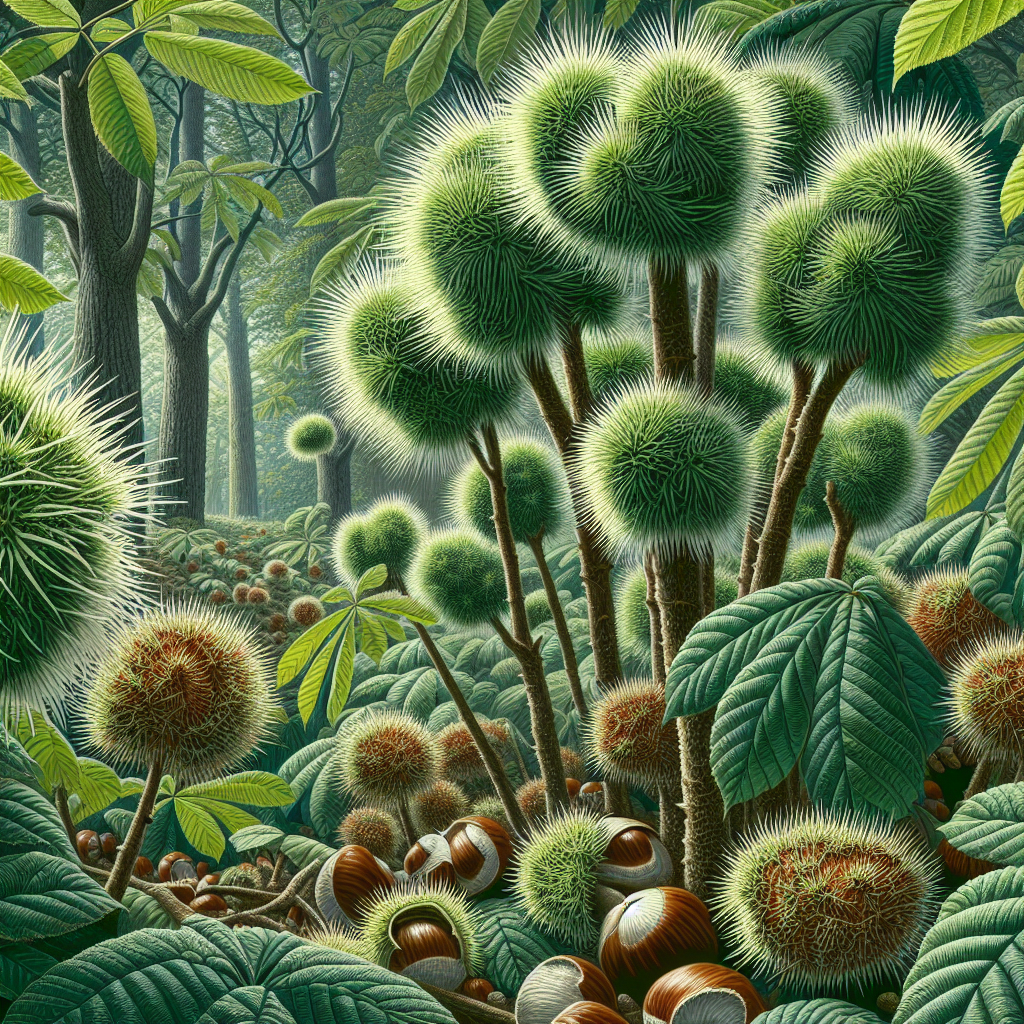
Introduction to Chinese chestnut
Chinese chestnut (Castanea mollissima), native to eastern Asia, has become a significant invasive pest in North American agriculture and forestry. Introduced in the early 20th century as a rootstock for the blight-susceptible American Chestnut and for nut production, it has escaped cultivation to form dense thickets that suppress native flora. Unlike the near-extinct American chestnut, Chinese chestnut thrives due to its resistance to chestnut blight (Chestnut Blight), broad climate tolerance, and prolific seed production—up to 50 nuts per bur per tree annually. These nuts serve as a food source for wildlife, facilitating rapid dispersal via squirrels, deer, and birds.
In agricultural contexts, Chinese chestnut competes aggressively with crops like Chestnut (Colossal), apple, and walnut orchards, reducing yields by 30-50% through shading, nutrient depletion, and allelopathy. Its spiny burs litter fields, posing hazards to livestock and harvest equipment. Economically, control costs U.S. landowners millions yearly, with infestations covering over 100,000 acres in the eastern U.S. alone. Early detection is critical, as mature trees produce thousands of viable seeds that persist in soil for years. This guide equips farmers with professional-grade diagnostics and organic management to reclaim invaded lands. For advanced monitoring, explore Spring Pest Patrol: Organic AI Strategies to Shield Your Crops from Common Invaders.
Identifying Symptoms & Damage
Distinguishing Chinese chestnut from natives requires keen observation. Trees reach 60 feet tall with broad, obovate leaves (5-7 inches long, 2-4 inches wide) featuring coarse teeth and dense brown fuzz underneath—unlike the finer-haired American Chestnut. Twigs have prominent, pale lenticels; bark forms plates with shallow furrows. Spiny burs (2-3 inches diameter) encase 2-3 shiny brown nuts each, ripening in September-October.
Damage manifests as canopy closure in understories, where saplings (1-10 feet) form monocultures, starving light-dependent crops. Seedlings emerge in spring, cotyledons opposite, with rapid vertical growth. Root systems are shallow yet extensive, competing for water and nutrients; studies show 40% soil nitrogen uptake advantage over natives. In orchards, leaf litter acidifies soil (pH drop to 4.5), exacerbating issues like root rot. Wildlife damage amplifies spread—squirrels cache 70% of nuts, with 20% germinating.
Diagnostic checklist:
- Leaves: Fuzzy underside, serrated margins.
- Nuts: 1-inch diameter, 2-3 per bur.
- Growth habit: Multi-stemmed shrubs to trees, suckering from roots.
- Damage signs: Thicket formation, native die-off, nut debris. Confirm via DNA testing if hybridization suspected with Chestnut (Bouche de Betizac). Monitor for associated pests like chestnut gall wasp or nut weevils.
Lifecycle and Progression of Chinese chestnut
Chinese chestnut completes an annual cycle optimized for invasion. Seeds overwinter in soil, stratifying at 34-41°F for 90 days. Germination peaks April-May, with 80% success on disturbed sites. Seedlings grow 2-4 feet year one, developing taproots by year two. Vegetative phase lasts 3-5 years, with suckering from lateral roots forming clones up to 100 feet wide.
Flowering occurs June-July: male catkins (4-6 inches) release pollen; female flowers in leaf axils develop burs. Pollination is wind-driven, effective up to 200 feet. Nuts mature 120-150 days post-pollination, dropping September-November. One mature tree yields 10-50 pounds nuts, viability 90% if stratified.
Progression stages:
- Seedling (0-2 yrs): Rapid establishment, shade-intolerant.
- Juvenile (3-10 yrs): Suckering, canopy competition.
- Mature (10+ yrs): Seed production, 100+ lbs nuts/tree. Overwintering buds protect against frost to -20°F. Longevity exceeds 100 years, with peak invasion 20-40 years post-introduction. Hybrids with American chestnut show intermediate blight resistance, complicating control.
Environmental Triggers & Risk Factors
Invasion thrives in USDA zones 4-8, preferring well-drained loams (pH 4.5-6.5) but tolerating clays and sands. Triggers include soil disturbance (logging, tillage), creating bare mineral soil for 95% germination success. Edges of corn, soybeans, and wheat fields serve as corridors, with 50% higher establishment.
High humidity (>60%) and mild winters favor blight-free growth; drought tolerance via deep roots allows survival in 20-inch rainfall zones. Risk factors: proximity to ornamental plantings (e.g., pecan groves), wildlife corridors, and poor land management. Climate change extends range northward, projecting 30% U.S. forest infestation by 2050. Acidic soils from leaf litter suppress competitors like [oaks](/wiki/oaks—not listed, skip). Monitor Phytophthora root rot in wet sites.
Organic Control & Treatment Plans
Integrated Pest Management (IPM) emphasizes prevention over eradication. Cultural: Mow thickets twice yearly (May, August) at 6-inch height to exhaust roots; repeat 3-5 years reduces density 80%. Mulch with cardboard (6-mil) under trees, topped with wood chips (4 inches), starves light.
Mechanical: Cut stumps flush, apply organic herbicide (20% acetic acid + clove oil) immediately; success rate 90% if <2-inch diameter. Girdle larger trees (June-August), removing 2-inch bark ring. Hand-pull seedlings <1 foot, roots intact. Burn debris to kill seeds.
Biological: Encourage predators like deer (browse 50% saplings) and goats (graze thickets clean in 2 weeks). Introduce Chinese chestnut-specific pathogens if available; research ongoing.
Treatment timeline:
| Stage | Method | Frequency |
|---|---|---|
| Seedling | Pull/mow | Spring/fall |
| Sapling | Cut/stump treat | Anytime |
| Mature | Girdle/mulch | Summer |
| Monitor yearly; combine with companion planting marigold to deter seedlings. Avoid tillage, promoting aphids vectors. |
Preventing Chinese chestnut in the Future
Sanitation is paramount: inspect equipment, remove burs/seeds before movement. Plant diverse natives like hazel as buffers. Solarization (clear plastic, 6 weeks summer) kills soil seedbanks (95% efficacy). Rotate cover crops (clover) to outcompete seedlings.
Quarantine infested zones 3 years post-control. Scout edges weekly spring-fall using phenology models (germination at 50 GDD base 32°F). Community efforts: partner with extension services for mapping. Long-term, select resistant rootstocks sans Chinese genetics. For farms, integrate into Soil Health Mastery: 5 Proven Strategies for Small Farms to Build Fertile Ground Without Breaking the Bank.
Crops Most Affected by Chinese Chestnut
Primary targets: nut orchards (almond, hazelnut, pecan), fruit trees (apple, peach, cherry). Field crops like corn and soybeans suffer edge losses. Forest understories with [oaks], [hickories] impacted indirectly. Yield drops: 40% in young orchards, 25% mature. Chestnut weevils thrive in mixed stands.