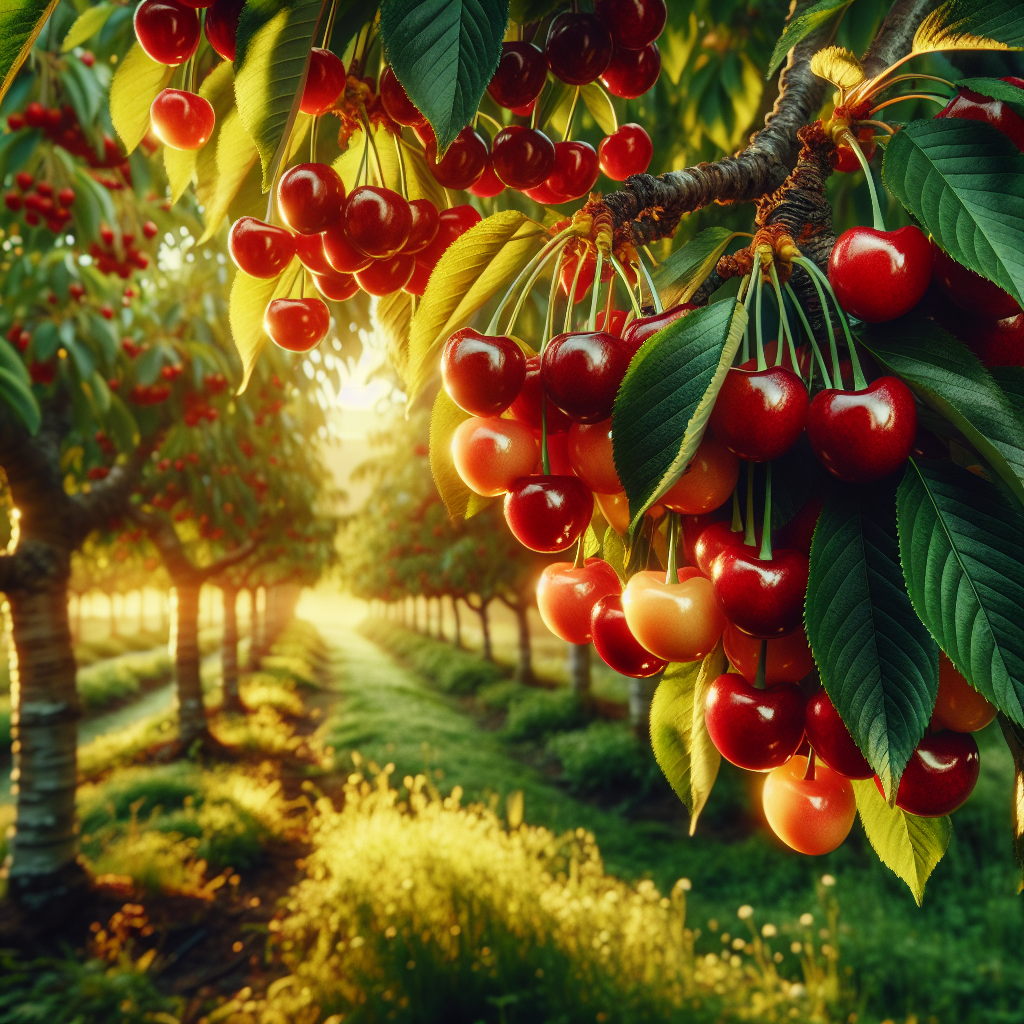
Introduction to Cherry
Cherries are among the most exacting and rewarding temperate fruit crops. They belong primarily to two cultivated groups: sweet cherry (Prunus avium), grown mostly for fresh eating, and sour or tart cherry (Prunus cerasus), grown for pies, preserves, juice, and processing. Sweet cherries usually produce larger, firmer, sweeter fruit with a shorter margin for handling errors, while tart cherries are generally more cold-hardy, more self-fertile, and somewhat easier to manage in less-than-ideal pollination conditions.
Historically, cherries have been cultivated for centuries across Europe and western Asia, with modern commercial production spreading into North America, South America, Australia, and parts of highland Asia. Their popularity comes not only from flavor, but from their extremely short, high-value harvest window. A well-managed cherry orchard can be profitable for decades, but the crop demands careful site selection before planting because many common problems—frost injury, Bacterial canker, root asphyxiation, and fruit cracking—are difficult to correct later.
Growers should think of cherry as a crop where location determines half the outcome. Deep, well-drained soil, good air movement, sufficient winter chilling, and protection from spring frost and harvest-time rain are far more important than routine fertilization alone. If you already grow stone fruits or tree fruits such as Peach, you will recognize some similarities, but cherry is generally less forgiving of wet feet and poorly timed pruning. For long-term success, treat orchard establishment as an engineering project rather than simply planting a fruit tree.
Botanical Profile of Cherry
The genus Prunus includes cherries, plums, peaches, apricots, and almonds. Cultivated sweet cherry (Prunus avium) is typically a vigorous deciduous tree with upright growth, shiny serrated leaves, white spring blossoms, and fruit borne mostly on spurs and one-year-old wood depending on cultivar and training system. Sour cherry (Prunus cerasus) tends to be smaller, more compact, and often fruits more consistently under home-garden conditions.
Sweet cherries are commonly divided into dark sweet, blush, and yellow-red bicolor types. Popular cultivar groups include 'Bing', 'Lapins', 'Rainier', 'Sweetheart', 'Skeena', 'Kordia', and 'Regina'. Tart cherries often include 'Montmorency' and 'Balaton'. Cultivar choice matters profoundly because fruit firmness, cracking resistance, bloom timing, chill requirement, pollination compatibility, and harvest season differ significantly.
Rootstocks are equally important. Standard vigorous rootstocks create large trees with deep anchorage but delayed bearing. Semi-dwarf and dwarfing rootstocks, such as Gisela series or Krymsk selections, promote precocity and higher-density plantings, but they often require more precise irrigation, support systems, and crop-load management. Dwarfing rootstocks can produce earlier yields, yet overcropping on weak root systems may reduce fruit size, sugar accumulation, and long-term tree health.
Cherry trees break dormancy early relative to some other fruit crops, making blossoms especially vulnerable to late spring freezes. Flowers are generally white with five petals and are insect-pollinated, primarily by bees. Many sweet cherry cultivars are self-incompatible, meaning pollen from a compatible cultivar is required for fruit set. Tart cherries are more often self-fertile, though pollinator activity still improves set and uniformity.
Fruit is a drupe, consisting of skin, flesh, and a hard stone containing the seed. Fruit quality is judged by size, firmness, soluble solids, skin color, stem freshness, absence of cracking, and flavor balance between sugars and acids. Commercial sweet cherries are often harvested at 16-22° Brix depending on market, cultivar, and local standards, while tart cherries are usually harvested for acidity, color, and processing quality.
Soil, pH, and Climate Requirements for Cherry
Cherry demands excellent drainage. This is the non-negotiable requirement. Trees perform best in deep sandy loam, gravelly loam, or well-structured loam soils with rapid internal drainage and moderate water-holding capacity. Heavy clay is risky unless it is extensively improved and planted on berms or raised rows. If water stands for more than 24 hours after rain, the site is generally unsuitable without major drainage intervention.
Ideal soil pH is typically 6.2 to 7.0. Cherries tolerate slightly alkaline conditions up to around 7.5 better than very acidic soils, but nutrient imbalances become more likely above pH 7.3, especially iron, manganese, and zinc deficiencies. At pH below 5.8, calcium availability can decline, aluminum toxicity risk rises, and root performance may weaken. A pre-plant soil test should include pH, organic matter, phosphorus, potassium, calcium, magnesium, cation exchange capacity, and salinity. If possible, conduct a subsoil assessment to at least 60-90 cm because compaction or hardpan layers can severely restrict rooting.
Climate suitability depends on species and cultivar. Most cherries need a true winter dormancy period and accumulate chill hours, often in the range of 700-1,400 hours below about 7°C, though this varies by cultivar. Insufficient chilling causes erratic bloom, weak leaf-out, poor fruit set, and uneven development. Sweet cherries are generally best suited to temperate regions with cold winters, mild springs, low humidity, and dry conditions near harvest. Tart cherries handle colder winters and slightly harsher continental climates better.
Flower buds and open blossoms are vulnerable to frost. Temperatures near -2°C to -4°C during bloom can destroy a significant portion of the crop, especially under calm, clear-night radiation frost conditions. Good orchard sites are on gentle slopes where cold air drains away, not in frost pockets at valley bottoms. North-facing or slightly delayed-bloom sites may reduce frost risk in marginal areas, though they can also delay maturity.
Rainfall timing matters more than annual rainfall total. Cherries can be irrigated successfully in relatively dry climates, but prolonged humidity and rainfall near ripening increase fruit cracking, Brown rot, and soft fruit. Sweet cherries are especially prone to rain cracking because rapid water uptake through fruit skin and roots can split the fruit. In wet regions, rain covers, high tunnels for small-scale systems, or highly crack-resistant cultivars may be necessary.
Wind protection is beneficial, but avoid dense barriers that trap cold air. Moderate airflow helps dry foliage and lowers disease pressure. In hot climates, cherries may suffer from sunburn, poor color development, and weak dormancy. Excessive summer heat above 35°C can reduce fruit quality and stress trees, especially if irrigation is inconsistent.
Step-by-Step Planting & Propagation
Start with certified disease-free nursery trees. One-year feathered trees or well-structured whips are usually preferred. Avoid planting material with galls, bark injury, dry roots, or darkened crown tissue. Bare-root trees should be planted during full dormancy, usually late winter to early spring, before bud break. Container trees can be planted over a longer window, but dormant-season establishment is still best in temperate regions.
Select the orchard site carefully. Choose full sun, at least 8 hours daily, with deep drainage and air movement. Test soil well in advance. If drainage is questionable, install tile drainage or plant on raised berms 30-45 cm high.
Prepare the soil before planting. Correct pH and phosphorus or potassium deficiencies pre-plant because these nutrients are harder to incorporate later. Avoid overloading the site with fresh manure, which can burn roots and stimulate excessive vegetative growth.
Plan spacing by rootstock and system. Standard trees may be spaced 6-8 m apart with 6-8 m between rows. Semi-dwarf systems may run 4-5.5 m by 4.5-6 m. High-density dwarf systems may be as close as 1.5-3 m within rows and 4-5 m between rows, but they require trellising, irrigation precision, and strict pruning.
Match pollinizers correctly. Many sweet cherries require compatible pollen from another cultivar blooming at the same time. Include pollinizer trees at intervals the bees can service efficiently, or use grafted pollinizer limbs. Self-fertile cultivars such as 'Lapins' simplify planning but still benefit from strong bee activity.
Plant at the correct depth. Spread roots naturally in a broad planting hole. Do not bury the graft union; keep it 5-10 cm above the final soil line, especially on dwarfing rootstocks. Planting too deep can cause scion rooting and loss of rootstock benefits.
Water immediately after planting. Settle soil thoroughly around roots. A newly planted tree generally needs enough water to moisten the root zone to 30-45 cm deep. This usually means 10-20 liters for small trees, more in sandy soil.
Install supports and guards. Dwarf and semi-dwarf systems often need stakes or trellis support from day one. Use trunk guards against rodents, sunscald, and mechanical damage.
Mulch carefully. Apply 5-8 cm of organic mulch over the root zone, but keep mulch 10-15 cm away from the trunk to prevent collar rot and vole damage.
Propagation for commercial uniformity is almost always by grafting or budding onto selected rootstocks. Seed propagation is not used for orchard production because seedlings are highly variable and slow to bear. Bench grafting, T-budding, and chip budding are common nursery techniques. Skilled growers may topwork existing trees to change cultivars or add pollinizer branches.
Care & Maintenance regimes for Cherry
Water management is one of the most decisive factors in cherry quality. Young trees need consistent soil moisture, especially in the top 30-45 cm where most new feeder roots develop. Mature trees should be irrigated to wet the active root zone deeply, often 45-90 cm depending on soil profile and rootstock. The target is moist but aerated soil, never saturated soil. As a practical benchmark, many orchard soils should remain around 60-80% of field capacity during active growth. If soil forms a weak ball in hand but does not smear or ooze water, moisture is often acceptable. If leaves become dull, slightly folded, or growth stalls in hot weather, the tree may be under-watered. If leaves yellow uniformly, shoots become overly soft, and the soil smells sour or remains sticky for days, overwatering is likely.
Drip irrigation is strongly preferred because it keeps the canopy dry and allows precision. During establishment, young trees may require 5-15 liters per tree every 2-4 days in warm weather depending on soil texture. Mature orchards may need the equivalent of 25-40 mm of water weekly in dry periods, adjusted for evapotranspiration, canopy size, and fruit stage. Reduce extreme fluctuations in water supply during final ripening because irregular watering can contribute to fruit cracking and softness.
Fertilization should be based on leaf analysis and soil testing, not guesswork. Nitrogen is the most commonly mismanaged nutrient. Too little nitrogen produces pale leaves, short shoots, and weak spur renewal. Too much causes rampant shoot growth, poor fruit color, delayed hardening before winter, and greater disease susceptibility. In young orchards, modest split applications in spring are usually sufficient. Mature bearing trees often receive nitrogen after harvest or in early spring depending on local recommendations, crop load, and vigor. Potassium is important for fruit size and sugar movement. Calcium supports firmness and cell wall strength, though foliar calcium programs are less dramatic in cherry than in apples. Boron can influence flowering and set, but overapplication is dangerous.
Training and pruning define orchard efficiency. Modern sweet cherry systems include central leader, steep leader, upright fruiting offshoots, Spanish bush, and KGB (Kym Green Bush). Tart cherries may be managed as open center or modified central leader depending on region and mechanization. The goal is a canopy with light penetration, manageable height, strong branch angles, and annual renewal of fruitful wood. Wide crotch angles reduce breakage and improve fruiting. Limb spreading in young trees is highly effective.
Dormant pruning should remove dead, diseased, crossing, and overly vigorous upright shoots. Summer pruning is often used to reduce vigor and improve light without stimulating excessive regrowth. However, timing matters: in areas with Bacterial canker pressure, pruning during dry periods is safer than during wet, cool conditions. Avoid severe pruning on young, weak trees because it can trigger excessive vegetative response.
Thinning needs vary. Sweet cherries are not hand-thinned as commonly as peaches, but crop load still must be balanced through pruning, rootstock choice, and vigor management. Overcropped trees produce smaller fruit, lower sugars, weak return bloom, and branch stress. Dwarfing rootstocks are especially vulnerable to overcropping early.
Weed control around the tree row is essential. Grass and perennial weeds compete strongly for moisture and nitrogen, especially in the first 3-5 years. Maintain a vegetation-free strip under the canopy, typically 0.75-1.5 m wide for young plantings and wider in mature orchards. Organic systems often rely on mulch, shallow cultivation, and flame or mechanical weeding.
Bee management is critical in self-incompatible orchards. Place strong hives at bloom, often 2-5 hives per hectare depending on orchard layout and surrounding forage. Avoid insecticide sprays during bloom. Cool, windy, or rainy weather reduces pollinator activity and may sharply reduce fruit set even when compatible cultivars are present.
For broader ecological orchard planning, see companion planting ideas.
Pests, Diseases & Organic Management
Cherry pest and disease pressure varies by region, but several issues are globally important. Birds are often the most economically significant “pest” in ripening sweet cherries. Starlings, Robins, Blackbirds, and other species can destroy a crop rapidly. Netting is the most reliable protection. Visual deterrents, distress calls, reflective tape, and predator decoys work inconsistently and usually only for short periods.
Common insect pests include Cherry fruit fly, Spotted wing drosophila, Aphids, Scale insects, Mites, Borers, and Caterpillars. Spotted wing drosophila is especially problematic because it lays eggs in ripening soft fruit. Organic management depends on sanitation, timely harvest, trapping, exclusion netting, and coordinated area-wide control. Fallen fruit and unharvested culls should be removed quickly to interrupt breeding cycles.
Aphids distort leaves and excrete honeydew that supports sooty mold. Beneficial insects such as lacewings, hoverflies, and lady beetles can suppress populations if broad-spectrum sprays are avoided. Dormant oil can reduce overwintering eggs and scale. Strong nitrogen excess often worsens aphid outbreaks by producing lush, tender growth.
Major diseases include Brown rot, Bacterial canker, Powdery mildew, Cherry leaf spot, Silver leaf, Gummosis, Crown rot, and Root rots caused by poorly drained soils. Brown rot infects blossoms and fruit, particularly under wet conditions. Remove mummified fruit, prune for airflow, and avoid overhead irrigation. Bacterial canker is one of the most serious problems in cool, wet climates or on stressed trees. It enters through wounds and leaf scars, causing dieback, cankers, gum exudation, and sudden scaffold death. Minimize pruning in wet weather, avoid excessive nitrogen, protect trunks from sunscald, and maintain tree vigor without over-irrigation.
Cherry leaf spot can defoliate tart cherries severely if unmanaged, reducing next year's bloom and winter hardiness. Good sanitation and organic-approved fungicide programs based on copper or biologicals may help, but timing is crucial. Powdery mildew tends to favor dense canopies and susceptible cultivars. Prune for light and avoid excessive shade and lush growth.
Rain cracking is technically a physiological disorder rather than a disease, but it can trigger decay. Cultivar selection, balanced irrigation, calcium nutrition, rain covers, and harvest timing all influence severity. Fruit splitting commonly occurs after rainfall close to maturity when fruit is fully turgid.
Organic management in cherry should follow integrated principles:
- start with resistant or tolerant cultivars and adapted rootstocks
- use disease-free planting material
- prioritize drainage and airflow
- prune in dry weather
- maintain orchard sanitation
- support beneficial insects with flowering alley species that do not compete excessively
- monitor with traps and regular scouting
- use approved biological or mineral inputs only when thresholds justify them
Healthy trees resist problems better. Stress from drought, flooding, trunk injury, nutrient imbalance, or winter damage almost always increases disease expression.
Harvesting, Curing & Optimal Storage
Cherries do not continue improving in flavor after harvest the way some climacteric fruits do, so picking at the correct stage is essential. Harvest based on cultivar color standards, firmness, flavor, and soluble solids. For sweet cherries, fruit should be fully colored for the cultivar, crisp, and sweet, with green fresh stems if sold stem-on. Pick too early and the fruit will be bland, small, and less attractive. Pick too late and softening, stem browning, cracking, and bruising risk increase.
Harvest by hand for fresh market fruit, holding the stem and lifting carefully to avoid tearing spur wood that will bear future crops. Handle fruit gently at all times. Cherries bruise easily, especially dark sweet cultivars at advanced maturity. Harvest in the cool of morning when fruit pulp temperature is low, but avoid harvesting wet fruit whenever possible because wet fruit stores poorly and decays faster.
Tart cherries for processing may be mechanically harvested once color, acidity, and firmness meet processor standards. Mechanical harvest requires appropriate trunk strength, orchard design, and timing.
There is no true “curing” process for cherries in the way garlic or onions are cured. Instead, the critical postharvest step is rapid cooling. Hydrocooling or forced-air cooling should bring fruit temperature as close as possible to 0-1°C soon after harvest. Every hour of delay reduces shelf life and stem freshness. Relative humidity should be kept high, around 90-95%, to reduce shrivel, but condensation on fruit should be minimized.
Sweet cherries usually store best at 0°C with very high humidity for 1-3 weeks depending on cultivar, harvest maturity, and handling quality. Premium late-season cultivars with excellent firmness may store longer under controlled atmosphere conditions, but quality decline is still inevitable. Tart cherries are generally processed quickly, frozen, dried, or refrigerated only briefly.
Store cherries away from ethylene-producing fruits when possible. Sanitation in storage bins, picking lugs, and packing lines is essential because small wounds become entry points for rot organisms. Stemless fruit deteriorates faster than stem-on fruit for fresh sale.
For small growers, market speed is as important as storage technology. The highest value often comes from same-day or next-day sales of fully mature, pre-cooled fruit. Sort out cracked, bird-pecked, soft, or diseased cherries immediately; one decaying cluster can spread problems through a package.
Companion Planting for Cherry
Companion planting around cherries should be designed for pollinator support, pest balance, soil protection, and traffic efficiency rather than crowded polyculture directly against the trunk. The root zone of cherry is sensitive to chronic competition and poor aeration, so companions belong mainly in alleyways, orchard margins, or designated flowering strips, not packed into the immediate trunk area.
Excellent companion categories include low-competition insectary plants such as yarrow, alyssum, phacelia, clovers, dill, fennel used carefully at margins, and native flowering perennials that bloom before and after cherry. These support pollinators and beneficial predators. White clover in row middles can provide nitrogen cycling and erosion control if mowed and kept from invading the tree strip. Deep-rooted forbs can also improve soil structure over time.
Avoid tall, dense companions that trap humidity in the canopy zone or compete aggressively for water during fruit sizing. Do not allow grasses or perennial weeds to grow up to the trunk. Keep the first 30-60 cm around the trunk completely clear, and often more in young orchards. Species that host shared pests or diseases should also be evaluated carefully.
Bee forage scheduling matters. Cherries bloom early, so companion species that support pollinators before and after bloom help maintain stronger local insect populations. Early bulbs and later insectary plants can bridge forage gaps. In dryland orchards, choose drought-tolerant understory plants that can survive without stealing excessive irrigation from trees.
Legumes can be useful, but they should be managed to avoid excessive nitrogen release in already vigorous orchards. Overly rich soils may push vegetative growth at the expense of fruit quality. In humid climates, keep orchard floors open enough for rapid drying after rain. In all systems, the best companion strategy is one that improves biodiversity while preserving light, airflow, machinery access, and a clean disease-managed tree row.