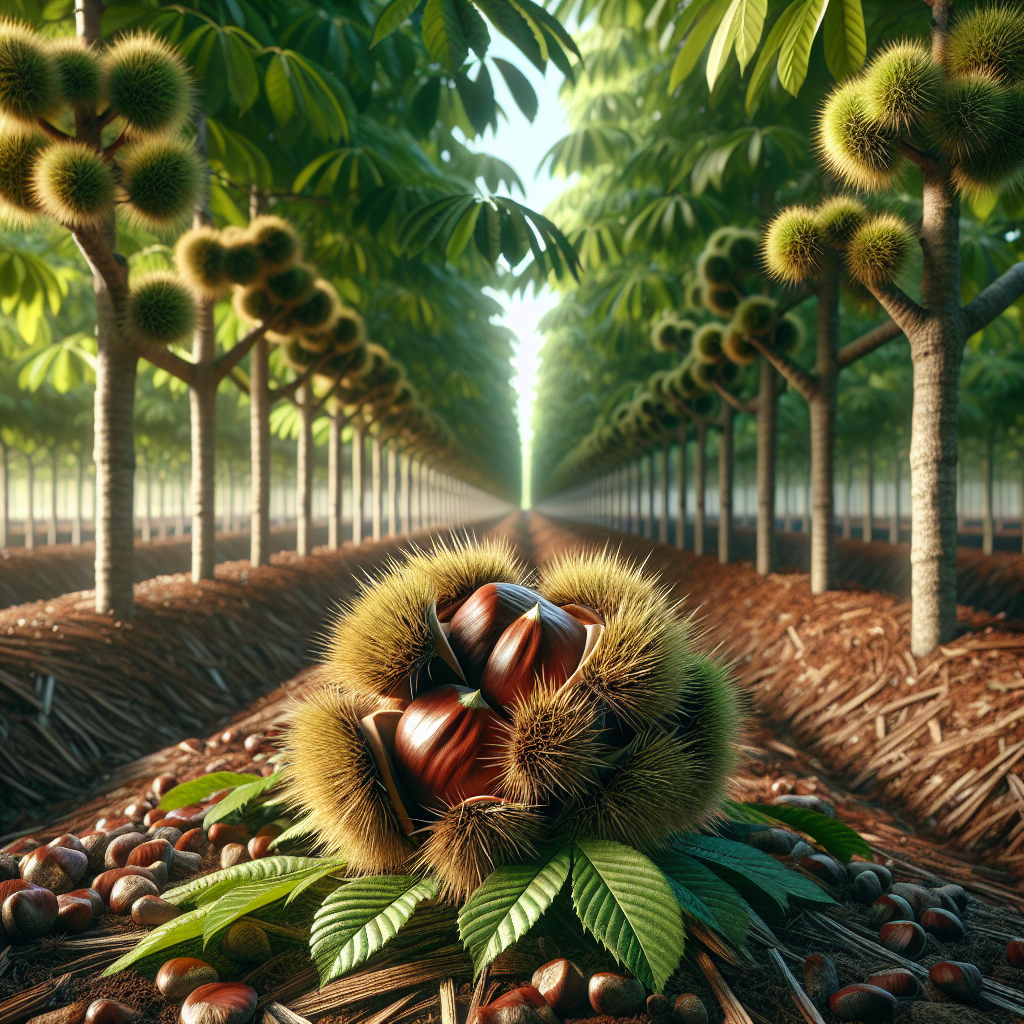
Introduction to Chestnut (Colossal)
Developed as a hybrid between Japanese chestnut and European chestnut lineages, this cultivar is widely recognized for producing unusually large, attractive nuts that stand out in fresh markets and direct sales. The name “Colossal” is not marketing exaggeration: mature burrs commonly carry one to three very large nuts, often substantially bigger than standard seedling chestnuts. That size advantage is one of its strongest commercial traits, especially for roasting, holiday markets, and premium retail packing.
The tradeoff for nut size is that orchard design and management matter more than many beginners expect. This is not a casual backyard tree if the goal is consistent cropping. It is a vigorous, upright-to-spreading tree that benefits from deliberate spacing, compatible pollinizers, good airflow, and disciplined soil management. The cultivar is often planted in western North America and other chestnut-suitable temperate zones, where growers want a high-value nut with strong visual appeal.
Like many chestnuts, it is monoecious, bearing separate male catkins and female flowers on the same tree, but it is not dependably self-fertile in a commercially useful way. Cross-pollination is essential for reliable nut set. In practice, growers usually pair it with compatible chestnut cultivars or seedling pollinizers. Because it descends partly from Japanese chestnut, it often shows vigor and large burr size, while the European chestnut contribution supports nut quality and adaptation to orchard production. For broader species context, see our Chestnut guide.
Botanical Profile of Chestnut (Colossal)
This tree belongs to the genus Castanea in the beech family, Fagaceae. The cultivar is generally described as a Japanese-European hybrid, most commonly expressed botanically as Castanea crenata × Castanea sativa. It is deciduous and can become a substantial orchard tree, often reaching 40 to 60 feet at maturity in favorable conditions, though size depends heavily on soil depth, water availability, rootstock or seedling vigor, and pruning strategy.
Leaves are long, lanceolate, glossy medium to dark green, and distinctly serrated, with a stronger resemblance to Japanese chestnut than to American chestnut. Spring growth is often vigorous, with long extension shoots on young trees. Flowering usually occurs in late spring to early summer after danger of hard frost has passed. Male flowers are borne in elongated catkins; female flowers are less conspicuous and typically located near the base of some catkins.
Burrs are large, green, and densely spiny, maturing to tan-brown as harvest approaches. The nuts themselves are one of the defining features: very large, mahogany-brown, and glossy, with a relatively broad shape. Kernel quality can be excellent when trees are not water-stressed late in the season. Nut size may decline if crop load is excessive, pollination is poor, or potassium availability is low.
The tree’s bearing habit is partly terminal and partly on lateral positions of current-season growth arising from one-year-old wood. That matters for pruning: overly aggressive heading cuts can reduce future flower-bearing wood. Juvenile vigor is strong, so early training should focus more on branch placement and structure than on heavy canopy reduction.
Compared with purely European chestnuts, this cultivar may break dormancy somewhat earlier in warm spring climates, which can be an advantage in long-season regions but a risk in frost-prone inland valleys. Compared with American chestnut types, it is generally grown for nut production rather than forest form, and orchardists choose it specifically for nut size rather than blight restoration traits.
Soil, pH, and Climate Requirements for Chestnut (Colossal)
This cultivar performs best in deep, friable, well-aerated soil with excellent drainage. The ideal profile is a sandy loam to loam with good organic matter, at least 3 to 4 feet of penetrable depth, and no restrictive hardpan. Chestnuts are notably intolerant of chronically wet feet. If water stands in the planting area for more than 24 hours after heavy rain, the site is usually unsuitable unless extensively mounded, drained, or tiled.
Target soil pH is 5.5 to 6.5, with the sweet spot often around 5.8 to 6.2. Trees can survive a little outside that range, but performance drops when pH approaches neutrality or rises above 7.0 because micronutrient imbalances become more likely, especially iron and manganese chlorosis on calcareous soils. In alkaline conditions, leaves may show interveinal yellowing while veins remain green, and shoot growth becomes weak. Avoid liming unless soil tests clearly justify it.
Organic matter should ideally be 3% to 6% in mineral soils. Too little organic matter reduces moisture buffering and nutrient holding capacity; too much poorly decomposed organic matter in a low-oxygen site can worsen root disease risk. Chestnut roots prefer oxygen-rich conditions. If you dig a test hole and smell sour, stagnant, or sulfurous odors, improve drainage before planting.
Climate is temperate with warm summers and cool winters. A winter chilling period is needed for normal dormancy release, but extreme cold below roughly -20°F (-29°C) can damage young wood, especially in exposed sites. The best production zones are those with moderate winter cold, a frost-free growing season of at least 150 to 180 days, and summer heat sufficient to mature burrs fully. Dry autumn weather is especially helpful during ripening and harvest.
Rainfall of 30 to 50 inches annually can support chestnuts if distributed sensibly and soils drain well. In Mediterranean or summer-dry climates, irrigation is usually necessary for commercial nut sizing. In humid climates, canopy airflow becomes critical to reduce foliar disease and burr rot pressure.
Young trees need even moisture for establishment. As a working target, keep soil in the main root zone moist but never saturated, roughly equivalent to 60% to 80% of field capacity. Practically, soil at 6 to 10 inches deep should feel cool and slightly damp and form a weak ball when squeezed, but not release water or feel sticky. Overwatered trees often show pale foliage, reduced extension growth despite adequate fertility, premature yellowing, and in severe cases dieback from root stress.
Avoid frost pockets. Female flowers and young burrs can be damaged by late spring frost, while low-lying cold air drainage areas often delay and reduce cropping. A gentle slope with air movement is ideal.
Step-by-Step Planting & Propagation
Start with grafted nursery trees from reputable sources if true-to-type production is the goal. Seedling propagation is possible, but seedlings do not remain genetically identical to the cultivar and can vary widely in nut size, quality, and bloom timing. Commercial and serious orchard growers nearly always plant grafted trees.
Select a well-drained site. Dig several test holes 24 to 36 inches deep in winter or during wet periods. If water remains in the hole after a day, install drainage or choose another site.
Run a soil test 6 to 12 months before planting. Measure pH, organic matter, phosphorus, potassium, calcium, magnesium, and boron. Correct major deficiencies before planting because incorporation is much easier then than after roots spread.
Control perennial weeds in advance. Eliminate bermudagrass, bindweed, thistle, and other competitive weeds in a strip at least 3 to 4 feet wide. Young chestnuts are poor competitors during establishment.
Lay out pollinizers. Do not plant a solid block of one cultivar. Interplant compatible chestnuts so pollen is available during bloom. A common arrangement is one pollinizer for every 4 to 8 main-crop trees, depending on bloom overlap and orchard size.
Space adequately. For standard orchard systems, use about 30 to 40 feet between trees and rows, with 35 x 35 feet common for vigorous sites. Tighter spacing may speed early yield but usually requires later thinning or heavier pruning.
Plant during dormancy. Late winter to early spring is ideal in cold climates; fall planting may work in mild-winter regions with well-drained soil. Keep roots moist before planting and never allow them to dry in wind or sun.
Prepare a broad planting area, not a narrow hole. Dig only as deep as the root system but 2 to 3 times as wide. Set the tree so the root flare sits at or slightly above final soil grade. Graft unions should remain above the soil line.
Backfill with native soil. Do not create a bathtub of amended soil surrounded by dense native soil. This encourages poor root transition. Break clods, firm gently, and water thoroughly to eliminate air pockets.
Mulch correctly. Apply 3 to 4 inches of wood chips or coarse organic mulch over the root zone, keeping mulch 4 to 6 inches away from the trunk to prevent crown rot and rodent damage.
Stake only if necessary. In windy sites, use a flexible tie system and remove it after the first year. Over-staked trees develop weaker trunks.
Propagation by grafting is usually done onto chestnut seedling rootstocks using whip-and-tongue, cleft, or bark graft methods in spring. Scion wood should be collected while dormant and stored cool and slightly moist. Because chestnuts can be somewhat tricky to graft compared with apples or pears, high sanitation and precise cambial alignment are important.
Care & Maintenance regimes for Chestnut (Colossal)
During the first three years, establishment is the priority. Irrigate deeply enough to moisten the top 18 to 24 inches of soil, then allow the upper few inches to begin drying before watering again. In many loam soils, that means one deep irrigation every 5 to 10 days during warm weather, but frequency varies with texture and temperature. Sandy soils may require water every 3 to 5 days; clay loams less often. The goal is consistency, not constant saturation.
For mature bearing trees, water demand rises sharply from late spring through nut fill in midsummer and early fall. Drought during this period reduces burr size, nut fill, and kernel quality. If using drip irrigation, multiple emitters per tree are better than one, expanding outward as the canopy grows. A mature orchard might receive the equivalent of 1 to 2 inches of water weekly in dry periods, adjusted for evapotranspiration and soil water-holding capacity.
Fertilization should be guided by leaf analysis and soil testing, not guesswork. Young trees usually benefit from modest nitrogen inputs split across spring and early summer. Excess nitrogen is a common mistake: it pushes rank vegetative growth, delays hardening off, and can increase susceptibility to winter injury and certain diseases. As a rough starting point, many growers apply 0.1 to 0.2 pounds of actual nitrogen per tree in year one, increasing gradually with age, but rates must be tailored to vigor, soil organic matter, and irrigation.
Potassium is especially important for nut crops. In deficient soils, low potassium shows up as marginal scorching on older leaves, weak burr development, and poor nut fill. Boron also matters in small amounts for flowering and fruit set; however, the margin between deficiency and toxicity is narrow, so apply only according to test results.
Train young trees to a strong central leader or modified central leader. Select well-spaced scaffold branches with wide crotch angles, ideally 45 to 60 degrees, beginning 3 to 5 feet above ground depending on equipment clearance. Remove narrow, upright competitors early. Mature pruning should be light and purposeful: eliminate dead, diseased, crossing, shaded, or weakly attached wood and maintain airflow. Heavy winter pruning often stimulates excessive vegetative regrowth at the expense of cropping.
Weed management is essential. Keep a vegetation-free strip at least 3 to 6 feet around the trunk during establishment. Grass competition can dramatically reduce early growth by stealing moisture and nitrogen. Once trees are mature, a managed alleyway of mowed sod can work well, but keep the root zone immediately around trunks mulched or otherwise free of aggressive competition.
Protect trunks from sunscald, rodents, and deer. In exposed young orchards, white trunk paint diluted 1:1 with water can reduce southwest injury. Use guards that do not trap moisture against bark. Deer browsing can deform young framework badly, so fencing is often worth the investment.
Many experienced growers include flowering insectary strips nearby rather than directly under the canopy. A good reference on orchard floor biodiversity is fall companion planting ideas.
Pests, Diseases & Organic Management
The most important disease risk in many chestnut plantings is root rot, especially from Phytophthora species in poorly drained soils. Symptoms include weak growth, sparse foliage, yellowing, premature leaf drop, and branch dieback, often progressing from subtle decline to death over one or more seasons. Prevention is far more effective than treatment: plant only in excellent drainage, avoid over-irrigation, and never allow the crown to sit below grade.
Chestnut blight, caused by Cryphonectria parasitica, is historically devastating to American chestnut, though susceptibility varies among species and hybrids. On orchard chestnuts, watch for sunken orange-brown bark cankers, cracking bark, and dieback above infected tissue. Prune out infected limbs well below visible symptoms, disinfect tools between cuts, and remove diseased wood from the site.
Ink disease, Anthracnose, Leaf spot, and Burr rots may also occur depending on climate. Dense canopies and overhead irrigation worsen many of these issues. Good spacing, dry foliage, and sanitation are foundational organic controls.
Insect pests vary by region. Chestnut weevils are among the most economically serious because larvae infest nuts. Adults lay eggs in developing nuts; larvae feed inside kernels and later emerge. Timely harvest is one of the best controls because it reduces the period when nuts remain exposed on the orchard floor. Orchard sanitation, prompt collection, and postharvest hot-water or cold treatments may help depending on local practice.
Gall wasps, Caterpillars, Aphids, Scale insects, and Japanese beetles can also appear. Aphids and scale usually become problematic where natural enemy balance is poor or trees are overfertilized with nitrogen. Encourage beneficial insects with habitat plantings such as Clover, Yarrow, and Thyme nearby, while avoiding dense vegetation pressed directly against trunks.
Organic management depends on prevention and monitoring:
- Inspect foliage, catkins, burr development, and bark every 2 to 3 weeks in the growing season.
- Remove mummified burrs, fallen infested nuts, and dead wood.
- Maintain mulch but keep it off the trunk.
- Avoid trunk wounds from mowing or string trimmers.
- Keep nitrogen balanced; lush, soft growth invites trouble.
- Promote airflow by sensible pruning and spacing.
If Borers or bark injury are suspected, peel back loose bark only enough to diagnose the issue and improve vigor through irrigation and nutrition. Stressed trees are much more attractive to opportunistic pests than balanced, actively growing ones.
Harvesting, Curing & Optimal Storage
Harvest usually occurs in autumn when burrs split naturally and nuts begin dropping. Do not pick immature green burrs unless weather or wildlife pressure makes emergency salvage necessary. Fully mature nuts detach more easily, cure better, and have better kernel flavor.
Collect nuts daily or at least every two to three days during peak drop. This is critical for quality. Chestnuts are unlike dry nuts such as walnuts; they are high in moisture and respiration, more like a starchy fresh product. If left warm on the ground, they quickly lose sweetness and become vulnerable to mold, fermentation, and insect infestation.
Wear heavy gloves when handling burrs. Mechanical pickup is possible in larger orchards if the orchard floor is smooth and clean, but hand gathering is common in small plantings. Cull nuts with cracks, insect holes, lightweight feel, or obvious mold.
After harvest, wash or sort as needed and begin curing immediately. A short curing period of a few days to two weeks under cool, humid conditions can improve eating quality by allowing starches to convert partially to sugars. Ideal storage conditions are around 32 to 34°F (0 to 1°C) with 85% to 90% relative humidity. At lower humidity, nuts shrivel; at higher temperatures, mold and sprouting increase.
For short-term home or farm storage, perforated polyethylene bags in refrigeration work well because they reduce moisture loss while allowing some gas exchange. Do not store at room temperature except for very brief handling. Depending on initial quality, sanitation, and storage conditions, chestnuts may keep for several weeks to a few months.
If curing for planting seed rather than eating, handling differs because viability and dormancy management become priorities. For edible market nuts, the priorities are cool temperatures, high humidity, rapid removal from field heat, and exclusion of damaged nuts from storage lots.
A simple float test can help identify some poor-quality nuts, though it is not perfect. Nuts that float are more likely to be poorly filled or insect-damaged, but sound nuts can occasionally float too. Use it as a rough sorting aid, not an absolute standard.
Companion Planting for Chestnut (Colossal)
Companion planting in chestnut orchards works best when it supports pollinators, beneficial insects, soil cover, and erosion control without creating excessive competition in the root zone. The key principle is separation: keep companions mostly in alleyways, border strips, or managed bands outside the immediate trunk area, especially during the first several years.
Low-growing legumes such as Clover are among the best companions because they protect soil, support beneficial insects, and can contribute biologically fixed nitrogen over time when managed as part of the orchard floor system. Clover is especially useful in row middles where mower traffic is expected.
Yarrow is valuable for attracting parasitic wasps, hoverflies, and predatory insects. Its umbels provide accessible nectar to many natural enemies of orchard pests. Plant it in insectary strips rather than directly at the trunk base.
Thyme can serve as a drought-tolerant flowering groundcover in well-drained orchard edges or herbary strips. It supports pollinators and remains relatively low, reducing shade competition.
A fourth useful companion is Nasturtium in younger orchards or garden-scale systems. It can attract beneficial insects and function as a visual trap plant for some soft-bodied pests, though it is less common in large mechanized chestnut systems.
Avoid deep-rooted, highly competitive perennial weeds, tall shading companions, and crops that require frequent cultivation near trunks. Also avoid companions that increase humidity around the lower canopy in already disease-prone, humid climates. In chestnut orchards, companion planting succeeds when it improves ecology without compromising airflow, harvest access, or root health.