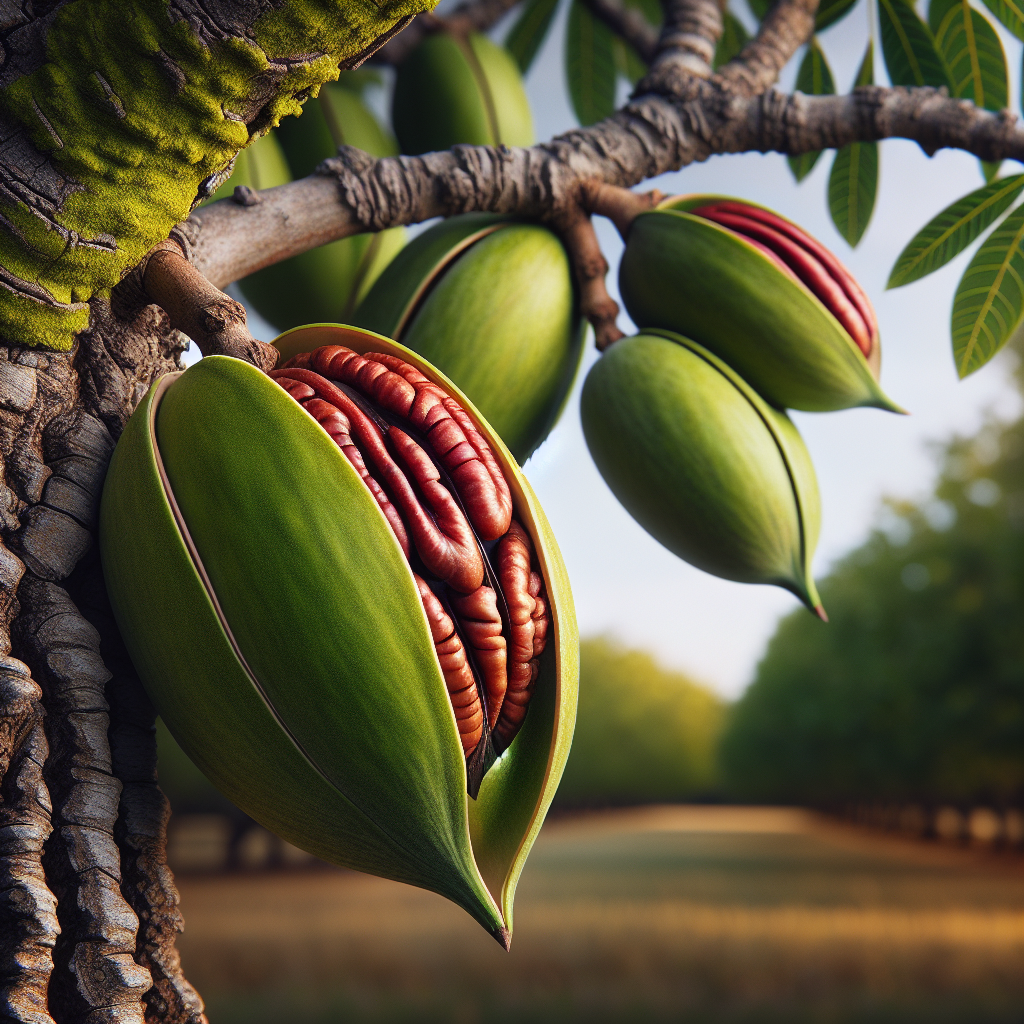
Introduction to Pecan
Native to the river bottoms and alluvial soils of the central and southern United States and northern Mexico, pecan is both a wild forest species and a highly managed commercial nut crop. It belongs to the hickory genus, and unlike many backyard fruit trees, it should be thought of as a century-scale planting: a healthy tree can remain productive for generations if given adequate space, water, and fertility.
Pecan culture has deep historical roots among Indigenous communities who gathered and traded the nuts long before formal orchard systems existed. Modern pecan production developed through seedling selection, grafting, and regional cultivar improvement, especially in the southern U.S., where orchardists learned to match varieties to climate, scab pressure, and pollination timing. Today, successful growers treat pecan as a precision crop. Yields and kernel quality are strongly influenced by irrigation, zinc nutrition, canopy light penetration, and crop-load balance.
For home growers, pecan can be immensely rewarding but requires patience. Seedling trees may take 8 to 15 years or longer to bear well, while grafted trees often begin meaningful production in 4 to 8 years depending on vigor, rootstock, climate, and management. Commercial growers also need to plan for alternate bearing, disease pressure, and harvest logistics. If you already grow orchard nuts, compare management principles with Walnut, though pecan typically demands warmer summers and more attention to scab and zinc.
Botanical Profile of Pecan
Pecan is a deciduous, monoecious tree, meaning each tree bears separate male and female flowers. The male flowers are pendulous catkins produced on previous season's wood, while the female flowers form in clusters at shoot terminals on current season growth. This flowering pattern is central to pecan orchard design because most cultivars show dichogamy: pollen shed and female flower receptivity do not fully overlap within the same tree.
Botanically, the tree is vigorous, deep-rooted, and strongly apically dominant when young. In favorable soils, a taproot develops early, followed by extensive lateral roots that can eventually occupy a very large soil volume. Mature orchard trees commonly reach 70 to 100 feet tall if unmanaged, though pruning and spacing influence ultimate architecture. The leaves are alternate, pinnately compound, and usually composed of 9 to 17 lanceolate leaflets. Healthy foliage should be a deep green; pale, rosetted, or strap-like new growth often points to zinc deficiency, one of the most common nutritional issues in pecan.
The fruit is technically a drupe-like nut enclosed in a green shuck. As the nut matures, the shell hardens and the kernel fills through late season. At maturity, the shuck splits along four sutures, exposing the shell and allowing natural drop or mechanical shaking harvest. Kernel quality depends on complete filling, which in turn depends on a long frost-free season, adequate leaf area, sufficient late-season moisture, and balanced crop load.
Cultivars are commonly grouped by pollination type. Type I, often called protandrous, sheds pollen before female flowers become receptive. Type II, or protogynous, has female flowers receptive before pollen shed. Because weather can shift bloom overlap, growers should plant at least two compatible cultivars with overlapping flowering windows rather than relying only on type labels. Well-known cultivars include 'Desirable', valued for nut quality but highly susceptible to scab in humid regions; 'Pawnee', early ripening and productive; 'Kanza', smaller nut but excellent scab resistance and kernel quality; 'Cape Fear', vigorous and productive; and 'Elliott', a smaller-nut cultivar prized in disease-prone climates for strong scab resistance.
Soil, pH, and Climate Requirements for Pecan
Pecan performs best in deep, well-drained, fertile soils with high water-holding capacity but good internal drainage. Ideal soils are loams, sandy loams over deep subsoil, or alluvial bottomland soils with at least 5 to 6 feet of rootable depth. Hardpans, shallow bedrock, compacted layers, and prolonged saturation all reduce root development and long-term productivity.
The optimal soil pH is generally 6.0 to 6.8, though trees can tolerate roughly 5.8 to 7.5 if nutrition is managed carefully. At high pH, zinc, iron, and manganese become less available, and deficiency symptoms become more likely. At very low pH, aluminum toxicity and nutrient imbalance may limit growth. Before planting, conduct a full soil test including pH, cation exchange capacity, organic matter, phosphorus, potassium, calcium, magnesium, and micronutrients. In commercial blocks, subsoil testing is also valuable because pecan roots exploit deep profiles.
Drainage is non-negotiable. Pecan roots need oxygen, and waterlogged soils for more than 48 to 72 hours during active growth can trigger root decline, reduced shoot extension, yellowing foliage, and increased susceptibility to crown and root pathogens. On the other hand, the species is not drought-efficient when heavily cropped. During nut sizing and kernel filling, water stress sharply reduces kernel percentage and can produce poorly filled, lightweight nuts.
Climate preference is warm temperate to subtropical, with long, hot summers and a sufficiently long frost-free period, often 180 to 220 days depending on cultivar. Winter chilling is needed for proper dormancy release, but pecan is less cold-hardy than many northern fruit and nut species. Severe winter injury may occur when temperatures fall below about -10 to -20°F (-23 to -29°C), especially in young trees or southern-adapted cultivars. Late spring frosts are dangerous because female flowers and new shoots are tender.
High humidity increases foliar and nut disease pressure, especially Pecan Scab. In arid and semi-arid regions, scab pressure is lower, but irrigation management becomes the central challenge. Wind exposure is another concern: strong winds can break limbs on heavily cropped trees and interfere with pollination. Choose sites with good air drainage to reduce frost risk, but avoid exposed ridges if wind desiccation is severe.
For orchard floor management and broader soil resilience, the principles in soil health strategies are especially useful on long-lived tree crops where compaction and low organic matter can have decades-long consequences.
Step-by-Step Planting & Propagation
Commercial-quality pecans are almost always established with grafted or budded trees rather than seedlings. Seedling trees are genetically variable and unpredictable in nut size, shell thickness, disease resistance, and bearing age. Use nursery trees that are true-to-type, healthy, and matched to regional conditions.
Select the right site first, not the tree first. Because pecan is long-lived and large, a poor site cannot be corrected easily later. Ensure deep soil, no persistent standing water, full sun, and room for mature canopy spread.
Choose compatible cultivars. Plant at least two cultivars with overlapping bloom. In larger orchards, distribute pollinizers throughout the block rather than clustering them in one corner. Pollination failures can occur when weather shifts bloom timing, so local extension recommendations matter.
Prepare the land. Remove perennial weeds, correct pH based on soil tests, and break compaction if a restrictive layer is present. Deep ripping before planting can help where soils are compacted, but only if drainage is adequate.
Lay out spacing according to management intensity. Traditional spacing may range from 35 x 35 feet to 50 x 50 feet. High-density systems can start tighter, such as 30 x 30 feet, but require planned thinning as canopies expand. Home growers should not underestimate mature size; planting too close to buildings or septic systems creates future problems.
Plant during dormancy, typically late fall through early spring depending on climate. Bare-root trees should be planted while fully dormant. Container-grown trees offer more flexibility but still establish best in cool seasons when transpiration demand is low.
Dig a planting hole wide enough to accommodate the root system without bending roots upward. Do not dig excessively deep. The tree should sit at the same depth it grew in the nursery or slightly higher in heavy soils to allow for settling. The graft union should remain above the soil line.
Trim damaged roots only lightly. Spread roots naturally, backfill with native soil, and eliminate large air pockets by firming gently and watering thoroughly. Avoid packing wet clay soils tightly.
Water in deeply after planting. A newly planted tree should receive enough water to moisten the entire root zone. For many soils, that means 5 to 10 gallons immediately after planting for a small nursery tree, then repeat as needed to keep the soil evenly moist but not saturated.
Head the tree if necessary to balance top and root. In some nursery stock, modest heading encourages framework development, but excessive pruning delays early growth. Follow local nursery recommendations based on tree form.
Install protection. Use trunk guards against rodents, sunburn, and herbicide drift. In deer-prone areas, fencing or individual cages may be essential.
Propagation from seed is mostly used for rootstocks or breeding. Nuts for propagation require stratification: typically 60 to 90 days of cold, moist treatment around 34 to 40°F (1 to 4°C). Seedlings are then field-grown and later topworked by whip grafting, bark grafting, or patch budding. Grafting success depends on active cambium, proper scion storage, and careful moisture control.
Care & Maintenance regimes for Pecan
Young pecan trees need strong early vegetative growth to establish trunk caliper, scaffold limbs, and root mass. Weed control is one of the highest-return practices in the first 3 to 5 years. Maintain a vegetation-free strip at least 3 to 6 feet wide around the tree. Grass competition can drastically reduce establishment by intercepting water and nitrogen.
Irrigation should be managed by soil type, tree age, and season. Newly planted trees need consistently moist soil in the upper 12 to 24 inches, especially during the first summer. A useful target is to avoid letting more than roughly 40 to 50% of available soil water deplete in the active root zone. In practical terms, the soil should feel cool and slightly moist several inches down, not powder-dry and not sticky anaerobic mud. Overwatered trees often show yellowing leaves, poor shoot growth, edema-like symptoms, and in heavy soils a sour smell in the root zone. Underwatered trees show leaf scorch, early leaflet folding, reduced shoot extension, nut drop, and poor kernel fill.
Mature bearing trees have very high water demand. In hot weather, a mature orchard may require the equivalent of 1.5 to 2.5 inches of water per week from rainfall plus irrigation, sometimes more on sandy soils during peak summer demand. The most critical period is from late spring through kernel filling. Water stress in August and September is especially damaging because it reduces kernel development even if shell size appears normal.
Nitrogen is usually the primary macronutrient driving growth and production. Young non-bearing trees often receive split nitrogen applications in spring and early summer, adjusted for vigor and soil test results. Bearing trees remove substantial nutrients in nuts and leaf biomass, so annual nutrient programs should be based on leaf tissue analysis rather than guesswork alone. Leaf sampling is often done in midsummer from the middle leaflets of current-season shoots. Zinc deserves special emphasis: pecan has a high zinc requirement, and deficiency is common, particularly in alkaline soils. Symptoms include small leaves, shortened internodes, chlorosis, and rosetting. Foliar zinc sprays are standard in many orchards, particularly early in the season during active leaf expansion.
Phosphorus and potassium needs vary by soil reserve and cropping load. Potassium deficiency can show as marginal scorch and poor nut filling. Calcium and magnesium are generally managed through liming and base saturation balance, while boron may be required in small amounts but should never be applied carelessly because excess boron can be toxic.
Training in the early years typically follows a central leader system. Select strong, well-spaced scaffold branches with wide crotch angles. Remove narrow, competing leaders and low branches that will interfere with equipment, but do not overprune; pecan responds best when enough foliage remains to fuel rapid growth. Mature trees are pruned more conservatively, mainly to remove dead, broken, crossing, or low obstructive limbs. In dense orchards, crowding eventually reduces light penetration, lowers spur productivity, and worsens disease. Mechanical hedging is used in some intensive systems, but spacing decisions made at planting largely determine how severe this issue becomes.
Alternate bearing is a fundamental management issue. A heavy crop one year can suppress return bloom and produce a light crop the next. Good irrigation, nutrient balance, and disease control help moderate alternation. In some orchards, crop thinning may be considered where severe overcropping threatens tree health and next year's production.
Orchard floor management should balance equipment access, erosion control, and water competition. A sod alley with a weed-free tree strip is common. In dryland situations, excessive groundcover competition can reduce yield. In wetter orchards, too much bare soil increases erosion and compaction.
Pests, Diseases & Organic Management
Pecan is vulnerable to a range of pests and diseases, and the most limiting problem varies sharply by region. The single most notorious disease in humid climates is Pecan Scab, caused by Venturia effusa. It attacks leaves, shoots, and shucks, producing dark, velvety lesions that can distort tissue, cause nut loss, and ruin marketability. Scab pressure is highest when susceptible cultivars are grown in warm, wet conditions with prolonged leaf wetness. The best organic-compatible defenses are resistant cultivars, open canopies, good airflow, sanitation where feasible, and avoiding excessive nitrogen that promotes dense, susceptible growth.
Other diseases include Powdery Mildew, Downy Spot, Anthracnose, Vein Spot, and Shuck Dieback disorders associated with stress and nutrient imbalance. Crown Gall may occur in nursery stock or wounded young trees. Phytophthora and other root diseases become more likely in poorly drained soils.
Key insect pests include Pecan Nut Casebearer, Aphids, Hickory Shuckworm, Stink Bugs, Pecan Weevil, Mites, Phylloxera, and Leaf-Footed Bugs. Pecan Nut Casebearer larvae can destroy young nutlets shortly after pollination, making close monitoring essential. Yellow and black pecan Aphids feed on foliage and can trigger premature defoliation through toxin injection and honeydew-related sooty mold. Pecan Weevil is highly destructive where present, laying eggs in developing nuts and causing kernel loss.
An organic or low-input management strategy begins with cultivar choice. Resistant cultivars dramatically reduce fungicide dependence. Next comes monitoring: scout foliage, nut clusters, terminals, and shucks on a regular schedule. Pheromone traps, degree-day models, and local extension alerts help time interventions, especially for casebearer and weevil.
Biological and cultural controls matter. Encourage beneficial insects by maintaining flowering habitat in alleyways or nearby borders, but avoid creating unmanaged weed reservoirs that harbor pests. Remove or destroy heavily infested dropped nuts where practical. Keep trees vigorous but not excessively lush. Good air circulation reduces humidity retention in the canopy, lowering disease pressure.
Organic sprays may include kaolin clay for some insect suppression, horticultural oils in appropriate dormant or low-heat windows, insecticidal soaps for soft-bodied pests where coverage is feasible, and approved copper or sulfur materials for some disease situations. However, pecan is a tall tree crop, and organic sprays become less practical as trees mature unless specialized equipment is available. This is why resistant cultivars and site suitability are often more important in pecan than in many smaller orchard crops.
Harvesting, Curing & Optimal Storage
Pecans are harvested when shucks split naturally and nuts reach full maturity. The timing varies by cultivar and region, typically from early autumn through late autumn. Do not rely only on shell color; mature nuts show full shuck opening, easier separation from the shuck, and a well-developed kernel interior when cracked.
For small-scale growers, harvest may be done by hand gathering as nuts drop, ideally every few days to reduce mold, insect damage, wildlife losses, and staining. Commercial orchards usually use trunk or limb shakers combined with sweepers and pick-up machines once a sufficient percentage of nuts are ready. Harvesting too early reduces kernel development and flavor; too late increases field losses and quality decline.
Immediately after harvest, remove sticks, leaves, and unfilled nuts. Wash only if necessary, and if nuts are washed, dry them promptly. Curing is essentially controlled drying. Freshly harvested pecans should be dried to about 4 to 5% kernel moisture for long-term storage and best shelling quality. In practical farm terms, this means spreading nuts in a thin layer in a warm, well-ventilated, shaded area for several days to two weeks depending on humidity, or using forced-air drying at gentle temperatures. Excess heat can damage flavor and shorten storage life.
Properly cured pecans should feel crisp when shelled, and kernels should snap rather than bend rubberily. Nuts stored too moist are prone to mold, darkening, off-flavors, and rancidity. Nuts dried too aggressively at high temperatures can lose aroma and develop quality defects.
In-shell pecans store best in cool, dry, dark conditions. For short-term storage, temperatures near 32 to 45°F (0 to 7°C) with low humidity are effective. Shelled kernels are more vulnerable to oxidation because of their high oil content. Refrigeration extends quality, while freezing preserves flavor for many months and often over a year if packed in airtight, moisture-proof containers. Protect pecans from odor absorption by keeping them away from onions, fuels, or strongly aromatic foods.
Companion Planting for Pecan
Because pecan is a large, high-canopy tree with strong root competition and deep shade as it matures, companion planting should be approached as orchard-floor design rather than close interplanting right against the trunk. The best companions are species that improve biodiversity, stabilize soil, attract beneficial insects, or provide short-term income during the orchard establishment years.
In young orchards, low-growing legumes and managed cover crops can be useful between rows. White clover, crimson clover, vetch, or regionally adapted mixes can add nitrogen biologically, support pollinators, and reduce erosion, though they must be managed so they do not compete excessively for water in dry climates. Deep-rooted species such as daikon-type tillage radish are sometimes used in rotation between rows to relieve surface compaction, but not in a way that disrupts tree roots.
Flowering insectary strips with species like yarrow, dill, alyssum, and native wildflowers can improve habitat for beneficial insects that prey on Aphids and caterpillars. However, maintain mowing and sanitation so these strips do not become rodent cover or impede air circulation.
Avoid heavy-feeding annuals or aggressive perennial grasses in the immediate root zone. Corn and other tall summer crops can compete strongly for moisture and light in young orchards; if grown as temporary intercrops, they require careful irrigation and fertility planning. For contrast in field crop water use and nutrient extraction, see Corn.
Do not plant shade-sensitive vegetables expecting long-term success under mature pecan canopies. In addition to shade, pecan leaf litter and root competition make understory production less dependable over time. Some growers also observe reduced vigor in certain understory plants beneath hickory relatives, so it is safer to use resilient orchard covers rather than delicate cash crops near mature trees.
A practical companion strategy is this: keep a clean mulched or weed-free strip around young trunks, maintain a managed sod or cover crop in row middles, add flowering borders at the orchard edge, and rotate temporary annual intercrops only during the first few years before the pecan canopy closes. This system supports tree establishment first, which is always the priority in a crop expected to produce for decades.