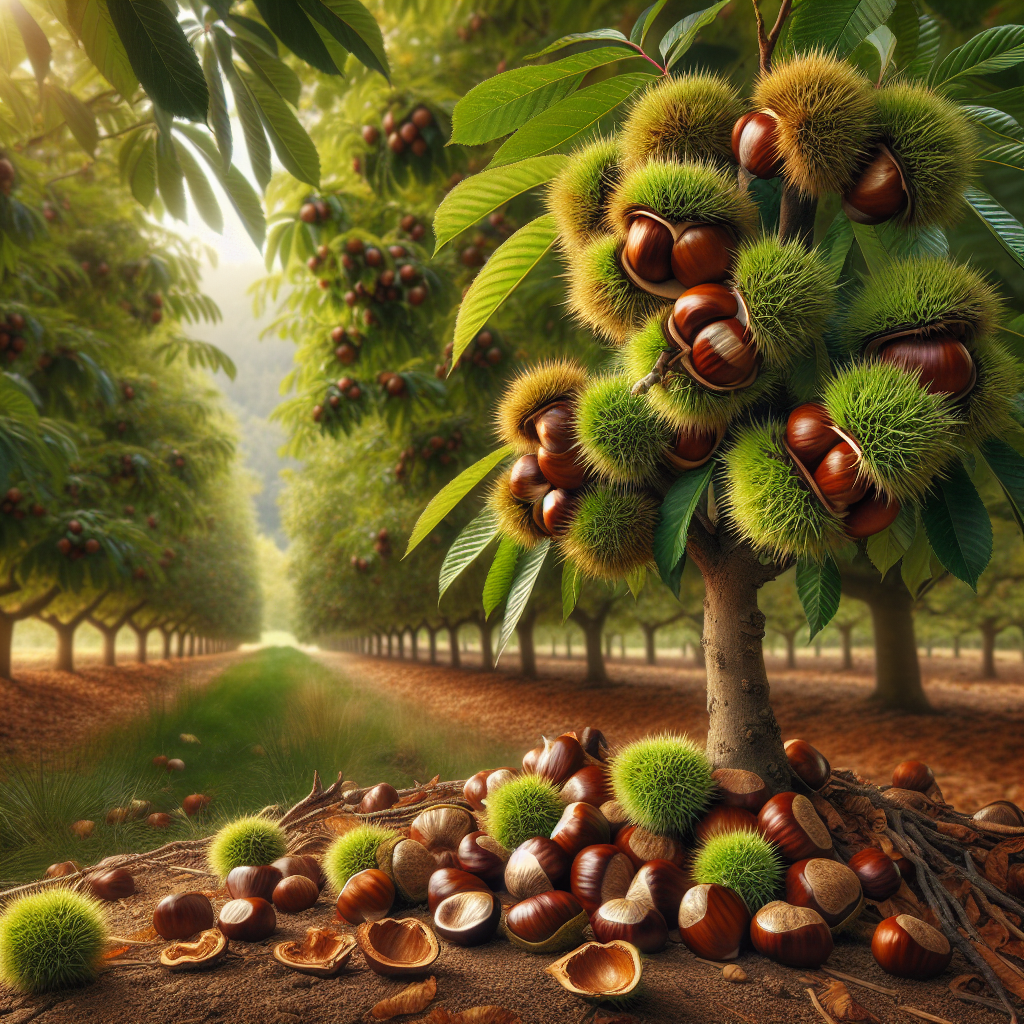
Introduction to Chestnut (Bouche de Betizac)
A French hybrid cultivar developed from European and Japanese chestnut parentage, this variety is best known for producing exceptionally large, attractive nuts with strong commercial appeal. It is often chosen by orchardists who want a tree that combines the nut quality and eating character associated with European chestnut types with some of the disease tolerance and vigor contributed by Japanese chestnut genetics.
Its reputation rests on three major strengths: size, productivity, and resilience. The nuts are typically large to very large, often with a bright brown shell and a relatively easy-to-peel kernel when properly cured. Trees are vigorous, upright to spreading with age, and can come into bearing earlier than many seedling chestnuts. In suitable climates, it can become a high-value specialty nut crop for farm-gate sales, roasting, fresh markets, flour, confectionery, and autumn seasonal demand.
A key practical point is that this is not a plant-and-forget tree. Like most chestnuts, it is highly sensitive to poor drainage, lime-rich soils, and pollination errors. Growers who fail with chestnuts often fail before planting: they choose the wrong site, ignore soil chemistry, or install only one cultivar. If these fundamentals are addressed correctly, this hybrid can be one of the more rewarding temperate nut trees to grow. For broader species background, see the general Chestnut guide.
Historically, European chestnuts were foundational food trees in many upland rural regions, while Japanese chestnuts contributed useful breeding traits such as vigor, adaptation, and disease resistance. Bouche de Bétizac emerged from this breeding logic: preserve premium nut characteristics while reducing some of the vulnerability that pure European types can show in modern orchard conditions.
Botanical Profile of Chestnut (Bouche de Betizac)
This cultivar belongs to the genus Castanea in the family Fagaceae, the same broad family as oak and beech. As a hybrid between Castanea sativa and Castanea crenata, it expresses intermediate traits. Leaves are long, lanceolate, sharply serrated, and glossy medium to dark green, with stronger, often more robust foliage than many pure European chestnuts.
Trees are typically vigorous, with a strong central leader when young if trained correctly. Unpruned specimens can become large orchard trees, commonly reaching 8-15 meters in height over time depending on rootstock, soil depth, rainfall, and spacing. Canopies can become dense if not thinned, which affects light penetration, burr ripening, and disease pressure.
Flowering occurs in late spring to early summer, usually after the worst frost risk has passed. Male catkins are conspicuous and pollen shed can be abundant, but this cultivar is notable for having limited or poor effectiveness as a pollinizer in some settings because of reduced pollen fertility, a trait reported in several commercial plantings. In practice, it should not be relied on as a stand-alone pollination source. Orchard design must include compatible pollinizing cultivars that flower at the same time.
The fruit is enclosed in a spiny burr, usually containing one to three nuts. Bouche de Bétizac is prized because a high proportion of nuts are large and visually uniform, traits especially important in premium fresh chestnut markets. Nut shape tends toward broad and attractive, with a relatively full kernel. The pellicle can separate reasonably well after curing and heating, although peeling quality still depends on harvest maturity, curing conditions, and storage humidity.
Roots are shallow to moderately deep but very oxygen-demanding. Fine feeder roots are easily damaged by waterlogging, compaction, and deep cultivation. This root sensitivity explains why chestnuts often collapse on heavy clay or in sites where water stands for even short periods during the growing season.
Juvenile trees grow quickly if their roots are happy. Excess nitrogen, however, can push rank vegetative growth at the expense of wood ripening and future flowering. Balanced development is especially important in this cultivar because vigor is already naturally high.
Soil, pH, and Climate Requirements for Chestnut (Bouche de Betizac)
This cultivar performs best in deep, well-drained, slightly acidic to moderately acidic soils. The ideal pH range is about 5.2 to 6.5, with best performance often seen around 5.5 to 6.2. Once soil pH rises above roughly 6.8, trees may begin to show nutrient lock-up, especially iron and manganese deficiency, expressed as interveinal chlorosis on younger leaves. On calcareous soils, repeated correction is difficult and often uneconomic; chestnuts are usually a poor choice there.
Texture matters as much as pH. The best soils are sandy loams, loams, decomposed forest soils, or light silt loams with excellent internal drainage and at least 1 meter of penetrable soil depth. Heavy, plastic clays are risky unless planted on substantial mounds or ridges and only where winter waterlogging never occurs. A practical drainage target is that a 30-45 cm deep test hole filled with water should drain within 12-24 hours. If water remains longer, root stress is likely.
Organic matter should be moderate to high, ideally 3-6%, but fresh manure directly in the planting hole should be avoided because it can burn roots and create uneven settling. Instead, improve the whole tree row with composted organic matter several months before planting.
Climatically, this is a temperate chestnut. It prefers regions with cold winters sufficient for dormancy and warm summers that allow nut filling and burr maturation. Annual rainfall of 700-1200 mm is acceptable if well distributed and drainage is excellent. In drier climates, irrigation is necessary, especially during nut sizing from midsummer to early autumn.
Winter hardiness is generally good for a hybrid chestnut, but the critical weather issue is not winter cold alone; it is spring frost during bud break and catkin emergence. Choose sites with air drainage, such as gentle slopes rather than frost pockets. South-facing slopes can encourage earlier bud break, which may be a disadvantage in frost-prone regions. East or northeast slopes are sometimes safer because they moderate premature warming.
Summer heat is tolerated, but extreme heat combined with drought can reduce kernel fill and cause premature burr drop. When midday temperatures exceed 32-35°C repeatedly, tree stress rises sharply unless soil moisture remains stable. The goal is even moisture, not saturation. In the active root zone, soil should remain moist but crumbly. If you squeeze a handful of soil from 15-20 cm depth, it should hold together lightly then break apart with a tap. Sticky, sour-smelling soil indicates excess moisture; powdery soil that cannot form a weak ball indicates drought stress.
Shelter from strong desiccating wind is beneficial, particularly in the first 3-5 years. Wind can tear leaves, reduce photosynthetic efficiency, and interfere with bee activity during bloom.
For orchard floor improvement and long-term biology, growers often use living covers and diverse understory management; the principles overlap with general soil care discussed in soil health strategies.
Step-by-Step Planting & Propagation
Use grafted nursery trees from reputable sources whenever possible. Seedling chestnuts vary too much in nut size, bearing habit, disease response, and harvest season to guarantee true Bouche de Bétizac characteristics. Grafted trees also shorten the time to first meaningful production.
Select the site one full season ahead if possible. Test soil pH, drainage, organic matter, and subsoil constraints. Remove perennial weeds thoroughly.
Plan pollination before ordering trees. Install at least one compatible pollinizer cultivar with overlapping bloom. A common commercial pattern is 8-15% pollinizer trees distributed evenly through the block rather than planted only on one edge.
Prepare the tree row. Rip compacted subsoil if needed when dry enough to shatter, not smear. Incorporate well-finished compost across the row rather than into isolated holes.
Plant during dormancy, usually late autumn to early spring depending on climate. In colder zones, early spring planting is safer. In milder regions with workable soil, autumn planting encourages earlier root establishment.
Dig a broad hole only as deep as the root system and at least twice as wide. The graft union should remain well above soil level, usually 10-15 cm above the final grade.
Spread roots naturally. Do not curl roots in a narrow hole. If container-bound, gently tease out circling roots.
Backfill with native soil. Avoid filling the hole with a radically different potting mix, which can create a bathtub effect and trap water.
Water in deeply to settle soil. Apply 15-25 liters immediately after planting, then reassess moisture 3-5 days later.
Mulch with 5-10 cm of coarse organic material over a 1-1.5 meter circle, keeping mulch 10 cm away from the trunk. Wood chips are excellent because they buffer moisture and support fungal soil ecology.
Stake only if necessary in windy sites. Over-staking can weaken trunk development.
Typical spacing is 8 x 8 m to 10 x 10 m for standard orchard systems, though higher-density early production systems may start tighter and later remove trees. Adequate spacing improves light distribution, air movement, and burr maturation.
Propagation is generally by grafting onto chestnut rootstocks. Whip-and-tongue, omega, or bark grafting can be successful depending on nursery practice and wood size. Scionwood should be taken during dormancy from healthy, true-to-type mother trees. Chestnuts are more exacting to graft than many pome fruits; temperature, scion hydration, and sanitation matter greatly.
Care & Maintenance regimes for Chestnut (Bouche de Betizac)
In the establishment phase, the priority is root expansion, trunk training, and avoiding stress. Water deeply and infrequently enough to moisten the top 30-45 cm of soil without leaving it saturated. In many temperate orchard soils, a newly planted tree may need 15-30 liters once or twice weekly during dry weather. The exact interval depends on texture: sandy soils may need more frequent irrigation, while loams hold longer. Never irrigate by calendar alone. Check moisture at 15 cm and 30 cm depths.
Signs of underwatering include drooping leaves during morning hours, marginal browning, small pale leaves, slowed extension growth, and burr abortion later in mature trees. Signs of overwatering include persistently limp but not dry leaves, yellowing from the interior canopy outward, darkened or sour-smelling soil, algae or fungus growth on bare wet ground, and poor shoot maturation. Repeated saturation predisposes roots to Phytophthora.
A mature bearing tree benefits from consistent moisture from flowering through kernel fill. The most critical period is roughly midsummer until 2-3 weeks before harvest. Severe moisture deficits during this window reduce nut size, increase empty nuts, and encourage burr drop. If using drip irrigation, multiple emitters spaced around the root zone are better than a single point source because chestnut feeder roots spread widely.
Fertilization should be guided by leaf and soil analysis. In the absence of data, apply modest nitrogen only after establishment begins. Young trees often respond to 30-60 g of actual nitrogen per tree per year, split into spring applications, increasing gradually with age and canopy size. Excess nitrogen can delay hardening, increase winter injury risk, and stimulate blight-susceptible lush growth. Potassium is important for nut fill and stress tolerance; boron is required in tiny amounts but is essential for flowering and nut set. Because chestnuts are sensitive, micronutrients should be supplied based on lab-confirmed deficiency.
Pruning is mainly structural and sanitary rather than aggressive. Train a strong central leader in the first years, selecting 3-5 well-spaced scaffold branches with wide crotch angles. Remove narrow, competing leaders early. Once the framework is built, annual pruning should open the canopy, remove dead wood, and maintain light penetration. Heavy dormant pruning can trigger excessive vigor; moderate, regular pruning is preferable.
Weed control is crucial, especially within the first 1-2 meters around the trunk. Grass competition can severely reduce establishment because chestnuts dislike root competition while young. Organic mulches, shallow cultivation well away from the trunk, or orchard floor mowing between rows are effective. Avoid deep tillage that severs feeder roots.
Trunk protection is wise in areas with rodents, rabbits, deer, or sunscald risk. Use ventilated guards and inspect them annually.
Pests, Diseases & Organic Management
This cultivar is valued partly because it shows useful resistance to Chestnut Blight relative to susceptible European material, but resistance is not immunity. Blight, caused by Cryphonectria parasitica, produces orange-brown bark lesions, sunken cankers, cracking, and dieback above the infection point. Remove and destroy infected branches during dry weather, disinfect tools, and avoid unnecessary bark wounds.
Phytophthora root rot is often the most serious preventable problem. It thrives in wet, poorly drained soils and causes reduced vigor, yellowing leaves, sparse canopy, dieback, and eventual collapse. The best organic management is site prevention: drainage, mounding, careful irrigation, and avoiding ponding. Once established in the soil, it is difficult to reverse.
Ink disease complexes and other root disorders also appear where aeration is poor. Healthy roots are cream to light tan and firm; diseased roots are dark, weak, and slough their outer tissue.
Chestnut gall wasp can deform buds and shoots, reducing flowering and yield. Inspect new shoots for green to reddish galls. Prune out light infestations before adult emergence when practical, and support beneficial parasitoids by maintaining floral diversity nearby.
Nut weevils and Tortricid moth larvae can infest nuts. Orchard sanitation is essential: collect and remove fallen nuts frequently during harvest, because larvae often complete development in the soil. Poultry foraging after harvest can reduce overwintering populations in some systems.
Aphids, Scale insects, and Leaf feeders are usually secondary issues on vigorous trees but can become problematic in stressed orchards. Encourage predators with habitat plantings and avoid broad-spectrum sprays that disrupt beneficial insect balance.
For organic disease prevention, focus on airflow, spacing, sanitation, balanced fertility, and moisture management rather than rescue treatments. A tree growing in correct soil is inherently less vulnerable than one pushed with fertilizer in a marginal site.
Harvesting, Curing & Optimal Storage
Harvest usually occurs in autumn when burrs split naturally and nuts begin dropping. Do not harvest too early from unopened burrs unless weather or pest pressure forces intervention, because immature nuts store poorly and have lower flavor.
The best quality comes from frequent collection, ideally every 1-3 days during peak drop. Chestnuts are living seeds with high moisture content, unlike dry nuts such as walnuts. Left on warm ground, they lose quality quickly, mold, or become infested.
Wear gloves when handling burrs. Gather nuts, separate damaged or lightweight ones, and float-test only if you can dry surface moisture promptly afterward. Sound nuts are generally heavy for their size. Discard visibly wormy, cracked, moldy, or shriveled nuts.
Curing improves sweetness and peeling quality. Hold nuts for several days to two weeks at about 0-4°C with high relative humidity, ideally 85-90%, and good airflow. This allows some starch conversion and moisture equalization. Do not let them dry like walnuts; excessive dehydration causes rubbery kernels and internal browning.
For short-term storage, keep nuts refrigerated just above freezing in perforated bags or ventilated crates. The target is cold, humid, and breathable storage. If humidity is too low, nuts desiccate. If airflow is too low, condensation and mold rise. Under good conditions, quality may hold for 1-3 months, though fresher is better for premium markets.
For long-term preservation, chestnuts can be peeled and frozen, or dried for flour. Drying should be controlled and gentle so kernels do not case-harden externally while retaining internal moisture.
Yield varies widely by tree age, pollination quality, soil moisture, and orchard management. Well-managed mature trees can produce substantial crops, but chestnut yields are notoriously variable when bloom weather is poor or irrigation fails during nut fill.
Companion Planting for Chestnut (Bouche de Betizac)
The best companions are not plants that crowd the root zone, but species that improve pollinator activity, support beneficial insects, and protect soil without competing too aggressively. In commercial orchards, the most useful companions are often managed understory species rather than neighboring trees.
Clover is one of the best choices for orchard alleys and strips away from the trunk. It helps feed pollinators, contributes nitrogen biologically, and suppresses erosion. Keep it mowed or managed so it does not become dense competition directly around young trunks.
Thyme works well in dry, sunny margins and attracts beneficial insects while remaining relatively low-growing. It is especially useful on berm edges or in orchard borders rather than right at the trunk base.
Yarrow is valuable for predator and parasitoid support, helping build a more balanced orchard insect community. Its deep-rooting habit can also improve soil structure in perennial systems.
Avoid heavy-feeding annual vegetables directly under the canopy. They compete for water during the exact period chestnuts need stable moisture for nut sizing. If intercropping during establishment, use shallow-rooted, low-demand species and keep a clean, mulch-protected circle around each tree.
The guiding principle is functional biodiversity: flowering companions in the alley, minimal disturbance in the feeder-root zone, and no plant that requires frequent digging, high irrigation swings, or heavy fertilization near the trees.