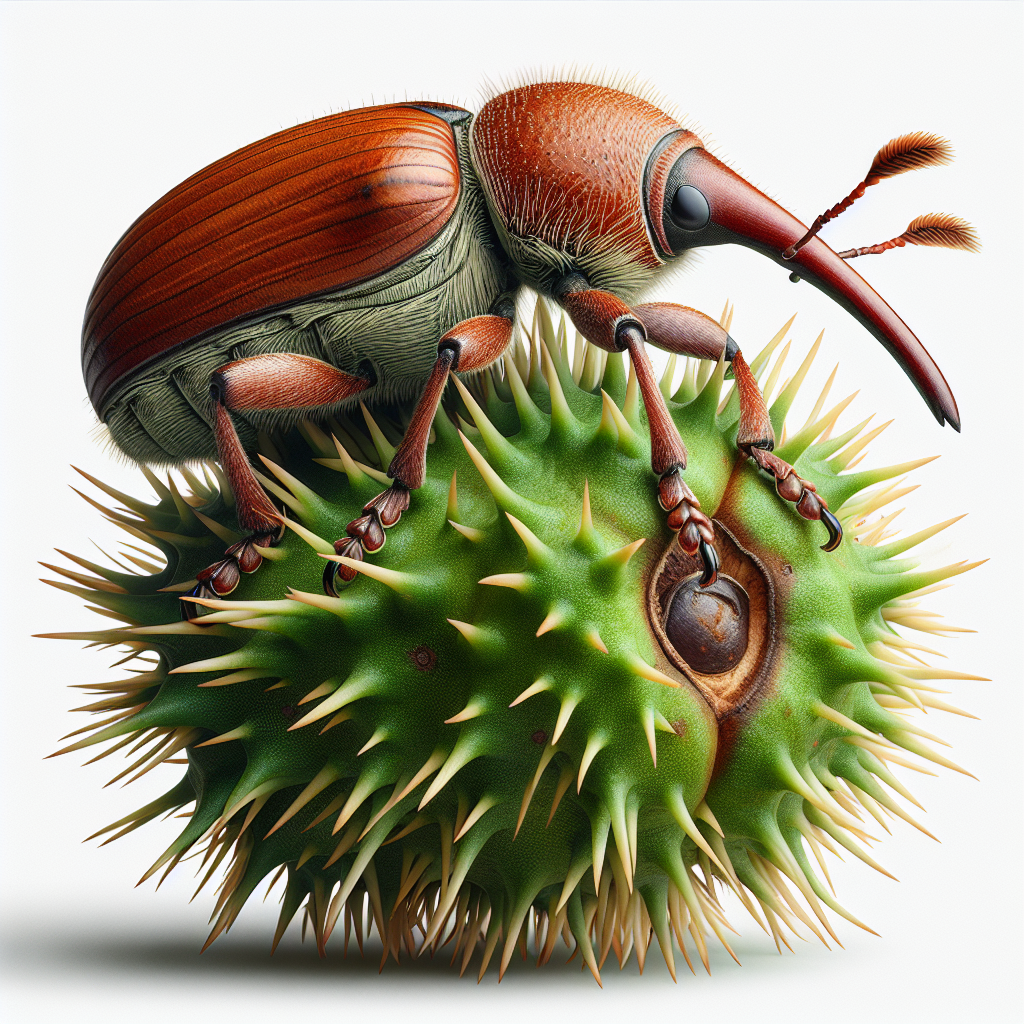
Introduction to Chestnut weevils
Chestnut weevils (Curculio spp., primarily the European chestnut weevil Curculio elephas and the lesser chestnut weevil Curculio caryatoides) represent one of the most devastating pests for chestnut growers worldwide. These snout-nosed beetles attack the developing nuts of chestnut trees, leading to kernel destruction and substantial economic losses. Native to Europe and Asia, they have spread to North America, threatening both wild and cultivated Chestnut orchards, including American and European hybrids like American Chestnut and Chestnut (Colossal).
Adult weevils are 5-8 mm long with elongated snouts, reddish-brown bodies, and distinctive curved antennae. Females use their snouts to chew holes in young burs and lay eggs inside nuts, where larvae develop and feed on the kernel. Infestation rates can exceed 50% in unmanaged orchards, reducing marketable yields and increasing post-harvest losses. Early detection and integrated management are crucial, as chemical controls are limited in organic systems. This guide provides professional-grade diagnostics, lifecycle insights, and organic strategies tailored for small to medium-scale chestnut producers. Learn how to protect your harvest while maintaining soil health and biodiversity, drawing from entomological research and field trials across Mediterranean and Appalachian growing regions.
Understanding chestnut weevils empowers growers to implement timely interventions, preserving nut quality for food, timber, and agroforestry systems. With climate change expanding their range, proactive strategies are more vital than ever.
Identifying Symptoms & Damage
Recognizing chestnut weevil damage early is key to minimizing losses. Adult feeding creates characteristic crescent-shaped notches on young leaves and burrs, often 1-2 mm wide, appearing in late spring to early summer. Look for these feeding scars on expanding burrs, which may ooze sap or show browning edges.
The hallmark sign is the egg-laying puncture: a neat, round hole (0.5-1 mm) in the husk or shell of developing nuts, typically clustered in groups of 2-5. Within 7-10 days, small white larvae (1-2 mm) hatch and bore into the kernel, producing reddish-brown frass (sawdust-like excrement) that accumulates at the entry hole. Heavily infested nuts turn black, shrivel, or drop prematurely, with internal galleries visible upon cutting.
Mature larvae (8-12 mm, legless, creamy white with brown heads) exit via a larger 'T-shaped' emergence hole (2-3 mm) on the nut's side, often after harvest. Infested nuts float in water due to hollowed kernels, a simple diagnostic test for grading. Secondary signs include sooty mold on burs from weevil excrement attracting fungi, and premature nut drop in August-September.
Differentiate from similar pests like nut weevils, Chestnut gall wasp, or Beetles by the snout beetle adults and specific T-exit holes. Use a 10x hand lens to confirm larvae inside nuts. Threshold: 5-10% burrs with feeding scars warrants action. Regular scouting from June saves yields.
Lifecycle and Progression of Chestnut weevils
Chestnut weevils are univoltine (one generation per year), with lifecycle synchronized to chestnut phenology. Adults overwinter in soil litter under trees, 10-30 cm deep in diapause cocoons. Emergence begins when soil temperatures reach 15-18°C (late May-June), coinciding with burr formation. Males emerge first, aggregate on trees, and call females via pheromones.
Feeding lasts 2-4 weeks, weakening trees and stimulating egg production. Gravid females lay 20-50 eggs singly or in batches inside soft nuts, sealing punctures with masticatory secretions. Eggs hatch in 5-10 days at 25°C. Larvae feed for 4-6 weeks, molting three times, consuming 70-90% of kernel tissue. Fully fed larvae drop to soil (September-October), burrow 10-20 cm, and form pupal cells.
Pupation occurs in spring (April-May), lasting 3-4 weeks before adults eclose. Total cycle: 10-12 months. Peak flight activity at dusk, monitored with pyramid traps baited with aggregation pheromones. Population dynamics favor humid, temperate climates; drought reduces larval survival. Understanding this progression enables precise timing for controls, such as trunk shaking during egg-lay (July).
Environmental Triggers & Risk Factors
Chestnut weevils thrive in mild winters (average >0°C) and warm, humid summers (20-28°C, 70-90% RH), common in USDA zones 5-8. Poor orchard sanitation—fallen nuts, leaf litter—harbors 80% of pupae, amplifying outbreaks. High tree density (>200 trees/ha) and susceptible varieties like European chestnuts increase risk over hybrids.
Soil type influences survival: loamy, well-drained soils retain pupae better than sandy. Nearby wild chestnut stands serve as reservoirs. Climate stressors like late frosts delay emergence, desynchronizing attacks, while excess nitrogen promotes lush burrs attractive to females. Irrigation mismanagement creates moist microclimates favoring oviposition.
Infestation history is predictive: fields with >20% loss prior year face 2-3x risk. Companion pests like aphids or mites weaken trees, indirectly boosting weevils. For more on hyper-local forecasting, see Why 80% of Small Farms Battle Weather Disasters - And How Hyper-Local AI Forecasts Can Save Your Harvest. Risk mapping via GIS identifies hotspots.
Organic Control & Treatment Plans
Organic management emphasizes cultural, biological, and mechanical tactics, avoiding broad-spectrum synthetics. Sanitation first: Collect and destroy fallen nuts weekly from August (hot water dip at 48°C for 20 min kills larvae). Flail mowing or burning litter disrupts pupae.
Trapping: Deploy 4-6 pyramid or bucket traps/ha baited with synthetic pheromones + ethanol (e.g., Biofen baits). Place under canopy June-July; remove adults weekly to mass-trap 70-90% populations. Trunk vibration (shakers) dislodges adults into collection sheets.
Biologicals: Encourage ground beetles (Carabidae) and ants via mulching; release Steinernema carpocapsae nematodes (10^9/ha soil drench, September) targeting pupae (80% mortality). Beauveria bassiana sprays on adults (LC50 at 10^7 spores/ml).
Barriers: Wrap trunks with burlap + tanglefoot bands August-October, catching 50% dropping larvae. Kaolin clay (Surround WP, 50 kg/ha) deters feeding/oviposition by 60-70%.
Treatment timeline:
- Scout weekly June.
- Trap/emerge bands pre-bloom.
- Nematodes post-harvest.
- Rotate with marigold understory for nematode enhancement. Integrated plans reduce populations 85% over 3 years. Monitor with nut dissection.
Preventing Chestnut weevils in the Future
Long-term prevention builds resilient orchards. Plant resistant hybrids like 'Marsol' or Chestnut (Bouche de Betizac), with 50% lower infestation. Space trees 8-10m, prune for airflow/sunlight, reducing humidity.
Soil tillage (20 cm depth, spring) exposes pupae to predators/desiccation (60% kill). Cover crops like clover suppress weeds without harboring pests. Annual hot liming (pH 6.5) deters pupation.
Scout grids (25 traps/ha) establish action thresholds. Quarantine infested areas; certify nursery stock. Biodiverse understories with yarrow and thyme boost parasitoids (Bracon hebetor, 30% larval kill). Post-harvest, solarize soil or flood (2 weeks) eliminates overwinterers.
Record-keeping tracks trends; rotate tactics to prevent resistance. For pest ID help, check Spring Pest Patrol: Organic AI Strategies to Shield Your Crops from Common Invaders. Resilient systems yield 2-3x longer.
Crops Most Affected by Chestnut weevils
Chestnut weevils primarily target Fagaceae family nuts. Primary host: Chestnut (Castanea spp.), including sweet chestnut (C. sativa), American chestnut (C. dentata), Chinese chestnut (C. mollissima), and hybrids. European varieties suffer 40-90% losses; Chinese more tolerant.
Secondary hosts: Oaks (Quercus spp.) like red oak, sustaining low-level populations. Rarely, beech (Fagus sylvatica) nuts. No impact on non-nut crops like apple, walnut, or pecan, distinguishing from broader nut weevils.
Global hotspots: Italy (90% commercial chestnuts infested), Turkey, US Appalachians. Small farms intercropping with hazelnut risk spillover. Focus protection on chestnut blocks.