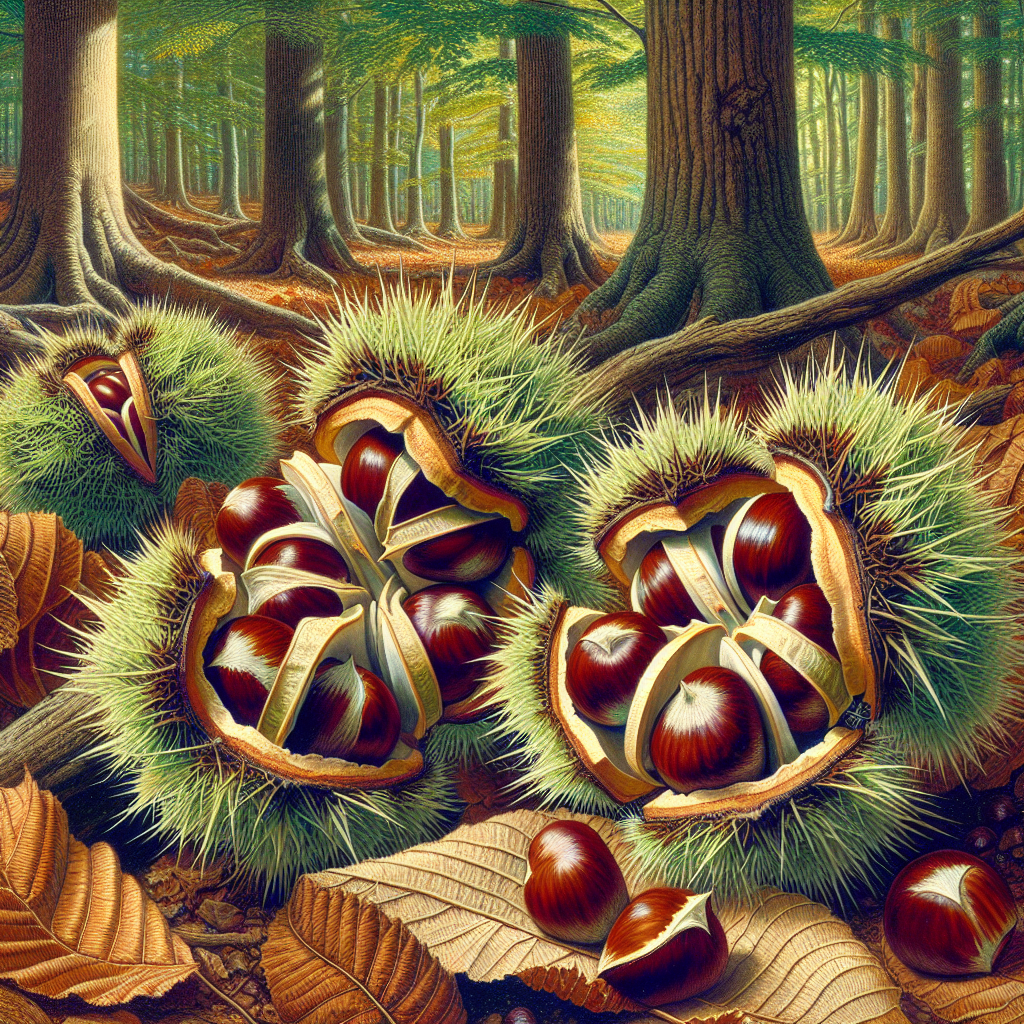
Introduction to American Chestnut
The American Chestnut (Castanea dentata) stands as a symbol of lost agricultural heritage, once comprising up to 25% of eastern U.S. hardwood forests and producing billions of pounds of nuts annually. These majestic trees, capable of reaching 100 feet tall with trunks up to 10 feet in diameter, provided food for wildlife and humans alike, with sweet, starchy nuts averaging 1-1.5 grams each in massive annual yields. Tragically, chestnut blight (Cryphonectria parasitica) introduced via Asian species in the late 1800s wiped out over 3 billion trees by 1950, reducing pure American Chestnuts to mere root sprouts that rarely fruit.
Modern revival efforts through breeding programs have produced blight-resistant hybrids, backcrosses (15/16 American genetics), and pure strains from surviving populations. Organizations like the American Chestnut Foundation (TACF) have released cultivars such as 'Clapper', 'Mahoney', and 'Abundance' that combine American traits with Chinese resistance. For growers, American Chestnuts offer high-value nuts (selling for $10-20/lb), durable rot-resistant wood, and ecosystem benefits like wildlife forage and carbon sequestration. This comprehensive guide equips agricultural professionals with proven techniques for propagation, cultivation, and management, focusing on hybrid and backcrossed varieties suitable for orchards, agroforestry, and small farms. Expect 10-20 year timelines to first harvests, with mature trees yielding 20-100 lbs of nuts annually per tree.
Botanical Profile of American Chestnut
American Chestnut belongs to the beech family (Fagaceae), distinguished by its serrated, lanceolate leaves (5-8 inches long) with coarse teeth and fuzzy undersides. Trees exhibit alternate branching with smooth, gray bark on young stems that develops characteristic deep, interconnected ridges on mature trunks. Monoecious flowers appear in catkins: long, yellow male catkins for pollen and short, red female styles clustered at bases, blooming in June-July.
Nuts develop in spiny burs (husk-like fruits) containing 2-3 shiny brown nuts each, ripening September-October. Roots form extensive lateral systems with deep taproots in well-drained soils, promoting drought tolerance once established. Blight-resistant hybrids like those from TACF breeding show intermediate morphology: American-sized nuts (larger than Chinese) with improved disease tolerance. Growth is rapid in youth (3-5 ft/year), slowing after 20 years. Pollinators include bees and wind; trees are mostly self-incompatible, requiring cross-pollination from compatible cultivars spaced 50-100 ft apart. For detailed chestnut cultivation insights, see the Chestnut (crop) wiki.
Soil, pH, and Climate Requirements for American Chestnut
American Chestnuts thrive in USDA zones 4-8, preferring cool temperate climates with 30-50 inches annual rainfall distributed evenly. Ideal temperatures range 32-85°F, with chilling hours (800-1200) essential for bud break. They tolerate -20°F winters but suffer in prolonged summer heat above 95°F or high humidity that exacerbates blight. Well-drained, loamy upland soils are optimal; avoid heavy clays or low-lying frost pockets prone to Phytophthora root rot.
Soil pH should be 4.5-6.5 (acidic), mimicking native forest floors rich in leaf litter. Test and amend with elemental sulfur if above 6.5, or lime cautiously for extremes below 4.5. Organic matter (5-8%) improves structure; incorporate composted leaves or pine bark. Chestnuts demand moderate fertility: nitrogen 50-100 lbs/acre/year via cover crops, avoiding high N that promotes succulent blight-susceptible growth. Full sun (6+ hours) is mandatory; partial shade reduces yields 30-50%. Site selection on south/west slopes enhances air drainage, minimizing frost and disease. For small farms, integrate into silvopasture systems with grazing animals excluded during nut drop. Hyper-local climate data can optimize planting—check resources like Why 80% of Small Farms Battle Weather Disasters - And How Hyper-Local AI Forecasts Can Save Your Harvest.
Step-by-Step Planting & Propagation
Seed Propagation (Stratification Method): Collect fresh nuts in fall, float-test for viability (sinkers only). Stratify in moist peat-sand (1:1) at 34-41°F for 90-120 days. Sow 1-2 inches deep in spring after frost, spacing 12 inches in nursery rows. Germination 70-90%; thin to 4-6 inches. Blight screening via TACF protocols recommended.
Grafted/Seedling Orchard Planting: Use 1-2 year bare-root or containerized blight-resistant stock (e.g., TACF backcrosses). Plant late winter/early spring, 20-30 ft apart (100-200 trees/acre). Dig holes 2x root width, 18 inches deep; incorporate mycorrhizal inoculant and 2-4 lbs compost/tree. Orient graft unions 2 inches above soil; stake if needed. Mulch 4-inch layer (woodchips) in 4-ft radius, excluding trunk.
Tissue Culture/Micropropagation: Advanced for elite clones; consult TACF for protocols yielding 95% success.
Pollination Blocks: Plant 10-20% pollinators (e.g., 'Eating', 'Revival') every 100 ft. Irrigate deeply (1 inch/week) first two years. Expect 80-90% survival with proper site prep.
Care & Maintenance regimes for American Chestnut
Irrigation: Drip systems delivering 20-30 gal/tree/week during establishment; taper after year 3. Deficit irrigation post-maturity enhances nut quality.
Fertilization: Soil test annually. Year 1-3: 1-2 oz 10-10-10 NPK/tree, increasing to 1 lb by year 5. Foliar micronutrients (Zn, Mn) if deficient. Legume cover crops (clover) supply N.
Pruning: Train central leader to 10-15 ft; remove basal sprouts, water sprouts annually winter. Thin canopy for light penetration, reducing blight risk.
Weed Control: Mulch perpetually; mow alleys. Pre-emergent herbicides (glyphosate spot-treat) year 1 only.
Monitoring: Annual blight scouting; hypovirus applications on cankers. Thin nuts if overloaded for size.
Pests, Diseases & Organic Management
Chestnut Blight (Cryphonectria parasitica): Primary killer; select hypovirulent strains via TACF. Remove cankers surgically; apply biocontrol pastes. Organic: copper sprays pre-bud break.
Phytophthora Root Rot: Improve drainage; phosphonate drenches. Resistant rootstocks essential.
Pests: Chestnut gall wasp, nut weevils—use kaolin clay barriers, BTK sprays. Leaf feeders controlled by neem oil. Deer fencing mandatory (8 ft high).
Integrated Management: Diverse understory, beneficial insects (yarrow). Scout weekly; thresholds: 5% cankers trigger action.
Harvesting, Curing & Optimal Storage
Harvest mid-September to October when burs split naturally. Rake or shake trees (mechanical shakers for orchards); separate nuts from burrs via rollers. Yield peaks years 15-30: 20-50 lbs/tree.
Curing: Spread 2-3 inches deep in ventilated sheds (50-60°F, 70% RH) 4-7 days until pellicle loosens. Dry to 10-12% moisture.
Storage: Cool (32-40°F), high humidity (80-90%); lasts 6-12 months. Vacuum-seal for 2+ years. Market fresh, roasted, or as flour ($15-25/lb).
Companion Planting for American Chestnut
Leverage polycultures for pest suppression and soil health. Underplant with hairy vetch for N-fixation, daffodils for nematodes deterrence. Nitrogen-fixers like pigeon pea (pigeon pea) boost growth 20%. Insectary strips of marigold and thyme attract predators against weevils. Avoid walnuts (allelopathic). Fallow with rye for blight suppression. For tailored strategies, explore Why Companion Planting Feels Like Guesswork for Small Farms - And How AI Makes It Foolproof. Agroforestry with apples (apple) enhances diversity.