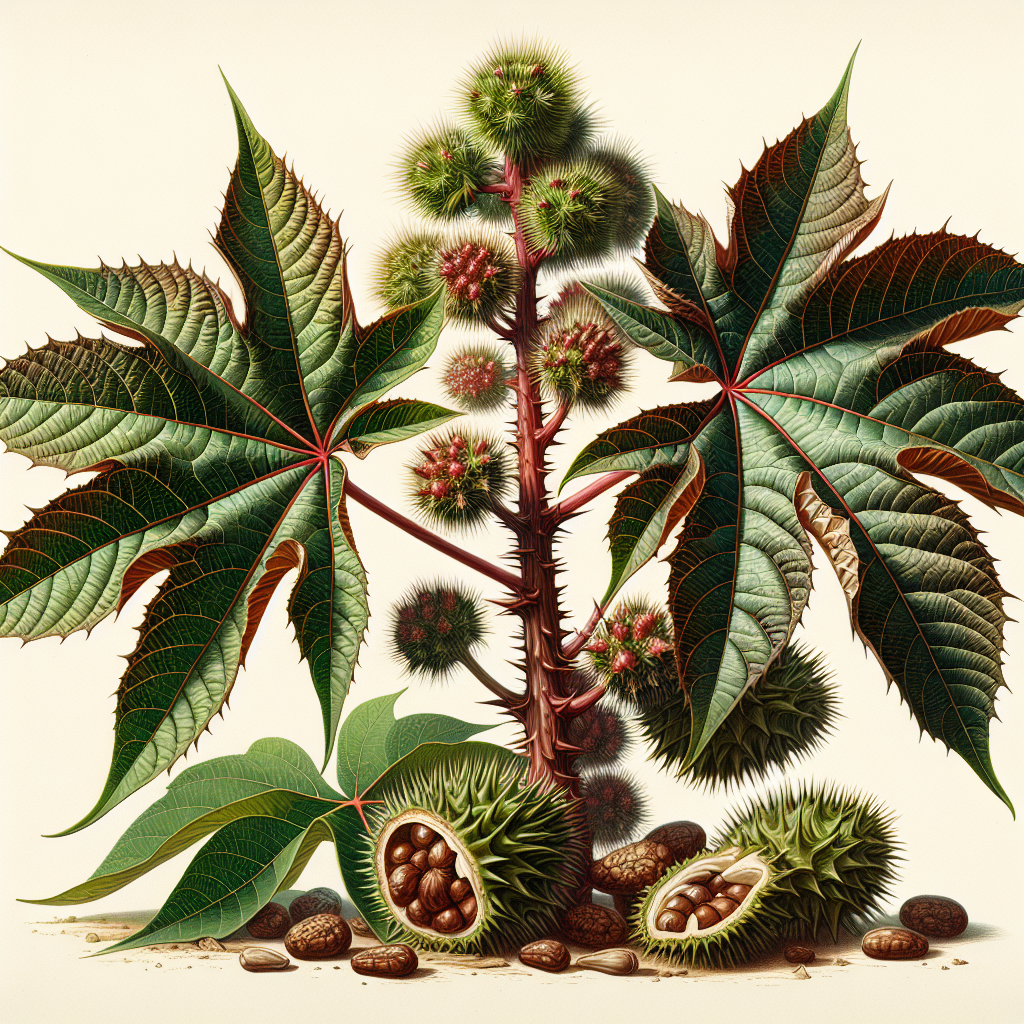
Introduction to castor beans
Castor beans refer to the seeds of Ricinus communis, a fast-growing, perennial plant native to tropical Africa but now widespread as a highly invasive weed across temperate and subtropical agricultural regions. Often mistaken for a beneficial oilseed crop due to its industrial uses in castor oil production, castor beans become a pernicious pest when they escape cultivation and overrun fields. This plant thrives in disturbed soils, rapidly forming dense stands that outcompete valuable crops, reduce yields, and complicate harvest operations with their large, spiny seed pods and toxic seeds containing ricin—a potent protein toxin hazardous to humans, livestock, and wildlife.
In agricultural contexts, castor bean infestations can lead to substantial economic losses, with reports of up to 50% yield reductions in affected soybeans and corn fields. The plant's resilience to drought, poor soils, and moderate herbicides makes it a challenging adversary for farmers. Early identification and intervention are critical, as mature plants produce thousands of seeds per individual, ensuring long-term persistence in the soil seedbank. This comprehensive guide equips growers with professional-grade diagnostics, lifecycle knowledge, and proven organic management plans to reclaim infested areas and safeguard future plantings. For more on integrated weed management, check out this insightful blog post on companion planting.
Identifying Symptoms & Damage
Diagnosing castor bean infestations requires keen observation of both above-ground and subtle below-ground indicators. The plant is unmistakable in its vegetative stage: large, palmate leaves (up to 1 meter across) with 5-11 deeply lobed, serrated edges, arranged alternately on stout, reddish stems that can reach 3-10 meters in height. Leaves emerge glossy green, often turning bronze or reddish in full sun, and exude a distinctive, unpleasant odor when crushed—a key diagnostic clue distinguishing it from similar weeds like giant ragweed.
Damage manifests progressively. Seedlings (cotyledons with first true leaves) compete early for soil moisture and nutrients, stunting nearby crop establishment. Vegetative growth shades out understory crops, reducing photosynthesis by up to 70% in wheat or sorghum stands. Inflorescences—large, cylindrical racemes up to 1 meter long—bear separate male (upper) and female (lower) flowers, with females developing into spiny, green-to-reddish capsules containing 2-6 glossy, mottled brown seeds (12-15 mm long, resembling ticks).
Harvest contamination is a primary economic impact: castor seeds mix with grain, lowering grade and market value while posing ricin risks during processing. Livestock grazing infested pastures suffer acute poisoning symptoms—abdominal pain, bloody diarrhea, dehydration—often fatal within 36-72 hours. Soil seedbanks persist 5-10 years, triggering recurrent outbreaks. Differentiate from look-alikes: castor leaves lack pubescence (unlike velvetleaf), and stems show maroon pigmentation. Scout fields post-rain or tillage, using quadrats (1m²) to quantify density >5 plants/m² warrants immediate action. Associated secondary issues include increased aphids and whiteflies harboring on castor, vectoring viruses to crops like tomato.
Lifecycle and Progression of castor beans
Ricinus communis exhibits a typical annual-to-perennial lifecycle adapted for explosive reproduction in warm climates. Germination occurs in 7-14 days at soil temperatures >18°C (65°F), with hypocotyls elongating rapidly to 30-50 cm. Seedlings develop true leaves by week 2, entering vegetative phase (2-4 months) where biomass accumulates exponentially, prioritizing height for light capture.
Flowering initiates 3-6 months post-emergence, with monoecious inflorescences producing 20-100 capsules per plant. Pollination is anemophilous (wind-aided), though insects boost efficiency. Capsules dehisce explosively 4-6 weeks post-fertilization, propelling seeds 2-5 meters—enhanced by ballistic dispersal. A single plant yields 1,000-5,000 seeds, with 40-60% viability persisting 3+ years buried <10 cm deep.
In frost-free zones, plants overwinter as perennials, resuming growth from woody crowns; elsewhere, they function as annuals, relying on seedbanks. Progression peaks mid-summer: vegetative dominance (June-July), reproductive surge (August-September), senescence (October). Multiple flushes possible under irrigation. Monitor using DD50 models (base 10°C): 1,500-2,000 degree-days to first capsule. Interrupt at pre-flower (BBCH 51-59) for maximal control efficacy. Synergies with root-knot nematodes exacerbate crop damage in rotations.
Environmental Triggers & Risk Factors
Castor beans exploit specific niches, proliferating where human activity creates openings. Primary triggers: soil disturbance via tillage, construction, or flooding exposes buried seeds, synchronizing mass germination. Warm, moist conditions (25-35°C, >500 mm annual rain) accelerate growth; drought tolerance (deep taproot to 2m) sustains via aquifers.
High-risk sites include field margins, roadsides, fencerows, and overgrazed pastures—seed sources for reinfestation. Poor crop competition (wide rows, delayed planting) favors invasion; nutrient-rich, neutral-pH loams (pH 6-7.5) optimize vigor. Climate change extends ranges northward, with models predicting 20-30% expansion by 2050 in marginal zones.
Rotation failures amplify risks: continuous cotton or sugarcane without cover crops leaves niches. Contaminated manure or equipment transports seeds >1 km. Monitor via remote sensing (NDVI drops >0.2 indicate shading). For predictive tools, integrate with weather data to forecast outbreaks.
Organic Control & Treatment Plans
Organic management demands integrated, multi-tactic approaches prioritizing prevention and mechanical disruption. Cultural: Mow or graze pre-flower (BBCH <49) repeatedly to exhaust seed reserves; flame weeding (propane torches) sears seedlings effectively (>90% kill). Mechanical: Hand-pull isolated plants (wear gloves—ricin hazard), ensuring taproot removal; deep tillage (30+ cm) buries seeds beyond germination depth, though combine with mulching.
Biological: Encourage natural enemies like beetles or goats (selective browsers). Cover crops (clover, hairy vetch) suppress via allelopathy and shading. Solarization (clear plastic, 6-8 weeks summer) heats soil to 50°C, killing 95% seeds. Organic herbicides: Vinegar (20% acetic) + clove oil burndown foliar growth; repeated applications (q14d) until senescence.
IPM Plan: 1) Scout weekly; 2) Threshold: 1 plant/100m²; 3) Escalate: Mow → Flame → Pull; 4) Post-control: Seed 3-yr rotation with suppressants. Avoid composting debris (viable seeds persist). Monitor efficacy via regrowth counts. Success rates: 85-95% first year, 70% sustained with vigilance. Synergize with marigold borders for nematode control.
Preventing castor beans in the Future
Long-term prevention hinges on seedbank depletion and barrier strategies. Clean equipment/machinery pre-field entry (high-pressure wash); source certified seed/manure. Establish 2-3m vegetative buffers (perennials like thyme or yarrow) along perimeters to intercept dispersants.
Crop competitively: narrow rows, high seeding rates, early planting. Rotate with allelopathic species (black pepper, sorghum-Sudan hybrids). Soil testing guides amendments reducing fertility niches. Annual monitoring grids track density declines. Community action: coordinate neighborhood control to eliminate source populations. Policy: Report infestations to extension services for quarantine. Projected ROI: 5:1 yield recovery Year 2. Integrate predictive scouting apps for hyper-local alerts.
Crops Most Affected by castor beans
Castor beans devastate row crops and orchards via shading, allelopathy, and contamination. Top victims: soybeans (40-60% yield loss from shading/nutrient steal); corn (ear contamination, corn earworm vectoring); cotton (capsule interference); sugarcane (marginal invasion). Grains like wheat, rice, sorghum suffer pre-harvest mixing. Vegetables (tomato, potato, onion) face seedling suppression. Perennials (mango, avocado) host secondary mites. Pastures contaminated poison livestock. Global incidence highest in tropics; U.S. Southwest/Midwest hotspots.