Introduction to Apricot
The apricot weevil, scientifically known as Otiorhynchus cribricollis, represents one of the most insidious threats to apricot orchards worldwide. Unlike more visible pests like aphids or caterpillars, this flightless, nocturnal beetle operates primarily underground, targeting roots and emerging to damage developing fruits. Native to the Mediterranean region, it has spread to major stone fruit growing areas in Europe, North America, and Asia, where it can reduce yields by up to 50% in severe infestations. Apricot growers often overlook early signs, mistaking damage for nutritional deficiencies or root rot. This definitive guide equips professional growers and small farm operators with diagnostic tools, lifecycle knowledge, and organic management plans to combat this pest effectively. By integrating cultural, biological, and targeted organic controls, you can safeguard your apricot harvest while maintaining sustainable practices. For small farms struggling with pest identification, check out Why Misidentifying Plants Costs Small Farms Thousands - And How AI Camera Diagnosis Fixes It Fast to streamline your diagnostics.
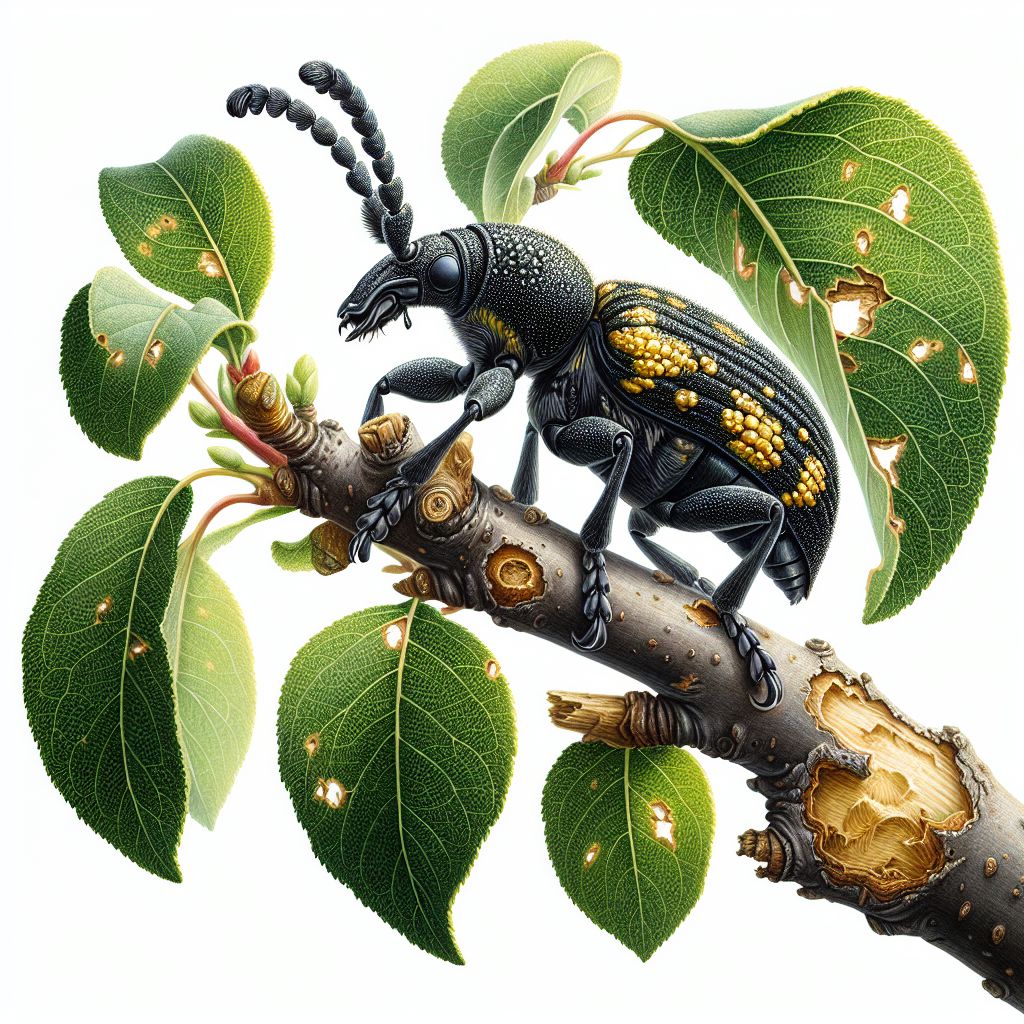
Understanding the apricot weevil's biology is crucial for timely intervention. Adults are 5-8 mm long, shiny black or dark brown with distinctive leg markings, active at night and hiding in soil or under debris during the day. Larvae, the primary damage agents, are white, legless grubs up to 10 mm long that feed voraciously on fine roots, girdling larger ones and causing tree decline. In apricot orchards, economic thresholds are reached when 10-20% of fruits show larval entry holes or when soil sampling reveals more than 5 grubs per square meter. This pest's parthenogenetic reproduction—females lay unfertilized eggs that develop into females—allows rapid population explosions without males. Global warming exacerbates spread, with warmer soils accelerating larval development. Successful management hinges on disrupting this cycle through integrated approaches, avoiding broad-spectrum chemicals that harm beneficial soil organisms. Apricot weevil infestations often coincide with spider mites or scale insects, compounding damage, so holistic monitoring is essential.
Identifying Symptoms & Damage
Accurate diagnosis begins with recognizing subtle above-ground signs that betray underground devastation. Adult feeding produces characteristic notching on leaves and bark, especially on young shoots, visible in early spring. Fruits exhibit small, ragged holes (1-2 mm) where females chew oviposition sites, often accompanied by gum-like frass. Internally, larvae tunnel through flesh to the pit, rendering fruits unmarketable and promoting secondary anthracnose infections. Severely infested trees show stunted growth, yellowing foliage, sparse canopy, and premature leaf drop, mimicking phytophthora root rot. Soil disturbances around tree bases reveal adult beetles at dusk, confirmed by their inability to fly.
Root damage is diagnostic: excavate around affected trees to find girdled taproots and fibrous roots devoured by C-shaped larvae. In advanced cases, trees lean or topple due to structural weakness. Differentiate from cutworms by larval size and lack of nocturnal surface activity; apricot weevil grubs remain subsurface. Use a Berlese funnel for soil extraction to quantify populations. Economic damage thresholds: 5% fruit infestation warrants action. Visual scouting at night with a headlamp, combined with shake sheets under trees, yields reliable counts. Sticky traps baited with pheromone lures detect adults early. Symptoms peak from April to July in temperate zones, aligning with fruit set. Companion symptoms include wilting during dry spells, as damaged roots impair water uptake. For stone fruits like cherry, similar damage patterns occur, but apricot weevil prefers apricots due to thinner skins.
Lifecycle and Progression of Apricot
The apricot weevil completes one generation annually, with lifecycle tightly synced to host phenology. Overwintering adults emerge in early spring (March-April) when soil temperatures exceed 10°C, feeding on buds and laying 200-500 eggs per female directly into fruitlets or soil. Eggs hatch in 7-14 days into first-instar larvae, which bore into fruits or roots, molting four times over 4-6 weeks. Mature larvae drop to soil, forming pupal cells 10-20 cm deep, pupating in summer (June-July). New adults eclose by late summer but remain quiescent until the next spring. Total cycle: 12-18 months, influenced by soil moisture and temperature.
Progression stages: Egg (1-2 weeks, 1 mm, translucent); Larva (4-6 weeks, progressive instars to 12 mm); Pupa (2-3 weeks, exoskeleton forming); Adult (3-8 mm, long-lived 1-2 years). Peak damage occurs during larval fruit infestation (May-June), with root feeding continuing into fall. Parthenogenesis ensures 100% female offspring, amplifying outbreaks. In cooler climates, development extends, allowing two partial generations. Monitoring soil temperature with probes predicts emergence: adults active above 12°C. Disrupt progression by targeting eggs with organic barriers or larvae with entomopathogenic nematodes.
Environmental Triggers & Risk Factors
Infestations surge under specific conditions favoring weevil survival and reproduction. Heavy, clay-loam soils retain moisture essential for egg hatch and larval survival, while poor drainage exacerbates root susceptibility. Warm, mild winters (above -5°C) boost overwintering adult survival rates to 80%. Proximity to wild Prunus species or neglected orchards serves as reservoirs. Over-fertilization with nitrogen promotes lush growth attractive to adults. Drought stress weakens trees, making roots prime targets. Weeds like dandelions provide adult cover, increasing populations 3-fold.
Risk factors include new plantings from infested nurseries (soil-borne larvae), mechanical injury exposing roots, and mulch layers insulating pupae. Climate change extends active periods, with models predicting 20% range expansion by 2050. High-risk zones: Mediterranean basins, California Central Valley, Pacific Northwest. Assess risk via soil sampling pre-planting; history of termites or root-knot nematodes indicates vulnerability. Companion pests like ants farm weevils indirectly by protecting them from predators.
Organic Control & Treatment Plans
Organic management emphasizes prevention and biological disruption. Cultural Controls: Deep plowing in fall exposes pupae to predators and desiccation, reducing populations 70%. Solarization with clear plastic (60-70°C for 4-6 weeks pre-planting) kills eggs/larvae. Biological Agents: Apply Heterorhabditis bacteriophora nematodes (500,000/m²) in evenings during larval stages; efficacy >85%. Predatory rove beetles (Dalotia coriaria) and ground beetles (Pterostichus spp.) naturally suppress adults. Organic Sprays: Neem oil (2% azadirachtin) or spinosad (OMRI-listed) targets adults at dusk; rotate to prevent resistance. Kaolin clay barriers deter oviposition.
Treatment Timeline: Scout weekly from bloom; apply nematodes at first fruit damage; clay sprays post-petal fall. Integrated Plan: 1) Fall tillage + cover crops (mustard for biofumigation). 2) Spring monitoring + neem. 3) Larval stage nematodes. 4) Bootstrap predators via beetle banks. Yields recover 40% in year one, 90% by year three. Avoid tilling near harvest to preserve soil structure. For broader pest patrols, see Spring Pest Patrol: Organic AI Strategies to Shield Your Crops from Common Invaders. Test soil post-treatment for residuals.
Preventing Apricot in the Future
Long-term prevention builds resilient orchards. Select resistant rootstocks like 'GF677' or 'Ishtara', which tolerate larval feeding. Quarantine nursery stock; hot-water treat bare-root trees (48°C/30 min). Maintain orchard sanitation: remove fallen fruits daily to starve larvae. Mulch with coarse materials (3-5 cm) excluding weevil habitats. Introduce companion plants like marigold for nematode synergy and thyme as adult repellents. Promote biodiversity with hedgerows hosting predatory birds and insects. Annual soil sampling (Berlese method) establishes baselines; intervene below 2 grubs/m².
Rotate with non-hosts like garlic every 4 years. Monitor via pheromone traps (10/ha). Drip irrigation avoids waterlogging. Prune for airflow, reducing humidity for egg survival. Certified organic farms report 95% control via these IPM stacks. Educate workers on night scouting. Climate-adaptive prevention: shade cloth in heatwaves to stress weevils.
Crops Most Affected by Apricot
Apricot weevil primarily targets stone fruits: apricots (primary host), peach, plum, cherry, and almond. Secondary hosts include apple, pear, and ornamentals like cotoneaster. In mixed orchards, apricots suffer 80% damage, peaches 50%, plums 30%. Avoid interplanting with strawberry or raspberry, which amplify populations. Focus prevention on Prunus spp. for maximal ROI.