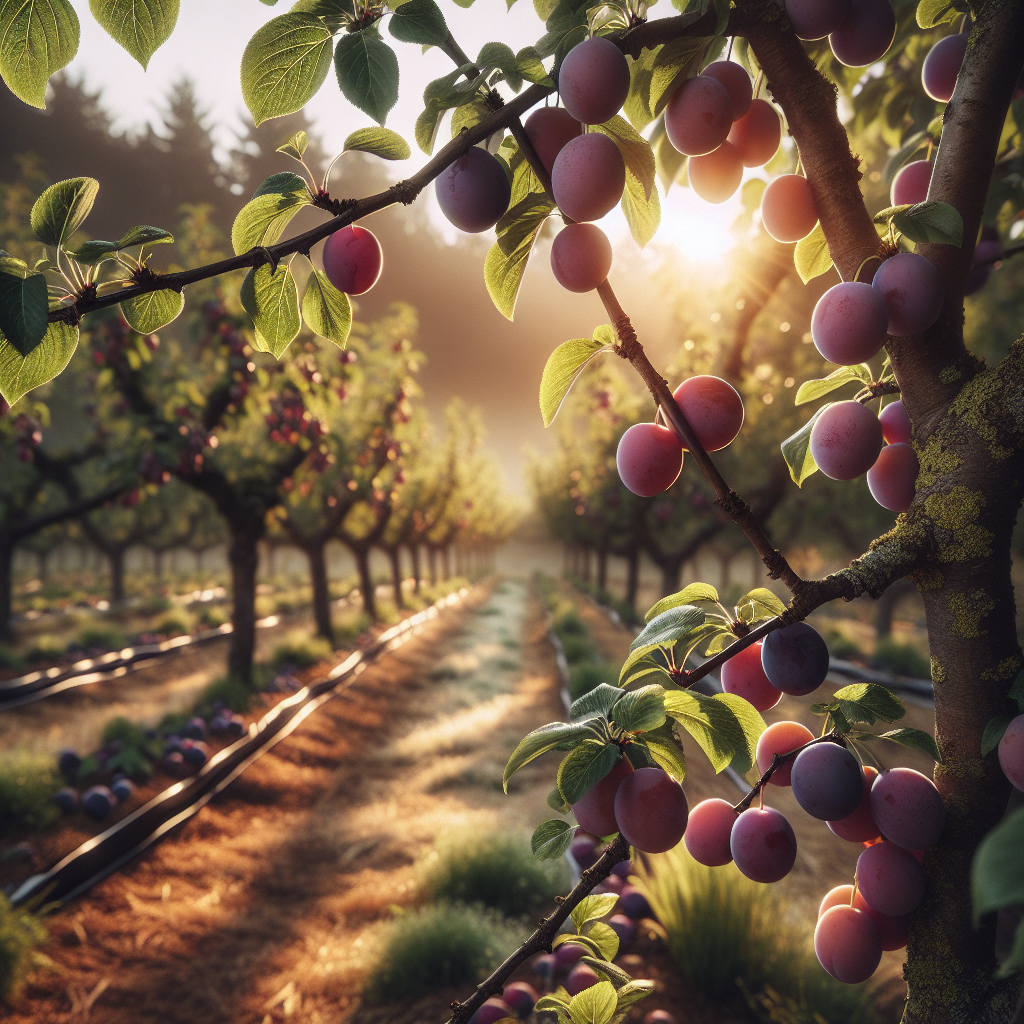
Introduction to Plum
Plum is one of the most adaptable and rewarding tree fruits for home orchards and commercial plantings in temperate regions. The name covers several cultivated species, but most production centers on European plum (Prunus domestica), Japanese plum (Prunus salicina and related hybrids), and a range of interspecific plums developed for improved flavor, color, disease resistance, and harvest timing. European plums are often preferred for drying, cooking, and late-season fresh use because of their firmer flesh and higher soluble solids, while Japanese plums are typically juicier, more aromatic, and outstanding for fresh markets.
Plums have a long cultivation history stretching from Eurasia into modern orchard systems worldwide. European types likely trace part of their origin to the Caucasus and regions near the Caspian, while Japanese plums were domesticated in China and later improved in Japan before spreading globally. This dual heritage explains why plum culture is not one-size-fits-all: some cultivars demand substantial winter chill, some bloom very early and are frost-prone, and others perform better in warmer temperate zones.
For growers, the core challenge is balancing vigor, fruit set, and tree health. A plum tree that grows too vegetatively becomes shaded, disease-prone, and unproductive; one pushed too hard into cropping can produce small fruit, broken limbs, and biennial bearing. Good plum culture therefore means choosing the right rootstock and cultivar, planting into well-drained soil, irrigating with precision, pruning for an open and illuminated canopy, and thinning heavily enough to protect fruit quality.
If you also grow related stone fruits, compare pollination and pruning habits with Peach. For broader ecological planning, review companion planting strategies.
Botanical Profile of Plum
Plum belongs to the genus Prunus in the Rosaceae family, placing it alongside peach, cherry, apricot, and almond. It is a deciduous tree that typically ranges from 3 to 8 meters tall depending on cultivar, rootstock, training system, and pruning intensity. In traditional standard form, trees can become quite large, but modern orchard systems often use semi-dwarfing rootstocks and annual canopy management to maintain a productive height of 2.5 to 4.5 meters.
Leaves are alternate, simple, and finely serrated, generally oval to lanceolate. Flowers appear in spring before or alongside leaf emergence, usually white, sometimes tinged with pink in bud. European plum commonly bears flowers in clusters of one to three from short spurs, while Japanese plum may flower more heavily and earlier, making it especially vulnerable to spring frost injury.
Fruit is a drupe, meaning it has a fleshy outer layer surrounding a hard pit. Skin color ranges from greenish yellow and amber to red, purple, blue-black, or mottled combinations. Flesh may be yellow, green, amber, red, or deep burgundy. A dusty, waxy bloom on ripe fruit is natural and desirable; it helps reduce moisture loss and signals minimal handling.
Botanically and horticulturally, plums differ in bearing habit. European plums often fruit heavily on older spurs that remain productive for several years. Japanese plums bear on one-year wood as well as short-lived spurs, so pruning strategy must preserve enough young fruiting wood without creating excessive density. This is one reason Japanese cultivars usually need more active annual structural pruning than European types.
Many plums are not fully self-fertile. European plums include some self-fruitful cultivars, but Japanese plums often require compatible pollinizers with overlapping bloom periods. Inadequate pollination causes sparse fruit set, misshapen fruit, or premature fruit drop even when trees appear healthy. Honeybees and wild pollinators are essential during bloom, and cool, rainy weather can sharply reduce bee activity during the brief pollination window.
Soil, pH, and Climate Requirements for Plum
Plums perform best in deep, fertile, well-drained loam or sandy loam with moderate water-holding capacity. Ideal topsoil depth is at least 60 to 90 cm, with unrestricted rooting deeper if possible. They dislike waterlogged soils and often decline in compacted ground where oxygen is limited around the root zone. If water stands for more than 24 hours after heavy rain, the site is risky unless drainage is improved.
The optimal soil pH is generally 6.0 to 6.8, though plums can tolerate about 5.8 to 7.2 if nutrition is carefully managed. Below pH 5.5, aluminum and manganese toxicity can impair root growth and reduce calcium and magnesium availability. Above pH 7.3, iron, zinc, and manganese deficiencies become more common, especially on calcareous soils, leading to chlorosis, weak shoots, and reduced fruit size.
Before planting, conduct a full soil test for pH, organic matter, phosphorus, potassium, calcium, magnesium, cation exchange capacity, and salinity. Organic matter around 3% to 5% is excellent for orchard establishment. In very light soils with under 2% organic matter, moisture fluctuation becomes more severe, and young plum trees may suffer intermittent drought stress even when irrigation seems adequate.
Climate needs vary by species group. European plums usually need higher winter chill, commonly 700 to 1,200 chill hours below 7.2°C, depending on cultivar. Japanese plums often require roughly 250 to 800 chill hours, making them better suited to milder winter regions. However, Japanese types also tend to bloom earlier, which increases frost risk. Flower buds can be injured around -2°C to -3°C depending on developmental stage, and open blossoms may be damaged even by short frosts.
The best growing climates for plum are temperate regions with cold winters sufficient for dormancy, mild springs, warm summers, and low to moderate humidity during ripening. High rainfall near harvest can cause fruit cracking, dilution of sugars, and increased brown rot. Summer temperatures of 24 to 32°C support good fruit development, but prolonged heat above 35°C can cause sunburn, softening, and reduced color in some cultivars unless canopy cover is adequate.
Air drainage matters as much as soil drainage. Avoid frost pockets at the bottom of slopes where cold air settles. A gentle slope with good air movement often outperforms a flat, fertile site that suffers recurrent bloom frost. Wind protection is useful, but dense barriers too close to the orchard can suppress airflow and increase frost risk or disease pressure.
Step-by-Step Planting & Propagation
Begin with named, disease-free nursery stock from a reputable source. One-year feathered trees or well-branched maiden whips are usually best. Choose a rootstock adapted to your soil and target tree size. In heavier soils, select rootstocks known for tolerance to wet feet only if drainage is moderate, not severe; no plum rootstock truly thrives in chronically saturated conditions.
Plant during dormancy, typically late winter to early spring in cold regions, or in late autumn through winter where soils do not freeze hard. Bare-root trees establish better than container trees when planted correctly because roots spread naturally and avoid circling.
- Prepare the site several months ahead if possible. Remove perennial weeds in a 1 to 1.5 meter diameter around each planting spot. Deep till only if compaction exists; avoid creating a smeared planting basin in wet soils.
- Incorporate compost only if soil is very poor, and do so broadly across the future root zone rather than filling the planting hole with rich material. Excess amendment in the hole can discourage outward root growth.
- Dig a hole wide enough to spread roots without bending, usually 60 to 75 cm wide and only as deep as the root system. Planting too deep is a common cause of decline.
- Identify the graft union and keep it 5 to 10 cm above the final soil line to prevent scion rooting.
- Backfill with native soil, firm gently, and water thoroughly to remove air pockets.
- Head the tree after planting if needed to balance root loss and establish scaffold height. Open-center systems often head at 60 to 80 cm; central leader systems slightly higher.
- Apply mulch 5 to 8 cm deep over the root zone, keeping it 10 to 15 cm away from the trunk to avoid collar rot and rodent damage.
Spacing depends on vigor and training. Standard trees may need 5 to 7 meters between trees; semi-dwarf systems often use 3.5 to 5 meters; intensive systems may go tighter with precise pruning and support. Rows should be spaced for machinery, sunlight penetration, and airflow.
Plum propagation is usually by budding or grafting onto rootstocks. T-budding in summer and whip-and-tongue grafting in late winter are common nursery techniques. Seed propagation is generally unsuitable for commercial production because seedlings are variable and may have poor fruit quality or delayed bearing. Hardwood cuttings root inconsistently for most plum cultivars and are not the standard method.
When planning pollination, plant compatible cultivars within 15 to 30 meters of each other, closer if bee activity is unreliable. Check bloom overlap, because two cultivars that are both “mid-season” in catalogs may still mismatch in your local climate.
Care & Maintenance regimes for Plum
Water management is one of the most critical factors in plum production. Young trees need consistent moisture in the top 30 to 45 cm of soil while roots establish. A useful target is to keep soil moist but never saturated, roughly 60% to 80% of field capacity in the active root zone. In practice, the soil should form a weak ball when squeezed by hand at 15 to 20 cm depth but should not ooze water or feel sticky and anaerobic.
For newly planted trees, provide deep irrigation once or twice weekly depending on soil texture and weather. Sandy soils may need 15 to 25 liters per tree every 2 to 3 days during warm spells; loams may need 20 to 40 liters once or twice weekly; clay loams need slower, less frequent irrigation. Mature trees generally need the equivalent of 25 to 40 mm of water per week during active growth, increasing during fruit swell and decreasing slightly as harvest approaches to reduce cracking in susceptible cultivars.
Signs of underwatering include dull leaves, midday wilting that persists into evening, small fruit, excessive fruit drop, and hard dry soil 15 cm below the surface. Signs of overwatering include yellowing leaves, soft lush growth, sour-smelling soil, algae or moss near emitters, dieback of young shoots, and fruit with poor sugar accumulation. Chronic excess moisture predisposes trees to root rot and can severely reduce longevity.
Nutrition should be based on annual leaf analysis and soil testing rather than guesswork. Young trees need moderate nitrogen to build framework, but overapplication creates long, soft shoots highly attractive to aphids and more susceptible to bacterial diseases. As a rough starting point, many growers apply modest nitrogen in early spring after establishment, then adjust according to shoot growth. Healthy non-bearing young plum trees often target 45 to 60 cm of annual extension growth; bearing trees commonly perform well with 25 to 40 cm, depending on cultivar and vigor.
Phosphorus is mainly important at establishment where soil tests are low, while potassium is essential for fruit size, sugar movement, color, and stress tolerance. Calcium supports fruit firmness and cell wall integrity, though foliar calcium response is generally less dramatic in plums than in apples. Zinc and boron deficiencies can impair bloom and fruit set; these are common where pH is high or soils are cold in spring.
Pruning style depends on plum type. Japanese plums are usually trained to an open vase with 3 to 5 main scaffolds to improve light penetration and reduce disease pressure. European plums may be trained to open center or central leader depending on system. Remove crowded, crossing, shaded, and overly upright branches. The goal is to maintain a canopy where sunlight reaches all fruiting wood for at least part of the day; shaded interiors produce weak spurs and bland fruit.
Winter pruning shapes structure, but summer pruning is often valuable for controlling excessive vigor and improving light. Avoid severe winter heading cuts on vigorous trees, as this can provoke watersprouts. Fruiting wood should be renewed gradually so the tree carries a balance of young shoots and productive spurs.
Fruit thinning is essential, especially for Japanese plums. Thin when fruit reaches about 1.5 to 2.5 cm diameter, ideally leaving 5 to 10 cm between fruits on a branch, depending on cultivar and branch strength. If clusters remain overloaded, fruits stay small, limbs split, and the tree may bear poorly the following year. Early thinning also improves color and reduces brown rot spread among touching fruits.
Keep the orchard floor weed-free in at least a 1-meter strip along the tree row for the first few years. Grass competition can significantly reduce establishment. Mulch helps conserve moisture and moderate soil temperature, but avoid piling organic material against the trunk.
Pests, Diseases & Organic Management
Plums face a range of insect and disease issues that vary by region. Common insect pests include aphids, scale insects, plum curculio, oriental fruit moth, borers, mites, and stink bugs. aphids distort young leaves and excrete honeydew that supports sooty mold. Heavy infestations often signal excessive nitrogen or poor biological balance. Strong water sprays, conservation of lady beetles and lacewings, and targeted insecticidal soap can suppress them if applied thoroughly to leaf undersides.
plum curculio is a major pest in many regions, especially after petal fall. Adults scar fruit for egg laying, causing crescent-shaped marks and premature drop. Organic management relies on sanitation, monitoring, perimeter awareness near woods, and well-timed applications of approved materials such as kaolin clay where permitted and effective. Fallen fruit should be collected and destroyed promptly to break the life cycle.
borers attack weakened trunks and scaffold crotches, especially when trees are stressed by sunburn, drought, or mechanical injury. White trunk paint diluted with water 1:1 can reduce southwest injury and lower borer attraction in young trees. Keep trunks clear of weeds and mulch contact.
Key diseases include brown rot, black knot, bacterial canker, bacterial spot, leaf curl in some regions, shot hole, rust, and root rots. brown rot is particularly destructive during bloom and pre-harvest periods, causing blossom blight, twig dieback, and fruit rot. Good airflow, annual pruning, removal of mummified fruit, and avoiding overhead irrigation are foundational controls. Any infected fruit left hanging becomes a major inoculum source.
black knot causes hard black swellings on shoots and branches, especially on susceptible cultivars and wild Prunus nearby. Prune out knots at least 15 to 20 cm below visible symptoms during dormancy and destroy prunings. Do not compost heavily infected wood unless the composting system reaches reliably lethal temperatures.
bacterial canker is favored by tree stress, frost injury, excessive nitrogen, and pruning in wet cool conditions. Symptoms include gumming, dead buds, cankers on limbs, and sudden dieback. Preventive management is more effective than cure: maintain balanced vigor, avoid winter trunk injury, and prune during dry weather when disease pressure is lower.
Organic disease management for plum depends on integration rather than single-product solutions. Core practices include resistant cultivars where available, excellent sanitation, open canopies, clean pruning cuts, moderate fertility, drip irrigation, and regular scouting from bloom through harvest. Dormant-season copper or lime sulfur may be useful in some systems, but their fit depends on climate, target disease, and certification rules. Always confirm local regulations, crop safety, and timing because stone fruits can be sensitive to poorly timed sprays.
Harvesting, Curing & Optimal Storage
Plum harvest timing has a major effect on flavor. Unlike some fruits, plums can continue to soften after picking, but sugar accumulation is best when fruit is harvested close to mature ripeness. Commercial maturity indicators include background color change, cultivar-specific skin color, ease of separation from the stem, flesh firmness, soluble solids, and taste. For fresh local sales, fruit can be picked at near-tree-ripe stage; for shipping, harvest slightly firmer.
European plums for drying are often left longer on the tree to concentrate sugars. Japanese plums intended for wholesale channels are usually harvested in multiple passes because fruit does not ripen uniformly across the canopy. Pick gently to preserve the natural wax bloom, which helps market quality and storage life.
Avoid harvesting when fruit is wet from rain or dew, as this increases the spread of decay organisms and bruising. Use shallow picking containers and cool the fruit quickly. Field heat removal is important; plums hold best when precooled soon after harvest to 0 to 2°C with high relative humidity around 90% to 95%.
There is no true curing stage for plums in the way there is for onions or sweet potatoes, but postharvest conditioning matters. Sort out bruised, split, bird-pecked, or diseased fruit immediately. Even a few rotting plums can accelerate losses in packed crates. Most fresh plums store for 2 to 5 weeks depending on cultivar, maturity at harvest, and temperature control. Firmer European cultivars generally store longer than very soft Japanese types.
At room temperature, ripe plums may last only 2 to 5 days. In cold storage, maintain consistent temperature and humidity; fluctuations encourage condensation and decay. Very long storage can lead to internal breakdown, mealiness, or loss of aroma. For home preservation, plums are excellent for jam, dehydration, freezing, chutney, and fermentation. Drying requires fully mature fruit with high sugar content; split or halve if needed for even dehydration.
Companion Planting for Plum
Companion planting around plum trees should support pollination, beneficial insects, soil stability, and weed suppression without creating excessive competition at the trunk. The most effective companions are usually low-growing flowering plants and dynamic orchard-floor species rather than tall aggressive crops.
Good choices include alyssum, yarrow, dill, fennel grown at a distance, chives, clover in managed strips, phacelia, calendula, and native pollinator flowers that bloom before, during, and after plum flowering. These plants attract hoverflies, lacewings, parasitic wasps, and bees, which help with aphid suppression and pollination support. Chives and garlic relatives are often used near stone fruit for their compact habit and possible pest-deterrent value, though they should not be seen as a standalone control.
Use caution with vigorous groundcovers. Anything planted within 30 to 60 cm of a young trunk can compete strongly for water and nitrogen. In the first 2 to 3 years, maintain a mostly clean tree ring, then expand into a managed understory once the tree is established. Clover can provide nitrogen and improve soil biology, but if allowed to grow too densely right against young trees it can also increase vole habitat and moisture competition.
Avoid companion species that shade the lower canopy, harbor shared pests, or demand heavy irrigation. Dense vegetable plantings under plum trees often create humidity and impede orchard operations. Instead, think in layers: a mulch or clean ring close to the trunk, a flowering insectary strip beyond that, and mowed alleyways for access.
A well-designed plum orchard understory improves resilience by supporting pollinators during bloom, predatory insects through summer, and soil structure over time. The best companions are not those that simply coexist, but those that fit the tree's water needs, preserve airflow, and enhance biological balance without sacrificing fruit quality.