Introduction to rubber
Rubber (Hevea brasiliensis) is one of the most economically vital crops in tropical agriculture, primarily grown for its milky latex used in tire manufacturing, medical gloves, and countless industrial products. Native to the Amazon rainforest, it has become a cornerstone of economies in Southeast Asia, Africa, and Latin America, with global production exceeding 14 million tons annually. However, rubber plantations are highly susceptible to a range of pests, diseases, and environmental stresses that can lead to significant yield losses, sometimes up to 50% if unmanaged. Effective diagnosis and management are crucial for sustainable production, especially as climate change intensifies vulnerabilities. This definitive guide equips farmers, agronomists, and plantation managers with professional-grade strategies to combat rubber pests and diseases organically, ensuring long-term profitability and ecosystem health. For small-scale growers diversifying into high-value crops, integrating rubber requires vigilant pest monitoring—check out Spring Pest Patrol: Organic AI Strategies to Shield Your Crops from Common Invaders for cutting-edge tips.
Understanding rubber's biology is key: it's a perennial tree reaching 20-30 meters, tapped for latex every 2-3 days after 5-7 years of maturity. Pests like leaf-feeding caterpillars and diseases such as Phytophthora target leaves, bark, and roots, disrupting latex flow and tree vigor. Early intervention through scouting and organic controls can prevent outbreaks, preserving panel quality and tree lifespan (25-30 years).
Identifying Symptoms & Damage
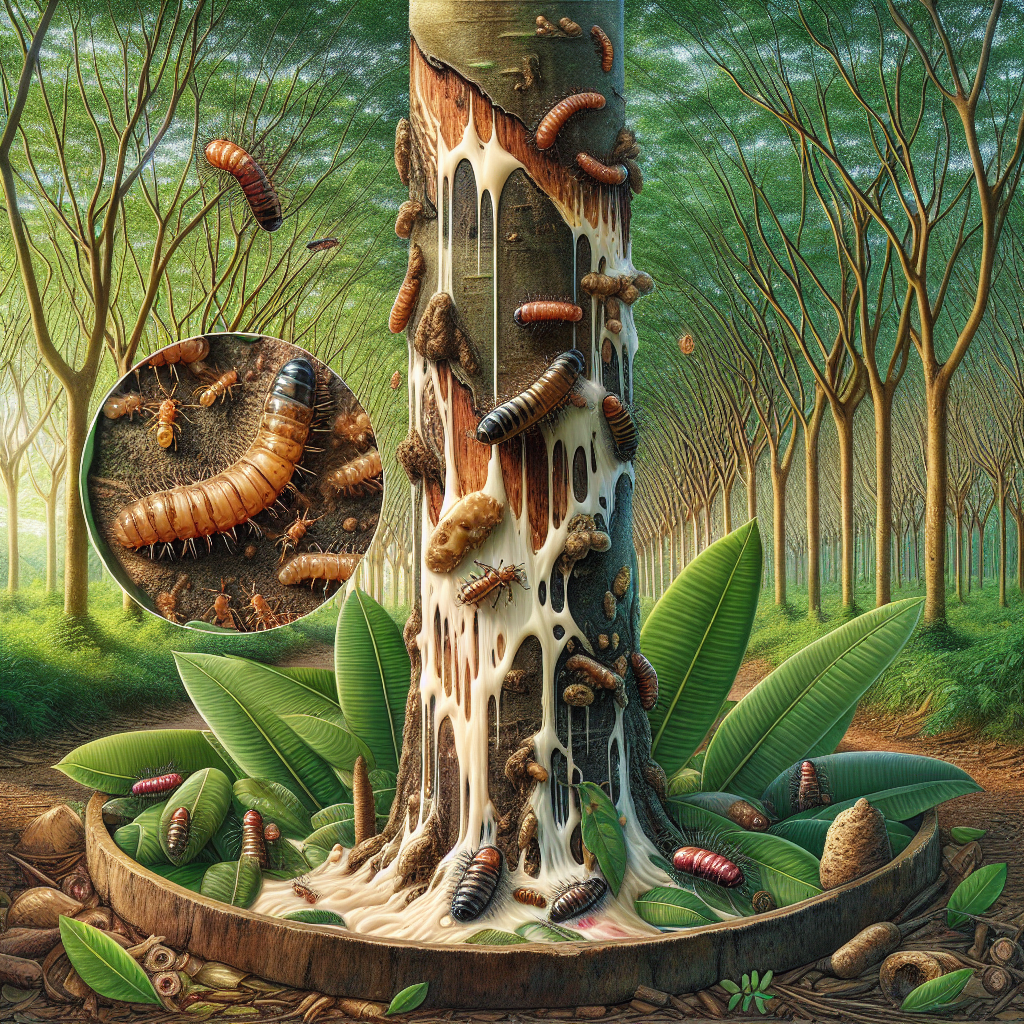
Accurate diagnosis begins with recognizing subtle early signs before damage escalates. Common symptoms include leaf yellowing, defoliation, bark lesions, and latex coagulation. For instance, Phytophthora palmivora causes brown, water-soaked lesions on tapping panels, leading to gummosis (oozing gum-like sap) and bark cracking. Leaves show shot-hole patterns from leaf-feeding caterpillars, with skeletonized tissues and frass (insect droppings) visible underneath.
Root damage from root-knot nematodes manifests as stunted growth, wilting during dry spells, and galls on feeder roots, reducing nutrient uptake. Inspect for termites boring into trunks, creating mud galleries and hollowed wood. Fungal issues like powdery mildew appear as white powdery coatings on young leaves, progressing to necrosis. Use a 10x hand lens to spot mites or eggs; differentiate from nutrient deficiencies by checking for pests like spider mites.
Damage progression: Minor leaf damage (<10% defoliation) is tolerable, but >30% triggers yield drops of 20-40%. Tapping panel disorders from scale insects cause dry bark and poor latex flow. Document symptoms with photos for tracking; consult local extension services for confirmation. Proactive scouting weekly during wet seasons prevents escalation.
Lifecycle and Progression of rubber
Rubber pests follow distinct lifecycles tied to tree phenology and seasons. Leaf-feeding caterpillars, such as those from Eupterote spp., overwinter as pupae in soil, emerging as adults in rainy seasons (May-July). Females lay 200-300 eggs on leaf undersides; larvae feed gregariously for 3-4 weeks, pupating in leaf folds. Multiple generations (3-5/year) coincide with flush growth, causing peak damage in August-October.
Termites (Coptotermes spp.) have subterranean colonies foraging year-round, with alates swarming post-rains. They tunnel into roots and collars, progressing from superficial bark damage to girdling over 1-2 years. Nematodes like Meloidogyne spp. complete cycles in 20-30 days at 25-30°C, with juveniles hatching from eggs in soil, penetrating roots to form galls.
Diseases like Phytophthora sporulate in wet conditions, splashing via rain to infect wounds; secondary spread via tools. Progression: Incubation 3-7 days, symptoms in 1-2 weeks, tree death in 6-12 months if untreated. Understanding these cycles allows timed interventions, such as applying neem during egg-laying peaks.
Environmental Triggers & Risk Factors
Rubber thrives in humid tropics (25-30°C, 2000-3000mm rain), but excesses trigger outbreaks. High rainfall (>250mm/month) and poor drainage favor Phytophthora and root rots; waterlogging reduces oxygen, stressing roots for nematode invasion. Close spacing (<4m) in monocultures heightens pest pressure, as seen in termites exploiting weakened trees.
Soil pH >6.5 limits micronutrients, mimicking deficiency symptoms confused with pests. Deficient nitrogen promotes scale insects via tender growth. Wind damage creates entry wounds for borers; drought stresses invite spider mites. Climate variability—erratic monsoons—increases susceptibility; young trees (1-5 years) are most vulnerable. Risk mapping via elevation (avoid <100m lowlands) and intercropping with banana reduces humidity microclimates.
Organic Control & Treatment Plans
Organic management emphasizes IPM: cultural, biological, and botanical controls. Cultural: Prune infected branches, improve drainage with contour terracing, and mulch to suppress nematodes. Rotate tapping rests (1 month/year) to heal panels. Biological: Introduce predatory beetles for caterpillars and entomopathogenic fungi (Beauveria bassiana) for termites at 10^9 spores/ha. Trichoderma spp. antagonizes Phytophthora; apply 50g/plant to soil.
Botanicals: Neem oil (5ml/L) sprays target eggs/larvae of leaf-feeding caterpillars, applied 3x at 10-day intervals. Garlic-chili extracts deter scale insects. For nematodes, marigold marigold interplanting releases alpha-terthienyl. Monitoring: Pheromone traps for moths (20/ha), sticky traps for mites. Threshold: Treat at 10% leaf damage.
Treatment plan: Week 1 scout/remove egg masses; Week 2 neem spray; Week 3 bioagent drench; monitor monthly. Efficacy: 70-85% control, with zero residues for export compliance. Avoid synthetic chemicals to preserve pollinators.
Preventing rubber in the Future
Prevention is 80% of success: Select resistant clones (RRIM600, PB235) from certified nurseries. Site selection: Well-drained loams, 500-800m elevation. Establish windbreaks with gliricidia for shelter. Sanitize tools with 10% bleach between trees.
Crop diversification: Intercrop with coffee, black pepper to disrupt pest cycles. Cover crops like clover build soil health, suppressing nematodes. Regular tapping hygiene: Clean panels with mild soap. Annual soil solarization (clear plastic, 6 weeks summer) kills soil pests. Scout grids (1 tree/10x10m) with apps for early detection. Long-term: Breed for tolerance via participatory selection. For farm planning, see The 1-Acre Blueprint: How to Plan and Optimize a High-Yield Small Farm Using AI.
Crops Most Affected by rubber
While rubber is the primary host, associated pests impact nearby crops. Leaf-feeding caterpillars migrate to mango and cassava; termites attack sugarcane, coconut. Root-knot nematodes shared with tomato, potato. Phytophthora affects avocado, citrus. Polyculture risks amplify; buffer zones (20m) with non-hosts like legumes mitigate. In Southeast Asia, rubber-adjacent [oil palm](/wiki/palm-oil—no link) sees heightened scale insects. Prioritize IPM across farms.