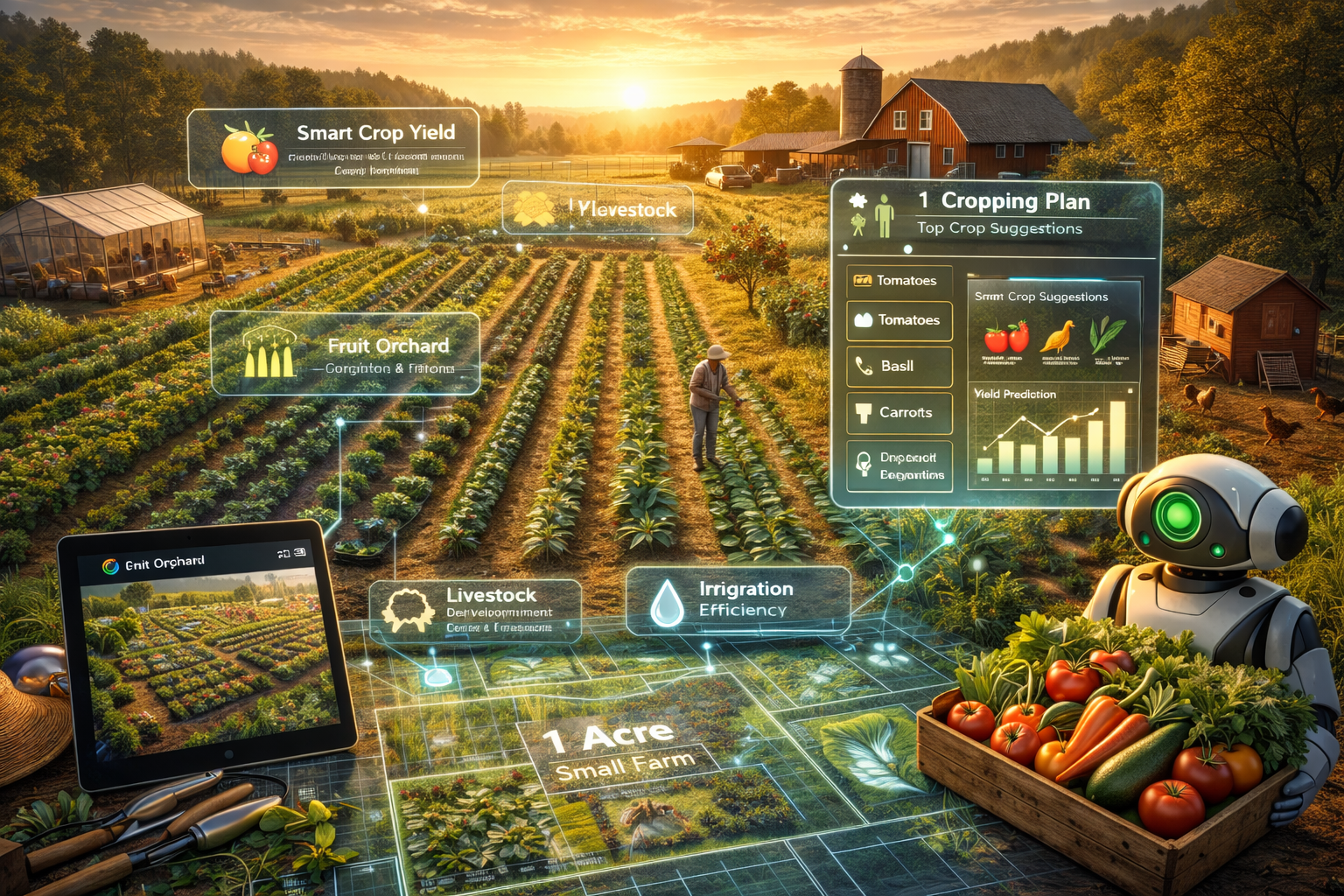
Many people assume that profitable farming requires dozens--or even hundreds--of acres.
In reality, a well-designed one-acre farm can produce an impressive amount of food and income when managed correctly.
The secret is not more land.
The secret is better planning, smarter crop selection, and efficient management.
Today, modern tools--including artificial intelligence--allow small farmers and homesteaders to plan their farms with a level of precision that was previously only available to large commercial operations.
This guide will show you how to design a high-yield 1-acre farm--and how AI can help you optimize every square meter.
Why 1 Acre Is Enough for a High-Yield Farm
One acre equals about 43,560 square feet (4,047 m²).
That might sound small, but with intensive farming techniques it can support:
- Diverse vegetable production
- Fruit trees and perennial crops
- Small livestock integration
- High-value specialty crops
The key is intentional design.
Instead of treating the acre as one large field, successful small farms divide it into high-efficiency production zones.
Step 1: Divide the Acre Into Smart Production Zones
A highly productive small farm rarely plants a single crop across the entire space.
Instead, divide the land into functional zones.
A common one-acre layout might include:
Intensive Vegetable Beds (40-50%)
These are the highest-yield sections of the farm.
Use raised beds or market-garden style rows for crops like:
- Lettuce
- Tomatoes
- Peppers
- Cucumbers
- Spinach
- Herbs
These crops offer fast turnover and frequent harvests.
Fruit Trees and Perennials (20-30%)
Plant perennial crops along borders or in dedicated sections.
Examples include:
- Mango
- Avocado
- Citrus
- Papaya
- Banana
- Berries
Perennials provide long-term yield with lower annual labor.
Crop Rotation Area (10-20%)
Maintaining soil health requires rotating crops.
Designate an area specifically for:
- Nitrogen-fixing crops
- Cover crops
- Seasonal rotation
This prevents soil exhaustion and pest buildup.
Infrastructure and Utility Space (10%)
Even the smallest farms need space for:
- Tool storage
- Compost systems
- Water tanks
- Pathways
- Small greenhouse or nursery
Efficient infrastructure reduces daily workload.
Step 2: Choose High-Value Crops
One of the biggest mistakes new farmers make is planting crops that produce high volume but low value.
Small farms perform best when growing high-value crops that maximize income per square meter.
Examples include:
- Microgreens
- Culinary herbs
- Specialty tomatoes
- Garlic
- Turmeric
- Ginger
- Salad greens
These crops often offer:
- Short growing cycles
- High market demand
- Multiple harvests per season
Step 3: Optimize Crop Spacing and Bed Design
Many farms lose productivity simply because plant spacing is inefficient.
Overcrowding leads to:
- Disease spread
- Lower yields
- Poor airflow
Underutilized spacing wastes valuable land.
A good small-farm layout should focus on:
- Uniform bed width (usually 30-36 inches)
- Permanent walkways
- Consistent irrigation lines
This allows for efficient planting, harvesting, and maintenance.
Step 4: Design a Water Strategy
Water management can make or break a one-acre farm.
Poor irrigation planning leads to:
- Uneven crop growth
- Water waste
- Disease pressure
A good system includes:
- Drip irrigation
- Rainwater collection
- Soil moisture monitoring
- Seasonal irrigation adjustments
Efficient watering ensures plants receive consistent moisture without excess humidity.
Step 5: Plan Continuous Harvest Cycles
One of the biggest advantages of small farms is the ability to run continuous production cycles.
Instead of planting once per season, stagger plantings so that crops mature in waves.
For example:
- Plant lettuce every 10-14 days
- Rotate fast-growing crops every 4-6 weeks
- Follow early crops with heat-tolerant varieties
This ensures consistent harvests instead of seasonal spikes.
Step 6: Track Everything
Successful farms are built on good data.
Tracking key information helps farmers improve each season.
Important records include:
- Planting dates
- Germination rates
- Pest outbreaks
- Fertilizer use
- Harvest yields
Without records, it's difficult to know what worked and what didn't.
How OnlyCrops AI Helps You Design and Optimize a 1-Acre Farm
Planning a high-yield small farm involves hundreds of decisions.
OnlyCrops AI helps simplify those decisions by combining farm management tools with artificial intelligence.
Here are some ways it can help.
📷 Farm Vision: Instant Crop Diagnostics
If plants begin showing unusual symptoms, the Farm Vision camera can quickly analyze them.
Simply take a photo and receive:
- Pest identification
- Disease detection
- Nutrient deficiency analysis
- Treatment recommendations
This allows farmers to solve problems before they spread across the acre.
🤖 AI Farm Assistant: On-Demand Farming Advice
Farming questions arise daily.
The OnlyCrops AI Assistant can help with questions such as:
- What crops grow best in my climate?
- How should I space tomatoes in raised beds?
- What is the best crop rotation plan for one acre?
- How do I treat aphids organically?
Instead of searching through forums and articles, farmers receive clear, tailored answers instantly.
📊 Smart Farm Records and Yield Tracking
OnlyCrops AI helps farmers keep organized digital records.
Track important information like:
- Crop planting schedules
- Harvest yields
- Pest outbreaks
- Soil treatments
Over time, the system learns from your farm and provides increasingly accurate recommendations.
The Future of Small Farms Is Intelligent
A one-acre farm may be small in size--but with the right planning, it can be extremely productive.
The most successful farms today combine:
- Smart land design
- Efficient crop selection
- Data-driven decisions
- Modern technology
AI is becoming one of the most powerful tools available to small farmers.
Instead of guessing, farmers can now plan, monitor, and optimize their farms with precision.
Start Building Your High-Yield Farm Today
Whether you're planning a homestead, a market garden, or a small commercial farm, the right tools can dramatically improve your success.
With OnlyCrops AI, you can:
- Detect crop problems early
- Optimize planting and harvest cycles
- Track farm performance
- Make smarter farming decisions
Start using OnlyCrops AI today and turn your one-acre farm into a highly productive system.