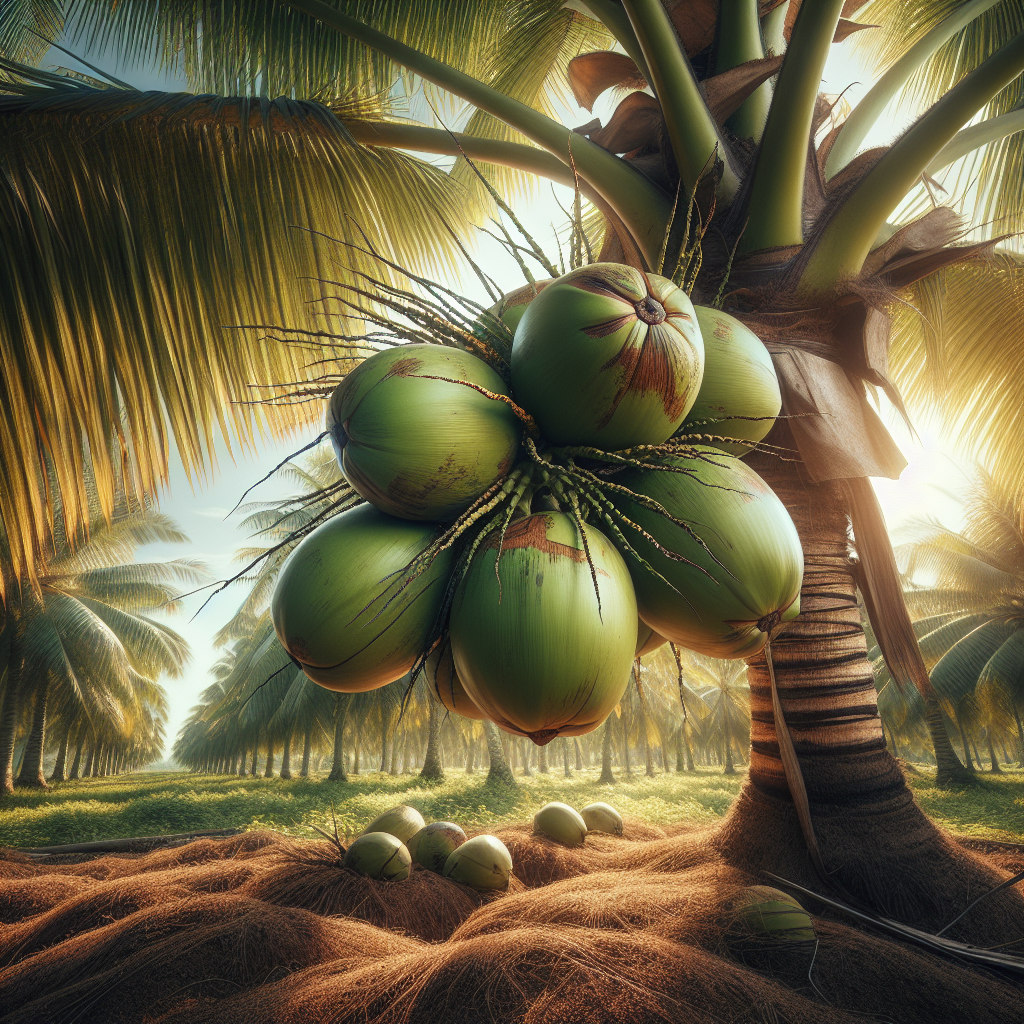
Introduction to Coconut
Few perennial crops are as economically and culturally important across the tropics as coconut. Often called the “tree of life,” it supplies drinking nuts, culinary flesh, oil, fiber, fuel, thatch, timber, activated carbon, sugar, vinegar, and livestock feed byproducts. Archaeobotanical and linguistic evidence suggests a long history of dispersal along tropical coastlines of the Indo-Pacific, aided both by human movement and the fruit’s remarkable buoyancy and salt tolerance. Today, coconut is grown from small coastal homesteads to commercial plantations across South and Southeast Asia, the Pacific, East Africa, the Caribbean, and tropical America.
From a grower’s perspective, coconut is not a casual fruit tree but a high-biomass, nutrient-demanding palm with a long juvenile phase and decades of production potential. A well-managed palm can remain productive for 40 to 60 years or more depending on cultivar, climate, nutrition, and pest pressure. The main production types are tall coconuts, dwarf coconuts, and hybrid combinations. Tall types are generally more robust, cross-pollinated, slower to bear, and longer lived. Dwarf types are earlier bearing, shorter, often preferred for tender-nut water markets, but can be somewhat more management-sensitive. Hybrids often combine precocity, improved nut set, and higher yield potential.
For mixed tropical systems, coconut is especially useful because its tall canopy allows multilayer cropping when spacing, light, and root competition are managed correctly. Growers often combine it with spices, tubers, legumes, or fruit crops in the juvenile years and even into maturity. For diversified tropical planning, see Banana.
Botanical Profile of Coconut
Coconut belongs to the family Arecaceae. It is a monocotyledonous palm, not a true woody dicot tree, so it does not form secondary thickening rings like mango or citrus. The trunk is a columnar stem marked by leaf scars and topped with a crown of large pinnate fronds. The palm emerges from a single apical growing point, sometimes called the “heart.” Damage to this growing point is usually fatal because the palm cannot resprout from dormant side buds the way many broadleaf trees can.
Roots are fibrous and adventitious, arising continuously from the bole at the trunk base. Mature palms can produce thousands of roots, most concentrated in the upper 1 to 1.5 meters of soil, though some penetrate deeper where aeration permits. This root architecture explains why coconuts respond strongly to surface mulching, organic matter, and regular nutrient placement in a broad basin rather than a narrow fertilizer hole.
Leaves may reach 4 to 6 meters long in vigorous palms. Each leaf contains numerous leaflets arranged along a central rachis. A healthy adult canopy often carries 25 to 35 functioning leaves, depending on cultivar and environment. Leaf emergence rate is climate dependent, commonly about 10 to 15 leaves per year in favorable tropical conditions.
The inflorescence develops inside a tough spathe and emerges from leaf axils. Coconut is monoecious: male and female flowers occur on the same inflorescence. Tall cultivars are predominantly cross-pollinated because male and female phases overlap less, while dwarfs tend toward greater self-pollination. Fruit development from fertilization to full maturity typically takes 11 to 12 months. Tender-nut harvest for water usually occurs around 6 to 8 months after fruit set, while fully mature nuts for copra and seed are harvested later.
Botanically, the coconut fruit is a fibrous drupe. The exocarp is the smooth outer skin, the mesocarp is the husk used for coir, and the endocarp is the hard shell enclosing the seed. Inside is the liquid endosperm, known as coconut water, and the solid endosperm, known as kernel or meat. As nuts mature, more of the liquid endosperm converts into firm kernel.
Soil, pH, and Climate Requirements for Coconut
Coconut performs best in true tropical climates with mean annual temperatures of 24 to 29b0C. Growth slows noticeably below 21b0C, and prolonged exposure below 15b0C can cause physiological stress, poor nut set, and leaf chlorosis. Frost is usually lethal, especially to young palms. Ideal annual rainfall is roughly 1,500 to 2,500 mm, well distributed, or supplemented through irrigation. Extended dry seasons reduce button retention, nut size, and inflorescence emergence unless soil moisture is carefully maintained.
Full sunlight is essential. Palms should receive unobstructed light for most of the day; heavy shade leads to elongated petioles, reduced photosynthesis, weaker flowering, and poor yields. Coastal humidity and air movement are generally favorable, but severe cyclone exposure can snap trunks or shred crowns. Windbreak design is useful in storm-prone landscapes, provided windbreaks do not cast significant shade.
Deep, well-drained soils are strongly preferred. The best textures are sandy loam, loam, alluvial loam, lateritic loam, and coastal sands improved with organic matter. Coconuts can tolerate sandy soils better than many tree crops because their roots spread widely and the species is naturally adapted to littoral zones. However, high productivity in sand requires frequent water and nutrient inputs because of low cation exchange capacity and nutrient leaching.
Optimum soil pH is about 5.2 to 8.0, with best nutrient balance often found near pH 5.5 to 7.0. Coconut tolerates moderate salinity and coastal conditions better than most fruit crops, but tolerance has limits. High sodium without adequate calcium, magnesium, drainage, and flushing can still suppress growth. In strongly acidic soils below pH 5.0, aluminum toxicity and phosphorus fixation may restrict root activity; liming or dolomitic amendments may be needed after soil testing.
Waterlogging is a major hidden cause of decline. Coconut roots require oxygen, and prolonged saturation can trigger root rot, stem weakness, nutrient lockout, and lower bunch retention. In practical terms, the soil should remain evenly moist but not anaerobic. After irrigation or rain, water should infiltrate and drain within 24 to 48 hours in most production settings. If the basin stays swampy, emits sour smells, or the soil feels greasy and oxygen-starved, drainage is inadequate. Yellowing older fronds, poor spear emergence, and reduced nut set can follow chronic root suffocation.
On the other hand, severe drought causes leaflet folding, scorched leaf tips, smaller crowns, premature nut fall, and reduced spadix production. A useful target in productive orchards is to keep the active root zone moist to roughly field capacity without repeated cycles of saturation and hard drying. Surface mulch 8 to 15 cm thick, kept 20 to 30 cm away from the trunk, significantly buffers soil temperature and moisture. For broader fertility strategy in perennial systems, read soil health tips.
Step-by-Step Planting & Propagation
Commercial planting begins with cultivar choice. Select according to end use: tender-nut water, copra, oil, culinary kernel, ornamental landscape use, or hybrid high-yield systems. Use seed nuts only from elite, disease-free mother palms with regular bearing, high bunch count, good copra content or water quality, and no visible Stem Bleeding, crown decline, or mite damage history. Avoid using undersized nuts, nuts from isolated weak palms, or nuts from irregular bearers.
For seed selection, choose fully mature nuts around 11 to 12 months old. They should have a well-developed husk, characteristic sound when shaken, and normal shape for the cultivar. Nursery establishment is usually done in a well-drained bed or polybag system. Nuts are placed either horizontally or slightly tilted with the stalk end sideways or upward depending on local practice. Spacing in nursery beds commonly ranges around 60 x 60 cm to allow sprout and early root development.
Germination typically begins in 2 to 4 months, though this varies by cultivar and temperature. Maintain nursery moisture uniformly; the medium should be damp but never stagnant. Seedlings are generally ready for field planting at 6 to 10 months when they possess 4 to 6 leaves, a sturdy collar, and active roots. Overaged seedlings can become root-bound or establish poorly.
Land preparation should prioritize drainage, weed suppression, and layout. Typical spacing for tall cultivars is 7.5 to 9 meters each way in square or triangular systems, while dwarfs may be planted somewhat closer, often around 6.5 to 7.5 meters depending on fertility and intercrop intentions. Triangular planting improves light interception and palm distribution per hectare but must still allow machinery and harvest access.
Dig pits large enough to loosen compact subsoil and create a favorable rooting zone. In many tropical soils, pits of 0.75 x 0.75 x 0.75 m to 1 x 1 x 1 m are suitable. In poor soils, refill with topsoil mixed with well-decomposed farmyard manure or compost, not raw organic matter that heats during decomposition. In termite-prone or Rhinoceros Beetle-prone areas, ensure the planting material and pit are clean and monitored.
Planting is best done at the onset of the rainy season where rainfall is reliable, or with assured irrigation in any warm period. Position the seedling so the sprouted nut sits slightly above or level with the surrounding soil surface in heavier soils; planting too deep can trap moisture around the collar and impair aeration. Firm the soil gently to eliminate air pockets while preserving porosity.
Immediately after planting, create a shallow basin wide enough to direct irrigation to the root zone. Apply mulch around, but not touching, the base. In windy sites, young palms may need temporary staking. Replace mortalities early to maintain uniform age and management.
Care & Maintenance regimes for Coconut
Young palms demand consistent establishment care for the first 3 to 5 years. Weed competition is especially damaging because coconut roots are shallow and broad. Keep at least a 1 to 1.5 meter radius around young palms free from aggressive weeds, grasses, and vines. Organic mulches, cover crops, and shallow manual weeding are preferable to deep hoeing, which severs feeder roots.
Irrigation should be based on soil type, evaporative demand, and palm age. In sandy soils during dry periods, newly planted palms may require water 2 to 3 times per week. In loam soils, once every 5 to 7 days may suffice if each irrigation wets the root zone thoroughly. Mature bearing palms often need the equivalent of 60 to 100 liters per day under hot dry conditions, commonly delivered as 400 to 700 liters per palm at 4- to 7-day intervals, or through drip systems calibrated to local evapotranspiration. The goal is deep, even moisture in the upper active root zone, not frequent shallow sprinkling.
Signs of underwatering include folded leaflets during midday that persist into evening, reduced spear growth, small nuts, button shedding, and dry soil below mulch. Signs of overwatering or poor drainage include yellowing lower leaves despite fertilization, sour-smelling soil, algal growth in basins, sluggish new leaf emergence, and eventual basal trunk decline.
Nutrition is central to yield. Coconut has particularly high demand for potassium, followed by nitrogen, and significant needs for chlorine, magnesium, sulfur, and boron in many soils. Deficiencies often appear first in older fronds because nutrients are remobilized to younger tissue. Potassium deficiency causes orange-yellow spotting, marginal necrosis, frond droop, and small nuts. Nitrogen deficiency leads to generalized pale green canopies and reduced vigor. Magnesium deficiency often shows as broad yellow bands on older leaf margins while the center remains greener. Boron deficiency can cause distorted leaflets, crumpled emerging leaves, and poor nut development.
Fertilizer schedules vary by region and soil test, but a professional regime usually splits annual applications into 2 to 4 doses, timed before rains or supported by irrigation. Distribute fertilizers in a broad circular band within the active root zone, often 1 to 2 meters from the trunk in young palms and wider in mature palms. Do not pile fertilizer directly against the trunk. In rainfed systems, integrating compost, green leaf manure, husk burial, and cover crops improves nutrient retention and soil moisture. Coconut husk can be buried in trenches between palms in dry sandy zones to act as a moisture reservoir.
Pruning should be conservative. Remove only dead, broken, or diseased fronds and old inflorescence stalks. Excessive pruning reduces photosynthetic area and can lower yield. Never cut green healthy leaves simply for neat appearance. In tall palms, harvesting and sanitation should be done by trained climbers or with appropriate mechanical tools for safety and to avoid crown injury.
Basins should be widened as palms age. In mature orchards, intercultural operations should avoid deep soil disturbance. Where erosion is a risk, maintain ground cover between rows. In coastal or cyclone-prone regions, nutrient-balanced palms with strong canopies and uninjured crowns recover better after storm events.
Pests, Diseases & Organic Management
Among insect pests, Rhinoceros Beetle is one of the most destructive, especially to young and recovering palms. Adults bore into unopened fronds and the crown, producing characteristic V-shaped cuts on emerging leaves. Severe attacks can damage the apical region and reduce future bunches. Sanitation is the first defense: remove decaying logs, unmanaged manure heaps, and rotting organic dumps that serve as breeding sites. Manual hook extraction from crown holes, pheromone trapping, and biological agents such as Oryctes nudivirus where available are important tools.
Red Palm Weevil is an even more serious threat because larvae tunnel within tissues and may kill palms. Oozing brown fluid, chewed fibers, fermented odor, crown weakness, and wilting may appear late, so prevention matters. Avoid trunk wounds, remove severely infested palms promptly, and use trapping programs where locally recommended.
Coconut Eriophyid Mite damages young nuts under the perianth, causing corky brown patches, cracking, and undersized fruits. Maintaining palm vigor, removing heavily damaged nuts where practical, and using approved botanical or sulfur-based interventions according to local regulations can reduce damage. Good bunch sanitation helps, though eradication is difficult.
Scale Insects, Mealybugs, Leaf-eating Caterpillars, and Slugs may occasionally flare in neglected systems. Encourage natural enemies by avoiding broad-spectrum pesticide misuse and preserving habitat diversity.
Major diseases vary by region. Bud Rot can kill the growing point, especially in wet, poorly ventilated conditions or after storm injury. Early symptoms include spear leaf discoloration, soft rot, foul smell, and eventual collapse of crown tissues. Immediate removal of infected tissue when feasible, improved drainage, and preventive copper-based measures where permitted may help in early cases. Stem Bleeding appears as dark reddish-brown exudation from trunk cracks and is associated with stress, injury, and pathogen invasion. Improve drainage, sanitation, and nutrition, and avoid mechanical wounds.
Lethal Yellowing and related phytoplasma diseases are devastating in some regions, causing premature nut drop, blackening of inflorescences, and progressive crown collapse. Management relies on resistant or tolerant varieties, vector suppression where relevant, and rapid removal of infected palms. Root Wilt and various decline syndromes require region-specific diagnosis because symptoms can overlap with drought, nutrient deficiency, or nematode injury.
Organic management in coconut works best as a systems approach: resistant cultivars, clean planting stock, palm nutrition, aerated soil, mulching, crown sanitation, habitat for beneficial organisms, pheromone trapping, biological control, and careful monitoring. Once the apical meristem is extensively damaged, rescue options are limited, so scouting should be routine rather than reactive.
Harvesting, Curing & Optimal Storage
Harvest timing depends entirely on market purpose. For tender coconuts used as a beverage, nuts are usually harvested at 6 to 8 months after fruit set, when water volume is high and the kernel is still soft and jelly-like. For culinary immature kernel products, the exact stage may be slightly later depending on local preference. Mature nuts for copra, oil extraction, seed, or long shelf life are harvested at 11 to 12 months when the husk and shell are fully developed and kernel thickness is maximal.
Indicators of mature harvest include drying of the outer husk color according to cultivar, a sloshing sound of water when shaken, fully formed eyes, and natural loosening of older nuts. In some systems, fully mature nuts are allowed to fall naturally and are collected regularly; in commercial orchards, bunch cutting provides better scheduling and reduces losses.
Harvest intervals are often every 30 to 60 days depending on labor, market, and palm bearing pattern. Frequent harvest is especially important for tender-nut enterprises to capture the right maturity window and maintain uniform quality.
After harvest, dehusking should be done with care to avoid shell cracks if nuts are destined for storage or seed. Mature coconuts intended for copra are often cured briefly by drying the husked nuts under shade and ventilation before splitting and kernel drying. Copra drying must be rapid enough to prevent mold and aflatoxin contamination but controlled enough to avoid scorching. Final moisture for copra storage generally needs to be low enough to prevent fungal growth, commonly around 6% or lower depending on the product chain.
Whole mature nuts store best in cool, dry, well-ventilated conditions out of direct sun and rain. Excess humidity encourages mold on the husk and shell; excessive heat accelerates deterioration and sprouting. Tender coconuts are highly perishable once harvested and especially after trimming; refrigeration extends quality, but physical injury and water loss remain concerns. Seed nuts should be stored only briefly before nursery sowing because prolonged storage lowers vigor.
Companion Planting for Coconut
Because coconut has a high canopy and comparatively open light pattern in many stages of growth, it lends itself well to multistory tropical systems. The best companions depend on palm age, spacing, rainfall, and whether the objective is income diversification, weed suppression, nitrogen fixation, or soil cover.
In the juvenile phase before full canopy closure, short-duration intercrops can be highly profitable. Suitable options include legumes such as cowpea, groundnut, or green manure species; tuber crops such as cassava or sweet potato where moisture permits; and shade-tolerant spices or medicinal herbs in more humid systems. In mature plantations with filtered light, crops like pineapple, certain gingers, turmeric, forage grasses managed carefully, and selected fodder legumes can perform well. Avoid highly competitive, water-hungry species planted too close to the palm basin.
A good practical rule is to keep heavy-feeding intercrops outside the immediate fertilizer basin of young palms and to synchronize irrigation so companion crops do not create chronic moisture stress for the coconuts. Nitrogen-fixing cover crops can improve organic matter, reduce erosion, and moderate soil temperature. However, covers must be managed so they do not climb trunks, harbor destructive pests, or obstruct harvest operations.
Ideal companion species also support biological control by providing nectar and refuge for predators and parasitoids. At the same time, avoid plants that are known alternate hosts for serious palm pests in your area. In integrated coastal farms, coconut pairs well with staggered production zones of annual vegetables, tubers, and small fruits, provided sunlight and nutrient budgets are calculated realistically.
The most successful companion planting under coconut is therefore not random polyculture but structured layering: palms as the upper story, medium perennials or spices in suitable light niches, seasonal legumes or groundcovers below, and clear management lanes for harvest, sanitation, and fertilizer placement. Done correctly, this improves land-use efficiency, buffers farm income, and can raise total biological productivity per hectare without compromising long-term palm health.