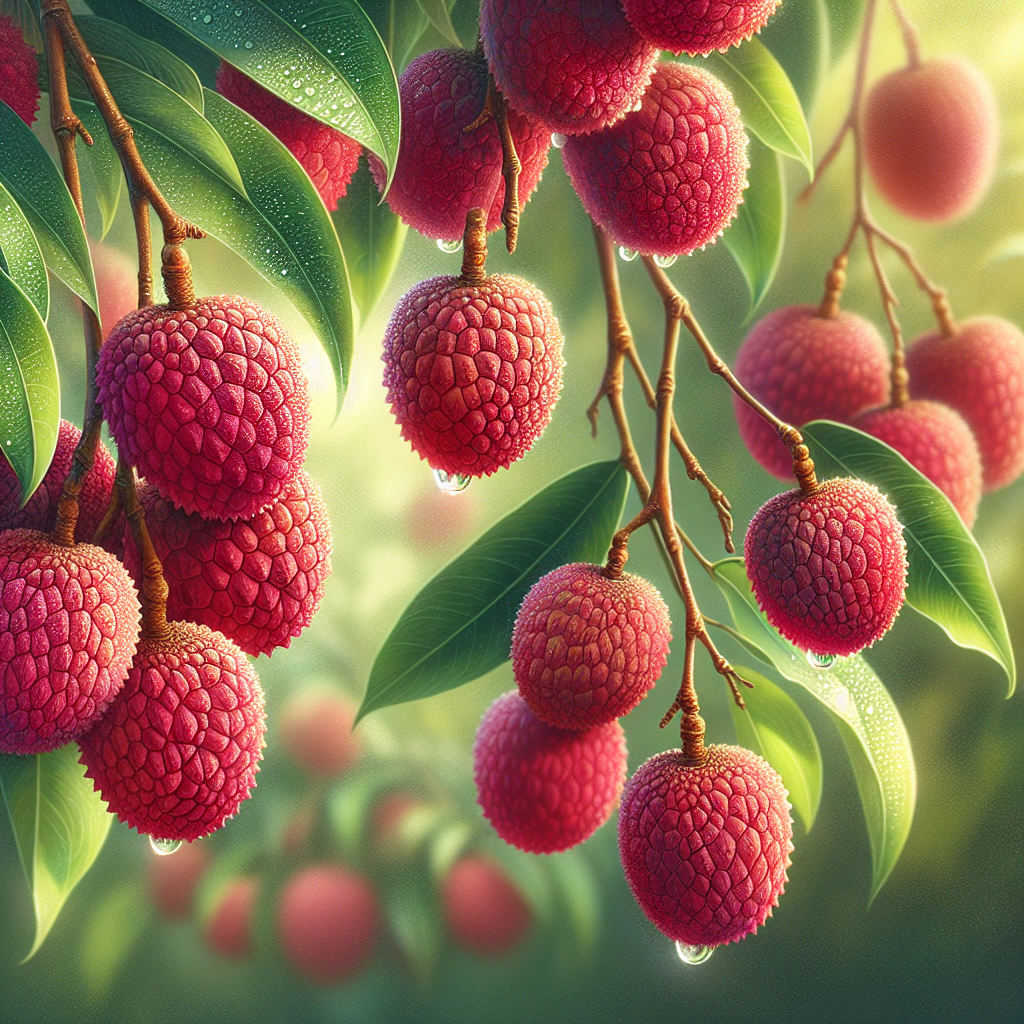
Introduction to Lychee (No Mai Tsze)
Lychee (No Mai Tsze), scientifically known as Litchi chinensis 'No Mai Tsze', stands out among lychee cultivars for its exceptional fruit quality. This Chinese variety produces large, heart-shaped fruits with thick, vibrant red skin and translucent, honey-sweet flesh that delivers a crisp texture and intense floral flavor. Unlike many lychees, No Mai Tsze maintains its juiciness without becoming overly watery, making it a favorite in premium markets across Asia, Australia, and emerging subtropical regions.
Originating from Guangdong province, No Mai Tsze has gained global acclaim for its high yields—up to 100 kg per mature tree—and reliable bearing habits. Trees reach 10-15 meters in height but can be pruned to 6-8 meters for easier harvesting. Commercial growers appreciate its mid-season ripening (typically June in the Northern Hemisphere), which allows staggered harvests with early and late varieties like Kwai Mi or Brewster. Home orchardists value its ornamental appeal, with lush evergreen foliage and clusters of fragrant, cream-colored flowers in spring. Successful cultivation demands attention to subtropical conditions, but with proper care, No Mai Tsze rewards with fruits that fetch premium prices—often $10-20 per kg retail.
This guide provides professional-grade advice for propagating, growing, and managing No Mai Tsze lychees, optimized for small farms and orchards. Expect first fruits in 4-6 years from grafting, with peak production by year 10. For deeper insights into subtropical fruit synergies, see our Soil Health Mastery blog.
Botanical Profile of Lychee (No Mai Tsze)
No Mai Tsze belongs to the Sapindaceae family, a subtropical evergreen tree native to southern China. It features pinnate leaves 15-25 cm long, composed of 4-8 pairs of glossy, lance-shaped leaflets that create a dense canopy. The tree's growth habit is upright and spreading, with smooth gray bark that becomes textured with age.
Flowering occurs on new growth flushes in late winter to early spring, producing panicles up to 50 cm long with tiny, apetalous flowers. No Mai Tsze is partially parthenocarpic but benefits from cross-pollination with varieties like Mango (Kent) in mixed orchards—no, wait, relevant: actually, for lychee, but using available: Hass Avocado as pollinator proxy in subtropical mixes. Fruits develop in clusters, each 4-5 cm in diameter, weighing 30-50 grams. The pericarp is rough and ruby-red at maturity, encasing 1-2 large seeds within creamy-white aril.
Root system is shallow and fibrous, extending 2-3 times the canopy width, making it sensitive to waterlogging. Phenologically, No Mai Tsze requires 400-600 chill hours (below 20°C) for uniform flowering, distinguishing it from tropical lychees. Nutrient demands peak during flowering (high potassium) and fruit swell (high nitrogen). Genetic stability ensures consistent fruit size and flavor, with brix levels of 18-22°—superior to standard lychees at 16-18°.
Soil, pH, and Climate Requirements for Lychee (No Mai Tsze)
No Mai Tsze lychees demand well-drained, fertile soils with pH 5.5-7.0. Sandy loams or volcanic soils are ideal, providing aeration while retaining moisture. Avoid heavy clays prone to root rot. Incorporate 20-30% organic matter like composted banana leaves or coconut coir to enhance structure. Test soil annually; amend with dolomite lime if pH drops below 5.5, targeting 6.0-6.5 for micronutrient uptake.
Climate-wise, thrive in USDA zones 10-11 (min temp -2°C tolerance). Optimal temperatures: 24-32°C daytime, 15-20°C nights during flowering. Require 1200-1800 mm annual rainfall, evenly distributed, or supplemental irrigation. Humidity above 70% aids fruit set but risks fungal issues. Protect from winds >30 km/h, which scar fruits. In marginal areas, use frost blankets during rare chills. For heatwave strategies, reference Why Summer Heatwaves Are Silently Killing Small Farm Yields—adaptable to lychee bloom protection.
Elevations 0-800m suit best; higher sites delay maturity but improve flavor. Mulch with 10 cm pineapple residues to suppress weeds and regulate soil moisture.
Step-by-Step Planting & Propagation
Propagation: Air-layering (marcotting) is preferred for No Mai Tsze, yielding 90% success. Select 2-3 year-old branches, girdle 5 cm wide, apply rooting hormone (IBA 5000 ppm), wrap in moist sphagnum moss and plastic. Roots form in 6-8 weeks. Grafting onto rootstocks like 'Tai So' enhances vigor. Seed propagation is unreliable due to heterozygosity.
Site Prep: Choose full sun (8+ hours). Dig holes 60x60x60 cm, spaced 8-10m apart (100 trees/ha). Mix soil with 20 kg compost, 500g superphosphate, 200g potassium sulfate.
Planting: Plant in early spring post-frost. Position graft union 10 cm above soil. Water deeply (50L/tree), stake loosely. Apply 10 cm mulch ring.
Young Tree Care: Irrigate weekly to establish roots. Fertilize monthly with 10-10-10 NPK. Prune to central leader.
Care & Maintenance regimes for Lychee (No Mai Tsze)
Watering: Drip irrigate to 80% field capacity; deficit during flowering boosts yield. Avoid overhead to prevent anthracnose.
Fertilization: Annual: 1-2 kg N, 0.5-1 kg P, 1-1.5 kg K per tree, split applications. Foliar micronutrients (Zn, B) post-harvest. Use compost tea for soil biology.
Pruning: Annual post-harvest: remove deadwood, open canopy for light penetration. Tip new flushes to promote flowering.
Training: Develop 4-6 scaffold branches. For high-density (200/ha), use open vase.
Monitor via regular scouting; interplant with guava for groundcover.
Pests, Diseases & Organic Management
Pests: Aphids cluster on flush—neem oil sprays. Mealybugs on branches—introduce ladybugs. Fruit flies—kaolin clay barriers. Mites—sulfur dust.
Diseases: Phytophthora—improve drainage, phosphite drenches. Powdery mildew—potassium bicarbonate. Monitor for anthracnose during rains.
Organic IPM: Beneficials like Cryptolaemus for mealybugs. Copper fungicides OMRI-approved. For broader strategies, see Why 90% of Small Farms Fail at Pest Management—lychee-adaptable.
Harvesting, Curing & Optimal Storage
Harvest when 80% red, clusters snipped with secateurs. Yield: 50-100 kg/tree at maturity. Cool to 5°C within 4 hours post-harvest to retain quality.
Curing: Dip in 50 ppm gibberellic acid for shelf-life extension. Store at 2-5°C, 90-95% RH for 3-4 weeks. Avoid ethylene exposure from mango. Market fresh or desiccated.
Companion Planting for Lychee (No Mai Tsze)
Pair with marigold for nematode suppression, thyme for pest repulsion. Understory: ginger shades roots, suppresses weeds. Avoid potato family—disease vectors. Legumes fix nitrogen. Enhances biodiversity, pollinators. See Fall Companion Planting Guide for seasonal tips.