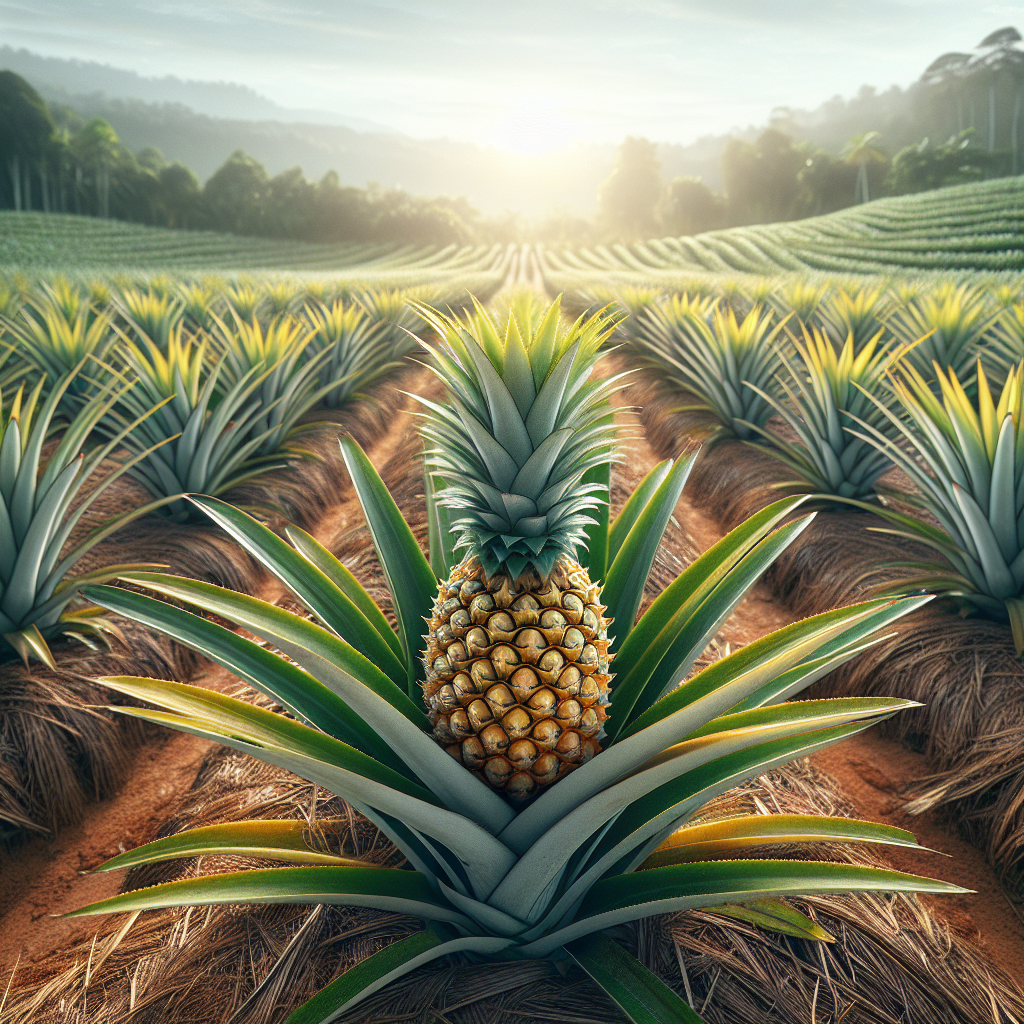
Introduction to Pineapple
Pineapple is one of the most distinctive tropical fruit crops in commercial agriculture, both botanically and agronomically. Unlike tree fruits, it is a perennial herb in the bromeliad family, producing a single composite fruit from a compact rosette of tough, waxy leaves. Its center of domestication lies in tropical South America, and from there it spread across the Caribbean, Asia, and Africa through early trade routes and colonial expansion. Today it is grown from backyard plots to export plantations in humid and sub-humid tropics worldwide.
For growers, pineapple offers several advantages: it tolerates relatively poor soils better than many fruit crops, withstands short dry spells once rooted, and can be propagated vegetatively with high uniformity. However, it is not a “plant and forget” crop. Marketable fruit size, sugar accumulation, shell color, crown quality, and disease pressure are all strongly influenced by drainage, plant spacing, nutrient ratios, and timing of flowering. Pineapple is particularly sensitive to waterlogging and root-zone oxygen deficiency, so successful production depends far more on soil structure and moisture management than many beginners realize.
Commercially, common cultivar groups include Smooth Cayenne, MD-2, Sugarloaf types, and Red Spanish types. MD-2 dominates export markets because of its uniform cylindrical fruit, high sweetness, lower acidity, and good shelf life. Smooth Cayenne remains important in some processing systems. Local growers should always prioritize cultivars adapted to their disease pressure, temperature range, and end market rather than simply choosing by name recognition alone.
Botanical Profile of Pineapple
Pineapple belongs to the family Bromeliaceae, genus Ananas, species Ananas comosus. It is a monocotyledonous perennial that forms a spiral rosette of narrow to broad leaves, often with spines on the margins depending on cultivar. The leaves are thick, fibrous, and covered with a waxy cuticle that reduces water loss. This morphology explains why mature plants can tolerate moderate dry periods better than shallow-rooted vegetables.
The root system is relatively shallow, with the majority of active roots concentrated in the top 15 to 30 cm of soil, though roots can explore deeper in loose, well-aerated profiles. Because of this shallow rooting pattern, pineapple responds strongly to surface moisture fluctuations, mulching, and top-dressed fertility. It also means that compaction and perched water tables quickly reduce vigor.
The fruit itself is not a true single-fruit structure but a multiple fruit formed by the fusion of many individual flowers and associated tissues around a central core. Flowering develops on a terminal inflorescence arising from the center of the rosette. After harvest, the mother plant usually produces ratoon shoots such as slips, suckers, and ratoons for subsequent propagation or crop cycles.
Three common vegetative propagules are used:
- Crown: the leafy top of the harvested fruit; slower to bear but widely available.
- Slip: shoots emerging from the peduncle beneath the fruit; often vigorous and preferred for uniformity.
- Sucker: shoots arising from leaf axils near the base; usually fastest to establish and often earliest to fruit.
Pineapple uses crassulacean acid metabolism-like water-conserving physiology to some degree typical of bromeliads, helping it use water efficiently in warm climates. This does not mean it thrives under neglect; rather, it means consistent but not excessive moisture is ideal. Compared with some tropical fruit crops such as Banana, pineapple is notably less tolerant of saturated soils and more forgiving of brief dryness.
Soil, pH, and Climate Requirements for Pineapple
Pineapple performs best in loose, well-drained sandy loams, loams, or friable volcanic soils rich in organic matter but never chronically wet. Drainage is the single most important soil trait. If water stands after rain for more than 24 hours, root suffocation, Phytophthora infection, and slow growth become likely. In heavy clay soils, raised beds or ridges are strongly recommended, often 20 to 40 cm high depending on rainfall intensity.
The ideal soil pH range is about 4.5 to 6.5, with optimum performance often around 5.0 to 5.8. Pineapple tolerates acidity better than many crops, and slightly acidic soils can even suppress certain soilborne problems. In alkaline soils above pH 7.0, micronutrient deficiencies, especially iron, zinc, and manganese, become more common. Symptoms include pale young leaves, reduced vigor, shortened leaves, and poor fruit development. If pH is too high, repeated foliar micronutrient sprays are often more effective than large soil applications.
Climate requirements are distinctly tropical to warm subtropical. Ideal temperature for active vegetative growth is roughly 22 to 32°C. Growth slows markedly below 18°C, and chilling injury can occur with prolonged exposure below about 10°C. Frost can severely damage leaves and destroy young plants. Excessive heat above 35°C, especially when combined with low humidity and reflective bare soil, can cause leaf scorch, reduced photosynthesis, and sun injury on exposed fruit.
Rainfall of 1000 to 1500 mm annually is suitable when well distributed and drainage is excellent. In lower-rainfall environments, irrigation is needed for uniform growth. In higher-rainfall areas, bed shaping, mulching, and runoff management become critical. Pineapple prefers bright light and full sun for best sugar development, but in extremely hot regions, light shading during establishment can reduce transplant stress.
Wind exposure matters more than many growers expect. Strong persistent winds can shred leaves, tilt developing plants, and scar fruit surfaces. Windbreaks or contour planting help in exposed sites. Salinity tolerance is moderate at best; the crop should not be irrigated repeatedly with saline water because leaf tip burn and yield decline may follow.
For long-term soil resilience, many growers benefit from improved organic matter management; see soil health tips.
Step-by-Step Planting & Propagation
Begin with clean, disease-free planting material. This decision affects the entire crop cycle because pineapple is propagated vegetatively, so pests and pathogens move easily from one generation to the next. Choose medium-sized slips or suckers weighing roughly 300 to 600 g for field planting when possible. Crowns may be used, but they generally produce slower, less uniform crops.
Select propagules. Choose sturdy material with no foul smell, basal rot, Mealybug colonies, or black lesions. Leaves should be firm, green to bluish green, and not excessively desiccated.
Trim and cure. Remove a few lower leaves to expose 2 to 4 cm of stem tissue at the base. Let the propagules cure in shade with good airflow for 3 to 7 days. This drying period helps wounds suberize and reduces rot after planting.
Sanitize if needed. In areas with a history of fungal disease or Mealybug wilt, dipping the base in an approved biological or low-toxicity protective treatment can reduce early losses. Avoid planting untreated material from unknown sources.
Prepare beds. Create raised beds or ridges in regions with moderate to high rainfall. Incorporate well-decomposed compost, but do not overload the planting zone with fresh manure. Excess undecomposed organic matter can heat up, hold too much moisture, and encourage rot.
Set spacing. Spacing depends on cultivar, fertility, and intended fruit size. Common field spacing is 25 to 35 cm between plants and 60 to 90 cm between rows, often in double-row systems. Higher density increases yield per area but may reduce average fruit size and airflow. For premium fresh-market fruit, slightly wider spacing usually improves uniformity and reduces disease pressure.
Plant at correct depth. Insert the base 3 to 5 cm into moist but not wet soil. Do not bury too deeply. Deep planting around the leaf base encourages rot, especially in heavy soils. Firm the soil lightly so the propagule remains upright.
Irrigate lightly after planting. Apply enough water to settle soil around the base but not enough to create saturation. During the first 2 to 4 weeks, the aim is slight, even moisture in the rooting zone. The top few centimeters may dry lightly between irrigations, but the root initiation area should not become bone dry.
Mulch the rows. Organic mulch or plastic mulch suppresses weeds, conserves moisture, protects shallow roots, and keeps fruit cleaner later. In very humid areas, keep mulch slightly away from the immediate stem base to reduce rot.
Rooting typically begins within several weeks under warm conditions. Vigorous establishment is indicated by firm anchorage and fresh central leaf growth. If the plant pulls up easily after three to four weeks, rooting is poor and moisture or rot issues should be investigated.
Care & Maintenance regimes for Pineapple
Water management should be precise rather than frequent by habit. Pineapple prefers evenly moist, aerated soil, not constant saturation. In practical terms, the root zone should feel lightly moist at 5 to 10 cm depth during active growth, never swampy or sour-smelling. If the soil remains wet and sticky for days, oxygen levels are likely too low. Overwatered plants often show dull leaf color, reduced new growth, basal yellowing, soft stem tissue, and in advanced cases a fermented odor from rotting roots. Underwatered plants show inward leaf folding, loss of sheen, reduced leaf extension, and slower canopy expansion.
During establishment, irrigate lightly and more often. Once plants are rooted, deeper but less frequent watering is better. Sandy soils may need irrigation every 3 to 5 days in hot periods, while loams may need it every 7 to 10 days depending on rainfall. Drip irrigation is ideal because it keeps foliage drier and reduces water waste. Overhead irrigation can be used, but repeated wetting in humid conditions may increase foliar disease and fruit blemish.
Nutrient management must be balanced. Pineapple is a relatively high feeder of nitrogen and potassium, with potassium especially important for fruit size, sugar accumulation, firmness, and stress tolerance. Excess nitrogen without adequate potassium often produces lush foliage but softer fruit, delayed maturity, and weaker quality. Phosphorus is needed in smaller amounts but remains important early for root establishment.
A practical fertility program includes:
- Base application of well-matured compost before planting.
- Split nitrogen and potassium applications during vegetative growth rather than one heavy dose.
- Foliar feeding with micronutrients where soils are alkaline or deficiency-prone.
- Reduced nitrogen and continued potassium emphasis as flowering approaches.
Typical deficiency symptoms include:
- Nitrogen deficiency: pale green older leaves, reduced plant size, slower growth.
- Potassium deficiency: marginal leaf necrosis, weak plants, poor fruit filling.
- Iron deficiency: yellow young leaves with greener veins, especially in high-pH soils.
- Magnesium deficiency: interveinal yellowing on older leaves.
Weed control is essential because pineapple grows slowly at first and has shallow roots that compete poorly with aggressive weeds. Hand weeding must be done carefully to avoid root disturbance. Mulching, stale seedbed preparation, and precise spot weeding are safer than deep hoeing. Weed pressure is usually highest in the first four to six months after planting.
Flower induction is a key management point in commercial systems. Naturally, pineapple flowers when mature, but growers often induce more uniform flowering using ethylene-releasing methods or other approved practices once plants reach adequate size. A plant forced too early produces small fruit; a plant induced at the correct stage produces more uniform harvests and better fruit mass. A common benchmark is sufficient leaf number and robust canopy size rather than age alone.
Fruit bagging or partial shading may be used in high-value production to reduce sunburn, pest damage, and cosmetic defects. Sunburn appears as bleached, later brown, sunken areas on exposed fruit surfaces, especially after leaf breakage or canopy disturbance.
Pests, Diseases & Organic Management
Pineapple is vulnerable to several economically important pests and diseases, especially under poor sanitation, high humidity, and waterlogged soils. The most common pest problem in many regions is Mealybug infestation. Mealybugs feed on sap, hide in leaf axils and roots, and are often associated with ant activity. They can transmit Mealybug wilt-associated problems, leading to reddening, decline, stunting, and poor fruiting.
Organic management of Mealybugs starts with prevention:
- Use clean planting material.
- Remove heavily infested plants.
- Control ants, which protect Mealybugs from natural enemies.
- Encourage beneficial insects such as lady beetles and lacewings.
- Apply horticultural soap or neem-based sprays to exposed colonies, repeating thoroughly because waxy coatings reduce contact effectiveness.
Nematodes can stunt roots and reduce vigor, especially where pineapple follows susceptible crops repeatedly. Crop rotation is difficult in perennial-style systems but still beneficial between production blocks. Soil solarization in hot climates, organic matter improvement, and the use of clean propagules help reduce pressure.
The most serious diseases often involve fungal or oomycete pathogens. Heart rot and Root rot, commonly associated with Phytophthora spp., are strongly linked to excess soil moisture and poor drainage. Early symptoms include wilting of the central whorl, soft rot, yellowing, and easy pulling of inner leaves. Once the central tissues collapse, salvage is limited. Prevention is far better than treatment: use raised beds, avoid deep planting, ensure rapid drainage, and never allow irrigation water to pond around crowns.
Black rot can affect harvested fruit, especially if bruised or handled in unsanitary conditions. Fruitlets or wounds become dark, watery, and decayed. Careful handling, field sanitation, and prompt cooling reduce losses.
Fusariosis and other localized fungal issues may distort fruit or affect propagules depending on region and cultivar. Because disease profiles vary geographically, growers should monitor fields frequently and rogue suspect plants early.
Integrated organic management principles include:
- Wide enough spacing for airflow.
- Sanitation of tools and packing areas.
- Removal of diseased debris.
- Biological soil amendments where locally validated.
- Avoiding excess nitrogen that promotes soft growth.
- Never replanting infected propagules.
Birds, rodents, and wild animals may feed on ripening fruit. Physical exclusion, timely harvest, and orchard hygiene are usually the most reliable controls.
Harvesting, Curing & Optimal Storage
Pineapple maturity is determined by a combination of fruit size, external color change, aroma, eye flattening, and days from flowering, depending on cultivar and target market. Fruit for local markets can be harvested at a more advanced color stage because it will reach consumers quickly. Fruit for distant shipping is often harvested greener but physiologically mature.
A mature pineapple generally shows:
- Improved aroma at the fruit base.
- Partial shell color shift from dark green toward light green, yellow-green, or golden tones depending on cultivar.
- Fuller, flatter eyes.
- Good fruit weight and developed shoulders.
Use a clean, sharp knife or harvesting tool and leave a short section of stalk attached. Avoid tearing, dropping, or piling fruit roughly, as bruising predisposes fruit to postharvest rot. Harvest during the cooler part of the day if possible and move fruit quickly out of direct sun.
Pineapple does not continue to sweeten significantly after harvest the way some climacteric fruits do. It may soften and change color further, but sugar content is largely determined before picking. Therefore, harvesting too early usually results in inferior flavor.
After harvest, fruit should be sorted for size, color, damage, pest injury, and crown condition. Remove field heat by placing fruit in shade with good airflow. Washing should use clean water, and fruit must be dried before packing to reduce fungal growth.
For short-term storage, ideal conditions are typically around 7 to 10°C with relative humidity of 85 to 90%, depending on cultivar and intended duration. Temperatures that are too low can cause chilling injury, expressed as internal browning, poor aroma, and increased susceptibility to decay. At room temperature, fruit quality declines much faster, especially in hot environments.
Crowns intended for propagation should be taken from healthy fruit only. Cure them in shade before replanting, exactly as with other propagules. Postharvest residues, diseased crowns, and rotten fruit should never be left near propagation stock.
Companion Planting for Pineapple
Companion planting in pineapple systems is less about classic kitchen-garden pairings and more about ecological support, erosion control, weed suppression, and beneficial insect habitat. Because pineapple is shallow-rooted and intolerant of heavy competition, companions must be chosen carefully.
The best companion plants are usually low-growing, non-aggressive species that do not create dense shade or compete heavily for shallow moisture. Leguminous groundcovers can be useful between widely spaced rows in larger systems if they are managed aggressively and kept from climbing into the crop. Their main benefits are weed suppression, reduced erosion, improved soil structure, and modest nitrogen cycling. In smallholder systems, short, restrained herbs or flowering strips on bed edges can support pollinators and predatory insects without crowding the crop.
Good strategies include:
- Low, mowable legume covers in alleyways rather than right at the plant base.
- Insectary borders with flowering plants to support beneficial insects.
- Mulch-producing companion species grown outside the immediate root zone.
- Windbreak species on field boundaries where storms or desiccating winds are common.
Avoid tall, fast-growing companions that cast heavy shade, trap humidity, or complicate harvest access. Also avoid companions that host the same soil pests or make ant and Mealybug management harder. The immediate area around each pineapple should remain relatively open, clean, and well aerated.
In diversified tropical farms, pineapple is often integrated with tree crops during the early years of orchard establishment, but light levels must remain high. If intercropped, the canopy should be monitored closely so pineapple still receives strong sun for fruit sweetness and color development. Companion design should always support the crop’s two non-negotiable needs: drainage and light.
When managed well, pineapple can be one of the most rewarding tropical fruits for both home and market growers. Success comes from respecting its unusual biology: a bromeliad with shallow roots, high sensitivity to waterlogging, and strong response to careful timing, balanced nutrition, and clean vegetative propagation.