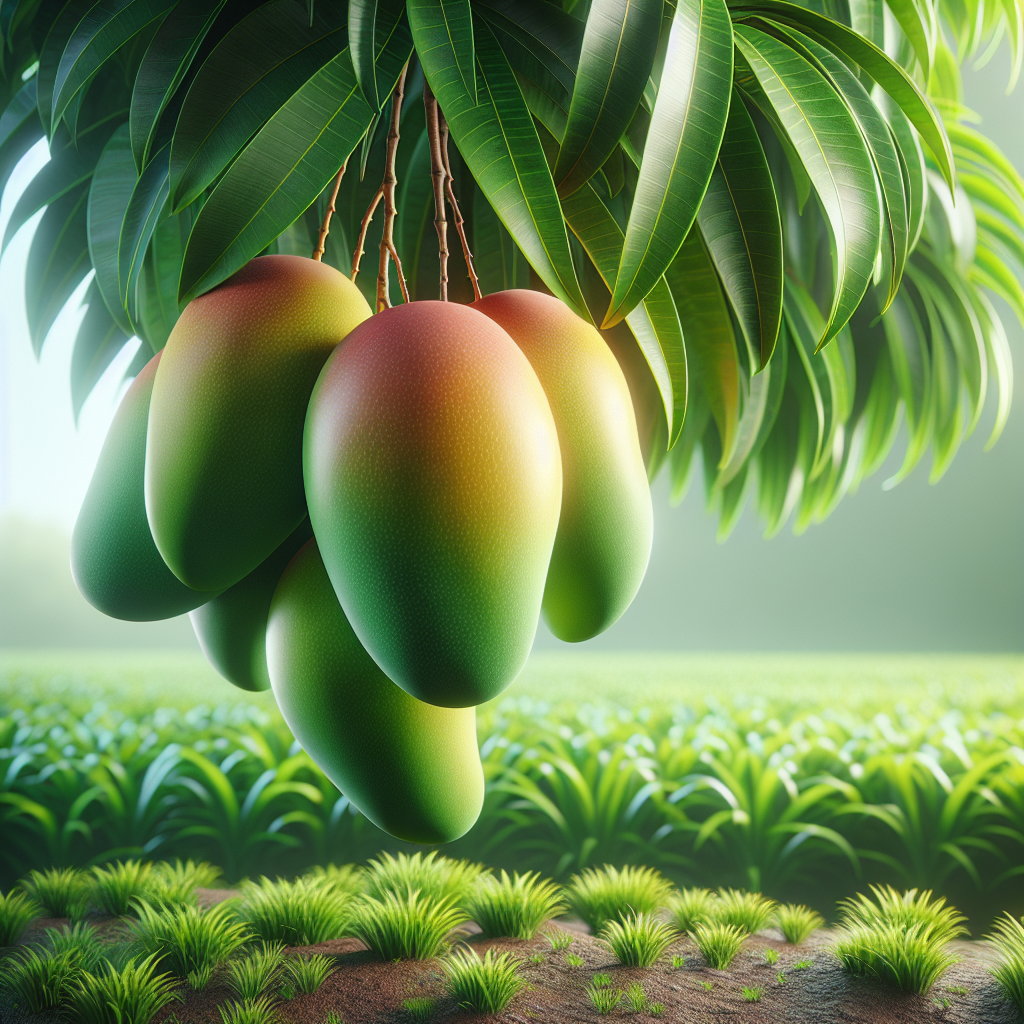
Introduction to Kent Mango
Originating in Florida in the mid-20th century, this cultivar became one of the most respected dessert mangoes because of its exceptionally smooth flesh, mild floral aroma, and low fiber content. It is widely grown for fresh consumption and export, especially where growers need a mango that combines handsome fruit size with very good internal quality.
Kent is generally considered a late-season cultivar, which is one of its biggest strategic advantages in mixed orchards. In suitable climates, it can extend the mango harvest window after many early and midseason cultivars have finished. Compared with more brightly colored commercial varieties, the fruit often stays mostly green even when mature, so harvesting must be guided by shape, shoulder fill, dry matter, and internal maturity rather than skin color alone. For general mango background, see the broader Mango guide.
A well-grown tree is vigorous, broad-canopied, and capable of producing very large fruit, often in the 500-800 gram range, with some fruit exceeding that under light crop loads. The flesh is deep yellow to orange-yellow, nearly fiberless, and notably juicy without the stringiness found in many seedling types. This makes it excellent for fresh slicing, puree, and premium fruit markets.
Botanical Profile of Kent Mango
This cultivar belongs to the Anacardiaceae family, the same family as cashew and pistachio. Like other mangoes, it is an evergreen tree with a dense canopy, leathery lanceolate leaves, and terminal panicles carrying hundreds to thousands of small flowers. Most flowers are male, while a smaller portion are hermaphroditic and able to set fruit.
Kent typically develops a medium-large to large tree if left unpruned, often reaching 8-12 meters in open ground, though commercial and home orchard management usually maintains it between 3-5 meters for spray access, light penetration, and harvest safety. The growth habit is upright in youth and broad-spreading with age. New vegetative flush emerges bronze to reddish before hardening to dark green.
Fruit shape is usually ovate to broad-oval with full shoulders and a slightly rounded apex. The skin is moderately thick and helps protect the fruit during handling, though bruising still reduces market life. Mature fruit often show a green background turning to green-yellow, with occasional crimson blush on sun-exposed surfaces. Lack of bright peel color does not indicate poor quality; in fact, fully mature fruit may remain visually greener than inexperienced growers expect.
The seed is monoembryonic, meaning seedlings do not come true to type. That is why true Kent trees are propagated vegetatively, usually by veneer grafting, cleft grafting, or side grafting onto seedling rootstocks. Seed-grown trees may bear acceptable fruit, but they will not reliably reproduce Kent's low-fiber character, fruit size, or seasonality.
Flowering is influenced by temperature, water stress patterns, tree age, and nutrition. In subtropical production, cool dry conditions tend to promote floral induction. In tropical climates with less seasonal contrast, flowering can be more erratic. Fruit set is often naturally heavy at bloom, followed by substantial drop, which is normal. Final retention depends on carbohydrate reserves, pollination conditions, wind, moisture balance, and disease pressure at flowering.
Soil, pH, and Climate Requirements for Kent Mango
This cultivar performs best in deep, well-drained soils with a slightly acidic to neutral pH of about 5.5-7.0. It can tolerate mildly alkaline conditions up to around 7.5 if drainage is excellent and micronutrient deficiencies are corrected, but performance generally declines in calcareous or poorly aerated soils. Iron, zinc, and manganese deficiencies become more likely above neutral pH, especially in high-lime ground.
The single most important soil requirement is drainage. Mango roots need oxygen. If water stands for more than 24-48 hours after heavy rain, root stress, feeder-root death, and Phytophthora risk increase sharply. Kent is especially productive in sandy loams, loams, decomposed volcanic soils, and raised mounds in heavier ground. In clay soils, planting on berms 30-60 cm high is often the difference between long-term success and chronic decline.
Ideal soil texture allows moisture retention without saturation. As a practical benchmark, the root zone should feel cool and slightly moist at 15-20 cm depth, never sour-smelling, slimy, or continuously wet. Chronic overwatering shows up as dull leaf color, reduced flush, blackened feeder roots, leaf yellowing beginning on older foliage, and poor flowering. Severe under-watering causes leaf folding, marginal browning, fruit drop, undersized fruit, and poor postharvest flavor development.
Kent Mango thrives in tropical to warm subtropical climates with a pronounced dry period before flowering and warm conditions during fruit development. Optimal temperatures are roughly 24-32°C during active growth, though established trees tolerate hotter conditions if soil moisture is adequate and roots are mulched. Temperatures below 4°C can damage foliage and young wood; frost can kill young trees outright. Flowers and small fruit are especially vulnerable to cold injury and wind desiccation.
Annual rainfall of 750-2500 mm can support production depending on drainage and seasonal distribution. Rain during flowering is less desirable because it can wash pollen, suppress pollinator activity, and increase Anthracnose. Dry weather at bloom followed by moderate moisture during fruit expansion is ideal. Humid conditions are manageable if canopy ventilation and disease control are good.
Full sun is essential. Trees need at least 8 hours of direct sun for balanced canopy development, strong flowering, and good sugar accumulation. Shaded trees become vegetative, tall, and less fruitful.
For broader soil management principles in perennial systems, this article on soil health offers useful context.
Step-by-Step Planting & Propagation
Start with a grafted tree from a reputable nursery. Select trees with a clearly visible graft union, healthy dark green foliage, no trunk wounds, and a balanced canopy. Avoid pot-bound plants with circling roots, weak chlorotic leaves, or signs of mango scale, Sooty Mold, or stem cankers.
Choose a site sheltered from strong prevailing winds but not enclosed so tightly that humidity stagnates around the canopy. Spacing depends on management intensity. For home orchards, 6-8 meters between trees is common. For high-density systems, 4-5 meters may be used with disciplined annual pruning. If planting in a mixed orchard, leave enough access for ladders, carts, and pruning.
Plant at the start of warm weather when soil temperatures are rising and the tree can establish before either drought stress or cool weather. In monsoonal climates, early wet season planting works well if the soil drains freely. In drier subtropical zones, early spring after frost danger is safest.
Prepare the planting area by removing perennial weeds in at least a 1-meter circle. Do not dig an excessively amended "pot" in native soil, as this can trap water. Instead, dig a hole only two to three times as wide as the root ball and no deeper than the root mass. Set the tree so the top of the root ball sits level with, or slightly above, surrounding soil. Planting too deep is a common cause of slow decline.
Backfill with native soil, breaking only major clods. Water in thoroughly to settle soil around the roots. If the site is windy, stake loosely for the first season, allowing some trunk movement for strength development. Apply 7-10 cm of mulch over the root zone, keeping it at least 15 cm away from the trunk to prevent collar rot.
For propagation, Kent should be grafted onto vigorous, locally adapted rootstocks. Polyembryonic seedling rootstocks are sometimes used in mango-growing regions because they provide more uniform rootstock performance, though local nursery practice varies. Scion wood should be mature but not old, pencil-thick, disease-free, and taken from trees known to be true-to-type. Grafts usually take best when rootstocks are in active growth and humidity is managed well.
Topworking older seedling trees is also possible. Scaffold branches are cut back, and Kent scions are grafted onto the regrowth. This is an effective way to convert low-quality seedling orchards into premium fruit production, though aftercare is critical to avoid sunburn and graft failure.
Care & Maintenance regimes for Kent Mango
Irrigation should be adjusted by tree age, soil type, and season. Newly planted trees need frequent but measured watering until roots move into native soil. In sandy soils, that may mean 10-20 liters two to three times weekly for the first month, then tapering based on weather. In loams, one deep irrigation every 5-7 days may be sufficient. The goal is to moisten the full root ball and adjacent soil, then allow mild drying before the next irrigation.
For established trees, deep irrigation is better than shallow daily watering. During vegetative growth and fruit sizing, soil should remain moderately moist in the top 30-60 cm, not saturated. Many mature trees perform well with irrigation every 7-14 days in dry weather, though sand may require more frequent application. Reduce irrigation before the flowering period to discourage excessive vegetative flush and help support floral induction, then resume once fruit set is established. Do not impose severe drought once fruit is swelling, or you may see fruit drop, spongy texture, or reduced size.
Nutrition should be balanced and age-specific. Young trees need modest but regular nitrogen to build canopy structure, along with potassium, magnesium, calcium, sulfur, and trace elements. Split applications are safer than heavy doses. A practical program for juvenile trees is 3-4 light feedings during the warm growing season using a fertilizer with a ratio near 6-2-8 or 8-3-9 plus micronutrients. Excess nitrogen creates lush, disease-prone shoots and delays fruiting.
Bearing trees generally benefit from emphasizing potassium relative to nitrogen, especially from pre-bloom through fruit fill. Potassium supports fruit size, sugars, peel strength, and overall quality. Calcium and boron are important for flowering and fruit integrity, while zinc and manganese are commonly needed where pH is high. Leaf analysis and soil testing are the professional standard for adjusting programs. Where organic fertility is preferred, well-made compost, composted manures in moderate amounts, fish hydrolysate, kelp extracts, sulfate of potash, and rock mineral corrections can be used carefully, but avoid over-applying high-nitrogen organic materials.
Pruning is essential because Kent is vigorous. Train young trees to develop 3-4 well-spaced scaffold limbs beginning 60-100 cm above ground. Tip-prune after each vegetative flush to encourage branching and keep the tree compact. Mature trees should be maintained at a practical height; after harvest, remove upright water shoots, crossing branches, dense interior growth, and weak shaded wood. Light penetration into the canopy directly affects flowering sites, disease pressure, and fruit color.
Sanitation matters. Collect and remove diseased fruit, mummified fruit, and fallen debris that can harbor pathogens and fruit fly larvae. Keep the trunk free from weed competition. Renew mulch annually but never pile it against bark.
Fruit thinning is not always practiced in mango, but on heavily setting Kent trees it can improve fruit size and reduce limb breakage. Where panicles set excessively, selective thinning while fruit are still small may improve uniformity.
Alternate bearing can occur, especially if trees carry a very heavy crop one year and enter the next season depleted. Balanced pruning, moderate nutrition, and avoiding excessive fruit load can reduce this tendency.
Pests, Diseases & Organic Management
The most important diseases depend on local humidity and rainfall patterns, but Anthracnose is often the key problem. It attacks flowers, young fruit, leaves, and postharvest fruit, causing blossom blight, black spotting, and rot. Kent is often considered to have relatively good tolerance compared with some cultivars, but it is not immune. Open-canopy pruning, dry airflow, sanitation, and timely copper-based organic sprays during bloom and early fruit set are standard preventive measures in wet regions.
Powdery Mildew is more likely in dry conditions with cool nights and humid mornings. It shows up as whitish fungal growth on panicles, flowers, and tender growth, leading to poor fruit set. Sulfur products can help in organic programs if used preventively and under temperatures that do not risk phytotoxicity.
Bacterial Black Spot, Stem-end Rot, and Phytophthora root problems can also occur. Avoid trunk injury, keep mulch off the collar, and never maintain chronically wet soil. Postharvest Stem-end Rot is reduced by harvesting at proper maturity, clipping stems cleanly, and cooling fruit appropriately.
Key insect pests include Mango Hoppers, Scale Insects, Mealybugs, Thrips, Mites, and Fruit Flies. Hoppers damage flowers and excrete honeydew that encourages Sooty Mold. Mealybugs and scale weaken trees and contaminate fruit. Fruit Flies can make late-season mango production especially difficult in endemic areas, as females puncture fruit for egg laying.
Organic management begins with monitoring. Inspect panicles during bloom, the undersides of leaves, trunk crotches, and developing fruit weekly. Yellow sticky traps can help monitor flying pests, though they are not a complete control. Encourage beneficial insects by maintaining flowering insectary plants nearby, including Thai Basil and Sunflower. Avoid broad-spectrum sprays that disrupt predator populations unless pest pressure demands intervention.
Useful organic tools include horticultural oils for scale and some mite suppression, insecticidal soaps for soft-bodied pests, kaolin clay for fruit fly deterrence and sunburn reduction, spinosad baits where permitted for fruit fly management, and neem-based products for certain sucking pests. Always spray during cooler parts of the day and avoid coating open flowers heavily when pollinators are active.
Bird and bat damage may become significant as fruit ripens. Netting, bagging select fruit, or timed harvest can reduce loss.
Harvesting, Curing & Optimal Storage
Kent is best harvested mature-green to partially ripe, depending on whether fruit is for shipping, local sale, or home use. Because peel color is not a fully reliable maturity indicator, look for filled shoulders near the stem end, a slight flattening of the beak, plump cheeks, and development of waxy bloom. In commercial settings, dry matter testing and harvest records by days from flowering are more accurate.
A mature fruit should exude less watery sap than an immature one, and the flesh near the seed should be transitioning from pale to richer yellow. Immature fruit harvested too early may soften unevenly, remain bland, or develop poor texture. Overmature fruit bruise easily, attract pests, and have shorter shelf life.
Harvest with clippers rather than pulling. Leave a short stem segment initially to reduce sap burn, then trim neatly after sap flow subsides. Sap can stain and burn skin, so workers often place fruit stem-end down briefly to drain latex before washing or packing. Handle gently; even minor compression injuries become dark spots during ripening.
Curing in mango usually refers less to a long curing phase, as with onions or sweet potatoes, and more to careful postharvest conditioning. Keep freshly harvested fruit shaded, dry, and ventilated. Clean off excess sap. In warm production zones, fruit intended for ripening can be held at around 20-24°C. For longer storage, mature-green fruit may be held near 12-13°C with high relative humidity around 85-90%. Temperatures much below 10-12°C risk chilling injury, which appears as uneven ripening, gray flesh, surface pitting, and poor flavor.
Ripening typically takes several days at room temperature. Fruit is ready for best eating when it yields slightly to gentle pressure near the shoulders and develops a strong sweet aroma at the stem end. Once ripe, refrigeration can slow deterioration for a short period, but prolonged cold storage still harms flavor.
Kent's excellent internal quality means it is particularly rewarding when tree-ripened close to maturity and finished indoors. For fresh markets, the challenge is balancing flavor with sufficient firmness for transport.
Companion Planting for Kent Mango
Companion planting around perennial mango systems should support pollination, soil protection, nutrient cycling, and pest balance rather than compete aggressively with the tree. The best companions are usually shallow-rooted, manageable, and tolerant of partial shade at the canopy edge.
Clover is one of the most useful understory companions because it acts as a living mulch, reduces erosion, supports beneficial insects, and contributes biologically fixed nitrogen when managed correctly. Keep it mowed low or terminated periodically so it does not compete heavily with young trees for moisture.
Garlic can be planted in the outer drip zone or in nearby intercrop beds where its strong scent may help disrupt some pest activity, while also making productive use of orchard space during the dry season. Ginger is another excellent companion in tropical systems, especially in young orchards where partial shade develops gradually; it helps monetize the understory and benefits from mulched, biologically active soils.
Avoid vigorous vines, tall grain crops close to the trunk, or thirsty plants directly over the main root zone of juvenile trees. In the first two to three years, the mango should have priority access to light, water, and nutrients. Keep a weed-free ring nearest the trunk, and place companions farther out where they function more as an orchard support layer than direct neighbors.
As the canopy matures, companion species should be selected for low competition and easy maintenance. The most successful mango guilds are simple, breathable, and service-oriented rather than crowded.