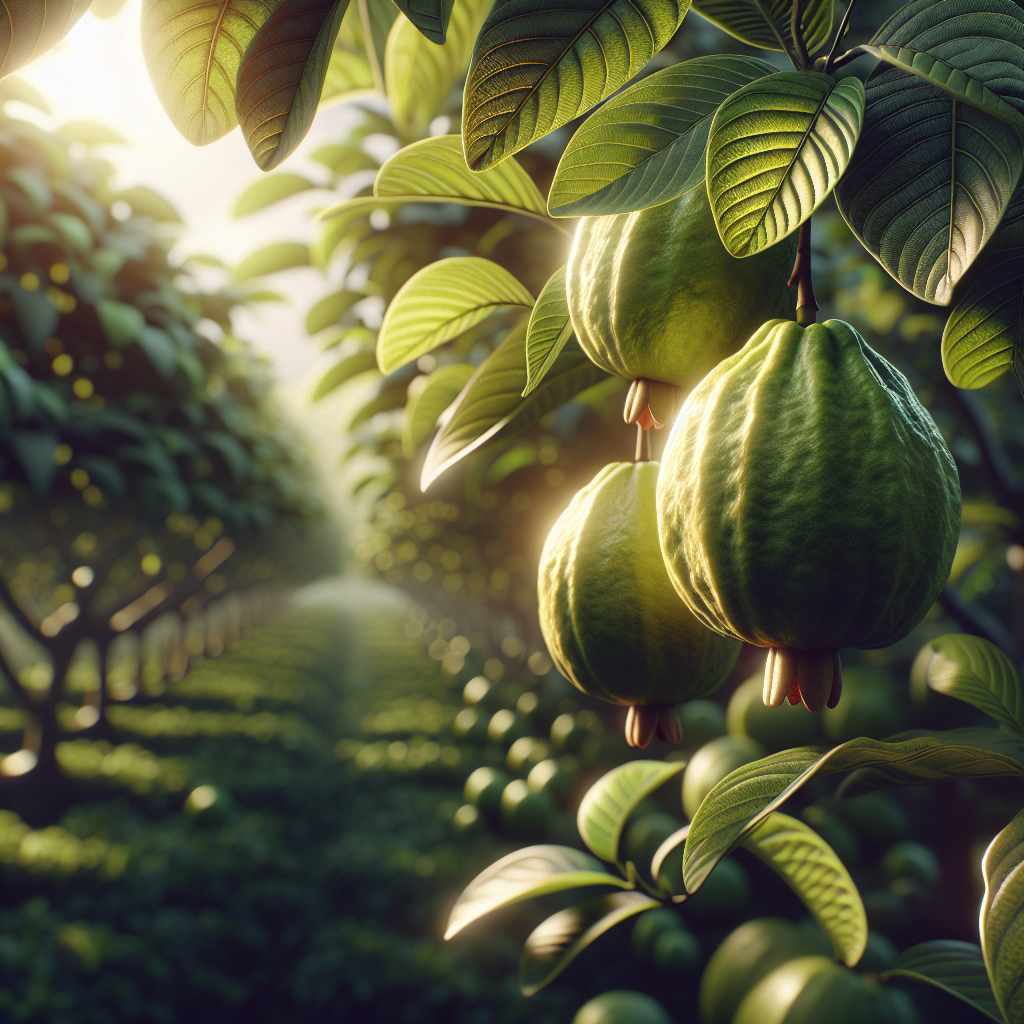
Introduction to Guava
Native to tropical America and widely naturalized across Asia, Africa, and the Pacific, guava has become one of the most dependable fruit crops for warm climates. It is prized not only for its sweet-tart flavor and high vitamin C content, but also for its precocity, capacity to fruit heavily, and ability to recover from pruning. In many regions, guava is considered a "poor soil survivor," yet truly premium crops come from disciplined management: balanced canopy structure, even soil moisture, and careful fruit fly prevention.
Guava can be grown as a backyard tree, a hedgerow orchard crop, or a container specimen in frost-prone areas. Fruit quality varies significantly by cultivar. White-fleshed types often have a pronounced perfume and lower acidity, while pink- to red-fleshed types usually command stronger fresh-market appeal. Commercially, growers often select cultivars for fruit size, seed softness, transport tolerance, and seasonality rather than flavor alone.
Because guava is shallow-rooted relative to many larger tropical fruit trees, it responds quickly to irrigation errors, mulch management, and nutrient imbalances. For growers interested in mixed tropical orchards, compare spacing and canopy management approaches used in other fruit trees such as Mango. Broad principles of soil building also apply; see soil health strategies.
Botanical Profile of Guava
Guava belongs to the family Myrtaceae, the same family as clove, allspice, and eucalyptus. The species Psidium guajava is the primary cultivated guava, though other Psidium species exist and may be used locally as rootstocks or minor fruits. It is typically a many-branched evergreen small tree or large shrub, commonly reaching 3-10 m in height if left unpruned, though commercial orchards usually maintain a much smaller working height for harvest efficiency and canopy renewal.
The bark is distinctive: thin, smooth to slightly flaky, often coppery or mottled, peeling in patches. Leaves are opposite, elliptic to oblong, with prominent veins and a slightly leathery texture. New flushes are especially important, because flowers and fruiting sites are closely tied to current season growth. Understanding that biology is essential: heavy, poorly timed pruning can either stimulate a productive flush or remove the next crop, depending on climate and crop cycle.
Flowers are usually white, bisexual, fragrant, and borne singly or in small clusters in leaf axils. Each flower has numerous stamens, a trait typical of Myrtaceae. Pollination is often assisted by bees and other insects, although many cultivars are at least partially self-fertile. Better pollinator activity generally improves fruit set and uniformity.
Botanically, the fruit is a berry with a thin to moderately thick rind, aromatic flesh, and numerous hard or semi-soft seeds embedded in the pulp. Cultivars vary enormously in skin color, shape, pulp color, sugar-acid balance, and seed hardness. A few broad cultivar groupings are useful in practice:
- White-fleshed guavas: frequently aromatic, suitable for fresh eating and processing.
- Pink-fleshed guavas: often preferred in retail markets for color and visual appeal.
- Apple guavas or round types: generally compact, mild, and popular for home gardens.
- Pear-shaped processing types: often selected for pulp yield and aroma.
Fruiting may occur once or multiple times per year depending on tropical warmth, irrigation scheduling, and pruning. In subtropical climates, a major crop often follows spring flowering, with a second lighter crop possible where frost-free conditions persist.
Soil, pH, and Climate Requirements for Guava
Guava is famous for tolerating difficult conditions, but tolerance should not be confused with optimum performance. The best orchards are established on deep, well-drained loams or sandy loams rich in organic matter, with enough structure to hold moisture but enough porosity to prevent root suffocation. Ideal soil depth is at least 1 m, though guava can survive in shallower profiles if irrigation and fertility are carefully managed.
Preferred soil pH is roughly 5.0-7.0, with an optimum around 5.5-6.5. It will grow in slightly alkaline soils, but iron, zinc, and manganese deficiencies become more likely above pH 7.5, especially in calcareous ground. In high-pH sites, young leaves may show interveinal chlorosis: the tissue between veins turns yellow while veins remain green. That is often mistaken for nitrogen deficiency, but in guava it frequently points to micronutrient lock-up.
Drainage matters more than many new growers expect. Guava roots need oxygen. If water stands for more than 24-48 hours after heavy irrigation or rainfall, root decline, reduced vigor, and fruit drop become likely. A practical field test is to fill a 30 cm deep hole with water after the soil has been pre-wetted; if it still drains poorly after several hours, raised beds or mounds are advisable.
Climatically, guava performs best in tropical and warm subtropical zones with annual temperatures roughly between 18-30°C. Vegetative growth slows markedly below about 15°C. Mature trees can survive brief exposure near 0°C, but young plants are far more vulnerable, and flowers or immature fruit can be damaged by even light frost. Ideal fruit development occurs under warm days, moderate humidity, and a drier period during ripening, which helps reduce fungal pressure and improve sweetness.
Rainfall requirements vary, but 1000-2000 mm annually is adequate if distribution is favorable. Where rain is seasonal, irrigation should bridge dry periods. Excess rain during flowering can reduce pollinator activity and fruit set; prolonged humidity during fruit maturation can increase Anthracnose and fruit fly pressure.
Wind protection is beneficial, especially in coastal or cyclone-prone districts. Although guava wood is relatively tough, heavy cropping combined with gusty weather can split limbs. Persistent wind also scars fruit and increases transpiration demand.
Step-by-Step Planting & Propagation
Commercial orchards usually rely on vegetative propagation rather than seedlings, because seedling guavas are highly variable in fruit quality, bearing age, and growth habit. Seed propagation is useful for breeding, rootstock production, or low-cost homestead planting, but not for uniform market production.
Propagation options include:
- Air layering: common and reliable for small-scale propagation; produces true-to-type plants.
- Grafting or budding: useful for multiplying elite cultivars and improving orchard uniformity.
- Cuttings under mist: possible but requires tighter environmental control.
- Seed: easy, but variable and slower to reach consistent bearing.
For seeds, extract from fully ripe fruit, wash off pulp thoroughly, and sow fresh or after brief drying. Germination can be uneven because the seed coat is relatively hard; soaking for 24 hours in clean water improves emergence. Sow in a sterile, well-drained medium at 1-2 cm depth. Seedlings are usually ready for transplanting after reaching 20-30 cm height.
For orchard establishment, choose healthy nursery plants 30-60 cm tall with a sturdy stem, active roots, and no signs of nematode galling, cankers, or scale infestation. Avoid pot-bound trees with circling roots, as these can establish slowly and remain structurally weak.
Planting steps:
- Site preparation: remove perennial weeds, rip compacted ground if needed, and incorporate well-matured compost into the topsoil rather than creating a highly amended planting pocket surrounded by poor soil.
- Layout: common spacings range from 4 x 4 m to 6 x 6 m for standard orchards. High-density systems may go tighter, but require intensive pruning and nutrient management.
- Planting hole: dig a hole two to three times wider than the root ball and only as deep as the root mass. Planting too deep is a frequent cause of decline.
- Root preparation: gently tease out circling roots if present. Do not excessively disturb fine roots.
- Set the tree: position so the top of the root ball is level with or slightly above surrounding soil, especially in heavy soils.
- Backfill: use mostly native soil. Excess fertilizer in the hole can burn new roots.
- Water in: irrigate thoroughly to settle soil and eliminate air pockets.
- Mulch: apply 5-10 cm of coarse organic mulch, keeping a 10-15 cm gap around the trunk to prevent rot and rodent damage.
- Initial heading: if the young tree is leggy, head it back lightly to encourage scaffold formation at a workable height.
Best planting is usually early in the rainy season in the tropics or in spring after frost danger in subtropical zones. Avoid establishing trees during peak heat unless irrigation is precise.
Care & Maintenance regimes for Guava
Irrigation should be regular but never stagnant. Young guava trees need consistently moist soil in the active root zone, roughly the top 20-40 cm. A useful target is moist, friable soil that forms a weak ball in the hand but does not smear or drip. In sandy soils, this may require 2-3 irrigations per week during hot weather; in loams, once weekly may suffice; in heavier clay loams, longer intervals with deeper irrigation are usually better.
Signs of underwatering include dull, slightly folded leaves, slowed shoot extension, small fruit, and premature fruit drop. Severe drought can cause a hard stop in flowering and a flush of recovery growth later, disrupting production cycles. Signs of overwatering include yellowing lower leaves, soft weak shoots, sour-smelling soil, persistent wetness below mulch, and reduced new root activity. Chronic saturation often leads to nutrient uptake problems that mimic deficiency even when fertilizer has been applied.
Nutrition should be based on leaf analysis and soil testing where possible. Guava is responsive to nitrogen, but excessive nitrogen creates rank vegetative growth, soft tissue, and poorer fruit quality. A balanced annual program for bearing trees typically emphasizes split applications of nitrogen with moderate phosphorus and ample potassium. Potassium is particularly important for fruit size, sugar accumulation, peel strength, and postharvest life.
As a broad practical schedule for non-tested soils:
- Year 1-2: light, frequent feeding every 6-8 weeks during active growth.
- Bearing years: 3-4 split fertilizer applications timed before flush, after fruit set, and after harvest or pruning.
- Organic systems: compost, vermicompost, oilseed meals, and well-managed mulches can support fertility, but potassium and micronutrient supplementation may still be needed.
Micronutrients matter. Zinc, boron, iron, and magnesium deficiencies are common in marginal soils. Zinc deficiency often shows as small leaves and shortened internodes; boron deficiency can distort new growth and affect fruit shape; magnesium deficiency may appear as yellowing on older leaves beginning between veins.
Pruning is one of the most important management tools in guava. Because fruit is borne on new growth, controlled pruning stimulates productive shoots and keeps the canopy open. Training young trees to 3-5 main scaffold branches helps distribute crop load and simplifies harvesting. Remove weak crotches early to avoid later breakage.
For mature trees, objectives are:
- maintain height at 2-3.5 m for easy picking,
- improve light penetration,
- renew fruiting wood,
- remove dead, diseased, crossing, or inward-growing branches,
- reduce fruiting on excessively weak twiggy growth.
In regions with defined crop cycles, strategic pruning can be used to shift flowering and avoid peak pest or rainfall periods. Light to moderate pruning after harvest commonly produces the next productive flush. Heavy pruning rejuvenates old trees, but the following crop may be delayed.
Weed management should prioritize a weed-free zone under the canopy drip line, especially for young trees. Guava does not compete well with aggressive grasses at establishment. Organic mulches moderate soil temperature, reduce evaporation, and slowly feed soil biology, but they should be monitored for termite activity in susceptible areas.
Fruit thinning is not always practiced, but in heavy-bearing cultivars it can improve fruit size and reduce limb stress. Bagging individual fruits or clusters is highly effective in premium production systems, especially where Fruit flies are severe.
Pests, Diseases & Organic Management
Fruit flies are among the most serious guava pests worldwide. Adult females puncture ripening fruit to lay eggs, and the larvae feed inside the pulp, causing breakdown, premature drop, and complete loss of marketability. Monitoring with traps is essential. Sanitation is non-negotiable: collect and destroy fallen fruit at least twice weekly during the season. Bagging fruit with paper, cloth, or perforated protective sleeves shortly after fruit set is one of the most effective non-chemical controls.
Other common pests include:
- Scale insects: cause sap loss, sooty mold, and general decline.
- Mealybugs: cluster on shoots and fruit stems, often protected by ants.
- Aphids and Psyllids: damage young flushes and may distort leaves.
- Bark-eating caterpillars or Borers: tunnel into limbs or trunks.
- Nematodes: especially problematic in sandy soils or replant sites.
Organic management depends on integrated tactics rather than a single spray. Encourage beneficial insects, suppress ant populations that protect sap-feeding pests, and use horticultural oils or insecticidal soaps on early infestations when temperatures are not excessively high. Prune out heavily infested shoots. Keep the canopy open; dense, shaded foliage favors persistent pest colonies and makes coverage difficult.
Among diseases, Anthracnose is especially important in humid weather. It can affect flowers, young shoots, and fruit, causing dark sunken lesions and postharvest rot. Good airflow, sanitation, avoiding overhead irrigation late in the day, and timely copper-based organic sprays where permitted are standard preventive tactics.
Wilt complexes and Root rots can devastate plantings on poorly drained soils. These are often not a single-cause issue; fungi, waterlogging, Nematodes, and root injury may combine. The first defense is site selection. Once chronic root disease is established, recovery is difficult. Avoid over-irrigation, improve drainage, and remove severely affected trees to reduce inoculum pressure.
Algal leaf and twig spots may occur in warm, wet climates, usually where canopies remain dense and humid. They are often more cosmetic than catastrophic, but repeated infection signals poor airflow and excessive shade.
Birds, bats, and monkeys can also be significant fruit predators in some regions. Netting, timely harvest, and bagging are often more effective than deterrents alone.
Harvesting, Curing & Optimal Storage
Guava does not improve in quality if harvested too immature, though it can soften after picking. The ideal harvest stage depends on intended market. For local fresh sales, fruit can be picked when skin color lightens from dark green to pale green or yellow-green and the fruit gives slightly under gentle pressure. For transport, harvest at the mature-green stage when full-sized but still firm.
Maturity indicators include:
- full fruit size for the cultivar,
- a change in skin hue from deep green to lighter green,
- development of characteristic aroma,
- slight softening near the blossom end,
- smoother, less angular fruit surface in some cultivars.
Harvest by hand rather than shaking. Clip with a short stem if possible to reduce skin tearing and sap injury. Handle gently; guava bruises easily, and bruising rapidly becomes infection sites under warm conditions.
Unlike curing crops such as onions or sweet potatoes, guava is not normally cured in the classical sense. Instead, postharvest handling focuses on pre-cooling, sorting, and humidity control. Remove field heat quickly after harvest, especially in hot climates. Wash only if clean water and proper drying are available; otherwise, dry cleaning and careful sorting may reduce postharvest disease risk better than poorly managed washing.
Store fruit at about 8-10°C with 85-95% relative humidity for short-term holding, depending on cultivar and ripeness. Temperatures that are too low may induce chilling injury in some guavas, leading to poor flavor development, skin pitting, or uneven softening. Ripe fruit at room temperature may last only 2-5 days, while mature-green fruit under cool storage may hold for 2-3 weeks under good conditions.
Do not store damaged fruit with sound fruit. One punctured, fruit-fly-infested, or Anthracnose-infected guava can accelerate losses across an entire crate. Grade by size and maturity, and market aromatic, softer fruit first.
Companion Planting for Guava
Companion planting around guava works best when it supports pollination, soil cover, and pest balance without creating excessive root competition. The most useful companions are low-growing, non-invasive species that do not form dense woody thickets under the canopy.
Good companion categories include:
- Pollinator plants: basil types, flowering herbs, marigold, and native nectar plants near but not crowding the tree.
- Living mulches: low legumes such as perennial peanut in suitable climates, managed so they do not climb or smother trunks.
- Dynamic biomass plants: comfrey in cooler subtropics or other chop-and-drop species positioned outside the immediate trunk zone.
- Trap or distraction plantings: selected according to local pest pressure, especially in diversified orchards.
Avoid heavy feeders planted directly in the root zone. Bananas, vigorous vines, and aggressive grasses can compete strongly for water and nutrients if planted too close. Keep at least the area within 0.5-1 m of a young tree free of dense companion vegetation.
For orchard-floor design, a practical pattern is a mulched tree row with flowering insectary strips between rows. This preserves access, improves beneficial insect activity, and reduces erosion. In small gardens, aromatic herbs planted on the sunny edge of the root zone can attract pollinators while remaining easy to manage.
Companions should also fit the irrigation regime. Guava prefers even moisture but not waterlogging, so avoid pairing it with species that demand continuously saturated soil. Likewise, extremely tall companions that shade the canopy will reduce flowering and sweetness. In well-designed mixed plantings, the best companions are not the most dramatic plants, but the ones that stabilize the orchard ecosystem while letting guava remain the dominant crop.