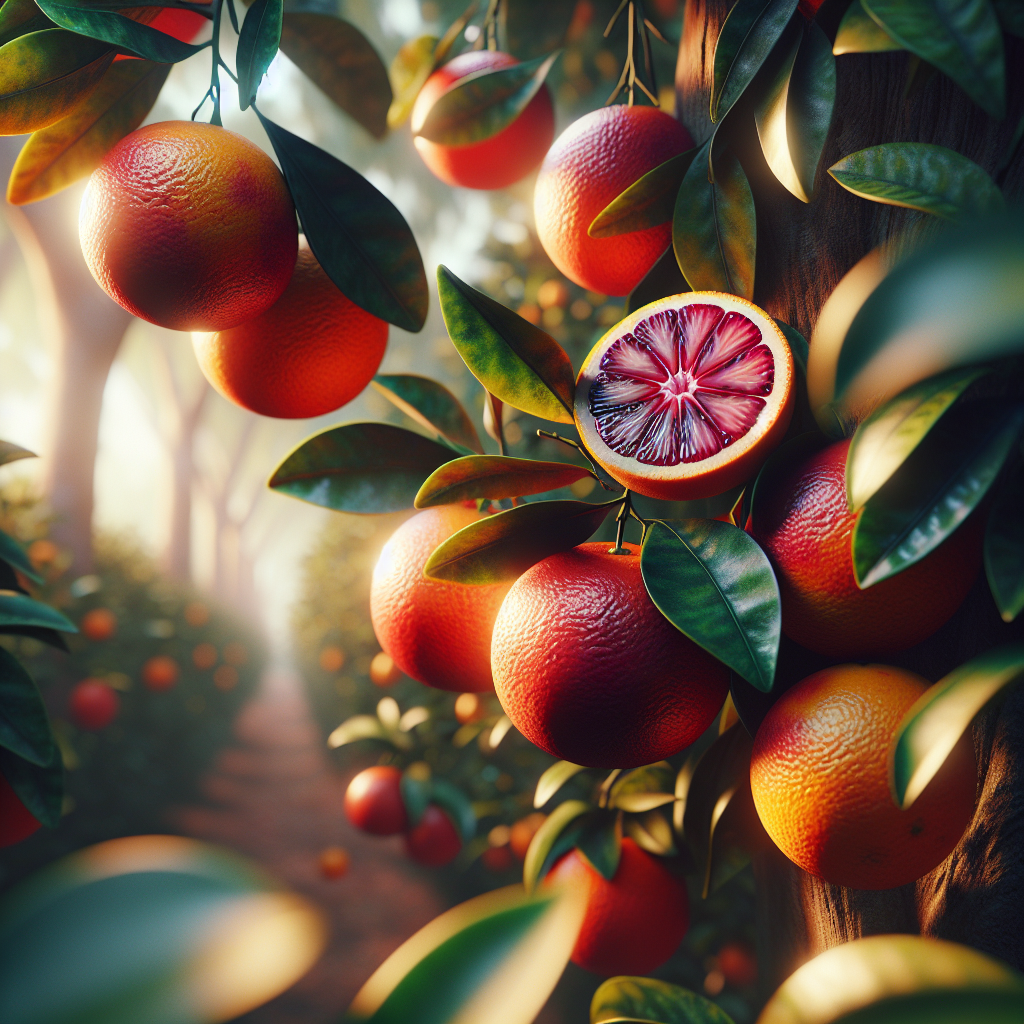
Introduction to Blood Orange (Moro)
Among blood oranges, 'Moro' is often considered the most dramatic in appearance and one of the most distinctive in flavor. This cultivar is believed to have originated in the citrus-growing regions of Sicily, where winter temperature swings between sunny days and cool nights help trigger anthocyanin development in the fruit flesh and sometimes in the rind. That pigmentation is what gives blood oranges their signature red to burgundy interior, but 'Moro' stands apart because it often develops color earlier and more intensely than other blood orange cultivars such as Tarocco or Sanguinello.
The fruit is generally medium-sized, round to slightly oval, with a peel that can show orange blushed with red-maroon. Internally, the flesh ranges from ruby streaked to nearly solid dark crimson when conditions are ideal. Flavor is not simply "orange-like"; mature fruit often combines bright citrus sweetness with raspberry-like berry notes, moderate acidity, and a faint floral bitterness near the peel oils. This complexity makes 'Moro' valuable for fresh eating, juice, marmalade, desserts, and premium local-market sales.
For growers, the main challenge is understanding that appearance and flavor quality are strongly influenced by environment. A healthy tree can produce acceptable fruit in many citrus regions, but truly exceptional color develops where autumn and winter nights are cool without prolonged hard freezes. In very hot tropical climates, fruit may remain largely orange inside even when fully mature. In addition, 'Moro' is somewhat vigorous but still sensitive to poor drainage, salinity, root stress, and overfertilization. Compared with standard Orange types, it rewards more precise site selection and harvest timing.
If you are building a biologically active orchard floor, principles similar to those described in soil health strategies can improve water infiltration, microbial balance, and long-term citrus resilience.
Botanical Profile of Blood Orange (Moro)
This cultivar belongs to the sweet orange group, classified botanically as Citrus × sinensis, a hybrid species within the Rutaceae family. 'Moro' is a grafted clonal selection rather than a seed-stable line, which means commercial and serious home growers nearly always purchase budded trees on a chosen rootstock. Rootstock choice affects tree size, salinity tolerance, cold hardiness, productivity, disease susceptibility, and fruit quality.
The tree is evergreen, with glossy, elliptic leaves and moderate thorniness when young. Mature trees typically reach 3.5-6 m in home orchards if left mostly unpruned, though rootstock and training can keep them smaller. On dwarfing or semi-dwarfing rootstocks, container culture and high-density plantings are possible, but yield per tree is reduced. Flowering usually occurs in spring, with fragrant white blossoms attractive to pollinators. Fruit matures in winter to early spring depending on region.
'Moro' typically has these defining characteristics:
- Early to midseason blood orange.
- Strong anthocyanin pigmentation in flesh under cool-night conditions.
- Medium vigor and good productivity once established.
- Fruit often somewhat smaller than navel oranges but richly flavored.
- Peel moderately adherent, with juice of deep red to crimson when properly matured.
- Flavor often more intense and tart-berry-like than many sweet oranges.
Color development is not caused by ripeness alone. Anthocyanin synthesis is stimulated by temperature contrast, especially cool nights in the approximate range of 4-10°C after fruit has developed. Fruit exposed to heat without chill may sugar properly yet remain pale internally. This is a critical nuance for growers selling on appearance.
Most commercial trees are grafted onto rootstocks such as Carrizo citrange, C-35 citrange, Sour orange where permitted, or Cleopatra mandarin in some regions. Heavier soils may call for more tolerant rootstocks, while calcareous or saline conditions require careful matching. Rootstock incompatibility or poor site pairing can reduce yield long before obvious decline symptoms appear.
Soil, pH, and Climate Requirements for Blood Orange (Moro)
The ideal soil is deep, well-drained, moderately fertile sandy loam or loam with good aeration and a minimum effective rooting depth of 90-120 cm. Blood orange roots require oxygen as much as water. If water stands in the planting area for more than 24 hours after rain or irrigation, root decline becomes likely. Trees in chronically saturated soil are more vulnerable to Phytophthora root rot, nutrient imbalance, weak flushing, leaf yellowing, and fruit drop.
Preferred soil pH is 6.0-7.0, though trees can survive from about 5.5-7.8 with adjusted nutrition. At pH above 7.5, iron, zinc, and manganese deficiencies become common, especially in calcareous soils. Symptoms include interveinal chlorosis on young leaves, reduced leaf size, weak shoot growth, and poor fruit set. At very low pH, aluminum and manganese excess can stress roots while calcium and magnesium availability decline. Before planting, a complete soil test should include pH, cation exchange capacity, organic matter, electrical conductivity, sodium, chloride, calcium, magnesium, phosphorus, potassium, and micronutrients where possible.
Drainage is more important than high fertility. If your site has clay subsoil, install raised beds or mounds 30-50 cm high and at least 1-1.5 m wide. This lifts the crown above perched water tables and improves oxygen diffusion. On coarse sand, increase organic matter gradually and mulch heavily to improve water retention, but keep mulch 15-20 cm away from the trunk to avoid bark disease.
Climate determines whether 'Moro' becomes merely productive or truly premium. Optimal production occurs in Mediterranean to warm temperate citrus regions with:
- Full sun, ideally 8 or more hours daily.
- Warm growing season temperatures around 25-32°C.
- Cool autumn and winter nights without severe prolonged freezes.
- Annual rainfall roughly 900-1200 mm if well distributed, or less with irrigation.
- Relative humidity moderate rather than persistently high.
Cold tolerance is moderate for sweet orange. Mature trees may survive brief dips to about -2 to -3°C with minor damage, but flowers, young shoots, and immature fruit can be harmed at warmer temperatures. Young trees are much more sensitive. Extended freeze events can crack bark, kill canopy wood, and reduce yields for multiple seasons.
Heat also matters. Persistent temperatures above 38°C, especially with dry hot wind, can cause sunburn on fruit and leaves, fruit drop, and stalled color development. In arid climates, maintain even soil moisture and protect exposed scaffold limbs with diluted white trunk paint or kaolin-based sunburn protectants.
Step-by-Step Planting & Propagation
Propagation from seed is not recommended if your goal is true-to-type 'Moro' fruit. Seedlings may vary genetically, take many years to fruit, and often lack the exact pigmentation and quality of the parent clone. Professional propagation is done by budding or grafting scion wood from verified 'Moro' trees onto suitable rootstocks.
For most growers, buying a certified disease-free nursery tree is the best option. Select a tree with a straight central stem, healthy green leaves, no circling roots if container-grown, and a clearly visible graft union above the root flare. Avoid trees with yellow foliage, cracked bark, gummy lesions, or roots protruding heavily from drainage holes.
Planting procedure:
- Choose the site. Use the warmest, sunniest, frost-sheltered location available with good air drainage. Avoid low pockets where cold settles.
- Prepare the ground. Remove perennial weeds in a 1-1.5 m circle. Do not heavily amend only the planting hole in native soil, as this can create a water-holding basin. Instead, improve a broader area if needed.
- Dig the hole. Make it 2-3 times wider than the root ball but no deeper than the root ball height.
- Check planting depth. The root crown should sit slightly above surrounding soil grade, especially in heavier soil. Keep the graft union well above soil level.
- Set the tree carefully. Loosen outer roots only if badly pot-bound. Place the tree upright and backfill with the native soil.
- Water in thoroughly. Apply enough water to settle the soil profile, usually 10-20 liters for a young tree depending on root ball size and soil type.
- Mulch correctly. Apply 5-8 cm of coarse organic mulch over the root zone, but keep it away from the trunk.
- Stake only if necessary. If the site is windy, use soft ties and remove staking as soon as the trunk is stable.
Spacing depends on rootstock and training system. Standard orchard spacing is commonly 4.5-6 m between trees and 5-6 m between rows. Dwarf or semi-dwarf trees may be planted at 2.5-4 m spacing. Crowding reduces light penetration, raises disease pressure, and lowers internal fruit color over time.
Container growing is possible if you use a very fast-draining medium, a large container of at least 60-90 liters for mature maintenance, and disciplined feeding. A mix with pine bark fines, coarse perlite, and peat or coco coir works better than dense garden soil. Containers dry quickly in summer and accumulate salts more easily, so periodic deep leaching is essential.
Care & Maintenance regimes for Blood Orange (Moro)
Irrigation should aim for steady, moderate moisture in the active root zone rather than frequent shallow wetting. Young trees need consistent establishment watering for the first 12-18 months. In loam soil, that may mean one deep irrigation every 5-7 days in warm weather; in sandy soil, every 2-4 days; in cool weather, much less. The target is moist but aerated soil from roughly 15-45 cm deep.
A practical field test is to dig a narrow inspection hole near the drip line. Soil should feel cool and slightly moist, forming a weak ball when squeezed in loam, not sticky and airless. Warning signs of overwatering include persistently wet soil smell, yellowing older leaves, leaf drop without drought stress, weak pale new growth, algae or moss near emitters, and twig dieback despite "regular watering." Underwatering shows as leaf cupping, dull foliage, small hard fruit, premature fruit drop, and dry soil below 10-15 cm depth.
Drip irrigation is preferred. For a young tree, start with 2 emitters and expand the wetted zone as the canopy grows. Mature trees should have irrigation distributed around a broad ring, not concentrated at the trunk. Reduce irrigation slightly as fruit approaches maturity to concentrate flavor, but do not impose severe drought stress, which can cause fruit splitting or drop.
Fertilization should be split into multiple light applications rather than one heavy dose. Nitrogen drives canopy growth, but excess nitrogen can dilute flavor, reduce peel color, increase pest attractiveness, and create soft vegetative flush vulnerable to disease. Young non-bearing trees need balanced growth; bearing trees need enough nitrogen to support crop load but not excessive leafiness.
General annual nitrogen targets often range from roughly 0.1-0.2 kg actual N per young tree, increasing gradually with age, while mature bearing trees may require 0.5-1.0 kg actual N depending on tree size, soil type, crop load, and irrigation regime. Apply in 3-5 doses from spring through midsummer. Avoid late heavy nitrogen that pushes tender autumn growth vulnerable to cold.
Phosphorus is usually needed only where soil tests indicate deficiency. Potassium is important for fruit size, juice quality, and stress tolerance. Calcium supports peel integrity. Magnesium deficiency appears as yellowing on older leaves with a green triangular area near the leaf base; correct with magnesium sulfate or dolomitic inputs based on soil chemistry. Micronutrient sprays containing zinc, manganese, and sometimes iron are often useful in alkaline soils.
Pruning should be conservative. Citrus stores energy in its canopy, and heavy pruning delays production. Remove dead, diseased, crossing, or inward-growing wood; eliminate shoots emerging from below the graft union; and open only enough canopy to improve light distribution. The best time is after harvest and before strong spring flush. Maintain a skirt high enough to improve airflow and reduce soil splash, but not so high that the trunk becomes overly sun-exposed.
Fruit thinning is rarely required on mature citrus, but if a young tree sets heavily in its first fruiting years, removing some fruit can improve structural growth and prevent limb bending. In the first 1-2 years after planting, many growers remove most or all fruit so the tree invests in roots and framework.
For freeze protection, water the soil well before a cold event, use frost cloth for small trees, and avoid pruning or fertilizing immediately before periods of expected cold. For trunk protection on young trees, wrap loosely or paint exposed bark with diluted white interior latex paint.
Pests, Diseases & Organic Management
The major pest complex varies by region, but common threats include aphids, citrus leafminer, scale insects, mealybugs, spider mites, whiteflies, thrips, and various fruit-feeding pests. citrus leafminer is particularly damaging to young flushing trees, where larvae tunnel through tender leaves and distort new growth. Mature trees usually tolerate some damage, but repeated attacks reduce vigor in newly established orchards.
aphids and soft scales also excrete honeydew, which encourages sooty mold. The mold itself does not infect tissue but blocks light and lowers photosynthesis. If ants are present, control them first, because they protect honeydew-producing insects from beneficial predators.
Organic management works best as a system:
- Maintain balanced nutrition; lush nitrogen-heavy growth attracts sap feeders.
- Encourage beneficial insects through flowering understory strips and reduced broad-spectrum sprays.
- Use horticultural oil during low-heat periods to suppress scale, mites, and some eggs.
- Apply insecticidal soap only when temperatures are moderate and trees are not drought-stressed.
- Monitor flush cycles, because many pests target tender new leaves.
Common diseases include Phytophthora root rot and foot rot, greasy spot in humid climates, anthracnose on stressed tissues, melanose, alternaria issues in susceptible citrus, and postharvest rots. Root diseases are strongly linked to poor drainage and trunk wetness. Gumming at the base of the trunk, bark cracking, collar lesions, sparse canopy, and chronic yellowing should prompt immediate inspection.
citrus canker, tristeza, huanglongbing (citrus greening), and other major regional diseases may be regulated or devastating depending on location. Always source clean nursery stock and comply with local quarantine rules. No fertility program can compensate for infected planting material.
Organic disease suppression focuses on prevention:
- Keep irrigation off the trunk.
- Avoid mulch against bark.
- Improve airflow with moderate pruning.
- Sanitize tools between trees.
- Remove mummified or rotting fruit promptly.
- Use copper-based products only when appropriate and legal in your area, especially during disease-conducive weather.
Regular scouting is essential. Check leaf undersides, new flush, trunk base, and fruit clusters at least every 7-14 days during active growth. Early intervention is far easier than correcting a full infestation after fruit quality declines.
Harvesting, Curing & Optimal Storage
Harvest timing is one of the most important quality decisions for 'Moro'. External rind color alone is not reliable. Fruit may show red blush before internal sugars and flavor fully develop, or remain somewhat orange externally while the flesh is richly pigmented. Use a combination of indicators: calendar timing for your region, taste tests, juice percentage, soluble solids, acidity, and internal color from sample fruit.
'Moro' is often harvested from midwinter into early spring. Fruit should feel heavy for its size, with a characteristic aroma when scratched lightly. The flavor should balance sweetness and acidity rather than tasting flat or sharply sour. If harvested too early, the fruit may be undercolored, less juicy, and more acidic. If left excessively long, some blood oranges can lose acidity and become less vibrant in flavor, though holding ability depends on climate.
Cut fruit with clippers rather than pulling, leaving a short stem nub or clipping close enough not to puncture neighboring fruit. Handle gently; citrus peel bruising is easy to underestimate and may appear later in storage.
Unlike bulbs or some storage crops, citrus does not undergo a true curing phase. However, fruit benefits from a short conditioning period in a shaded, well-ventilated packing area to dry any surface moisture and stabilize temperature before packing. Never leave harvested fruit in direct sun or in deep field bins where internal heating develops.
For storage, ideal conditions are about 3-8°C with 85-90% relative humidity, depending on intended storage duration and local recommendations. Too dry, and fruit loses weight and shrivels; too humid without airflow, and mold risk increases. At room temperature, expect best eating quality for roughly 1-2 weeks. Under cool storage, sound fruit may last 3-8 weeks, though flavor is generally best when consumed relatively fresh.
Wash only if necessary, and ensure fruit is fully dry before refrigeration. Damaged or split fruit should be separated immediately. For local-market sales, grading by size, rind finish, and internal color consistency can substantially improve presentation and price.
Companion Planting for Blood Orange (Moro)
The best companions around citrus are not aggressive competitors but low-growing, shallow-rooted, beneficial plants that improve pollinator activity, suppress weeds, attract natural enemies, or contribute biologically active mulch. Good companion planting for 'Moro' should never compromise airflow around the trunk or create constantly damp bark conditions.
Thai Basil is a strong option near but not directly at the trunk. Its flowers attract pollinators and beneficial insects, while its aromatic foliage may help diversify the orchard ecology. Clover can function as a living mulch in wider orchard alleys, helping reduce erosion and contribute nitrogen through biological fixation, though it must be managed so it does not compete heavily for water during dry periods. Garlic is useful in small-scale orchards as a border or ring planting outside the immediate root crown zone, where it can help suppress weeds and add diversity. Lettuce can be used seasonally in young orchards where light still reaches the soil, giving a short-term intercrop without major root competition.
A practical layout is to keep a vegetation-free ring of about 45-60 cm around the trunk of young trees, then establish companions beyond that zone. In mature orchards, companion species are best placed in strips between tree rows or near the drip line rather than densely under the trunk canopy. Avoid tall, dense, or thirsty companions that reduce airflow or compete strongly during fruit sizing.
Also avoid heavy feeders such as large brassicas planted too close to young trees, and do not let perennial weeds masquerade as companion plants. Effective companions support the orchard system; they should not become alternate hosts for pests or create irrigation complications.
When managed well, companion planting in a blood orange orchard improves soil structure, beneficial insect presence, and resilience, but irrigation and fertility should still be calibrated primarily for the tree, not the understory.