Introduction to Banana weevil
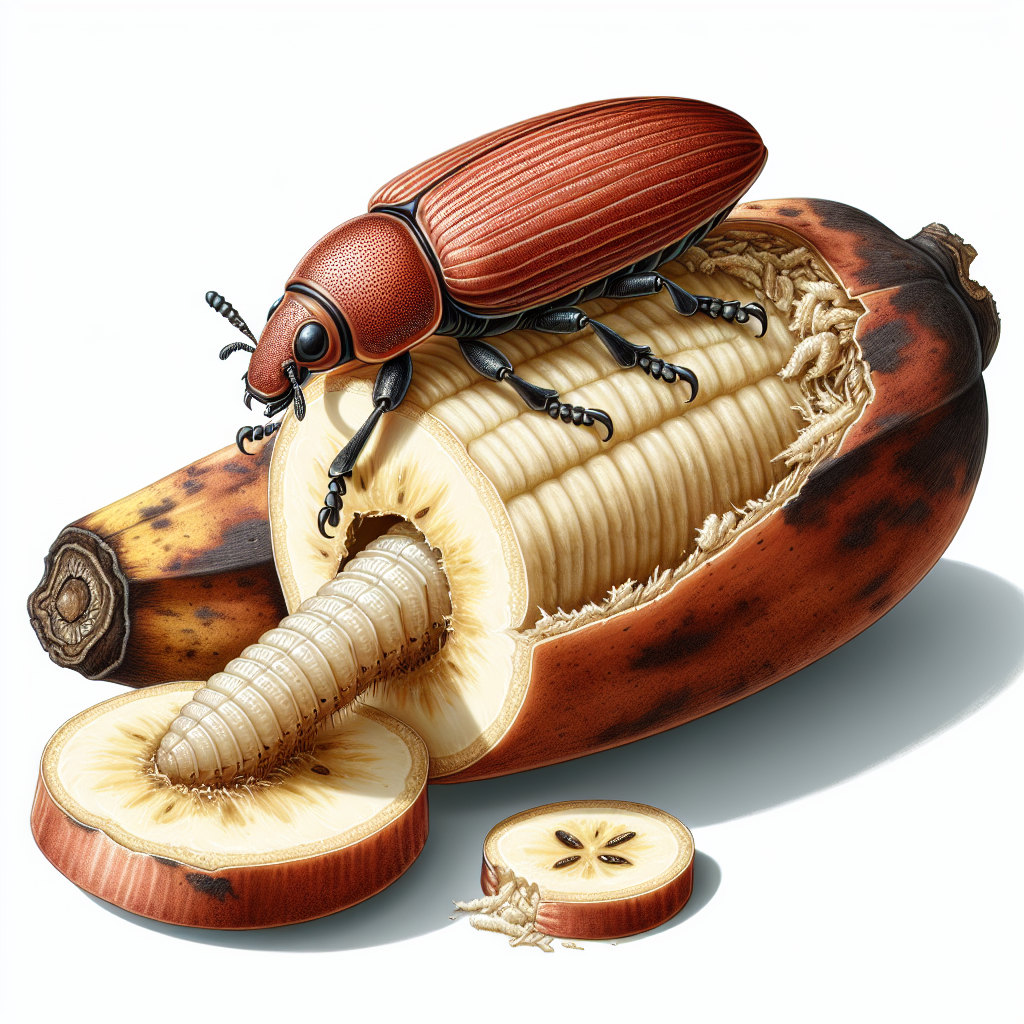
The banana weevil, scientifically known as Cosmopolites sordidus, ranks among the most destructive pests affecting banana plantations worldwide. Native to Southeast Asia, this flightless beetle has spread to tropical and subtropical regions, posing a severe threat to commercial banana production and smallholder farms. Adult weevils measure 10-15 mm long, with a reddish-brown body, black head, and elongated snout, blending seamlessly with plant debris. Females lay up to 150 eggs in their lifetime, primarily in the base of banana pseudostems or corm tissue, leading to larval infestation that weakens plants and reduces bunch weight by 30-50% in unmanaged fields.
This pest thrives in humid, warm environments, multiplying rapidly in dense plantings with poor sanitation. In regions like East Africa, Latin America, and Southeast Asia, banana weevil causes annual losses exceeding $1 billion, exacerbating food insecurity for communities reliant on Cavendish Banana and Plantain (Horn). Early detection is crucial, as hidden larval damage often goes unnoticed until plants topple or fail to fruit. Integrated Pest Management (IPM) emphasizing organic methods offers sustainable control, minimizing chemical reliance while preserving beneficial soil organisms. For detailed insights on related threats, see Banana weevil borer. This guide equips growers with professional diagnostics and actionable strategies to safeguard yields.
Identifying Symptoms & Damage
Banana weevil damage manifests subtly at first, escalating to catastrophic levels if unchecked. Key symptoms include wilting or yellowing of younger leaves, often mistaken for nutrient deficiencies or Fusarium wilt. Examine the base of pseudostems for V-shaped notches chewed by adults, typically 2-5 mm wide, appearing at night. The hallmark sign is internal larval tunneling: slice open the corm or lower pseudostem to reveal creamy-white grubs (up to 25 mm long) with brown heads, packed frass (sawdust-like excrement), and galleries that compromise structural integrity.
Affected plants exhibit stunted growth, reduced bunch size, and premature toppling, especially during storms. Corms develop rot-prone cavities, inviting secondary pathogens like corm rots or bacterial soft rots. In heavy infestations, daughter suckers emerge weak and deformed, perpetuating the cycle. Differentiate from similar pests like corm weevils by the absence of external webbing and the specific frass pattern. Use a knife to probe 10-20% of plants monthly; if 5% show tunneling, initiate controls. Trap counts exceeding 5 weevils per trap per week signal high risk. Early diagnostics prevent 70-90% yield loss, underscoring vigilant scouting in Lady Finger Banana fields.
Lifecycle and Progression of Banana weevil
Understanding the banana weevil's lifecycle is pivotal for timed interventions. Adults are long-lived (2-4 years), nocturnal, and negatively geotactic, hiding in leaf axils or debris by day. Oviposition peaks at night, with eggs (1-2 mm, whitish) laid singly in wounds or cracks, hatching in 5-10 days at 25-30°C. Larvae, the primary damage agents, bore upward for 15-40 days through 4 instars, growing from 1 mm to 25 mm while feeding on parenchyma.
Pupation occurs in earthen cells within galleries, lasting 6-20 days, yielding reddish-brown adults that remain soil-bound for 20-45 days before emerging. The full cycle spans 24-56 days, with 5-12 generations yearly in optimal tropics. Progression accelerates in moist soils (>60% field capacity) and temperatures 25-30°C, slowing below 18°C or above 35°C. Population booms post-harvest when debris accumulates. Monitor with pseudostem traps (split stems baited with cut tissue) or pheromone lures, dissecting 20 plants biweekly to track larval stages. Lifecycle knowledge enables precise organic treatments, targeting eggs/larvae during peak vulnerability. For broader pest insights, explore Spring Pest Patrol: Organic AI Strategies to Shield Your Crops from Common Invaders.
Environmental Triggers & Risk Factors
Banana weevil proliferation hinges on specific environmental cues and farm practices. High humidity (>80%) and temperatures 26-30°C trigger oviposition and rapid development, common in lowland tropics. Poor drainage fosters moist soils ideal for larval survival, amplifying damage by 3-5 fold. Risk escalates in continuous monocultures of susceptible varieties like Dwarf Cavendish Banana, where weevil densities reach 50+ per plant.
Post-harvest debris—unremoved stools, matooke trash—serves as breeding reservoirs, with adults dispersing 30-50 m via walking or machinery. Overcrowded plantings (>2 m spacing) limit sunlight penetration, cooling soil and retaining moisture. Nutrient imbalances, especially potassium deficiency, weaken pseudostems, easing larval entry. Introduce risk via infested suckers or contaminated tools. Drought stress indirectly boosts populations by stressing plants, mimicking root-knot nematodes. Mitigate by mapping microclimates, ensuring >2000 mm annual rain well-distributed, and rotating with non-hosts like cassava. Vigilance in high-risk zones preserves Cavendish Banana productivity.
Organic Control & Treatment Plans
Organic management of banana weevil integrates cultural, biological, and mechanical tactics for 70-90% efficacy without synthetics. Cultural: Pare corms of new suckers, removing 80% outer tissue to expose/exclude eggs; hot water dip at 50°C for 20 min kills 95% larvae. Desuckering maintains 3-4 plants per mat, discarding infested material >50 m away. Chop and bury debris pre-planting or mulch with Gliricidia (300 g/plant) to deter adults.
Biological: Deploy Beauveria bassiana or Metarhizium anisopliae (10^12 spores/ha) via soil drenches, achieving 60-80% mortality. Steinernema carpocapsae nematodes (10^9 IJs/ha) target soil stages effectively. Release chickens or ducks (10-20/ha) to forage adults/larvae. Mechanical: Install split pseudostem traps (20-30/ha), baited with pheromone (cosmolure), replacing weekly; yields 10-20 weevils/trap. Vertical barriers (plastic sheets) around fields curb spread.
Treatment Plan: Scout weekly; at 10% infestation, apply nematodes + fungal sprays. Rotate treatments; interplant with neem (Azadirachta indica) for repellency. Monitor banana aphids as they exacerbate via virus vectors. Expect 2-3 years for suppression in established fields.
Preventing Banana weevil in the Future
Prevention fortifies long-term resilience against banana weevil. Select resistant varieties like FHIA hybrids or Goldfinger Banana. Quarantine new planting material, hot-water treating suckers. Maintain sanitation: harvest promptly, destroy stumps mechanically or via solarization (black plastic, 45°C+ for 30 days). Space plants 2.5-3 m in rows for airflow/drying.
Mulch with pathogen-free materials (e.g., rice hulls) to 10 cm depth, suppressing soil populations. Use push-pull: intercropping with desirable plants repels weevils toward traps. Regular scouting with 1 trap/100 plants sustains low densities. Farm hygiene—clean tools, footbaths—halts spread. Build soil health via compost to bolster plant vigor against damage. Annual audits ensure <2% infestation, sustaining yields in Manzano Banana.
Crops Most Affected by Banana weevil
Banana weevil primarily targets Musa spp., devastating Cavendish Banana, Dwarf Cavendish Banana, Lady Finger Banana, Plantain (Horn), and Blue Java Banana (Ice Cream). Plantains suffer 40-60% losses in Africa/Asia. Minor hosts include ginger, turmeric, and taro, with occasional attacks on yam. Non-hosts like cassava aid rotation. Global hotspots: Uganda (50% loss), Philippines, Colombia. Diversify with papaya to buffer monoculture risks.