Introduction to corm weevils
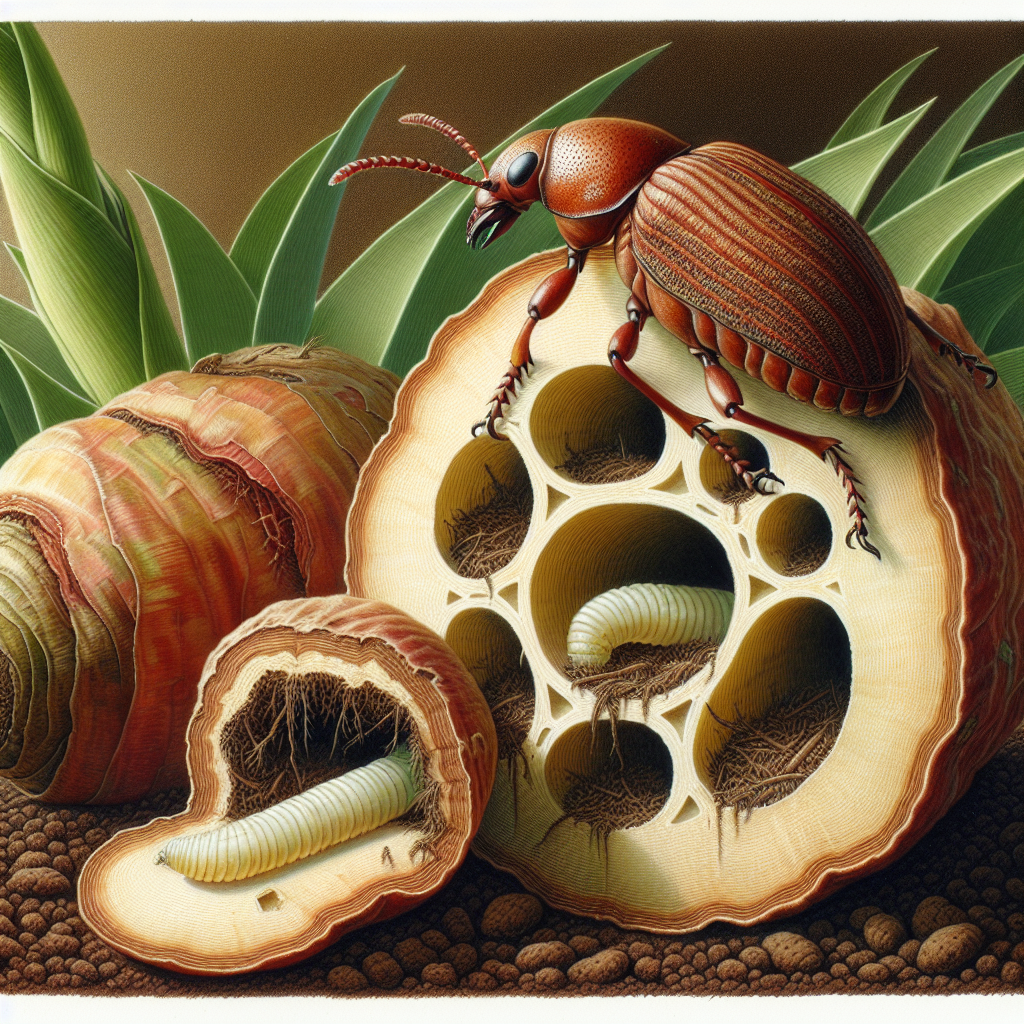
Corm weevils (Ochyromera spp., particularly Ochyromera gladioli) represent a significant threat to bulb and tuber crops worldwide, especially in warm, humid agricultural regions. These pests belong to the Curculionidae family and are specialized feeders on the underground storage organs known as corms—swollen underground stems found in crops like Saffron Crocus, gladiolus, taro (Elephant Ear Taro), and certain lilies. Adult weevils are small, 4-7 mm long, with elongated snouts, reddish-brown to black bodies covered in fine scales, and distinctive markings that aid camouflage in soil. Larvae are creamy-white, legless grubs with brown heads, reaching up to 8 mm, and are the primary destructive stage.
Infestations often go unnoticed until plants exhibit sudden decline, making early detection challenging. Originating from tropical and subtropical areas, corm weevils have spread through contaminated planting material, affecting commercial flower farms, ornamental growers, and small-scale vegetable producers. Annual losses can exceed 50% in untreated fields, underscoring the need for integrated pest management (IPM). This guide provides professional-grade diagnostics, lifecycle insights, organic controls, and prevention strategies to safeguard your crops. For broader pest management insights, check this Spring Pest Patrol: Organic AI Strategies to Shield Your Crops from Common Invaders.
Identifying Symptoms & Damage
Recognizing corm weevil damage is crucial for timely intervention. Above-ground symptoms include sudden wilting of leaves, starting from the outer whorls and progressing inward, even under adequate irrigation—a hallmark distinguishing it from drought stress. Plants appear stunted, with yellowing foliage, premature flowering, or complete collapse. In severe cases, entire rows fail, mimicking root rot or Phytophthora infections.
Inspect corms for the telltale signs: small entry holes (1-2 mm) on the surface, often plugged with frass (insect excrement resembling sawdust). Inside, larvae create irregular tunnels filled with brownish frass and chewed tissue, leading to secondary rot by pathogens like Fusarium or bacteria. Affected corms become soft, shrunken, and emit a foul odor. Adult feeding scars on corm necks appear as shallow grooves. In storage, infested corms show powdery frass around holes and larval galleries extending deep into the center.
Differentiate from similar pests: unlike wireworms, which create clean tunnels, corm weevil galleries are frass-packed. Root-knot nematodes cause galls, not holes. Use a hand lens to spot live larvae or pupae in tunnels. Early-season scouting (pre-planting) by slicing sample corms reveals 10-20% infestation thresholds warranting action. Document patterns for IPM tracking.
Lifecycle and Progression of corm weevils
Understanding the corm weevil lifecycle enables precise timing of controls. Adults emerge from overwintered pupae in soil during warm springs (20-30°C), coinciding with host plant growth. Peak activity occurs at dusk, with females laying 50-100 eggs singly or in clusters near corm bases or in soil cracks. Eggs hatch in 5-7 days into larvae that burrow directly into corms, feeding for 3-4 weeks while molting through three instars.
Mature larvae (L3 stage) exit to form earthen cells 5-10 cm deep, pupating for 10-14 days. New adults remain in cells until soil moisture and temperature favor emergence. The cycle completes in 6-8 weeks, with 2-4 generations per year in tropics. Overwintering occurs as diapausing adults or late larvae in soil up to 30 cm deep. Population peaks align with host availability, exacerbated by mild winters.
Monitor using soil traps (buried corm pieces) or pheromone lures. Lifecycle progression ties to crop phenology: eggs at planting, larvae during rooting, pupae at flowering, adults at harvest. This informs targeted interventions, reducing reliance on broad-spectrum treatments.
Environmental Triggers & Risk Factors
Corm weevils thrive in specific conditions, amplifying outbreaks. High soil moisture (above 25% volumetric water) and temperatures (25-32°C) accelerate egg hatch and larval development. Poor drainage, heavy clay soils, and excessive irrigation create ideal microhabitats. Warm, humid climates (USDA zones 9-12) see chronic issues, with rainfall >1000 mm/year boosting survival.
Risk factors include planting infested corms, monocropping, and minimal tillage, which preserve pupal banks. Weedy fields harbor adults, while nearby host residues serve as bridges. Drought-stressed plants are more susceptible due to weakened defenses. Over-fertilization with nitrogen softens corms, enhancing palatability. Crop rotation gaps exceeding two years fail against soil-persisting stages. Imported planting stock from endemic areas (Africa, Asia) introduces biotypes. Compounding pests like fungus gnats or diseases such as corm rots mask weevil damage, delaying response.
Organic Control & Treatment Plans
Organic management emphasizes prevention but includes curative options. Cultural: Hot-water treat corms (45-50°C for 30-45 min) pre-planting to kill eggs/larvae without viability loss. Solarize soil (clear plastic, 6-8 weeks summer) to desiccate pupae. Rotate with non-hosts like grains for 2-3 years.
Biological: Introduce entomopathogenic nematodes (Heterorhabditis indica, 10^6 IJ/m²) targeting soil larvae; apply evenings with irrigation. Encourage predators like ground beetles via mulch. Bacillus thuringiensis (Bt) var. israelensis has limited larval efficacy.
Mechanical: Hand-pick adults at dusk using aspirators. Trap crops (peripheral gladiolus) divert infestations. Post-harvest, rogue infested corms and deep-plow (>30 cm) to expose pupae to predators/sun.
Botanicals: Neem oil (azadirachtin 0.03%) drenches soil weekly for 4 applications, repelling oviposition and disrupting hormones. Pyrethrum or spinosad sprays target adults, with 3-5 day reapplication. Diatomaceous earth barriers around plants deter crawling.
Integrated Plan: Scout weekly (lift 10% plants), treat at 5% infestation. Combine nematodes + neem for 80-90% control. Monitor aphids as vectors. Avoid resistance by rotating modes.
Preventing corm weevils in the Future
Long-term prevention builds resilient systems. Source certified, hot-water-treated corms from reputable suppliers. Practice 3-year rotation with grasses or legumes. Enhance soil health with cover crops (clover) suppressing weevils via allelopathy. Use raised beds for drainage, amending with compost for natural enemies.
Plant repellents like marigold or garlic borders. Time planting post-adult peak (soil >25°C). Mulch heavily (10 cm organic) to disrupt emergence. Quarantine new stock 4 weeks. Annual soil sampling (Berlese funnels) tracks populations below thresholds. IPM apps aid timing. Clean equipment prevents spread. Resistant varieties (e.g., certain gladiolus hybrids) reduce risk by 40%.
Crops Most Affected by corm weevils
Corm weevils primarily target bulb/corm crops: Saffron crocus (Crocus sativus), gladiolus (Gladiolus spp.), taro (Colocasia esculenta), elephant ear taro, calla lily (Zantedeschia), and canna. Secondary hosts include ginger, turmeric, and amaryllis. Ornamental flower farms suffer most, but subsistence taro growers in Pacific islands face devastation. Yields drop 30-70%, with corm production halted in heavy infestations. Diversify to mitigate.